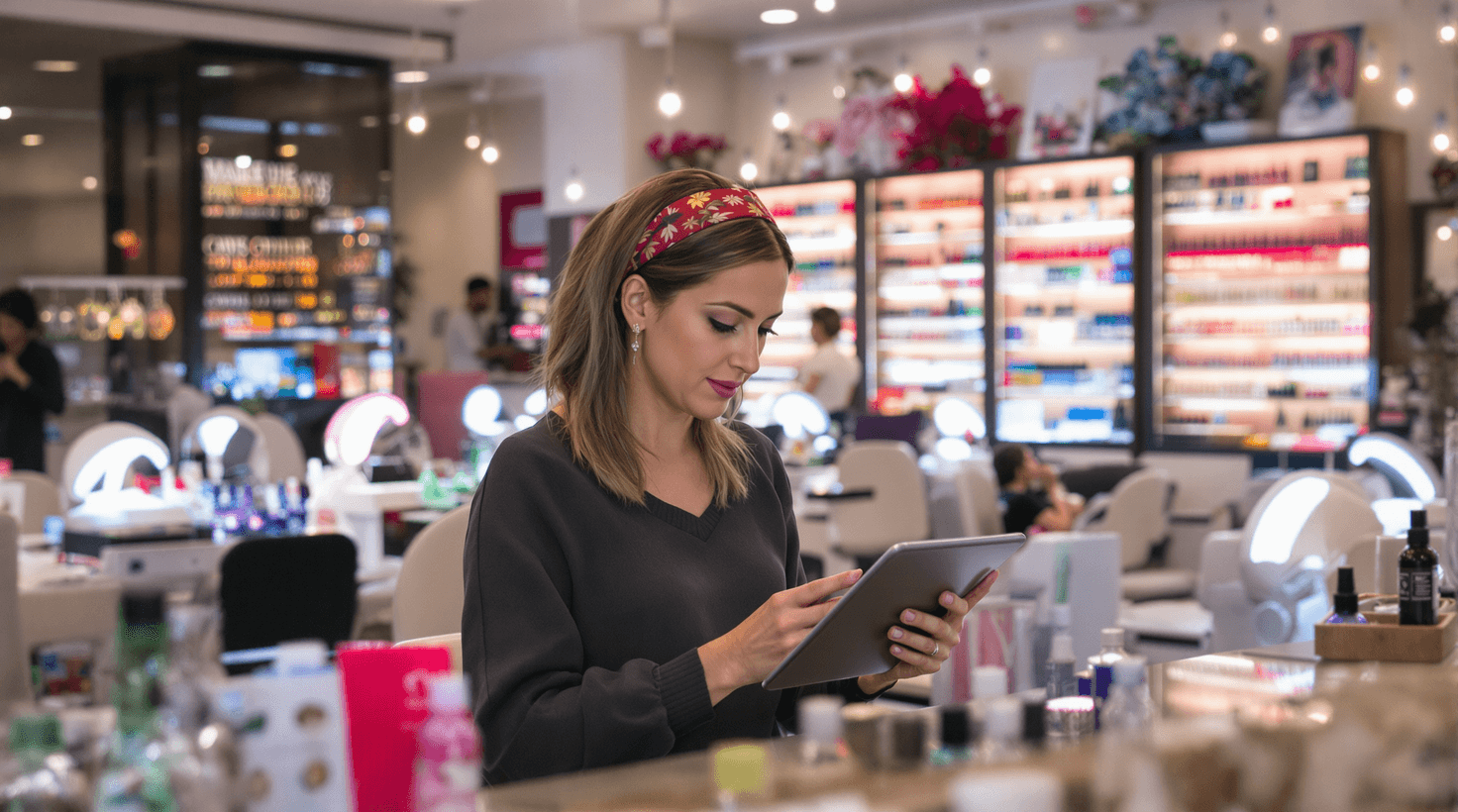
It's 2:47 on a Saturday afternoon. Three of your four chairs are working a full set of acrylics, the pedicure rotation is two-deep, and the front desk phone has rung eleven times in the last hour. Two of those calls were existing clients trying to reschedule. Three were walk-ins asking about wait times. One was a brand-new client who wanted a Gel-X set with chrome accent nails for a wedding next Friday — and got voicemail because nobody could pick up the receiver without a glove change. By Monday, when you check the caller ID, half of them have already booked somewhere else.
Here's the thing about nail salons that separates them from almost every other beauty business: you're running two booking flows simultaneously. Walk-ins off the street read your Google rating and decide in 15 seconds whether to come in. Booked regulars need a frictionless rebooking experience timed to their specific service — gel clients every 2.5 weeks, acrylic fills every 2-3 weeks, pedicure clients every 4. Get either flow wrong and the chair sits empty. Get both right and a 4-chair shop can sustain 80%+ utilization without a dedicated front desk person.
That's the spine of this guide. We're not going to tell you AI "transforms" your business or "unlocks new revenue." We're going to tell you which specific tools plug which specific leaks — missed calls, lapsed regulars, walk-in conversion, review velocity — and what each one realistically costs and returns.
TL;DR — The 3 Highest-ROI Moves
- Turn on automated SMS reminders + card-on-file in your existing booking software. This alone takes the industry-average 16% no-show rate down to 5-8%. Cost: $0 if you already pay for Vagaro, GlossGenius, or Booksy.
- Add an AI phone receptionist like My AI Front Desk ($79-99/mo) or Emitrr ($99/mo flat). Captures the 5-10 calls per day your techs can't answer mid-service.
- Use ChatGPT or Claude as your free copywriter for review responses, promo SMS, captions, and policies. Saves 3-5 hours/week. Cost: $0.
The Two Flows That Drive Nail Salon Revenue
Walk into any independent nail salon and you'll find a version of the same split: some chairs are booked in advance, some fill from walk-ins, and the front desk is constantly juggling both. The exact ratio varies by location, neighborhood, and how aggressive the salon has been about building an appointment book — but data from independent salon operators puts the typical breakdown somewhere around this:
| Traffic Source | Share of Visits | Share of Revenue | Avg Ticket |
|---|---|---|---|
| Booked appointments | 55-65% | 65-75% | $55-75 |
| Walk-in / same-day | 35-45% | 25-35% | $40-55 |
Walk-ins have a lower ticket on average because they're more likely to do express services — a quick gel soak-off, a polish change, a basic pedicure. Booked clients plan ahead, so they tend to book nail art, Gel-X extensions, or longer pedicure upgrades.
The business implication: you need two different AI strategies running in parallel. One strategy keeps your booked clients showing up and rebooking on time (reminders, rebooking cadence, waitlist management). The other converts more walk-in curiosity into actual visits (Google reviews, Instagram presence, fast phone pickup). Most "salon software" guides focus entirely on the booked side. This one covers both.
There's also a direct relationship between review volume and new walk-in traffic that most salon owners don't track quantitatively:
| Google Reviews (total) | Avg New Walk-in Clients/Month | Notes |
|---|---|---|
| Under 50 | 8-15 | Essentially invisible in local search |
| 50-150 | 18-30 | Appears in "nail salons near me" for nearby searches |
| 150-300 | 35-55 | Consistently in top-3 local pack |
| 300+ | 60-90+ | Dominates local discovery; new clients cite reviews unprompted |
These numbers come from operator interviews and are directional, not scientific — but the pattern is consistent. Salons that actively collect reviews after every appointment grow their walk-in base 3-4x faster than salons that wait for happy clients to review spontaneously.
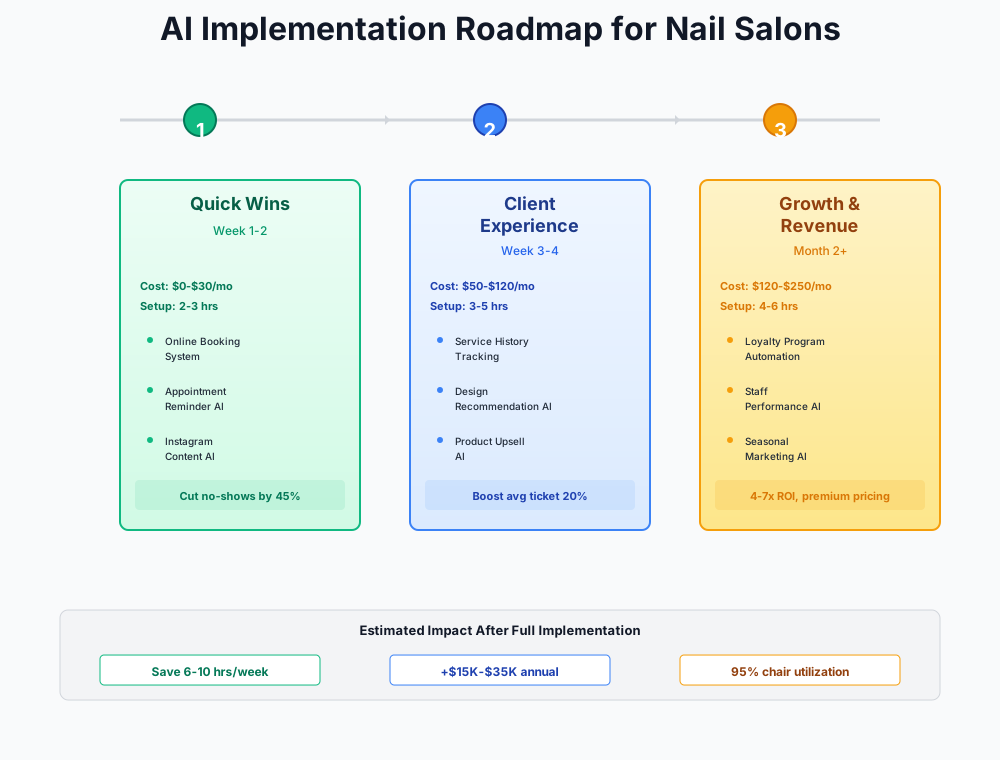
Here's a visual overview of the implementation roadmap:
The Foundation: Free AI Tools You Can Set Up This Week
These three implementations require zero new subscriptions, work with whatever booking software you already have, and show measurable results — fewer no-shows, more Instagram engagement, faster review responses — within two weeks.
1. Use ChatGPT or Claude as Your Free Business Assistant
Open ChatGPT right now. Paste this prompt. You'll have a professionally written response to that 2-star review in 45 seconds.
Most salon owners spend 30-45 minutes agonizing over a review response because it feels high-stakes. Then another 45 minutes on the Mother's Day promo email. Then 20 minutes on a job posting. Those small writing tasks collectively eat 3-5 hours a week — not because they're hard, but because they feel hard enough to procrastinate. A free AI chatbot gets you 80% of a polished draft in 30 seconds. You edit for tone and post.
I own a nail salon. A client left this review:
[PASTE REVIEW HERE]
Write a professional, empathetic response that acknowledges their concern, offers to make it right, does not get defensive, and does not over-apologize in a way that admits fault we don't know yet. Keep it under 75 words. Sign off with "—[Your name], Owner."
Write a firm but friendly cancellation policy for my nail salon for use in the booking confirmation SMS. Requirements: 24-hour notice for cancellations or a $25 fee. No-shows charged the full service price to the card on file. The tone should not scare away first-time clients but should clearly set expectations. Keep it under 100 words.
I just posted a nail art photo. Here's the design: [DESCRIBE — e.g., "chrome powder ombre on almond-shaped nails, rose gold to champagne fade"].
Give me:
- Five caption options ranging from playful to professional
- Twenty hashtags mixing high-volume (#nails #nailart) and niche (#almondnails #chromenails #ombrenails) tags
- One CTA at the end of each caption
Tone: warm, confident, slightly fun.
Save those three prompts in your phone's Notes app. You'll reuse them every single week. Create a free account at chat.openai.com or claude.ai — takes two minutes, no credit card.
Time saved: 3-5 hours/week. And faster review responses have a compounding effect on Google's local ranking algorithm — it rewards active profile engagement, so the weeks you respond to every review are the weeks your "nail salons near me" position climbs.
Don't Post AI Output Cold
Always read what the AI wrote before publishing. Tell it your tone explicitly ("casual and fun" or "warm but professional"). And never post an AI-drafted negative review response without sleeping on it for at least an hour — emotions cloud editing.
2. Turn On Automated Reminders to Slash No-Shows from 16% to 5-8%
How many hours did your front desk spend last week making manual confirmation calls? Whatever the answer, that time is better spent on clients in chairs.
A 4-6 chair salon with a 16% no-show rate loses roughly $11,700/year — that's 5 missed appointments per week at a $45 average ticket. Your booking software almost certainly has automated SMS reminders built in. Most owners either never turned them on, or only enabled a single reminder that fires 24 hours out.
The sequence that actually moves the needle is three touches: instant confirmation text when the appointment books, 48-hour reminder, and a 2-hour final reminder. Add two-way reply-to-confirm and card-on-file, and best-in-class salons get to 5-8% no-shows. In Vagaro: Settings → Notifications → Automated Messages. In GlossGenius: Settings → Client Communication. In Booksy: Settings → Automated Messaging.
- Confirmation text fires at booking (not 24 hours later)
- 48-hour reminder enabled with reply-to-confirm option
- 2-hour final reminder enabled
- Cancellation policy text appears in the confirmation message
- Card-on-file is required for new client bookings
- Two-way SMS replies route into a dashboard (not lost)
Enable card-on-file requirement for new bookings. Even if you rarely charge it, the fact that the client knows you have it cuts no-shows by another 30-40%. The cancellation policy in the confirmation message — "24-hour notice required. Late cancellations subject to $25 fee. No-shows charged full service price to card on file" — should be non-negotiable.
ROI Snapshot
Monthly Cost
$0/mo
Time Saved
6hrs/week
Monthly Value
$2,800
ROI
Infinity%
3. Batch a Week of Social Media in One Hour with Canva AI + CapCut
Instagram nail-art photography is the single most important new-client acquisition channel for nail salons. This isn't opinion — it's the reason walk-in clients say they picked you. But creating polished posts with captions takes 3-7 hours a week, so most owners post inconsistently, the algorithm punishes their reach, and they lose discovery clients to competitors who post daily.
The fix is batching. One hour per week covers all seven days of content. Here's how:
During the week, take 10-15 nail photos at the station — ask client permission, natural window light beats any ring light. Pick one slow morning as your content hour. In Canva (free tier, 50 AI credits), use Magic Design: upload a nail photo and Canva generates multiple post layout options in seconds. Use Background Remover to clean cluttered station backgrounds.
For captions, batch all seven at once in ChatGPT: "Here are 7 nail descriptions: [list them]. Write 7 Instagram captions and a hashtag set for each." Seven captions in 90 seconds, then you lightly edit.
For Reels: record 30-second time-lapse clips during the work week. Drop into CapCut (free), hit auto-captions and beat-sync. A polished Reel in 5 minutes. Schedule everything via Instagram's built-in scheduler or Later's free plan (up to 12 posts/month per profile; paid plans start at $25/month for 30 posts/month).
Reels Beat Static Posts in 2026
Instagram's algorithm heavily favors video. One 15-second nail art time-lapse per week consistently outperforms five static photos. CapCut's auto-captions are critical — most viewers watch with sound off.
Consistent posting compounds. At 40-60% higher follower growth from daily vs. sporadic posting, the new bookings start showing up in month 2 and accelerate through month 6. This is the same content batching approach we cover for hair salons and barbershops — the discovery dynamics are nearly identical.
Plugging the Phone and Rebooking Leaks (Month 1-2, $70-$350/month)
Once automated reminders and social content are running, two leaks remain that free tools can't fix: missed phone calls and the gap between a client's last appointment and their next one.
4. Stop Losing Bookings to Voicemail with an AI Phone Receptionist
A 4-5 chair salon fields 30-50+ inbound calls on a busy day. During peak service hours, no tech can answer mid-acrylic. After-hours calls — Sunday afternoons, holidays — disappear entirely. Each missed call from a new client is a $45-75 booking that walks to the next salon in Google Maps results. Salons miss somewhere between 30-50% of calls during peak service windows.
An AI voice receptionist answers every call 24/7, books into your scheduling software, handles pricing and availability questions, and texts callers back. Under $50/month for a tool that works evenings and weekends without sick days.
My AI Front Desk
Best for: Solo and small salons (1-4 techs) losing 5-10 calls/day
Purpose-built AI phone receptionist for salons. Answers calls 24/7 in natural conversation, books appointments directly into Vagaro/GlossGenius/Booksy/Square, and sends SMS follow-ups for missed calls. The plan structure has consolidated since this guide was first published: it's now a single Business-in-a-Box plan with 200 voice minutes, 500 SMS, and 100 chatbot conversations — $99/month billed monthly or $79/month billed annually. Custom Enterprise pricing above that for higher volume. 7-day free trial, no credit card required.
Emitrr
Best for: Higher-volume salons (4+ techs) where per-minute charges would blow the budget
Flat-rate AI voice agent — no per-minute overage charges, which matters when you're getting 60+ calls/day. Includes missed-call-to-text auto-response: when a call goes unanswered, Emitrr instantly texts the caller. Two-module pricing (voice and SMS are separate) means it's not the cheapest option for low-volume salons.
Tidio (Lyro AI)
Best for: Capturing website and Instagram DM inquiries (not phone)
Not a phone solution — but Tidio's free plan (50 conversations/month) is a genuinely useful addition for capturing after-hours website chat and Instagram DM inquiries. The Lyro AI agent resolves up to 67% of customer questions automatically. Pair with one of the phone tools above.
Start the My AI Front Desk 7-day free trial, connect your booking software, and input your full service menu — every gel color upgrade, every nail art tier, every Gel-X price. The AI cannot book "Gel-X full set with French" if you only listed "manicure." Then call your own salon line after hours and try to book a complex service. Listen for anything awkward, update the FAQ, try again. After week one, the call log tells you exactly how many calls converted — and which questions the AI couldn't handle (those need FAQ updates).
Don't Replace Your Personal Touch — Configure Overflow Mode
Many salons set the AI to answer ALL calls. We usually recommend overflow mode instead: the AI picks up only when the salon line goes unanswered for 3 rings. Regulars who prefer talking to the front desk still get a human; missed and after-hours calls get the AI safety net.
If you're a single-tech booth-renter operation, this is overkill — just use SMS auto-reply on your iPhone or Android. The math works at 3+ techs.
Front desk time freed: 3-6 hours/week. Recovered bookings: $2,000-$5,000/month. ROI is typically 20-60x the monthly cost in month one.
5. Activate Smart Rebooking and Waitlist Automation
A gel manicure client who doesn't rebook within 2.5 weeks usually starts looking for a new salon. A regular polish client at 1.5 weeks. An acrylic-fill client at 2 weeks. Most salons send the same generic "we miss you" text 30 days out — which is too late for half their service mix and too soon for the other half. Meanwhile, when a client cancels Saturday's 11am slot, nobody texts the three people on the waitlist who'd happily take it.
Modern booking platforms bake service-type-aware rebooking intervals and intelligent waitlist matching into the base subscription. Most salons either don't have these features (wrong platform) or have them but never configured them.
GlossGenius
Best for: Solo to small salons (1-3 techs) wanting modern UI and smart automation
All-in-one salon platform with AI-powered analytics and smart rebooking automation tuned to nail service intervals. Standard at $24/month (solo, annual billing). Gold at $48/month adds multi-user, waitlist, intake forms, commission reporting. Platinum at $148/month adds full AI Growth Analyst. Payment processing at 2.6% flat.
Booksy Biz
Best for: Salons that want new-client discovery via the Booksy consumer marketplace
Booking platform with a built-in consumer marketplace that drives meaningful new-client discovery. AI booking gap optimization suggests marketing targets to fill open slots. All features included in every plan — no upsell tiers for email or reminders.
Vagaro
Best for: 3-8 chair salons with strong commission/payroll needs
The most widely-used salon platform in the segment. Scales by number of bookable calendars (1 calendar at $23.99/month up to 7+ calendars at $85/month). Strong payroll and commission tracking. UI is dated compared to GlossGenius, but the platform is mature and full-featured.
Configure rebooking intervals by service type, not a single global setting:
- Regular polish: 1.5 weeks
- Gel manicure: 2.5 weeks
- Acrylic full set: 4 weeks (fill at 2-3 weeks)
- Gel-X extensions: 3 weeks
- Pedicure: 4 weeks (adjust seasonally)
Enable the waitlist feature — when a cancellation opens, matching clients get an automated text offering the slot. Turn on AI booking gap alerts: when tomorrow's schedule has an open slot, the platform auto-sends targeted promotions to fill it. Most salons lift their rebooking rate from ~45% to ~70% within 60 days of proper configuration. That's $1,500-$4,000/month in revenue that was already there, just not captured.
6. Automate Review Collection and Use AI to Draft Responses
Your Google rating is a walk-in conversion lever, not a vanity metric. Look at the second table at the top of this guide — the difference between 50 reviews and 300 reviews is roughly 50 more new walk-in clients per month. That's a full additional chair's worth of incremental revenue, driven entirely by review volume.
Most booking platforms include automated post-appointment review request texts. Turn it on, point it at your Google Business Profile, and configure it to fire 2 hours after checkout — when the fresh manicure feeling is still strong. The template that converts: "Hi [Name]! Thanks for visiting [Salon Name] today. If you loved your nails, we'd be so grateful for a quick Google review [link]. It means the world to our small business."
Set the review link to Google Business Profile, not Yelp. Google reviews drive 3-5x more local search ranking impact.
Build a 5-minute daily habit: check Google reviews, paste new ones into ChatGPT with the prompt below, edit lightly, post.
I own a nail salon. Write a response to this [STAR_RATING]-star Google review:
[PASTE REVIEW]
Requirements:
- Under 50 words
- Thank them specifically for what they mentioned (the tech's name, the service, the nail art style)
- For 4-5 star: warm and personal, not generic
- For 1-3 star: acknowledge their concern, offer to make it right offline ("Please call us at [PHONE]"), do not sound defensive
- Sign off "—[YOUR NAME], Owner"
One note on Podium: it works, but at ~$400+/month it costs more than many salons pay for rent. The combination above — existing booking platform plus ChatGPT — achieves roughly 80% of what Podium does for $0 incremental cost. Podium makes sense at 3+ locations or 500+ existing reviews. Almost no independent nail salon meets that threshold.
Getting Operational: The Tools That Move Margin (Month 3-6, $200-$800/month)
With the booking and review foundations running, optimize the operational layer: scheduling, inventory, financial visibility, and loyalty. These move the margin needle — but only after the earlier steps are stable.
7. AI Smart Scheduling for Staff and License Renewal Tracking
Building the weekly tech schedule takes 5-8 hours because you're juggling availability, skill specialties, peak-hour coverage, and labor cost targets — and then someone calls out and the whole thing collapses. This is exactly the kind of structured, repetitive optimization problem that AI scheduling tools handle well.
Homebase
Best for: Salons with 3-10 W-2 technicians
All-in-one team management with AI Smart Scheduling, time clock, and a hiring module. Free plan covers up to 10 employees at one location. Essentials at $30/month adds advanced scheduling and time-off management. Plus at $70/month adds AI-powered scheduling and PTO controls. All-in-One at $120/month layers in hiring, onboarding, and HR compliance tools. License renewal tracking is configurable on the free plan — set each tech's state cosmetology license expiration date and Homebase fires reminders 90/60/30 days out.
Add each technician with availability, skill tags (gel, acrylic, nail art, pedicure, Gel-X), pay model, and state license expiration date. Set coverage rules — minimum 2 techs during slow periods, 4 during peak hours, always at least one nail-art-capable tech on duty. Generate the first week's schedule with AI Smart Scheduling, then adjust. By week 3 the AI has learned your patterns and needs minimal edits.
The license renewal tracking is the underrated feature here. Most salons track tech licenses in a Google Sheet nobody opens. When a tech's license lapses during a state board inspection, the fine is $500-$2,000 per technician — and the salon's establishment license can be put on probation. Automated reminders at 90/60/30 days eliminate this risk surface entirely, for free, on the base plan.
Skip this if your salon is booth-renter-only. In that case, just use Homebase free for license tracking and skip the scheduling module.
8. Inventory Tracking and True Cost-Per-Service Math
You're spending $1,000-$3,000/month on supplies and you probably don't know your true cost per gel manicure. You don't know which polish colors are dying on the shelf. And the tariffs on Korean and Chinese nail products that started landing in 2024-2025 are still in effect and have been quietly compressing your margin month by month — they just make everything feel more expensive without forcing a clear price-increase decision.
Suplery
Best for: Salons spending $1,500+/month on supplies
Dedicated salon inventory platform. Auto-deducts product from inventory when services are checked out at POS, predicts reorder points based on historical velocity, calculates true cost-per-service, and alerts on supplier price changes (critical given tariff volatility). Solo at $40/month. Optional Bluetooth scale (~$195 one-time) for weight-based gel tracking.
Vagaro and GlossGenius both include basic inventory modules in their base subscriptions. Start there. Only upgrade to Suplery once you're spending $1,500+/month on supplies and can quantify the waste you're trying to eliminate.
Start by cataloging your top 50 products, not everything. The top 50 cover 90% of usage: every gel polish color in active rotation, acrylic powders/liquids, nail tips, files/buffers, and top-selling retail items. Map products to services — a gel manicure uses X ml base coat plus Y ml color plus Z ml top coat. After 30 days, run the inventory report: which products have been sitting 90+ days, which are chronically understocked, and which polishes you should retire from the menu. Track retail product sales separately — cuticle oils, hand creams, and nail treatments run 50-70% gross margins, and most salons under-sell them significantly.
9. AI-Powered Bookkeeping (Especially for Cash-Heavy Salons)
Your accountant sees the books once a quarter. Between visits, you have almost no visibility into which services make money after product costs, or whether the newest tech generates enough revenue to cover their commission. QuickBooks' built-in AI agents fix this.
QuickBooks Online (with Intuit Assist AI)
Best for: Any salon on spreadsheets or only seeing books quarterly
Built-in AI agents auto-categorize transactions, reconcile bank statements, scan receipts, and answer financial questions in plain English. Simple Start at $38/month. Essentials at $85/month for multiple users. Plus at $140/month adds inventory tracking — appropriate if you sell retail. Intuit runs frequent introductory promotions (recently 50% off for 3 months), so check the current offer before you commit. Integrates with Vagaro, Square, and GlossGenius.
Connect your business bank account and POS in the 30-day free trial. Let Intuit Assist auto-categorize the first month — review and correct mistakes; the AI learns. Set up specific expense categories: backbar product, retail inventory, tech wages/commissions, rent, utilities, marketing, software, licensing. Use receipt capture to photograph every BSG/OPI/CND/SNS supply order. Build a monthly 30-minute finance review habit.
The Cash and Venmo Reality
The biggest blind spot in nail salon bookkeeping is informal cash and Venmo payments. Don't try to automate this with software — it creates a paper trail that can complicate things if you're not already reporting correctly. Talk to your accountant about proper tip reporting first, then digitize.
Most owners discover at least one underpriced service the first time they see real cost-per-service numbers. That visibility alone typically recovers $500-$2,000/month in margin through better pricing decisions.
10. Digital Loyalty Programs to Maximize Lifetime Value
Converting a walk-in into a regular who visits every 2-3 weeks is the most profitable thing your salon can do. Zenoti's 2025 Beauty and Wellness Benchmark Report found 81% of salon clients say feeling recognized is what keeps them loyal — and digital loyalty programs increase the share of clients visiting 5+ times per year by roughly 9%.
Stamp Me
Best for: Salons wanting a dedicated loyalty platform with referral tracking
Digital loyalty card platform with automated push notifications for dormant clients, birthday rewards, segmentation-based campaigns, and tracked digital referral links. Used by bookstores and other retail-adjacent businesses for similar repeat-visit dynamics.
GlossGenius, Vagaro, and Booksy all include basic loyalty modules at no extra cost — check those first. If you go dedicated, design simple rewards: "10 visits, 11th is a free gel upgrade" beats complex point systems. Clients have to understand it in 5 seconds.
Set "we miss you" triggers at 45+ days for regular polish clients, 30+ days for gel/acrylic clients. A client at day 20 is on their normal schedule, not lapsed. Auto-send birthday rewards 7 days before each client's birthday. Launch a referral program with tracked links so you know who your top promoters are.
Compliance and the Booth-Renter Reality (What Generic AI Advice Misses)
Two industry-specific topics cause more failed AI implementations in nail salons than anything else.
State Cosmetology Board Compliance
Every practicing tech needs an active state-issued license. Every salon needs an establishment license. OSHA requires a maintained Safety Data Sheet binder for every chemical product on premises — including the "Toxic Trio" disclosures (toluene, formaldehyde, dibutyl phthalate). New York State has its own Nail Salon Minimum Standards Law with wage bond requirements. Some states require posted signage about ventilation and chemical hazards.
AI helps with automated license renewal reminders (Homebase free plan), daily/weekly sanitation checklist generation, and drafting OSHA-compliant chemical hazard signage in multiple languages. AI cannot replace your physical SDS binder — OSHA still requires accessible Safety Data Sheets at the location — and software can't fix HVAC.
Create a daily and weekly sanitation checklist for a nail salon in [YOUR STATE] that complies with [STATE] State Board of Cosmetology requirements and OSHA standards.
Include sections for:
- Tool sterilization (autoclave/UV sterilizer log entries)
- Pedicure bowl cleaning (chemical disinfectant contact times)
- Chemical storage (proper labeling, ventilation, fire-safe storage)
- SDS binder verification
- End-of-day disposal procedures (acetone, solvent waste per EPA)
Format as a printable checklist with empty checkboxes and a column for staff initials. Add a header for date and lead tech signature.
How AI Tools Work With Booth Renters
Most salon software assumes one unified client list and one calendar. Booth-renter shops break this assumption — each renter is a legally independent business with their own client book, pricing, and hours.
The AI phone receptionist works for the salon, not the renters. It can answer general calls, handle FAQs, and route specific tech requests to the renter's individual number, but it should not book for renters without their explicit consent. Inventory and bookkeeping tools should be salon-only. Marketing tools like Canva and ChatGPT can and should be shared — the rising tide of consistent salon-wide content benefits everyone.
If your salon is mixed — some W-2 commission techs, some booth renters — draw the line clearly. The IRS draws it harder than you do, and misclassification is one of the top compliance risks in the nail industry.
What to Skip (and When to Revisit)
Boulevard ($195+/mo) and Zenoti (~$150+/mo) are designed for high-volume, multi-location operations. A 4-6 chair independent salon uses 20% of the features and pays for 100%. GlossGenius at $24-48/mo or Vagaro at $24-85/mo delivers 90% of the value for the typical independent shop. Revisit enterprise platforms at 2+ locations or 10+ technicians.
AI nail-art printers (e.g., Nailbot 2.0) aren't ready for professional use. Print quality on natural nails is still inconsistent and lacks the nuance skilled techs deliver. Use NailsDesignAI ($2.99 credit pack) for design inspiration and revisit the hardware in 2-3 years.
Don't try to automate tip management or off-books cash tracking. Work with your accountant on proper tip reporting first.
And don't migrate booking platforms during peak season. Migration always causes short-term disruption. January or September are the right windows — never April-June (pedicure/prom/wedding season) or November-December (holiday rush).
Getting Started Checklist
- Week 1, Day 1: Create free ChatGPT or Claude account. Save the three prompts from the free tools section in your phone Notes.
- Week 1, Day 2: Log into your booking software and enable the 3-touch automated reminder sequence + two-way SMS replies.
- Week 1, Day 3: Enable card-on-file requirement for new bookings. Add cancellation policy text to confirmation messages.
- Week 1, Day 4: Take 10 nail photos. Set up free Canva account on phone. Use Magic Design + Background Remover.
- Week 1, Day 5: Use ChatGPT to batch-write 7 Instagram captions and hashtag sets. Schedule via Instagram's built-in scheduler.
- Week 2: Run no-shows report. Compare to prior month. You should see early signal of improvement.
- Week 3-4: Sign up for My AI Front Desk 7-day free trial. Connect to booking software. Test by calling your own salon.
- Month 2: Audit your existing booking platform's smart rebooking and waitlist features. Configure service-type-specific rebooking intervals.
- Month 2-3: Enable post-appointment Google review request automation. Build the 5-minute daily review-response habit.
- Month 3-6: Layer in Homebase for staff scheduling + license tracking, then QuickBooks Online for financial visibility, then loyalty program activation.
- Every 90 days: Review the success metrics dashboard (no-show rate, missed call rate, rebooking rate, Google rating). Adjust what isn't working.
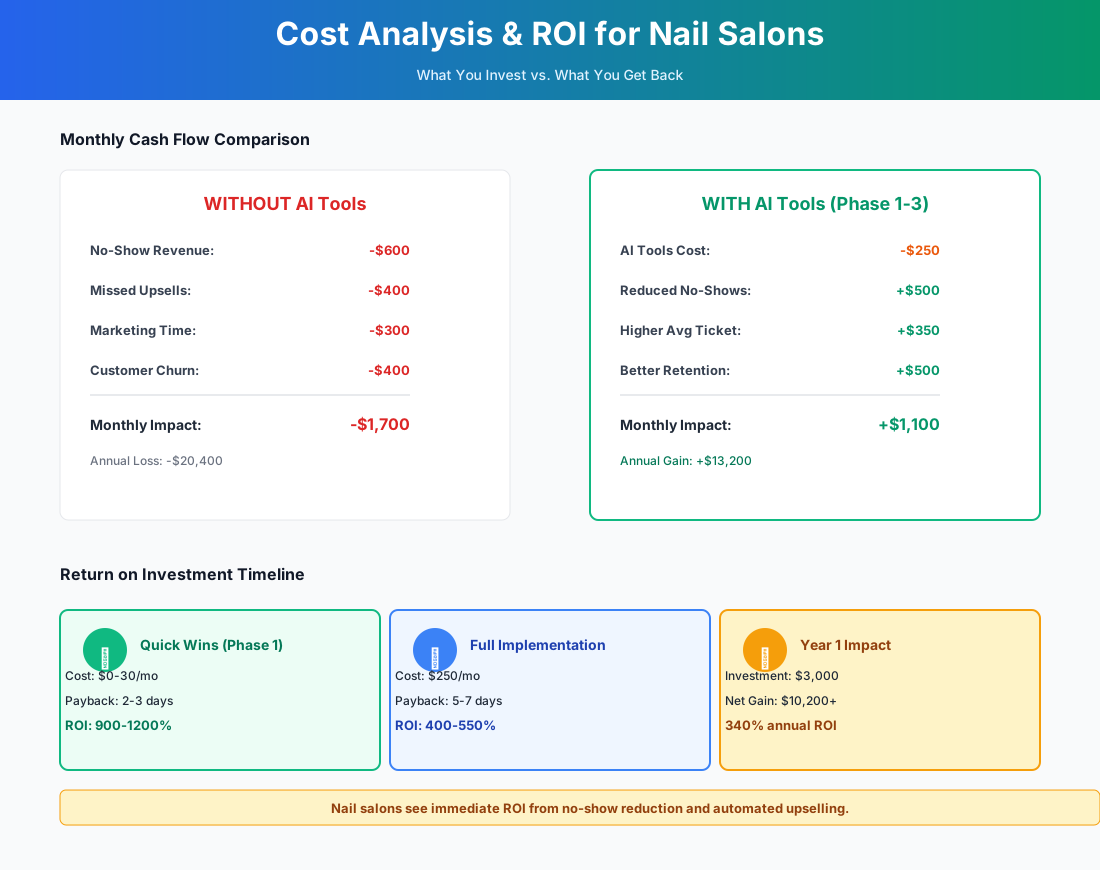
Here's a breakdown of the costs and expected returns:
FAQ
How do AI rebooking texts handle clients who switch between gel, acrylic, and Gel-X services?
Service-aware platforms like GlossGenius and Vagaro track each client's most recent service and time the rebooking reminder to that service's typical interval — 2.5 weeks for gel manicures, 2 weeks for acrylic fills, 3 weeks for Gel-X. The interval updates automatically when the client changes services. Where it falls down: clients who alternate between services on different visits (gel one month, regular polish the next). For those, set the reminder to the shorter interval and let the client decide when to come back.
Can an AI phone receptionist handle clients who primarily speak Vietnamese, Korean, or Spanish?
Performance varies significantly. My AI Front Desk supports multilingual configuration, but Vietnamese — the most common non-English language in U.S. nail salons — is hit-or-miss in real-world use. Accents and code-switching cause misunderstandings. The practical setup for salons with significant non-English-speaking clientele: configure the AI to recognize when a caller is struggling in English and immediately offer to text the booking link instead. SMS works in any language because the client reads and replies at their own pace.
Does requiring card-on-file violate any state-specific consumer protection laws?
In most states it's legal as long as you clearly disclose the cancellation policy at booking, only charge per that disclosed policy, and give clients an opportunity to cancel within the window without penalty. New York, California, and Massachusetts have stricter enforcement — verify your disclosure language with your accountant or a small-business attorney. The booking platforms generally provide compliant default templates as a starting point.
How do AI tools work with our booth renters who run their own client books?
Booth renters are independent contractors — legally separate businesses in your physical space. The salon's booking platform, payment processor, and AI receptionist should serve only salon-employed techs unless you have a formal written arrangement with each renter. Free tools like ChatGPT and Canva can absolutely be shared. But touching renter bookings or finances without explicit agreement creates 1099 misclassification exposure with the IRS and your state labor department.
What happens to OSHA SDS compliance if we go fully digital?
OSHA's Hazard Communication Standard requires Safety Data Sheets to be accessible to employees during all working hours. Some jurisdictions allow electronic-only access if employees can access the SDS quickly without barriers — no logged-out accounts, no internet outage blocking access. Most state cosmetology boards still expect a physical binder during inspections. The safe approach: maintain both. A physical binder at the front desk plus a digital backup. AI tools can help generate updated SDS summaries and chemical hazard signage in client-facing languages, but they don't replace the physical compliance documentation.
How do tariff-driven price increases on Korean and Chinese nail products affect AI inventory recommendations?
This is where Suplery earns its keep. When supplier prices change — which happened repeatedly through 2024-2025 and continues as tariff rates get adjusted — Suplery alerts you and recalculates true cost-per-service so you can adjust pricing or substitute. Generic booking-platform inventory modules track quantities but not unit-cost changes. If your supply spending has increased more than 10% in the last 12 months without a proportional service price increase, your margin is quietly eroding and you need a tool that tracks unit cost over time.
Is AI going to replace my front desk staff?
No. What AI handles well: answering the phone when everyone is mid-service, sending rebooking reminders at the right interval, collecting reviews automatically. What it handles poorly: calming an upset client, upselling a specific nail art design, recognizing that a regular needs their appointment adjusted. The front desk person who spends less time answering "what are your hours" can spend more time on the things that actually keep clients loyal.
The Bottom Line
Every leak described in this guide is fixable. Most of the fixes are free or under $100/month. The salons running at 10-12% net margin in a tough cost environment aren't doing anything magical — they're answering more calls, holding more rebookings, posting consistently, and actually knowing their cost per service. These AI tools are how a 4-6 chair independent operator runs that tight without hiring an operations manager.
Start with the reminder sequence and the free AI writing assistant this week. Both are free, both show results in two weeks, and both set the foundation that makes every later tool more effective.
For peer-business playbooks that share many of the same tools and dynamics, see our guides on hair salons, barbershops, dog grooming businesses, and med spas.
More AI Implementation Guides
AI Tools for Breweries: The 2026 Owner's Playbook
The best AI tools for breweries in 2026: cut TTB compliance time, tighten COGS, streamline taproom scheduling, and target release marketing — starting free.
AI Tools for Bookkeeping Services: 2026 Guide
Best AI tools for bookkeeping services in 2026: Automate categorization, reconciliation, and document chasing without hiring extra staff.
AI Tools for Marketing Agencies: 2026 Playbook
The best AI tools for marketing agencies in 2026. A phased plan to kill Hell Week reporting, scale content, and fix billable utilization without new hires.
AI Tools for Home Health Care Agencies: 2026 Guide
A practical 2026 guide to AI tools for home health care agencies — HIPAA-safe automation for shift-filling, OASIS-E documentation, EVV, and claim denials.
AI Tools for Dermatology Practices: 2026 Guide
The best AI tools for dermatology practices in 2026 — cut prior-auth hours, reduce no-shows, and grow your cosmetic line, with a HIPAA-first rollout plan.
AI Meeting Assistant Cost for Accountants in 2026
What does an AI meeting assistant cost for an accounting firm? Free tiers, per-seat pricing from ~$17/user/mo, and the real total for a 3-, 5-, and 10-person team, compared.
Keep exploring
See every AI implementation guide we've published for Beauty & Personal Care, or browse the full library by industry or category. Looking for a specific platform? The AI tools directory indexes every product mentioned across our guides, and the comparisons hub puts the most-asked head-to-heads side by side.