A new patient calls about laser hair removal. Your front desk is mid-treatment and lets it go to voicemail. The caller doesn't leave a message. Three minutes later they've booked a consultation with the practice two miles down the road.
That caller cost you somewhere between $400 and $1,200 in marketing spend to generate — Google Ads, Instagram, SEO, referral program, whatever your patient acquisition mix looks like. You paid to get them to the point of picking up the phone. You just didn't answer.
This is the core economic problem in elective aesthetics: the lead cost is high, the consideration cycle is long, and the drop-off at every handoff point is brutal. Industry surveys put average cost-per-lead for aesthetic practices at $60–$180. Consultation-to-treatment conversion rates cluster around 55–70% for in-person consults and drop below 40% when patients leave without booking. No-shows on a blocked laser slot cost $400–$800 in lost revenue plus supplies loaded and room reserved. The patient who bought a Botox series and hasn't been back in eight months? That's $2,800–$4,500 walking to your competitor.
AI tools don't fix all of this. But they fix specific, measurable pieces of it — and in aesthetic medicine, those pieces add up fast.
There's a catch: med spa AI adoption operates under constraints that most AI guides completely ignore. Every tool that touches patient data needs a signed Business Associate Agreement. Automated appointment messages can't reveal treatment details. AI-generated charts still require provider sign-off. General-purpose AI like ChatGPT or Claude cannot receive patient names, dates of birth, or treatment records — that's a HIPAA breach regardless of intent. AI skin analysis can support a consultation, but the treatment plan must come from a licensed provider.
This guide works through those constraints honestly, then walks through the tools that meet them — with real pricing and the specific places they stop revenue from leaking out.
TL;DR — Top 3 Recommendations
- Aesthetic Record ChartSmart AI ($30/mo) — Saves injectors 5–10 hours/week on charting via voice dictation to structured SOAP notes with lot tracking
- DialIQ AI Phone Receptionist ($49–$99/mo) — Answers every inbound call 24/7, books appointments, captures $5,000–$15,000/mo in leads that would've gone to voicemail
- RepeatMD (custom pricing) — AI-powered membership management and patient retention that turns one-time visitors into recurring revenue
Where Revenue Leaks in an Aesthetic Practice
Elective aesthetics has a funnel problem most owners can't see clearly because the leaks happen at different points in a long patient journey. The table below maps the most common drop-off points, their typical cost, and which category of AI tool addresses each one.
| Drop-off Point | Typical Cost | AI Fix |
|---|---|---|
| Missed inbound call | $400–$1,200 per caller (lead cost + lost booking) | AI phone receptionist |
| Consult no-show | $0 in billing + slot blocked 60–90 min | Automated reminder + confirmation sequences |
| Consult booked, treatment not accepted | 35–45% of consults with no same-day booking | Financing integration + follow-up automation |
| No-show on booked laser/injectable slot | $400–$800 lost revenue + supplies | Confirmation + pre-payment workflows |
| Patient lapse after initial series | $1,200–$3,000 lost annual value | Reactivation campaigns + membership programs |
| Provider time on charting | $3,000–$12,000/month/provider in lost treatment capacity | AI-assisted voice-to-chart |
That last row is the most underappreciated. Your nurse injectors generate $250,000–$500,000+ annually in treatment revenue. They're also spending 1–2 hours a day on SOAP notes, injection maps, lot number tracking, and consent documentation. At $150–$300 per hour in treatment capacity, that's not a minor inconvenience — it's a significant portion of their productive ceiling. AI charting tools built specifically for aesthetics (not generic medical dictation) recover most of that time.
The tools below are organized by where they plug each leak. Compliance comes first because it determines which tools you can legally deploy everywhere else.
Compliance & Privacy Framework
Before you implement a single AI tool, you need to establish the legal and regulatory floor your entire tech stack will operate on. This isn't optional or aspirational — it's existential. A single HIPAA breach from texting patient photos on a personal phone can cost $50,000+ in fines. A scope-of-practice violation can shut your doors.
HIPAA Requirements for AI Tools in Med Spas
Every AI tool that stores, processes, or transmits patient data requires a signed Business Associate Agreement (BAA). This includes your EMR (obviously), but also your AI receptionist, your review management platform, your scheduling tool, and your marketing automation — if any of them can access patient names, appointment details, or treatment information.
The critical rule for general-purpose AI: never paste patient names, dates of birth, phone numbers, or specific treatment details into ChatGPT, Claude, or any general AI tool. These platforms do not sign BAAs. Use anonymized descriptions only — "Patient with moderate glabellar lines, last treated 4 months ago" is fine. "Jane Smith, DOB 3/15/1985, received 40 units Botox on 1/12/2026" is a HIPAA violation.
State-Specific Med Spa Regulations
Med spa regulations vary dramatically by state. As of January 1, 2026, California's SB 351 requires Good Faith Exams to be performed by a physician, nurse practitioner, or physician assistant (RNs are now explicitly barred from conducting the exam), mandates a patient-specific order rather than a standing protocol, and prohibits your MSO from interfering in that clinical judgment or setting patient quotas (telehealth GFE platforms like Moxie enable remote compliance under these rules — pricing varies by practice; contact Moxie for current rates). Texas allows NPs broader independence. Florida has tightened supervision requirements. Before adopting any tool that changes your clinical workflow, verify compliance with your state's:
- Medical director supervision requirements — Some states require the MD to be physically present for certain procedures
- Good Faith Exam documentation standards — In-person vs. telehealth GFE rules vary
- Scope-of-practice boundaries — What an RN can independently perform differs from an NP or PA
- Facility licensing requirements — Some states require med spas to register as medical facilities
Building Your Compliance Stack
Compliancy Group
Best for: HIPAA/OSHA policy management and audit defense
Automated HIPAA Risk Assessment walks you through the full evaluation in about 2 hours. Tracks staff training completion, manages BAAs for every vendor touching patient data, and provides breach response workflows. Essential for audit defense documentation.
Moxie Compliance Defender
Best for: Injector-owned practices needing telehealth GFE + compliance monitoring
Purpose-built for med spas. AI monitors for scope-of-practice violations and documentation gaps in real-time. Particularly valuable if you're an injector-owned practice without an on-site medical director — Moxie handles telehealth GFEs and compliance tracking in one platform.
Implementation steps for your compliance foundation:
- Audit every software tool that touches patient data — list vendor names, what data they access, and whether you have a signed BAA on file
- Sign up for Compliancy Group and complete the HIPAA Risk Assessment (required annually for compliance defense)
- Set up staff training modules and track completion dates — every team member, including front desk
- Create a compliance calendar: annual HIPAA risk assessment, quarterly training refreshers, monthly policy reviews, license renewal dates for all providers
- Document your photo consent protocol explicitly: clinical photos in EMR only (HIPAA-compliant), marketing photos require separate written consent, never text patient photos on personal devices
The Photo Texting Trap
Your injector takes an amazing before/after and texts it to the practice Instagram account from their personal phone. That's a HIPAA violation — patient images transmitted over non-HIPAA-compliant channels. Even if the patient consented to marketing use, the transmission method must be compliant. Use your EMR's secure photo sharing or a HIPAA-compliant image transfer app.
Automated Appointment Messages and HIPAA
When you set up automated reminders and confirmations (covered in the next section), your message content matters legally. An automated text that says "Your Botox appointment is tomorrow at 2pm with Dr. Smith" reveals treatment information to anyone who sees the phone screen. HIPAA-compliant automated messages use generic language only:
- Compliant: "Your appointment at [Practice Name] is tomorrow at 2:00 PM. Reply C to confirm."
- Non-compliant: "Reminder: Your dermal filler touch-up with Nurse Jessica is at 2 PM tomorrow."
Every AI communication tool recommended below supports HIPAA-compliant message templates — but you need to configure them correctly during setup.
Patient-Facing AI
These are the tools your patients interact with directly — from the first phone call to the post-treatment follow-up. They're where the fastest ROI lives because they capture revenue you're currently losing to missed calls, no-shows, and lapsed patients.
AI Phone Reception: Every Call Answered, Every Lead Captured
Picture your front desk at 11:30 AM on a Tuesday. The injector is mid-treatment. The aesthetician has a client in the room. A potential patient — who saw your Instagram ad and has been thinking about lip filler for three weeks — calls to ask a few questions and maybe book a consult. Nobody answers. There's no voicemail. She's already texting a competitor.
That caller almost certainly cost you $80–$150 in paid advertising to generate. She was warm, she was ready, and the conversion window was about 90 seconds. This is why AI phone reception has the fastest payback of anything in this guide — not because it's clever technology, but because aesthetic medicine callers are high-intent and impatient.
DialIQ
Best for: Single-location med spas wanting dedicated AI phone handling
AI phone receptionist that answers every inbound call 24/7 with a natural voice. Qualifies patient inquiries, answers treatment FAQs, books appointments directly into your calendar, and sends SMS follow-ups. White-glove implementation included. The Triage Engine routes urgent calls (adverse reactions, medical concerns) to your on-call provider.
Podium (Avery AI)
Best for: Multi-location practices wanting an all-in-one communication platform
Purpose-built AI Operating System for aesthetic practices. Avery AI responds to leads across phone, text, web, Instagram DMs, and Google in under 2 minutes. Books appointments with room and equipment awareness — critical when you have one laser shared across providers. Also handles review collection and AI-generated review responses.
Setup for DialIQ (recommended for most single-location practices):
- Sign up for the free trial at dialiq.ai (Essential plan at $49/mo handles up to 50 calls; Growth at $99/mo is the most popular tier for active practices)
- During onboarding, provide your treatment menu with descriptions, top 10 patient FAQs, booking policies, and scheduling platform details
- Configure the Triage Engine — adverse reaction calls and medical concerns must route to your on-call provider's line immediately
- Set business hours so DialIQ handles calls independently after-hours and serves as overflow during business hours
- Test with 10 mock calls: new patient Botox inquiry, pricing question, rescheduling, after-hours emergency
- Go live and monitor the real-time dashboard daily for 2 weeks
ROI Snapshot
Monthly Cost
$99/mo
Time Saved
4hrs/week
Monthly Value
$8,400
ROI
8385%
Automated Review Collection
Google reviews are the single most important trust signal for new med spa patients. Practices with 200+ reviews and a 4.7+ star rating dominate local search in their market. Most practices collect 2–3 reviews per month when they could be getting 15–20 — not because patients don't want to leave reviews, but because nobody asks at the right moment.
NiceJob
Best for: Automated review collection with smart timing
Sends perfectly-timed review request sequences via SMS and email after every appointment. Smart timing sends requests when patients are most likely to respond — typically 2–4 hours post-treatment, when they're admiring results. Multi-touch sequence: SMS 3 hours post-appointment, email at 24 hours, final SMS at 3 days.
If you're already considering Podium for phone reception, note that it includes review collection as well — which may eliminate the need for a separate NiceJob subscription. The right choice depends on whether you need the all-in-one approach (Podium) or a lighter, cheaper dedicated review tool (NiceJob). If you run an HVAC company or car detailing operation, you'll see NiceJob recommended in those guides too — it works well across service industries.
Timing Matters for Aesthetics
Don't send review requests immediately after filler or laser appointments. Patients may have temporary bruising, swelling, or redness. Configure 24–48 hour delays for injectable and laser treatments — you want the review request to arrive when results look great, not when side effects are visible.
Patient Retention and Membership Automation
Aesthetic treatments require maintenance: Botox every 3–4 months, facials monthly, laser series over 6–12 months. Without systematic rebooking, patients lapse. Industry benchmarks suggest non-membership practices historically retain around 30–40% of patients, while membership practices typically retain 65–75% — and Zenoti's 2026 Beauty and Wellness Benchmark Report found med spa members visit 2.9 times more often and spend 35% more per visit than non-members, with membership sales up 13% year over year. Each lapsed patient represents $1,200–$3,000 in annual lost revenue.
RepeatMD
Best for: AI-powered membership management and patient reactivation
Includes AI treatment advisors (Adonis for male aesthetics, Aria for female) that answer patient questions and sell memberships 24/7 through a patient-facing app. Automates membership billing, paused-account tracking, benefit redemption, and lapsed-patient reactivation with AI-personalized messaging based on treatment history.
If you don't have a membership program yet, design one before signing up:
A simple starter structure that works: $149–$199/month including one monthly treatment (HydraFacial or similar), 15–20% off injectables, 10–15% off retail skincare, and priority booking. Model your unit economics first — if your HydraFacial costs $50 in supplies + $30 in labor, a $149/month membership including one HydraFacial leaves room for the discount structure to work while still being profitable.
I own a med spa that offers these treatments: [LIST YOUR TREATMENTS AND PRICES].
My monthly overhead per member visit is approximately $[X] in supplies and labor.
Help me design a 2-tier membership program:
- Tier 1: $149/month targeting facial/skincare clients
- Tier 2: $249/month targeting injectable clients For each tier, suggest: included monthly treatment, percentage discounts on other services, percentage discount on retail, and 2-3 exclusive perks. Make sure each tier is profitable assuming the member uses all included benefits. Show me the unit economics.
Cherry Patient Financing: Zero-Cost Revenue Recovery
High-ticket treatments ($1,500–$8,000 for laser packages, body contouring, or large filler sessions) see a 30–40% consultation-to-treatment drop-off when patients can't afford the full amount upfront.
Cherry Patient Financing
Best for: Increasing treatment acceptance on services over $500
Patients apply on a tablet in under 60 seconds with a soft credit check, get approved 80%+ of the time, and spread payments over 3–60 months. Zero subscription cost to your practice. Integrates with Alle loyalty programs so patients can combine Allergan rewards with financing.
Train every patient-facing staff member on the natural financing pitch: "We offer flexible financing — you can check your rate in under a minute with no impact on your credit score." Offer this proactively to everyone considering treatments over $500, not just when someone says they can't afford it. Framing it as convenience rather than necessity increases application rates dramatically.
Clinical-Workflow AI
These tools operate inside the treatment room, used by your providers during and after patient encounters. They're where the biggest time savings live — and where the compliance stakes are highest.
AI-Powered Charting and Documentation
Your injectors spend 10–15 minutes documenting each treatment: SOAP notes, injection maps with unit counts per zone, product lot numbers, laser settings, and before/after photos. That's 1–2 hours per provider per day of non-revenue-generating documentation. At $150–$300/hour in billable treatment capacity, this costs $3,000–$12,000 per month per provider in lost revenue.
Aesthetic Record (ChartSmart AI)
Best for: Voice-to-chart AI built specifically for aesthetic treatments
Converts voice dictation during treatments into structured, compliant SOAP notes with injection maps, lot number tracking, and post-care documentation. First 5 charts are free to validate. Handles aesthetic-specific documentation that generic medical dictation tools miss — face mapping zones, units-per-area for neurotoxins, syringe placement for fillers, and laser fluence/pulse settings.
Pabau (Pabau Scribe)
Best for: Practices wanting an all-in-one platform with built-in AI charting
Pabau Scribe (formerly branded Echo AI) provides clinical charting similar to ChartSmart, plus Linda AI handles 24/7 booking. The all-in-one approach (EMR, scheduling, charting, inventory, marketing) may save money vs. separate subscriptions if you're also considering a platform migration. Injection plotting features standardize treatment mapping across providers.
Worth noting: generic medical dictation tools (Dragon Medical, Otter.ai) can transcribe speech, but they don't understand injection mapping notation, don't auto-populate lot numbers from your inventory, and don't generate face-zone diagrams. ChartSmart and Pabau Scribe are built for the specific documentation your medical director needs to sign off on — that's the difference that matters.
Based on this patient intake form data, create a concise 1-page provider briefing:
Patient initials: [XX] Age range: [30s/40s/50s] Chief concerns: [LIST FROM INTAKE FORM — e.g., "forehead lines, lip volume, under-eye hollows"] Medical history flags: [LIST RELEVANT — e.g., "no blood thinners, no allergies, previous Botox x2"] Previous treatments at our practice: [LIST OR "new patient"]
Format the briefing as:
- Primary concerns (ranked by patient priority)
- Relevant medical history for treatment planning
- Suggested treatment options to discuss (based on concerns)
- Questions to ask during consultation
IMPORTANT: Do NOT include patient full name, DOB, or any identifying information.
Implementation for ChartSmart AI:
- Sign up for Aesthetic Record — platform starts at $15/user/month, ChartSmart AI Starter is $30/month
- Test on 5 charts free — have your lead injector dictate during their next 5 treatment sessions
- Configure custom prompts for your most common procedures: Botox forehead/glabella, lip filler, HydraFacial, and your laser treatments
- Set up injection map templates with your standard zones and connect lot number tracking to your inventory
- Train all providers in a 15-minute huddle showing before (manual charting time) vs. after (AI-generated chart reviewed in 30 seconds)
ROI Snapshot
Monthly Cost
$45/mo
Time Saved
8hrs/week
Monthly Value
$5,600
ROI
12344%
AI Skin Analysis for Consultations
Consultations are only as good as the provider conducting them — and they're inconsistent by nature. An objective, data-driven skin assessment changes the consultation dynamic entirely: treatment recommendations feel clinical rather than salesy, and skincare retail attach rates increase substantially when patients can see their skin issues quantified on screen.
Perfect Corp. AI Skin Analysis
Best for: Software-based skin analysis without $25K hardware investment
AI-powered skin analysis runs on a tablet (iPad recommended) — no $25,000 VISIA hardware needed. Patients get a 30-second scan that quantifies UV damage, fine lines, pore concerns, moisture levels, and more. Providers map findings to treatment recommendations and skincare products. Before/after skin score tracking turns patients into long-term clients who want to see their numbers improve.
Create a protocol document mapping AI skin analysis findings to your treatment menu:
| AI Finding | Recommended Treatment | Recommended Retail |
|---|---|---|
| UV damage detected | IPL Photofacial series | Skinceuticals C E Ferulic |
| Fine lines moderate | Botox + retinoid protocol | ZO Skin Health Retinol |
| Pore concerns elevated | HydraFacial series | SkinMedica HA5 |
| Moisture barrier compromised | LED light therapy + hydration facial | Alastin HydraTint |
This mapping turns the analysis from a gimmick into a clinical workflow that lifts both treatment acceptance and retail revenue.
Admin & Billing AI
The back office of a med spa is deceptively complex: cash-pay billing with packages and memberships, injectable inventory tracked by lot number with same-day expiration on reconstituted vials, manufacturer loyalty portals (Alle, Aspire, Evolus), and commission-based provider compensation. AI tools here reduce errors and free up your practice manager's time for higher-value work.
Automating Daily Operations with ChatGPT/Claude
Before spending on any paid tool, your practice manager and front desk can start using free AI for the repetitive writing tasks that consume 5–8 hours per week.
Write 3 different response options for this Google review of our med spa.
Rules:
- NEVER confirm or deny that the reviewer is a patient
- NEVER mention specific treatments, conditions, or outcomes
- Be warm, professional, and grateful
- Keep each response under 75 words
- Include an invitation to contact us directly for any concerns
The review: "[PASTE REVIEW TEXT HERE]" Our practice name: [YOUR PRACTICE NAME]
Create a 30-day Instagram content calendar for a med spa. Our top treatments: [LIST YOUR TOP 5-6 TREATMENTS] Our brand voice is: [e.g., "luxurious but approachable, clinical authority with warmth"]
For each day, provide:
- Post type (Reel, carousel, static, Story)
- Topic/hook
- Caption draft (under 150 words)
- 5 relevant hashtags
Mix content types: 40% educational, 25% social proof/results, 20% behind-the-scenes, 15% promotional. IMPORTANT: Do NOT suggest posting before/after photos — those require separate patient consent and clinical photo protocols.
Content Creation at Scale
Canva Pro
Best for: Professional social media content without a graphic designer
Magic Write generates caption options, Magic Media creates images from text prompts, Magic Resize adapts one design for Instagram feed, Stories, TikTok, and Facebook instantly. Brand Kit ensures everything matches your practice's colors and fonts. Create 2 weeks of content in 90 minutes instead of 8+ hours.
One hard rule: never use AI-generated before/after images. FDA and FTC rules require that before/after photos represent actual patient results. Use Canva for graphics, educational content, and promotional materials — never for fabricating treatment outcomes.
Inventory and Platform Consolidation
By the time you've implemented tools from the sections above, you may be running 4–6 separate subscriptions. The average med spa spends $500–$2,000/month on fragmented software. Platform consolidation can reduce this while adding AI capabilities.
Pabau
Best for: All-in-one platform consolidation for single-location practices
Handles EMR, scheduling, AI charting (Pabau Scribe), booking assistant (Linda AI), inventory management, marketing automation, and patient communication in one system. Injection plotting standardizes treatment mapping. At $62/month, it's significantly cheaper than Zenoti ($200–$350+/month with $5,000+ implementation fees) and more appropriate for single-location practices.
Don't adopt Zenoti for a single location. Its enterprise features and pricing are built for 3+ location operations. For practices under 3 locations, Pabau delivers equivalent AI capabilities at a fraction of the cost. If you're a dental practice or chiropractic office reading this for comparison, the same principle applies — right-size your platform to your operation.
Injectable Inventory: The Botox Vial Waste Problem
Reconstituted Botox vials must be used the same day per manufacturer guidelines. A wasted vial costs $350–$700. Filler syringes that expire on the shelf cost $400–$800 each. Injectable inventory is often your #2 or #3 largest expense after payroll and rent.
AI-native EMR platforms like Aesthetic Record and Pabau include inventory modules that track lot numbers, expiration dates, and usage rates per provider. The smarter play: batch similar appointments (Botox days, filler days) to maximize vial usage, and let the system alert you when stock drops below reorder thresholds.
I need help optimizing my med spa's injectable inventory. Here's my current data:
Monthly Botox usage: [X] units across [Y] providers Average units per Botox appointment: [X] units Botox appointments per week: [X] Current vial size: 100-unit vials Cost per vial: $[X]
Monthly filler usage: [X] syringes of [PRODUCT NAMES] Average syringes per filler appointment: [X]
Help me:
- Calculate optimal Botox appointment batching to minimize vial waste
- Identify the ideal reorder point for each product
- Estimate monthly waste reduction if we batch appointments by product type
- Suggest a weekly scheduling template that groups similar treatments
A Note on Scale and Platform Fit
Aesthetic practices sometimes over-invest in enterprise platforms before they've validated the fundamentals. Zenoti, for example, is a capable all-in-one system — and it's designed for multi-location chains with $5,000+ implementation budgets and dedicated IT staff. For a single-location or two-location practice, Pabau delivers equivalent AI capabilities (charting, scheduling, patient communication) at $62/month versus $200–$350/month, with onboarding measured in days rather than weeks.
The same logic applies to skin analysis hardware. VISIA machines run $20,000–$30,000 and make economic sense at 20+ consultations per week. Perfect Corp.'s tablet-based analysis proves the consult workflow and the revenue lift first — at a fraction of the cost. If utilization justifies the hardware investment six months later, that's an easy decision with data behind it.
The most important constraint in this category isn't money — it's scope. AI in aesthetic medicine has a hard ceiling: the treatment plan must come from a licensed provider. AI tools can analyze skin, answer patient questions, manage schedules, and write chart drafts. None of them can legally recommend specific treatments to patients, and deploying them in a way that blurs that line creates liability under medical practice acts. Keep AI in its lane and it performs well. Push it into clinical territory and you're managing risk, not revenue.
Your Implementation Sequence
The order matters here. Start with compliance and charting, not marketing — because if you deploy AI communication tools before you've audited your HIPAA posture, you might be building an efficient breach machine.
- Run a BAA audit first: list every software tool that touches patient data, confirm you have a signed BAA for each one
- Save the HIPAA-compliant prompt templates from this guide in a shared team doc — your office manager needs these before touching ChatGPT
- Sign up for Aesthetic Record and test ChartSmart AI on 5 charts (free) — have your lead injector time the difference vs. manual charting
- Set up Cherry Patient Financing (free) and run a 15-minute staff training on the natural financing pitch for treatments over $500
- Deploy DialIQ ($49/mo Essential or $99/mo Growth) as your AI phone receptionist — configure the adverse-reaction escalation rules BEFORE going live
- Set up NiceJob ($75/mo Reviews plan) or Podium's review collection — establish your baseline review count and track it weekly
- Model your membership program unit economics using the prompt above before launching — profitability at full benefit utilization is the test
- After 60 days with the foundational tools running, evaluate RepeatMD for membership automation and Perfect Corp. for consultation skin analysis
- Set a quarterly compliance calendar reminder: HIPAA risk assessment, staff training refresh, BAA vendor audit
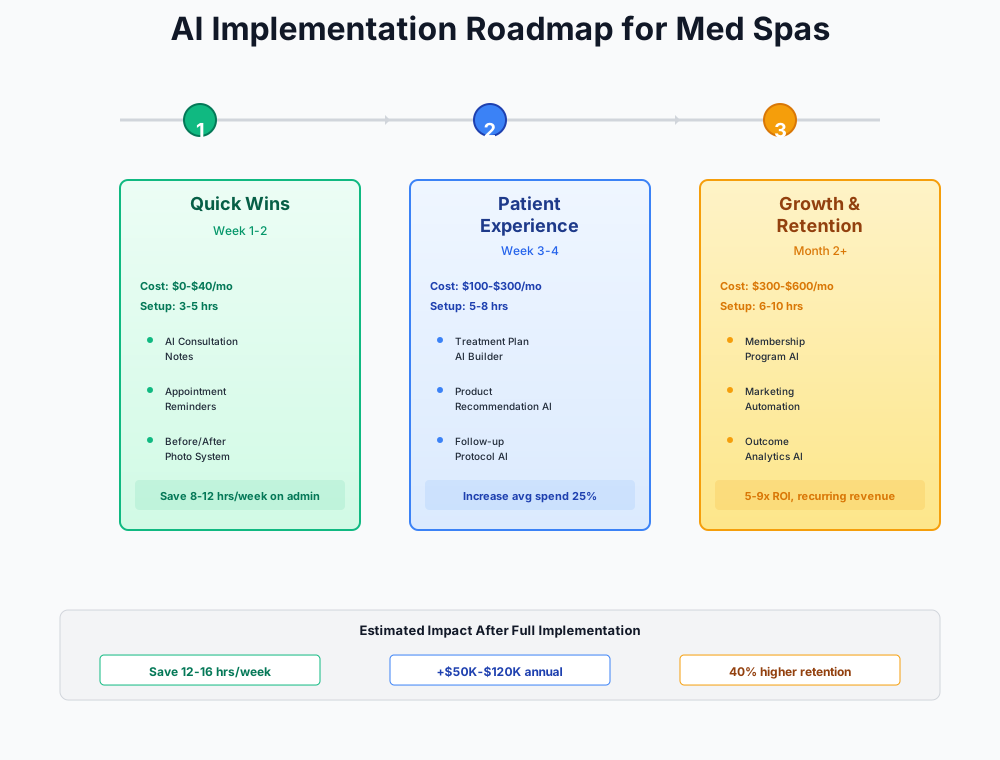
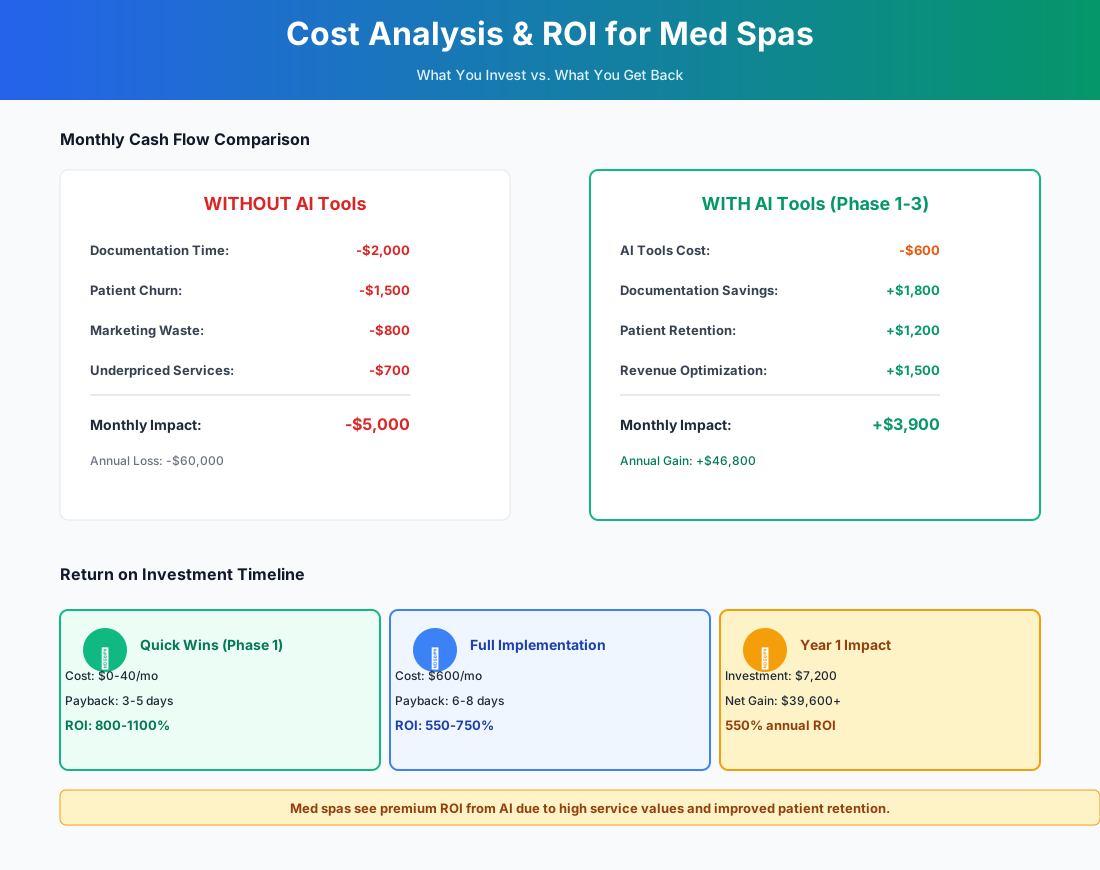
Here's a rough monthly cost picture once everything is running:
- Compliance + charting foundation (Aesthetic Record + ChartSmart): $45–$75/month
- Communication layer (DialIQ + NiceJob + Cherry): $174/month at the Growth tier ($49/mo at Essential), $0 for Cherry
- Content (Canva Pro): $18/month
- Retention (RepeatMD): custom pricing — contact for quote
Total: roughly $237–$267/month for the first three layers fully deployed; add RepeatMD on top once you've modeled the membership unit economics. For context, the foundation stack alone is about what many practices spend on a single Allergan product order — and it's working every hour the practice is open.
Frequently Asked Questions
If my provider reviews and signs every AI-generated chart, does that satisfy medical board documentation standards?
Yes — provider sign-off is what makes the chart legally yours. ChartSmart and Pabau Scribe produce structured SOAP notes with injection mapping, lot number tracking, and post-care documentation that meet standard documentation requirements. The AI writes the draft; the provider verifies clinical accuracy, adds judgment, and signs. What you should document separately is the review workflow itself: "provider reviews AI-generated chart within X hours of treatment, signs digitally via [platform]." That paper trail is what an auditor needs to see, not just the signed chart.
Do I need technical skills to set up DialIQ?
No. Onboarding takes 1–2 hours over Zoom — you answer questions about your treatment menu, FAQs, and booking policies, and their team configures the system. The one piece you must not delegate is configuring the Triage Engine escalation rules yourself (or sitting in the room when it's done). That's the setting that routes adverse reaction calls to your on-call provider rather than letting AI handle them. Test it with mock calls before going live.
Our consultations are converting at about 50%. Is there an AI tool specifically for improving that number?
Partly. Cherry Patient Financing directly addresses the most common reason consultations don't convert same-day — cost hesitation. Getting 80%+ approval in under 60 seconds with a soft credit pull removes the awkward conversation about price and replaces it with a payment option. Separately, Perfect Corp.'s skin analysis makes the consultation more clinical and objective, which tends to improve acceptance on facial treatment packages because the recommendation feels data-driven rather than salesy. For follow-up with patients who didn't book, your AI phone receptionist (DialIQ or Podium) can handle reminder outreach — though those scripts need to stay generic, not mention specific treatments discussed.
Can RepeatMD's AI advisors legally recommend treatments to patients?
This question comes up a lot, and the short answer is no — and they don't try to. Adonis and Aria operate like a knowledgeable front desk coordinator: they explain membership benefits, describe what services are available, and offer to book a consultation. "Many of our members interested in reducing forehead lines find our injectable consultations helpful — want me to check availability?" is as far as they go. The actual treatment recommendation comes from your licensed provider during the Good Faith Exam. Review the advisor scripts during setup and flag anything that sounds clinical.
How do Alle and Aspire loyalty points stay accurate when AI is handling bookings and patient interactions?
Honestly, this is an unsolved problem. Allergan's Alle and Galderma's Aspire programs track points per unit purchased and per visit, and no AI tool currently handles cross-platform loyalty reconciliation automatically. The practical approach: configure your EMR's inventory module to log lot numbers and units per patient session (ChartSmart does this during voice dictation), then run a monthly reconciliation against the manufacturer portals. Budget 90 minutes a month for this until the portals release better API integrations — RepeatMD shows patient point balances in-app, which at least reduces front-desk inquiry volume while you wait.
Is it worth switching our entire EMR to Pabau just for the AI features?
Only if you're already unhappy with your current platform. Platform migrations for a running practice are disruptive and time-consuming — staff retraining, data migration, a few weeks of workflow friction. If you're on a platform you like, adding ChartSmart AI at $30/month and DialIQ at $99/month costs less and causes zero disruption. If you're already planning a platform switch, or if you're a newer practice without an EMR investment, Pabau's all-in-one approach at $62/month is genuinely competitive. Run the numbers on what you're currently paying across separate tools — the consolidation math sometimes makes the migration worth it.
Aesthetic medicine is one of the few healthcare niches where the clinical work and the business development happen in the same room, with the same provider, on the same hour. Every minute your injector spends on paperwork is a minute they're not treating a patient, building a case study, or doing a consult that converts at a premium. The AI tools in this guide don't change the medicine — they protect the time of the people delivering it, and plug the specific revenue gaps that elective practices are most exposed to.
If you're running a practice with a retail skincare component, our guides for dental practices and chiropractic offices cover parallel workflows for patient retention and financing adoption. Start with the BAA audit on the checklist. That one step — knowing exactly which vendors touch your patient data and whether you have the agreements in place — is the difference between a compliant AI stack and a liability.
More AI Implementation Guides
AI Tools for Home Health Care Agencies: 2026 Guide
A practical 2026 guide to AI tools for home health care agencies — HIPAA-safe automation for shift-filling, OASIS-E documentation, EVV, and claim denials.
AI Tools for Dermatology Practices: 2026 Guide
The best AI tools for dermatology practices in 2026 — cut prior-auth hours, reduce no-shows, and grow your cosmetic line, with a HIPAA-first rollout plan.
AI Tools for Mental Health Practice: 2026 Therapist Guide
Best AI tools for mental health practices in 2026: HIPAA-compliant scribes, measurement-based care, no-show reduction, and intake automation for therapists.
AI Tools for Massage Therapy Practices: 2026 Guide
How massage therapists use AI for SOAP notes, no-show defense, 24/7 phone answering, and retention — without breaking HIPAA, TCPA, or scope of practice
AI Tools for Optometry Practices: 2026 Guide
AI tools for optometry practices in 2026: HIPAA-safe scribes, ABB Verify, dual vision/medical billing, OCT AI, and a phased plan independents can run.
AI Tools for Physical Therapy Practices (2026)
The best AI tools for physical therapy practices in 2026. HIPAA-compliant solutions for documentation, scheduling, HEP delivery, and billing automation.
Keep exploring
See every AI implementation guide we've published for Healthcare, or browse the full library by industry or category. Looking for a specific platform? The AI tools directory indexes every product mentioned across our guides, and the comparisons hub puts the most-asked head-to-heads side by side.