Before you install a single AI tool in your practice, you need to answer a question that no vendor sales page will lead with: does this software have a signed Business Associate Agreement, and where is the protected health information going?
HIPAA violations carry fines up to $2,190,294 per violation category (the calendar-year cap was adjusted upward again in January 2026). The OCR settled more than a dozen enforcement actions against dental practices between 2022 and 2025 — eight in 2022 alone — several involving cloud-based software that handled PHI without proper BAAs. State dental boards in California, Texas, and New York have added AI-specific guidance to their technology use policies. And the TCPA's rules on automated patient texting — the backbone of every recall and reminder tool in this guide — create a separate layer of compliance that most "AI for dentists" articles never mention.
That's why this guide starts with the regulatory floor, not the feature list. Every tool we recommend below has been evaluated for HIPAA readiness, BAA availability, and integration with the practice management systems (Dentrix, Eaglesoft, Open Dental) that the vast majority of you already run.
TL;DR — Top 3 Recommendations
- Heidi Health (free tier) — Ambient AI scribe that eliminates post-visit charting. Start today, costs nothing.
- Weave ($279+/mo) — ADA-endorsed patient communication platform that cuts no-shows by 30% and automates recall.
- Pearl AI (pricing on request) — FDA-cleared diagnostic imaging AI that increases case acceptance by 15–25 percentage points.
The Best AI Software for Dental Insurance Claims and Verification
If your front desk loses 10–15 hours a week to insurance portals and hold music, the highest-ROI AI in a dental practice is software that verifies eligibility before the visit and scrubs claims before they're submitted. The strongest 2026 setup pairs a verification engine — Weave or DentalRobot, which pull plan eligibility, frequencies, and remaining benefits automatically — with Overjet, whose AI reviews radiographs and claim attachments to catch the errors that trigger denials. None of these replace your biller; they remove the data-entry grind so your biller works exceptions instead of portals. Optometry practices run the same eligibility-first playbook, just with vision-plan benefit windows instead of dental frequencies — worth a look if you're evaluating Weave against a vision-specific verification tool.
What "AI for dental insurance claims" actually does:
- Real-time eligibility pulls the patient's plan and remaining benefit before they sit down — no 20-minute IVR call, no awkward surprise at checkout.
- Pre-submission scrubbing flags the missing attachment, wrong CDT code, or coordination-of-benefits issue that would have bounced the claim into a 30-day rework cycle.
- Denial triage parses the rejection reason on the small set of claims that do come back and routes them to a human, instead of a daily portal sweep.
A solo GP practice loses $15,000–$30,000 a year in labor to manual verification alone — the claims channel pays for itself on the first denial it prevents. The compliance framework and the full tool-by-tool breakdown follow, in order of payback speed.
The Chair-Time Problem Nobody Fixes First
A hygiene appointment is worth roughly $150–$200 in production. An empty hygiene chair at 10 AM on a Tuesday is not a recoverable event — that hour is gone. You can't sell it back tomorrow. There's no inventory to carry forward.
This is different from almost every other small business. A restaurant can seat a later party. A retailer's unsold shirt stays on the rack. Dental production is tied to real-time chair occupancy, and every gap in your schedule is permanent revenue destruction.
Here's what that looks like across a typical solo GP practice:
| Revenue Leak | Cause | Annual Cost Estimate |
|---|---|---|
| No-shows and late cancellations | No automated reminder sequence; no same-day fill system | $70,000–$150,000 |
| Dormant recall patients (20–30% of active base) | Manual outreach only; patients fall through between hygiene cycles | $40,000–$90,000 |
| Unscheduled diagnosed treatment | Low case acceptance; no visual aids in case presentation | $60,000–$180,000 |
| Insurance verification delays | 10–15 hrs/week on portals and IVR calls | $15,000–$30,000 (labor) |
| Post-visit charting time | 1–4 hrs/day of dentist time after patients leave | $50,000–$100,000 (opportunity cost) |
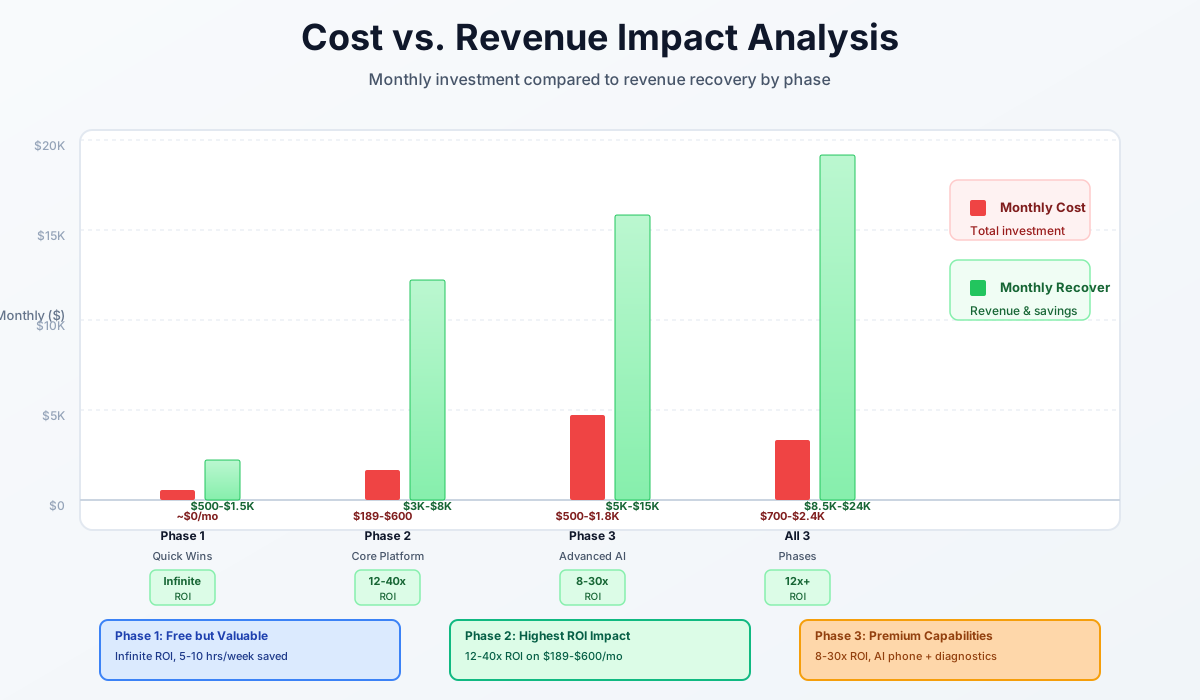
That bottom line — $235,000 to $550,000 in recoverable value sitting in fixable processes — is why AI tools aimed at dental practices have a return profile unlike most small-business software. You're not adding a small efficiency. You're filling chairs that are already paid for.
The guide below works through each of those five leaks, in order of payback speed.
Compliance & Privacy Framework
HIPAA: The Non-Negotiable Starting Point
Every AI tool that touches patient data in your practice must comply with the HIPAA Privacy Rule, Security Rule, and Breach Notification Rule. This isn't optional and it isn't something you can delegate entirely to vendors. As the covered entity, you are responsible for ensuring compliance — even if the AI company swears they're "HIPAA compliant" on their website.
Here's what that means in practice:
Business Associate Agreements (BAAs): Any AI vendor that receives, stores, processes, or transmits protected health information (PHI) must sign a BAA with your practice before you share a single patient record. This includes:
- AI scribes that listen to patient conversations (Heidi Health, Pearl Voice, Overjet Voice)
- Patient communication platforms that send texts with appointment details (Weave, NexHealth)
- Insurance verification tools that pull patient eligibility data (DentalRobot, Toothy AI)
- Diagnostic AI that analyzes patient X-rays (Pearl AI, Overjet, Videa)
What a BAA doesn't cover: General-purpose AI chatbots. ChatGPT and Claude's free tiers do not sign BAAs and are not HIPAA-compliant. You can absolutely use them for generic templates — drafting recall message templates, writing job postings, creating social media content — but never paste a patient's name, date of birth, treatment history, or any identifiable information into these tools.
The ChatGPT/Claude Rule
Use general AI chatbots for templates only. "Write a recall message for a patient overdue 9 months" is fine. "Write a recall message for John Smith who had a crown on #19 last March" is a HIPAA violation. Always strip PHI before prompting.
TCPA Compliance for Automated Patient Texting
This is where most dental AI guides go wrong. Every automated text message your practice sends — appointment reminders, recall campaigns, review requests — falls under the Telephone Consumer Protection Act (TCPA). Violations carry statutory damages of $500–$1,500 per message.
Key requirements for dental practices:
- Prior express written consent before sending automated marketing texts (recall campaigns, reactivation messages)
- Prior express consent (can be verbal) for informational texts (appointment confirmations, reminders)
- Opt-out mechanism in every automated message
- Minor patient accounts: When a parent signs consent for a child's account, that consent covers texts about the minor — but if the child turns 18, you need fresh consent. Your communication platform should flag these age-outs automatically.
Tools like Weave and NexHealth handle TCPA consent tracking within their platforms, but you need to verify this is configured correctly during onboarding. Don't assume the default settings are compliant for your state.
State Dental Board Regulations and AI
State dental boards regulate the scope of practice for AI in clinical settings. Key considerations:
- AI diagnostic tools (Pearl, Overjet, Videa) are FDA-cleared as clinical decision support — they assist the dentist's diagnosis, they don't replace it. You must still review and confirm AI findings before treatment planning.
- AI-generated clinical notes (Heidi Health, Pearl Voice) must be reviewed and signed off by the treating provider. The note is your documentation, not the AI's.
- Radiograph interpretation: Most state boards require a licensed dentist to interpret radiographs. AI overlays and detection are aids, not substitutes for your professional judgment.
Compliance Checklist Before Any AI Tool
Before signing with any AI vendor: (1) Get a signed BAA, (2) Confirm PHI is encrypted in transit (TLS 1.2+) and at rest (AES-256), (3) Verify audit logs are retained 6+ years, (4) Check state dental board guidance on AI use, (5) Review TCPA consent workflows for any messaging features.
No-Shows and Recall: Filling the Chairs You Already Have
No-shows and lapsed recall patients are your two biggest revenue leaks — and they're both solvable with patient-facing AI that pays for itself within the first month.
AI-Powered Patient Communication: Weave
Your front desk is fielding 40–80 calls per day, sending reminders, verifying insurance, checking in patients, and collecting payments — often simultaneously. Weave consolidates all patient communication into a single platform with AI layered on top.
Weave
Best for: ADA-endorsed all-in-one communication
ADA Member Advantage-endorsed (March 2026) platform combining AI receptionist, automated reminders, two-way texting, missed call text-back, online scheduling, review requests, and call intelligence analytics. Integrates with 40+ dental PMS systems including Dentrix, Eaglesoft, and Open Dental. AI features included at no additional cost.
Weave's AI layer handles what your front desk can't. Missed calls get an instant text-back — "Hi, we just missed you, how can we help?" — so patients don't hang up and dial the next Google result. Call Intelligence transcribes every call and flags the ones where someone asked about scheduling but never booked. Reminder sequences fire automatically at 1 week, 2 days, and 2 hours before each appointment, configurable per appointment type. Review requests go out after every visit, with AI-drafted HIPAA-compliant replies to whatever comes in.
Up to 30% fewer no-shows — roughly $1,750–$3,750/month recovered depending on your volume — plus 5–8 fewer hours on the phone each week.
AI Voice Receptionist: Arini
Your lunch break is 45 minutes. Your front desk has exactly zero coverage during that window, and new patients calling at 12:15 PM hear a voicemail and hang up.
Arini
Best for: 24/7 AI call handling and outbound recall
Dental-specific AI voice agent that answers 100% of calls in 300ms with natural conversation, books directly into your PMS, handles rescheduling, and runs outbound recall campaigns. Confirmed integrations include Open Dental, Eaglesoft, and Denticon, plus compatibility with Weave, GoTo, and Mango phone systems. Request a demo to confirm current PMS coverage and pilot terms.
Arini fills a specific gap: it's not replacing your front desk — it's covering the calls they physically can't answer. After-hours, lunch breaks, peak volume overflow. One practice reported a 12% revenue increase and 17% reduction in headcount, resulting in a 24% profit increase.
If you already have Weave from the recommendation above, test Weave's built-in AI Receptionist first before adding Arini. Weave's version is included in your subscription. Add Arini only if you need more sophisticated call handling or dedicated outbound recall campaigns.
Online Scheduling and Digital Intake
NexHealth
Best for: Modern real-time PMS sync and patient experience
Real-time online scheduling, digital forms that sync directly into your PMS, automated recall campaigns, and payment processing. Month-to-month billing with no long-term contracts. RESTful API for custom integrations. Integrates with Dentrix, Eaglesoft, Open Dental, Curve, and Denticon.
NexHealth is the strongest option for practices that want a modern, clean patient booking experience. Its key differentiator is real-time PMS sync — when a patient books online, it appears in your schedule instantly, not on a batch sync delay.
For digital intake specifically, mConsent with its Zaha AI receptionist or Yapi (established since 2011, with documented time savings from eliminating paper intake and manual filing) are worth evaluating if your current PMS forms solution is lacking.
Recall Campaigns: Your Cheapest Growth Channel
Reactivating a lapsed patient costs roughly $15–$40 in staff time and messaging fees. Acquiring a new patient through Google Ads or direct mail runs $150–$300. The math is obvious — yet most practices spend far more energy on new patient marketing than on the 20–30% of their active base that hasn't been back in over a year.
Industry benchmarks for recall reactivation with automated outreach: 18–25% of dormant patients (9–18 months overdue) respond and book within 30 days of a personalized multi-touch sequence. For a 1,500-patient practice, that's potentially 75–110 booked hygiene appointments from a single campaign — enough to fill several weeks of hygiene gaps without adding a single new patient.
Write 3 variations of a friendly text message (under 160 characters each) to send to a dental patient who hasn't been in for their cleaning in 9 months. Include a sense of urgency about oral health but keep it warm and non-judgmental. End with a call to action to book online or call. Do not use the patient's name — I'll add that in my messaging platform.
Write a warm, personal email to a dental patient who hasn't visited in over a year. Acknowledge the gap without guilt-tripping. Mention 3 specific reasons regular cleanings matter (early cavity detection, gum disease prevention, oral cancer screening). Include a mention that we've added new technology that makes visits faster and more comfortable. Keep it under 150 words. End with a clear booking link CTA.
ROI Snapshot
Monthly Cost
$249/mo
Time Saved
7hrs/week
Monthly Value
$5,700
ROI
2189%
Clinical AI: Diagnostics, Documentation, and the Case Acceptance Gap
DSOs have been running AI diagnostics and ambient documentation in their operatories for two years. Solo practices can now access the same tools — at solo-practice prices.
FDA-Cleared AI Diagnostics: Pearl AI
This is the single highest-ROI tool in the entire guide. Pearl AI's Second Opinion analyzes every radiograph in real-time, detecting 100+ conditions with 94% accuracy (validated by independent third party). But the real value isn't just detection — it's case presentation.
Pearl AI (Second Opinion)
Best for: Case acceptance and diagnostic accuracy
FDA-cleared AI that detects 100+ conditions on 2D and 3D radiographs. Includes Practice Intelligence analytics, Pearl Voice for ambient documentation, smart scheduling, and instant insurance verification. Catches 37% more disease than unaided clinicians. Integrates with Dentrix, Eaglesoft, Open Dental, Curve, Denticon, and tab32. Pearl does not publish pricing publicly — request a quote directly; ask about current setup fee promotions.
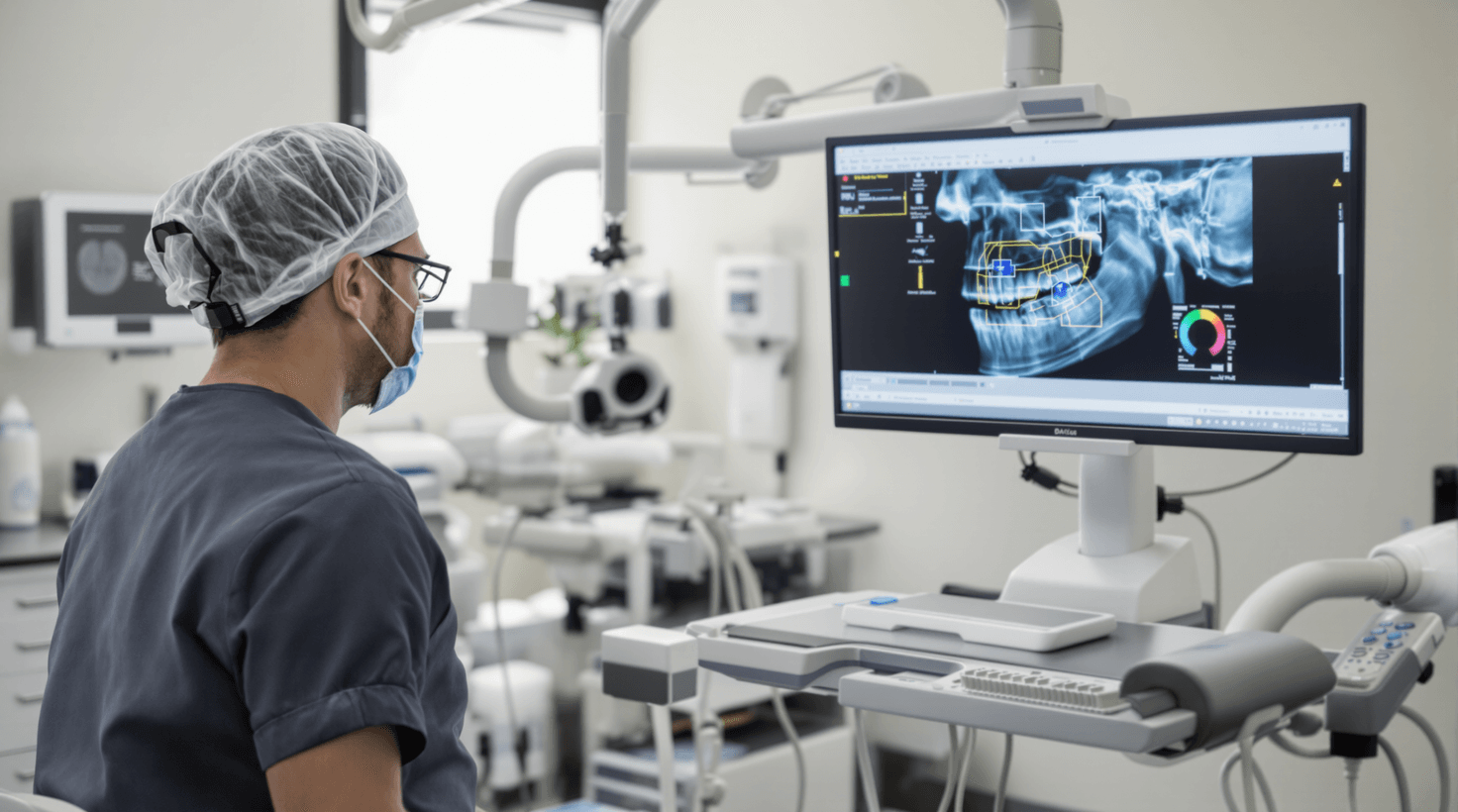
When you tell a patient "you need a crown on #19," they hear an expense. When you rotate the monitor and show them the AI-highlighted overlay on their own X-ray — the orange zone marking recurrent decay under the existing filling, the insufficient remaining structure — they see it. Practices using Pearl report case acceptance increases of 15–25 percentage points, and it's not hard to understand why.
The math: if your practice presents $100,000/month in diagnosed treatment and case acceptance moves from 50% to 65%, that's an additional $15,000/month in scheduled treatment. If your diagnosed treatment total is higher — as it should be in a busy GP practice — the upside scales proportionally. Calculate the ROI based on your own numbers during the demo.
Overjet as an alternative:
Overjet (AI Assist + IRIS + Voice)
Best for: All-in-one clinical AI platform
FDA-cleared detection with millimeter-level precision, AI-native imaging software (IRIS) that replaces legacy viewers, and ambient clinical documentation (Overjet Voice) in English and Spanish. Deployed across 9 of the 15 largest DSOs. Full platform ranges $1,000–$3,000/month. Core AI Assist starts at $250/month.
Overjet is the stronger choice if you want a single vendor for diagnostics, imaging software, and clinical documentation. Their IRIS product is the first AI-native imaging viewer — built around AI from the ground up rather than bolting AI onto legacy software. The full platform's pricing ($1,000–$3,000/month) makes it more suited to multi-provider practices or groups. If you're weighing the two head-to-head, our Pearl vs Overjet comparison breaks down accuracy, integrations, and pricing side by side.
AI Clinical Documentation: Eliminating Post-Visit Charting
Dentists spend 5–10 minutes per patient on post-visit clinical notes. Across 15–25 patients daily, that's 1–4 hours of documentation that happens after the patient leaves the chair — often eating into lunch, after-hours time, or the next patient's slot. That's $50,000–$100,000 per year in dentist time spent typing.
Heidi Health
Best for: Zero-cost entry to AI clinical documentation
Ambient AI scribe that listens to patient consultations and auto-generates structured SOAP notes, referral letters, and clinical documentation. Free tier includes unlimited basic consults and dictation with 10 Pro Actions/month. Supports 110+ languages. HIPAA-compliant with BAA. PortmanDentex (UK's second-largest dental group) deployed Heidi across all practices in April 2026.
Start with Heidi Health's free tier today. Download the app, tap record at the start of an appointment, and review the generated note afterward. Customize templates for your most common procedures — prophy, crown prep, composite filling, SRP — and you'll cut charting time by 70–80%.
One important limitation: Heidi Health does not currently integrate directly with Dentrix, Eaglesoft, or Open Dental. The AI generates structured notes, but your team will need to copy them into your PMS manually. For a purpose-built dental scribe with native PMS write-back, evaluate Bola AI (dentistry-specific, integrates directly with Dentrix, Eaglesoft, and Open Dental) or Pearl Voice (included with Pearl AI subscription). If you're already planning to adopt Pearl, use Pearl Voice instead of Heidi Health to eliminate the manual copy step.
Create a clinical documentation template for a crown preparation appointment at a general dental practice. Include fields for: tooth number, existing restoration being replaced (if any), reason for crown (caries, fracture, failed restoration), anesthesia type and amount, prep technique, impression method (digital scan vs. PVS), shade selection, temporary crown material, occlusion check, and post-op instructions given. Use standard ADA CDT terminology.
AI-Assisted Perio Charting
Traditional periodontal charting requires a hygienist calling out pocket depths while an assistant records — a two-person workflow that's ripe for automation. Both Pearl Voice and Overjet Voice offer hands-free perio charting where the hygienist simply speaks the measurements and the AI records them directly.
This isn't just a time-saver — it's a consistency improvement. Manual perio charting has well-documented inter-examiner variability. AI-recorded charting from voice input, combined with AI-analyzed radiographs showing bone levels, creates a more complete and reproducible periodontal record.
For practices not yet ready for Pearl or Overjet Voice, you can still use Heidi Health's free tier to record the hygienist's verbal charting and generate structured notes — then copy the data into your PMS. It's a manual step, but it eliminates the need for a second person in the room during charting.
Treatment Planning with AI Visual Aids
Write a patient-friendly explanation of a crown procedure for a patient who seems hesitant about the cost. Include: what happens at each visit (prep and temporary, then permanent crown), why the crown is needed instead of a filling (too much tooth structure lost), what happens if they delay (risk of fracture, root canal, extraction), and approximate recovery expectations. Their insurance covers 50% of the $1,200 cost, so their out-of-pocket is approximately $600. Use a warm, reassuring tone and avoid clinical jargon. Keep it under 200 words.
When combined with Pearl or Overjet's visual overlays on the radiograph, a clear written explanation dramatically increases the likelihood a patient schedules. Create template explanations for your top 10 procedures and customize them per patient using ChatGPT or Claude.
Admin & Billing AI: Insurance, Claims & Revenue Cycle
Insurance verification consumes 10–15 hours per week at most practices. That's a full-time employee's worth of time going toward phone trees, portal logins, and manual data entry — before you've seen a single patient.
Automated Insurance Verification: DentalRobot
DentalRobot
Best for: Affordable insurance verification automation
AI that retrieves insurance data from 300+ payer portals and IVR systems, writing full benefit breakdowns directly back into your PMS. Supports Dentrix, Eaglesoft, Open Dental, Curve, Denticon, tab32, and 6+ more with direct read/write capability. Lite Plan starts at $150/month with month-to-month contracts.
Your billing coordinator currently spends 10–15 minutes per patient navigating payer portals, calling IVR systems, and manually entering benefit details into Dentrix or Eaglesoft. DentalRobot runs overnight — your entire next-day schedule is verified before anyone walks through the door.
Set it to verify patients 3 business days in advance. This gives your front desk time to contact patients with lapsed or changed coverage before they're sitting in your chair expecting treatment.
At $20–$25/hour for billing staff, the 8–12 hours freed each week works out to $640–$1,200/month in labor savings alone — plus fewer claim denials from incorrect eligibility data and fewer patient surprises at checkout.
ROI Snapshot
Monthly Cost
$150/mo
Time Saved
10hrs/week
Monthly Value
$2,380
ROI
1487%
Full Revenue Cycle Automation: Toothy AI
Toothy AI
Best for: End-to-end RCM automation (early adopters)
Y Combinator-backed (W25 batch) AI automating the entire dental revenue cycle — verification, claims filing, payment posting, denial management, and follow-ups. Claims early customers cut back office teams by 50–75% and save 160+ hours/month. In commercial deployment as of early 2026; still early-stage — pilot carefully.
Toothy AI is the most ambitious tool in this guide — and the newest. It aims to automate not just verification but the entire revenue cycle: claims submission, payment posting, denial correction, and A/R follow-up. If their numbers hold up — 50–75% reduction in back-office staffing needs — that's a very different conversation for practices currently outsourcing billing at $3,000–$5,000/month.
Request a pilot. Don't commit until you've run it alongside your current workflow for at least 30 days. The technology is promising, but real-world results are still limited — vet the references thoroughly before committing.
Insurance Appeal Letters: An Immediate Free Win
Your billing coordinator writes appeal letters for denied claims — a task that takes 15–20 minutes per letter and often gets deprioritized when the desk is busy. AI can draft these in under a minute.
Write a professional insurance appeal letter for a denied dental claim. Procedure: D2740 (porcelain/ceramic crown) on tooth #19. Denial reason: insurer states existing restoration is adequate. Clinical justification: existing large amalgam restoration has recurrent decay on mesial and distal margins confirmed by periapical radiograph dated [DATE], remaining tooth structure insufficient for direct restoration due to loss of two or more cusps, and existing restoration has been in place for 12+ years with documented marginal breakdown. Include the CDT code, tooth number, clinical rationale, and request for reconsideration. Professional but firm tone.
Membership Plans: Reducing PPO Dependence
PPO write-offs consume 20–35% of your production. Every practice should be building an alternative revenue channel for fee-for-service and uninsured patients.
Clerri
Best for: In-house membership plans to replace PPO revenue
The largest dental membership plan platform (20,000+ dentists across 5,000+ independent practices). AI Plan Builder recommends pricing and benefits based on your market data and practice economics. Pricing is usage-based rather than a flat monthly fee — request a walkthrough for current terms. Integrates with Dentrix, Eaglesoft, and Open Dental.
A typical plan charges patients $25–$35/month for 2 cleanings, exams, X-rays, and 15–20% off other treatment. At 50 members paying $30/month, that's $1,500/month in predictable recurring revenue with zero insurance paperwork. Clerri's own data shows membership patients generate 76% more visits and 146% more procedures than cash-pay patients — members feel like they have "coverage" and are more likely to say yes to recommended care.
Practice Analytics: Data-Driven Scheduling and Production
Dental Intelligence
Best for: Morning huddle dashboards and production optimization
AI-powered analytics layered on your PMS: daily Morning Huddle briefings, smart scheduling for maximum production per chair, provider performance tracking, case acceptance reporting, and automated patient engagement. Consistently high-rated by dental users on G2 and Capterra. Integrates with Dentrix, Eaglesoft, Open Dental, Curve, and Denticon.
Dental Intelligence answers the questions you should be asking every morning: What's our production goal today? Which patients on today's schedule have unscheduled treatment? Who's at risk of canceling? Which provider has the lowest case acceptance rate — and why?
If you've already adopted Pearl AI, start with Pearl's built-in Practice Intelligence dashboard before adding another subscription. It may cover your analytics needs.
Sequencing Matters: Start Here, Not Everywhere
A few hard-won observations on implementation order:
Don't migrate your PMS right now. Switching from Dentrix or Eaglesoft to a cloud system like tab32 ($99–$249/month) is tempting — the cost savings are real and some AI features are built in. But a PMS migration is a 3–6 month project that disrupts everything while you're trying to build momentum on AI adoption. Every tool in this guide connects to your existing system. Revisit the PMS question after you've had six months of results.
Don't use ChatGPT or Claude for clinical diagnosis. These are general-purpose language models, not FDA-cleared medical devices. Only Pearl, Overjet, and Videa have FDA clearance for radiograph analysis. Using non-cleared AI for diagnosis creates liability and regulatory exposure regardless of accuracy.
On Videa and Toothy AI: Videa expanded beyond DSOs to independent practices in April 2026. Toothy AI (YC W25) is still in early commercial deployment. Both show promise — neither has the independent-practice track record to justify skipping a pilot. Run them alongside your existing workflows before making a commitment.
On CDT code updates: AI billing tools are trained on current CDT codes, which update annually every January. After each ADA CDT update, verify that your insurance and claims tools have been updated accordingly. A tool submitting deprecated codes generates denials, not savings.
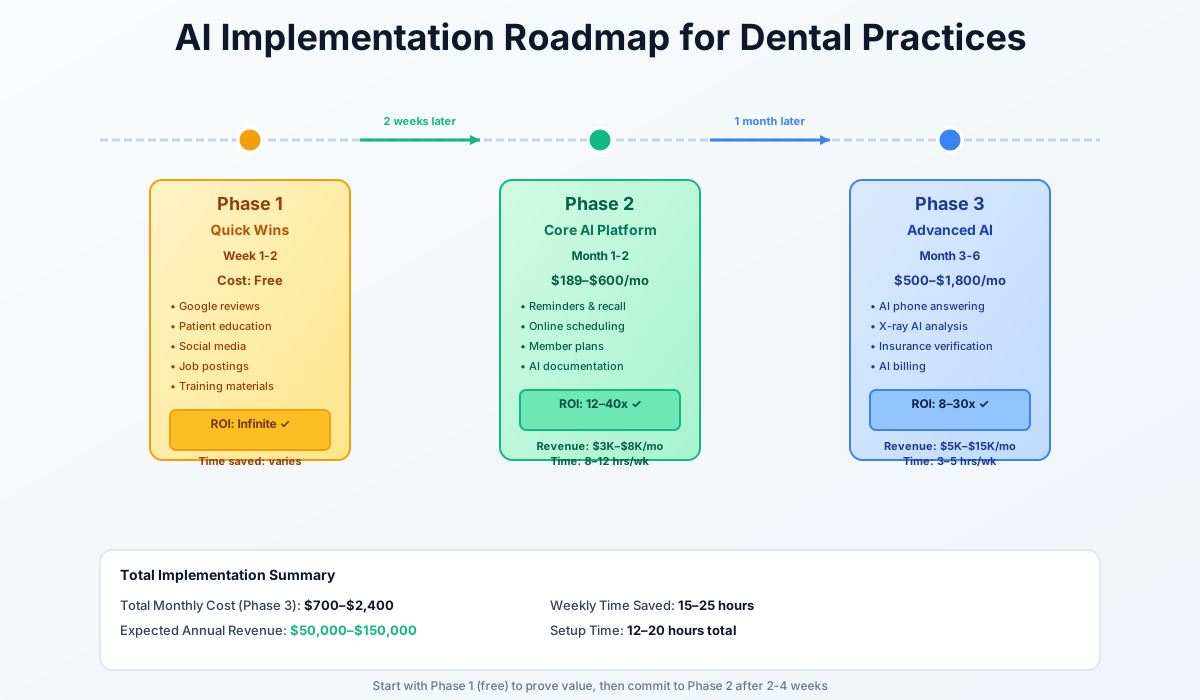
The sequencing that works: free tools first (Heidi Health, ChatGPT for templates, Clerri membership plan), then communication and insurance verification (Weave, DentalRobot), then diagnostics after you've got 60 days of baseline data to measure against.
Getting Started Checklist
- Week 1: Create free Heidi Health account — use the AI scribe for 5 patient visits to test documentation accuracy
- Week 1: Use ChatGPT or Claude to generate recall message templates, review response templates, and a social media content calendar (never paste PHI)
- Week 1: Request a Clerri demo to explore in-house membership plan options — set up the plan and train front desk to present it
- Week 2: Sign up for DentalRobot Lite ($150/mo) — connect to your PMS and configure 3-day advance insurance verification
- Week 2: Contact Weave for a demo — confirm PMS integration, plan phone number porting, and configure reminder sequences
- Week 3: Go live with Weave — port your number, enable missed call text-back, activate online scheduling and review requests
- Month 2: Pull 30-day analytics from Weave (no-show rate, calls answered, reviews) and DentalRobot (verification completion rate) — compare to your pre-AI baseline
- Month 2: Schedule a Pearl AI demo — ask about current setup fee promotions and request a pilot period
- Month 3: Implement Pearl AI — integrate with PMS and imaging, train team on using AI overlays in case presentations
- Month 3: Review case acceptance rate weekly using Pearl Practice Intelligence or your PMS reports
- Month 4: Evaluate whether Weave's built-in AI receptionist covers your needs or if Arini's dedicated voice agent adds value
- Month 6: Assess full AI stack ROI — total hours saved, revenue impact, and tool consolidation opportunities
If you run a chiropractic practice, veterinary clinic, or med spa, we've built similar compliance-first AI guides tailored to those verticals — each with specialty-specific tool recommendations and regulatory frameworks.
FAQ
How do AI-generated clinical notes from ambient scribes hold up in a malpractice defense?
Once you review and sign an AI-generated note, it's your documentation — legally the same as anything you'd dictate yourself. The review step is what matters. An AI scribe that generates a note you never checked creates liability: if the note contains an error (wrong tooth number, missed allergy) and you signed it, that's on you. Treat AI-generated notes exactly like notes from a human scribe — review every one before finalizing. Most malpractice carriers have not added AI-specific exclusions as of 2026, but check with yours. The upside is that AI scribes tend to produce more consistent, complete documentation than hurried post-visit notes, which actually strengthens your defense in most scenarios.
Can AI diagnostic tools like Pearl or Overjet detect conditions my CBCT or panoramic misses — or is it limited to bitewings and periapicals?
Pearl AI's Second Opinion works on both 2D (bitewings, periapicals, panoramic) and 3D (CBCT) radiographs. Overjet's AI Assist is FDA-cleared for 2D images with millimeter-level precision. Neither tool claims to find conditions that aren't visible on the image type you're using — they detect what's there more consistently than a human eye under time pressure. The real value is catching pathology that gets missed during a busy day: early interproximal caries, subtle periapical radiolucencies, calculus deposits that affect perio treatment planning. You'll still get significant diagnostic uplift from AI analysis of standard BWX and PAs.
How do AI patient-recall texts stay TCPA-compliant when a minor patient on the account turns 18?
Most practices don't realize this is a gap until something goes wrong. When a parent consents to automated texts for their child's account, that consent doesn't automatically transfer when the child turns 18 — you need a fresh opt-in from the now-adult patient. Weave and NexHealth both track patient age, but the age-out alerts aren't always on by default. Configure them during onboarding and set a quarterly audit to review patients who've turned 18 in the past 90 days. The TCPA's statutory damages ($500–$1,500 per unsolicited text) make this worth 20 minutes of quarterly admin.
My hygienist uses a different recall script than my front desk coordinator. Will AI automation make that inconsistency worse?
Honestly, it might surface it faster — and that's useful. Weave and NexHealth let you standardize recall messaging across your entire practice, so every patient gets the same sequence regardless of who noticed they were overdue. The bigger win is that you can finally A/B test message copy: run one version for 90 days, swap it, compare booking rates. That's not something a manual recall process can do. Use the rollout as an opportunity to sit down with your hygienist and coordinator and agree on a single voice before you automate it.
What's the actual workflow for using Pearl AI during a case presentation — step by step?
Here's how it works in real time: (1) Take the radiograph as you normally would. (2) Pearl analyzes the image in seconds and displays color-coded overlays highlighting caries, bone loss, existing restorations, and other findings on your existing imaging monitor. (3) Rotate the monitor toward the patient. (4) Walk them through what the AI found on their X-ray — "See this orange area? That's where the AI is detecting decay under your existing filling." (5) Explain your recommended treatment with the visual evidence visible. (6) The patient sees objective AI confirmation of your diagnosis, not just your word. This visual evidence is why case acceptance jumps 15–25 percentage points. The entire AI analysis adds roughly 10 seconds to your existing X-ray workflow.
Will my existing Dentrix or Eaglesoft installation work with these AI tools, or do I need to upgrade?
You do not need to switch to a cloud PMS. Pearl, Overjet, Weave, DentalRobot, NexHealth, Clerri, and Dental Intelligence all connect via existing PMS bridges or APIs — and every one of them supports current versions of Dentrix, Eaglesoft, and Open Dental. The one hardware prerequisite: AI diagnostic tools need digital X-ray sensors. If you're still on film (increasingly rare), that's the investment to make first. For Dentrix specifically, Pearl's TWAIN bridge works with G5 and above. Check with each vendor during your demo for version-specific details.
Is DSO consolidation a real threat to independent practices, or is this vendor fearmongering?
Nearly 40% of U.S. dental practices are now affiliated with organized dental groups, and the largest DSOs have made AI diagnostics and automated scheduling part of their standard clinical stack. That's real. What's also real: every tool those DSOs use is now available to independent practices at solo-practice pricing. The competitive threat isn't that DSOs have technology you can't access — it's that they have dedicated implementation teams and you don't. That's a solvable problem. The checklist above is your implementation team.
The chair that's sitting empty right now costs you money whether you fill it or not. The overhead doesn't pause. The question is whether the next hygiene cancellation turns into a same-day fill call or a gap in your schedule that closes at 5 PM with no production attached to it. Most of that gap is a workflow problem, not a demand problem — and workflow problems are what AI is actually good at fixing.
More AI Implementation Guides
AI Tools for Home Health Care Agencies: 2026 Guide
A practical 2026 guide to AI tools for home health care agencies — HIPAA-safe automation for shift-filling, OASIS-E documentation, EVV, and claim denials.
AI Tools for Dermatology Practices: 2026 Guide
The best AI tools for dermatology practices in 2026 — cut prior-auth hours, reduce no-shows, and grow your cosmetic line, with a HIPAA-first rollout plan.
AI Tools for Mental Health Practice: 2026 Therapist Guide
Best AI tools for mental health practices in 2026: HIPAA-compliant scribes, measurement-based care, no-show reduction, and intake automation for therapists.
AI Tools for Massage Therapy Practices: 2026 Guide
How massage therapists use AI for SOAP notes, no-show defense, 24/7 phone answering, and retention — without breaking HIPAA, TCPA, or scope of practice
AI Tools for Optometry Practices: 2026 Guide
AI tools for optometry practices in 2026: HIPAA-safe scribes, ABB Verify, dual vision/medical billing, OCT AI, and a phased plan independents can run.
Best AI Chatbot & Lead Conversion Tools for Med Spas
Compare AI chatbots, lead conversion & generation tools for med spas. Capture missed calls 24/7, book online, recover $5K-$15K/mo in lost leads. See picks.
Keep exploring
See every AI implementation guide we've published for Healthcare, or browse the full library by industry or category. Looking for a specific platform? The AI tools directory indexes every product mentioned across our guides, and the comparisons hub puts the most-asked head-to-heads side by side.