
Most healthcare AI guides treat the doctor's office as a single thing — intake, exam, billing, done. Optometry isn't that. Your practice runs two businesses in the same building: a clinical operation that bills insurance for professional services, and a retail optical that sells frames, lenses, and contact lenses at retail margin. The average independent practice generates 60–70% of its revenue from optical goods and 30–40% from professional fees. Those two lines have completely different economics, different staff, and different failure modes.
Which means AI for optometry has to solve for things that a general medical AI guide never touches: annual-exam recall timing tied to insurance frequency cycles, optical capture rate (how many patients who got an exam from you also bought their glasses from you), and the coordination-of-benefits maze between vision plans and medical insurance that generates more denials than anything else in your billing queue.
The table below is the starting point. Everything after it explains why these numbers are recoverable — and which tools move which metric.
| Metric | Average Independent Practice | Top-Quartile Practice | Revenue Impact of Closing the Gap |
|---|---|---|---|
| Optical capture rate | 50–60% | 70–75% | +$30K–$50K per $1M practice per 5-point gain |
| Annual exam recall compliance | 55–65% | 75–80% | +$40K–$80K per 1,000 active patients |
| Verification error rate | 5–15% | Under 3% | +$35K–$70K annually on a $1M practice |
| OD after-hours charting | 1–2 hrs/day | Under 20 min/day | 5–10 hours/week returned to the OD |
| COB dual-billing capture | 30–45% of eligible visits | 70%+ | +$55–$110 per eligible encounter |
This guide is calibrated for the 1–3 location independent practice. A sub-specialty practice doing 80% medical billing will weight toward AI scribes, Altris AI, and Anagram earlier. For everyone else, start with the recall and capture rate columns.
TL;DR — start here
- Turn on ABB Verify this week — if you order contacts through ABB Optical, it's free and recovers $10K–$22K/month in unused-benefit optical sales.
- Add an optometry-specific AI scribe (Doctora at $199/mo or MaximEyes EVAA if you're on MaximEyes) — kills 5–10 hours/week of after-hours charting and catches medical billing codes you've been leaving on the table.
- Outsource dual vision-plus-medical billing to Anagram — at 6% of collections, it's the highest-ROI lever for a practice doing $700K+ in collections with a 5–15% denial rate.
Why Recall Rate and Capture Rate Are the Same Problem
Here's the thing that most practice consultants miss: annual exam recall and optical capture aren't two separate marketing problems. They're one loop. A patient who bought their glasses from you is roughly twice as likely to come back for their next exam than a patient who walked out with an Rx and bought elsewhere. The optical sale is the retention mechanism. The exam recall is how you protect the optical relationship before EyeBuyDirect gets there first.
The industry benchmark for recall compliance — patients with an annual exam benefit who actually schedule within 12 months of their last visit — runs 55–65% for an average independent practice. Top performers hit 75–80%. On a practice with 1,000 active patients, that 15-point gap is 150 patients a year. At $350 average revenue per comprehensive-exam-plus-materials visit, that's $52,500 in annual revenue sitting in an un-sent text message.
The recall automation tools below address the messaging side. But the optical capture side is what makes the economics compound: a practice that captures 70% of its exam patients into optical at $600 average optical ticket generates $60K more annually than a practice at 55% capture on the same exam volume. That's the number worth protecting.
Two levers that move both metrics simultaneously:
ABB Verify handles the benefit-expiration side — patients with unused vision plan dollars get triggered automatically, driving both recall bookings and optical-purchase urgency before December 31.
Weave or Solutionreach handles the recall-by-segment side — different message, different timing, different call to action depending on the patient's lens type, age, and how long since their last exam.
Neither of these is a "Phase 3" initiative. Both should be running in month one.
Compliance First — This Isn't Optional
Every tool below that touches a patient name, DOB, insurance ID, or clinical finding needs a HIPAA Business Associate Agreement with your practice. Before signing up for anything, ask the vendor's sales rep for their BAA template. If they redirect you to "our security team will follow up" or send a generic privacy policy, that's a disqualifying answer.
Tools that sign BAAs for optometry out of the box: Weave, Solutionreach, 4PatientCare, DoctorConnect, Emitrr, Doctora, Sully.ai, Barti, MaximEyes, Anagram, Birdeye, Podium, RingIQ, and Patient Prism.
Tools that do not sign BAAs: ChatGPT, Claude, Google Gemini (consumer versions). That line is hard and it doesn't move. Those tools are useful for building templates, drafting de-identified content, and coding sanity checks. You cannot paste a patient name, DOB, refraction, or chief complaint into them.
Two additional compliance layers specific to optometry:
The Contact Lens Rule (FTC) requires automatic release of the CL Rx at the end of the fitting — no patient request required. Any automated CL reorder workflow must not bypass this release.
The Eyeglass Rule requires release of the spectacle Rx at exam end regardless of whether the patient buys from you. Optical-capture automations that funnel patients toward your dispensary before releasing the Rx are a compliance risk.
For recall texts: the TCPA requires prior express written consent for automated messages to mobile numbers. Your intake form needs an explicit SMS-consent checkbox — separate from the HIPAA acknowledgment. Pediatric patients require documented parental consent for the number on file. Test your opt-out flow on yourself before launching any recall campaign.
The BAA test
Before you sign up for any tool that will see patient data, ask three questions:
- Will you sign a HIPAA Business Associate Agreement with my practice?
- Where is patient data stored, and is it encrypted at rest and in transit?
- Do you train your AI models on my practice's patient data? (Answer should be "no" or "only with explicit opt-in.") If any of those answers is unclear or evasive, walk away.
Insurance Verification: The Leak You Can Measure
A busy schedule means 20–40 staff hours a week logging into VSP, EyeMed, Spectera, Davis, Medicare, and BCBS portals. That's before counting the rework when verification is wrong. On a $1M practice with a 7% verification-error rate, the arithmetic is straightforward: $70K walking out the door before a single lens is ordered.
The verification problem has two sub-problems. The first is plain eligibility lookup — what plan does this patient have, what's their benefit allowance, when did their last exam date? The second is coordination of benefits — when a patient has both vision and medical insurance, which covers what, in what order, and what's the incremental billing opportunity? Most practices solve the first manually and leave the second on the table entirely.
ABB Verify
Best for: Practices already ordering contacts through ABB Optical Group
Runs continuously in the background, identifies patients with unused vision plan benefits, and automatically sends them text/email reminders to drive incremental optical sales. One ABB-customer practice reported $22,500 in benefit-reminder-driven sales in a single month. Effectively zero incremental cost if you're already buying contacts through ABB.
Doctora Auto-Verify
Best for: Practices accepting 8+ plans including medical insurance like Medicare and BCBS
Doctora's verification module is designed to connect to 500+ payers including vision and medical plans, returning eligibility, frequency limitations, and benefit allowances in seconds. Coordination-of-benefits detection is a planned feature. As of mid-2026, Auto-Verify is in a waitlist phase — check doctora.io for current availability. Doctora's AI scribe (reviewed separately below) is live and actively subscribed.
Anagram
Best for: Practices struggling with vision + medical dual billing and COB denials
The most comprehensive optometry-specific verification AND billing platform. Their Spyglass module handles coordination of benefits — the top denial driver in optometry. Practices using Anagram for dual billing recover $55–$110 per patient encounter on average vs. vision-plan-only billing.
Most practices run ABB Verify for vision plans and pair it with Anagram or a medical clearinghouse for Medicare and commercial medical. ABB Verify covers VSP, EyeMed, Spectera, and Davis Vision — it does not touch medical insurance.
Recall and Patient Communication
"Time for your annual eye exam!" gets under 15% open rates. Your patient saw that same text from their dentist that morning. The fix isn't sending more messages — it's sending the right one to the right patient for a specific reason that's true right now.
A 52-year-old CL wearer with an expiring Rx needs a different message than a parent of a 9-year-old myopia management patient. A patient whose FSA dollars expire December 31 responds to urgency framing that a March patient doesn't need. Segmented recall — message copy tied to a specific reason this patient should book now — consistently outperforms generic blasts by 2–3x in optometry vendor case studies.
Write 5 recall text message variations (under 160 characters each) for an independent optometry practice reminding patients their annual eye exam is overdue. Make each one feel personal and reason-specific, not generic. Use these segments:
- Vision plan benefits expiring December 31 (FSA/HSA + insurance allowance angle)
- Digital eye strain for remote workers (under 45, on a screen 8+ hours/day)
- Contact lens prescription about to expire (and they can't reorder without a current Rx)
- Pediatric back-to-school exam (parent of school-age child)
- Patient over 50 — annual glaucoma and macular monitoring
For each, keep the language warm and direct. Include a clear next step (reply YES to schedule, or include the booking link). Do not include patient names or any PHI in the output.
Run these through Weave, Solutionreach, 4PatientCare, or DoctorConnect — all of them support patient-segment-based message templates. Segmented messages hit 35%+ engagement versus 12–15% for generic blasts, and that's a consistent pattern across multiple optometry vendor studies.
Missed calls and after-hours coverage
Independent practices field 40–80 inbound calls per day. When your front desk is checking in a patient, calls go to voicemail. Roughly 30–40% of those callers dial the practice down the street rather than wait for a callback. After-hours are worse — patients with year-end FSA balances don't wait until Monday.
Three layers, stacked by budget:
- Missed-call recovery (~$99/mo): Patient Prism analyzes every inbound call, identifies new-patient callers who didn't book, and alerts the front desk lead within minutes. Healthcare practices report recovering 10–30% of previously lost new-patient bookings.
- Always-on chatbot ($99/mo + $200 setup): Emitrr's HIPAA-compliant chatbot answers patient inquiries via text and web chat 24/7, books appointments, sends recall reminders, and handles digital intake.
- Full AI receptionist ($249–$599+/mo): Weave Ultimate (with AI Call Intelligence), DoctorConnect's ARIA, or RingIQ's Iris handle full call volume — booking directly in the EHR, answering FAQs, routing complex calls to staff.
The same pattern holds here that applies in dental practices and veterinary clinics: the practices that get results brief their staff before launch. "Here's what the system does, here's what happens when it routes a call to you." Skipping that briefing is the most common reason these deployments underperform.
Reviews and local search
The Walmart Vision Center nearby probably has 400+ Google reviews. Your independent practice has 47. That gap costs you new patients directly — Google's local pack for "optometrist near me" favors volume and recency, and most patients never scroll past it.
The mechanics are simple: automated text request 4–6 hours after the visit, direct link to your Google Business Profile. Weave, Solutionreach, Birdeye, and Podium handle this. Every review — including 1-star — needs a personalized reply within 24 hours.
Write a warm, personalized response to this Google review of our optometry practice:
[paste review text here — do not include patient name if it identifies them as a patient]
Requirements:
- Under 100 words
- If a first name appears in the review, use it
- Acknowledge the specific thing they praised or complained about
- Naturally mention one of our specialties: [dry eye clinic / myopia management / pediatric exams / scleral lenses]
- Sound like a real person at the practice wrote it — not a corporate template
- For negative reviews: acknowledge, do not argue, invite them to call the office manager directly
Do not include any patient PHI beyond a first name they themselves posted publicly.
The Exam Room: AI Scribes and OCT AI
This is where the OD's daily experience actually changes. The 1–2 hours of after-hours charting isn't primarily a cost problem — it's a burnout problem. And it's largely solved for optometry now.
Why general medical scribes don't work here
DeepScribe, Suki, and base-mode Sully were trained on primary care and internal medicine documentation. They don't know what to do with optometry notation:
- Refractions:
OD: -2.25 -0.75 x 095 VA 20/20 - Slit-lamp grading:
1+ nuclear sclerosis, trace PSC, mild MGD grade 2 - Fundus notation:
C/D 0.4 round, no NVD, flat macula OU - CL fitting:
Acuvue Oasys 1-Day -2.25 OU, BC 8.5, DIA 14.3, 3-3-3 alignment
Feed those into a primary-care-trained scribe and you get drafts that take longer to correct than charting from scratch. The optometry-specific scribes below understand this language natively.
Doctora AI Scribe
Best for: Any OD doing 15+ comprehensive exams/day who wants to keep their existing EHR
The only AI scribe trained exclusively on optometry clinical language. Understands refractions, slit-lamp grading, fundus descriptions, and CL fitting notation. Generates SOAP notes, suggests ICD-10 codes, and flags encounters that should be billed medical instead of vision. Works as a layer on top of RevolutionEHR, Eyefinity, Compulink, and Crystal PM — no system switch required. Claims 80–95% reduction in charting time.
MaximEyes with EVAA Scribe
Best for: Practices already running MaximEyes or willing to consolidate EHR + scribe in one vendor
EVAA is built directly into the MaximEyes EHR — no third-party integration friction. Captures clinical narrative, exam findings, assessment, and treatment plan in real time. Note saves back into the right EHR fields so billing, recalls, and orders auto-populate downstream.
Barti AI Scribe
Best for: New practices or practices already planning an EHR switch
AI-native EHR built exclusively for eye care, AOAExcel-endorsed, raised $12M Series A in 2025. Bundles EHR, scheduling, billing, optical/inventory, AI scribe, and a native phone system. Don't switch to Barti just for the scribe — but if you're starting a practice or already planning an EHR migration, it's the most integrated option.
One implementation note: run the scribe in shadow mode for 10–20 exams. Let the AI draft while the OD charts normally, then compare side by side. After two weeks of calibration, flip to AI-first — AI drafts, OD reviews and signs. Plan for a 1–2 week period where speaking through the exam feels unnatural. After that, after-hours charting largely disappears.
Where the scribe also pays for itself — medical coding uplift
Nobody talks about this part, but it's often where the scribe pays for itself fastest. When you document a comprehensive exam that included dry eye evaluation (TBUT, Schirmer, DEWS grading), a diabetic patient (dilated fundus, IOP, nerve assessment), or glaucoma monitoring (visual fields, OCT RNFL, IOP trending), you're frequently entitled to bill medical insurance at $55–$110 more per encounter than the vision plan pays.
Most ODs miss these opportunities because they're conditioned to vision-plan-first billing. The medical codes never surface at the point of documentation. Doctora flags these encounters automatically, suggests the appropriate ICD-10 codes (H40.x for glaucoma, H35.3x for AMD, E11.311 for diabetic eye exam findings), and identifies the documentation elements that support medical necessity.
I'm an optometrist documenting a patient encounter. Findings (de-identified):
- Chief complaint: eye fatigue and intermittent blurred vision
- TBUT 6 sec, DEWS grade 2 dry eye signs
- Trace nuclear sclerosis OU
- IOP 16 OU
- C/D 0.4 round OU, no NVD, flat macula OU
I want to bill this as a medical visit (not a vision plan exam). What ICD-10 codes should I consider? What CPT code is appropriate for a 20-minute established patient visit? What chart-note elements must I include to support medical necessity?
Do not invent codes — only use real, current ICD-10/CPT codes. If you're uncertain about a code, say so.
Confirm any suggested codes against current CMS guidelines and your biller before submission. ChatGPT here is a sanity check, not a coding authority.
OCT and fundus image AI
60–70% of practices now own an OCT. A busy practice generates 30–100 scans a day. Reviewing every one visually is time-intensive, and the liability cost of missing pathology on a diabetic or glaucoma patient is real.
Altris AI (altris.ai) detects 70+ retinal pathologies from OCT scans — glaucoma, AMD, DME, ERM, and rarer conditions — assigns a referral urgency score, and generates patient-facing color-coded retinal visualizations for case presentation. Works with Zeiss CIRRUS, Topcon, Heidelberg Spectralis, and Nidek. The Altris IMS platform received FDA 510(k) clearance for OCT image analysis support — covering clinical decision support, not autonomous diagnosis. Free trial available; validate accuracy on 30–50 scans of patients whose findings you already know before using it in clinical workflow.
Optos AI for Diabetic Retinopathy runs on Optos ultra-widefield images. CE-marked in Europe; as of mid-2026, FDA clearance in the US has not been confirmed. Confirm current US availability with Optos directly before clinical reliance.
Zeiss CIRRUS PathFinder (CE-marked August 2025) adds AI interpretation to CIRRUS OCTs already in many practices. As of late 2025, not yet FDA-cleared for US use. Confirm current US availability with Zeiss before deploying clinically.
On all three: the OD reviews, interprets, and signs every finding. The practical use case is triage — quickly identifying which among the day's scans need your full attention versus confident normals. That's a legitimate and valuable time-saver. Altris AI flags a referral-urgent OCT and your clinical judgment differs? Document your reasoning. Your license is the authority.
Billing and Revenue Cycle
Optometry's dual billing pipeline — vision plans on one track, medical insurance on the other, often for the same patient on the same date — generates more denials than anything else in the industry. The average practice leaves $55–$110 per eligible encounter on the table by defaulting to vision-plan billing when medical would have paid more.
The make-or-buy calculation for billing
An in-house biller at $25/hour for 30 hours/week runs ~$48K/year fully loaded. Anagram at 6% of collections on a $900K practice is $54K/year — but that includes recovered COB denials and dual-billing uplift that an in-house biller without optometry-specific COB training is likely leaving on the table.
ROI Snapshot
Monthly Cost
$4500/mo
Time Saved
20hrs/week
Monthly Value
$8,500
ROI
89%
Above ~$700K in collections, outsourcing nearly always wins on a fully-loaded comparison. Below that threshold, in-house billing paired with a verification tool is usually right.
Anagram (goanagram.com) is the leader for optometry-specific RCM. Their Spyglass module handles coordination of benefits — the most common denial driver in optometry. Claims are scrubbed before submission and denial-management logic handles resubmission automatically. IrisMed (irismed.co/optometry) is a newer alternative that combines billing RCM with optical analytics in one platform — worth a look if you haven't already set up EDGEPro.
Practice analytics: finding the leak before it costs $50K
You can't fix a 55% optical capture rate without knowing exactly where the 45% goes. One optician running at 42% while everyone else is at 65%? A vision plan with allowances too tight to close a sale? Three frame brands that sell and forty that don't?
EDGEPro by GPN Technologies (gatewaypn.com/edgepro) is the eye care industry's leading analytics platform. Tracks capture rate, revenue per comprehensive exam, frame board turnover, plan profitability, and individual staff performance — pulled automatically from your EHR/PM. Free for IDOC and PECAA members.
The pattern at top-performing practices is simple: a 30-minute monthly KPI review with the OD, office manager, and lead optician, focused on those four metrics. Every meeting produces one specific action — return-authorize the bottom 20% of frame SKUs to free up $10K–$40K in stagnant capital, flag the optician who needs coaching, or drop the vision plan that's been draining margin all year.
- Set up EDGEPro or IrisMed analytics this month (free if you're an IDOC/PECAA member)
- Schedule a recurring 30-minute monthly KPI review on the OD's calendar
- Pull current baseline: capture rate, revenue per exam, frame board turnover by brand, plan profitability
- Identify the bottom 20% of frame SKUs by turnover — start the return-authorization process
- Set a specific 90-day capture rate target (typically +5 points) and identify which optician(s) drive the gap
- Audit vision plan profitability — be willing to drop one plan that's draining margin
Implementation Order
A realistic sequence. Don't try to run all of this in month one.
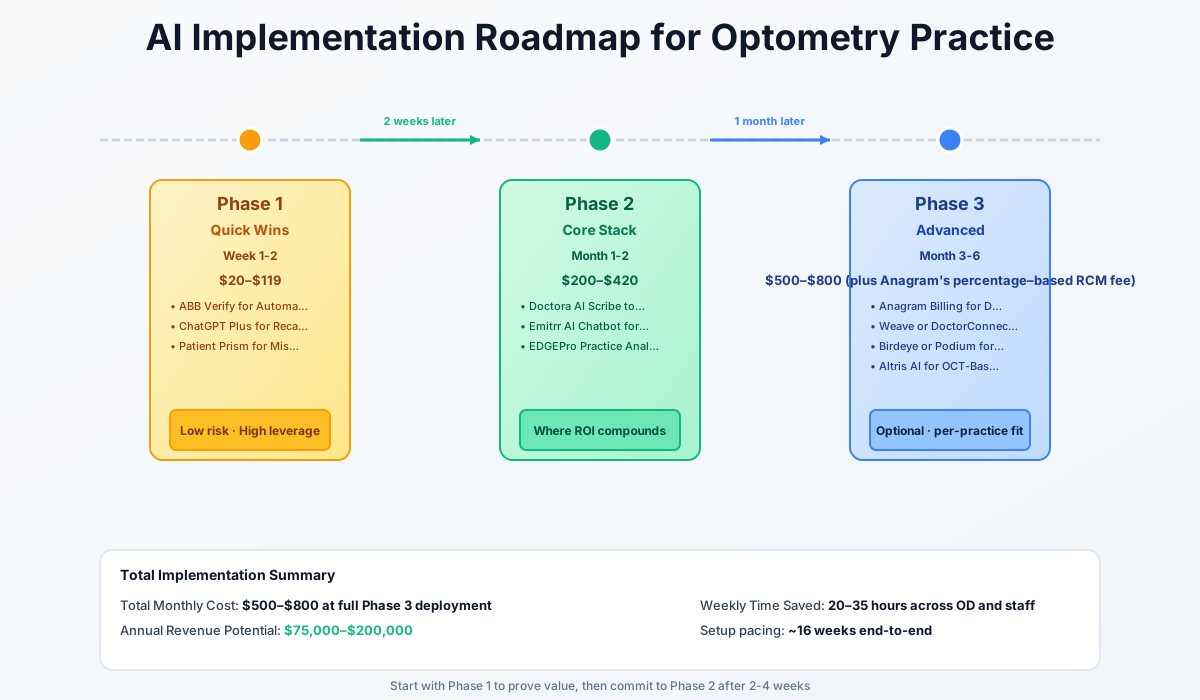
- Week 1: Call your ABB Optical rep and activate ABB Verify (free if you already buy contacts through ABB)
- Week 1: Sign up for ChatGPT Plus or Claude Pro ($20/mo). Build a shared 'AI prompts' Google Doc with the recall, review-response, and coding prompts from this guide
- Week 2: Audit your patient comms platform (Weave, Solutionreach, 4PatientCare, DoctorConnect) — what tier are you on, and what AI features are already included but not enabled?
- Week 2–3: Sign up for Patient Prism (~$99/mo) for missed-call recovery. Tape a callback script next to the front desk phone
- Month 2: Request a Doctora AI Scribe free trial. Run it in shadow mode for 10–20 exams before going live
- Month 2: Activate EDGEPro analytics (free for IDOC/PECAA members) and schedule a recurring monthly KPI review
- Month 2–3: Add Emitrr AI chatbot ($99/mo + $200 setup) for after-hours patient inquiries and 24/7 booking
- Month 3: Request an Anagram billing audit — have them analyze 90 days of your claims data to quantify your COB denial rate and missed dual-billing revenue before committing
- Month 3–4: If your patient comms platform doesn't already automate review requests, add Podium or Birdeye (or upgrade your Weave tier). Set a 90-day goal for review velocity
- Month 4+: If you do 30+ OCTs/day and lean into medical optometry, request an Altris AI free trial. Validate accuracy on 30–50 scans of patients whose findings you already know
- Every month: Review the four KPIs in EDGEPro (capture rate, revenue per exam, frame board turnover, plan profitability) and take one specific action
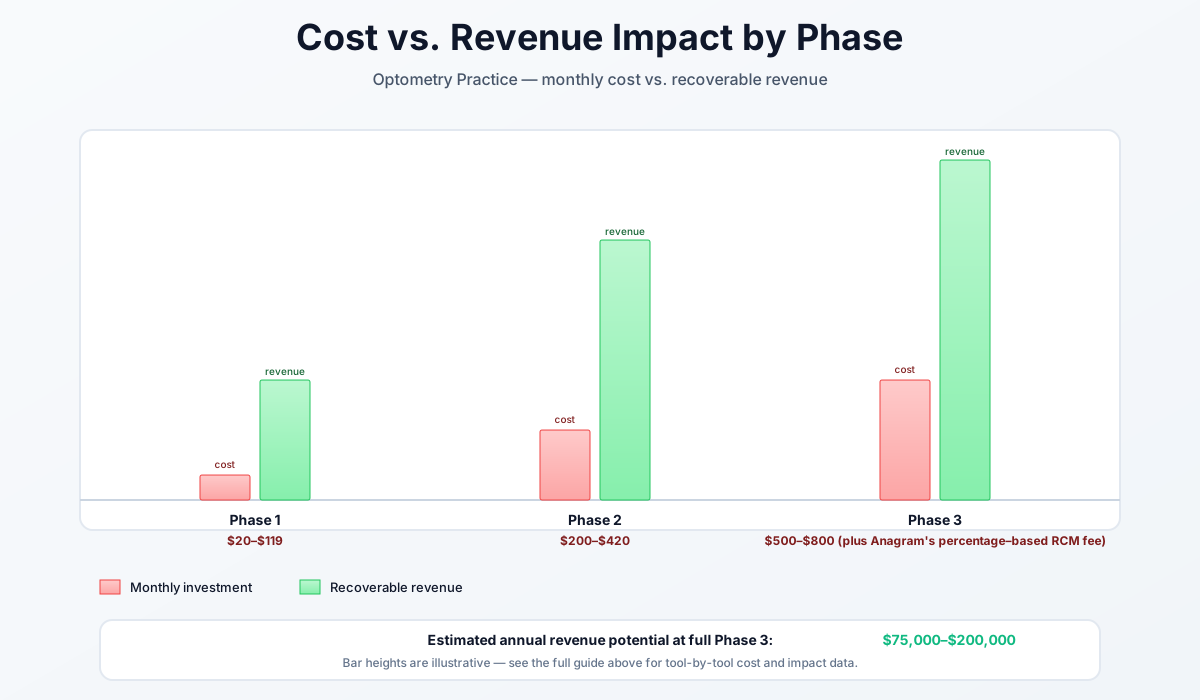
A $1M practice that runs this stack through 90 days realistically recovers $30K–$60K in annualized revenue from ABB Verify benefit reminders and medical-billing uplift, gets back 5–10 hours of OD charting time per week, and frees 15–25 staff hours previously spent on portal verification. Total software cost: $500–$800/month — roughly one-sixth the fully-loaded cost of a part-time front-desk hire.
Start with ABB Verify this week. If you buy contacts through ABB Optical, it's free, and it pays for everything else on this list.
FAQ
Can an AI scribe actually handle optometry refraction notation like "OD: -2.25 -0.75 x 095 VA 20/20"?
Doctora, Barti, and MaximEyes EVAA can — they're trained on optometry clinical language. Refractions, slit-lamp grading (1+ NS, trace PSC), fundus descriptions (C/D 0.4 round, flat macula OU), CL fitting notes — all handled natively. General medical scribes like DeepScribe or Suki will mangle this notation; the drafts they produce are slower to fix than charting from scratch. Sully has an ophthalmology mode but it's less purpose-built than Doctora for routine optometry flows. Whichever you choose, run it in shadow mode for 10–20 exams before going live.
Does ABB Verify cover medical insurance like Medicare and BCBS, or only vision plans?
Vision plans only — VSP, EyeMed, Spectera, Davis Vision. For Medicare and commercial medical, you need Anagram or a dedicated medical clearinghouse. Doctora's Auto-Verify module covering 500+ payers is in development (waitlist at doctora.io) — check current availability before relying on it for medical verification. Most practices run ABB Verify for vision and pair it with Anagram for medical.
What's actually driving our optical capture rate below 60%, and can AI fix that?
Usually it's one of three things: the optician doesn't have a clear picture of what's in stock versus what the patient's plan allowance covers, the frame board has too many slow-movers eating up capital, or there's no systematic follow-up when a patient leaves without buying. EDGEPro answers the first two — it shows per-optician capture rates and per-SKU turnover, so you can see exactly where the gap lives. For follow-up, Weave's text automations can send a "still looking for frames?" sequence to patients who had exams but no optical purchase. That's not a replacement for a good optician, but it recovers some of the patients who left undecided.
How do AI patient-recall texts stay TCPA-compliant for unconfirmed minors on the account?
Your intake form needs a separate explicit SMS-consent checkbox for the parent's mobile number, with the parent listed as responsible party. If the phone on file is the minor's own mobile and you don't have documented parental consent, recall goes by mail or to the parent's number. Weave, Solutionreach, 4PatientCare, and DoctorConnect all let you flag accounts as "parent consent only" so the system routes correctly. Audit your consent records before launching automated pediatric recall — this is the piece most practices skip.
What happens to AI-flagged OCT findings from Altris if I don't agree with the AI's interpretation?
You override it and document your reasoning. Altris is clinical decision support — the Altris IMS platform has FDA 510(k) clearance for OCT image analysis support, but that clearance is for decision support, not autonomous clinical diagnosis. If Altris flags "referral urgent" and your clinical judgment is artifact or stable, note that in the chart. Your license is the authority here, not the algorithm.
Does Doctora's medical-billing uplift create any compliance risk if the AI suggests a code I haven't fully documented?
Yes, if you submit without reviewing. Doctora flags encounters that could be billed medical based on documented findings — it doesn't unilaterally upcode. But if it suggests H40.011 (glaucoma suspect) and your note is missing RNFL thickness, visual field, and optic nerve description, don't submit the medical claim until the documentation matches. Treat Doctora's coding suggestions as a starting point for your biller to review, not a final answer.
We just bought an Optos device — is the Optos AI for Diabetic Retinopathy module worth adding?
Depends on diabetic patient volume. If you see 5+ diabetics per week and bill medical for their exams, AI-assisted DR screening is a real liability-reduction and billing-uplift tool. If you see one or two a month, the money is better spent on Altris AI (which covers 70+ pathologies including DR) or on billing automation. Also confirm US FDA-clearance status with Optos directly before clinical reliance — the module is CE-marked in Europe but US status needs current verification.
Is it worth switching EHRs to get a better AI scribe?
Almost certainly not. Migrating from RevolutionEHR or Eyefinity is a 6–12 month disruption affecting billing cycles, recall history, and staff workflows. Doctora overlays on your existing EHR at $199/month — same AI quality, no migration. The only scenario where a full switch makes sense is a new practice startup or an OD who was already planning a platform change. In that case, Barti is the most integrated option.
If you're also managing a medical-heavy patient mix, the chiropractic office guide covers HIPAA-compliant scheduling and insurance-heavy billing automation in depth. For a deeper look at AI scribes in clinical settings, the physical therapy practice guide covers documentation workflows in detail.
More AI Implementation Guides
AI Tools for Home Health Care Agencies: 2026 Guide
A practical 2026 guide to AI tools for home health care agencies — HIPAA-safe automation for shift-filling, OASIS-E documentation, EVV, and claim denials.
AI Tools for Dermatology Practices: 2026 Guide
The best AI tools for dermatology practices in 2026 — cut prior-auth hours, reduce no-shows, and grow your cosmetic line, with a HIPAA-first rollout plan.
AI Tools for Mental Health Practice: 2026 Therapist Guide
Best AI tools for mental health practices in 2026: HIPAA-compliant scribes, measurement-based care, no-show reduction, and intake automation for therapists.
AI Tools for Massage Therapy Practices: 2026 Guide
How massage therapists use AI for SOAP notes, no-show defense, 24/7 phone answering, and retention — without breaking HIPAA, TCPA, or scope of practice
Best AI Chatbot & Lead Conversion Tools for Med Spas
Compare AI chatbots, lead conversion & generation tools for med spas. Capture missed calls 24/7, book online, recover $5K-$15K/mo in lost leads. See picks.
AI Tools for Physical Therapy Practices (2026)
The best AI tools for physical therapy practices in 2026. HIPAA-compliant solutions for documentation, scheduling, HEP delivery, and billing automation.
Keep exploring
See every AI implementation guide we've published for Healthcare, or browse the full library by industry or category. Looking for a specific platform? The AI tools directory indexes every product mentioned across our guides, and the comparisons hub puts the most-asked head-to-heads side by side.