
Here's a pattern that repeats across dozens of private practices: a prospective client sends an inquiry on a Tuesday evening. By Thursday, they've booked with someone else. Meanwhile, Friday's schedule has two empty slots from no-shows that came in with 20 minutes notice — not enough time to backfill. The clinician spends Sunday catching up on documentation from the week.
These are solvable problems. Not with hustle, but with a handful of well-placed tools.
The friction points in mental health practice are unusually specific: high inquiry volume that converts poorly because response time lags, no-show rates that average 20–30% in outpatient settings (compared to roughly 5–8% in primary care), documentation that can consume a third or more of a clinician's working hours — one widely cited cross-setting clinician survey put the average at 13.5 hours per week — and compliance constraints that make general-purpose AI tools genuinely off-limits rather than just inconvenient. That last point matters more here than in almost any other practice setting. HIPAA's heightened protections for psychotherapy notes, 42 CFR Part 2 for substance use records, and state-specific duty-to-warn statutes all shape which AI tools can legally touch which parts of your workflow.
This guide works through each friction point in order of impact: intake and waitlist management first, then no-show reduction, then documentation, then admin and billing. The compliance framework runs through all of it — not as a separate section to skip, but as the filter that determines which tools are actually on the table.
TL;DR: Top 3 Recommendations
- Blueprint Core (free) — Full EHR plus auto-administered PHQ-9/GAD-7 across 500+ validated measures. Free forever. Activates audit protection from day one.
- Mentalyc or Upheal — HIPAA-compliant AI scribe with BAA at signup. Mentalyc for highest therapy-specific note accuracy; Upheal for all-in-one EHR + scribe at a $69/month cap.
- Spruce Health Communicator ($49/mo) — HIPAA-compliant phone/text/messaging hub with auto-attendant routing. Replaces personal cell phone use — the most common unrecognized HIPAA gap in solo practice.
The Intake Funnel Problem
Roughly 60% of psychologists aren't accepting new clients, which means motivated prospective clients are shopping 3–5 providers in parallel. Data from group practice operators consistently shows the same pattern: whoever responds within an hour captures the relationship. The typical wait between inquiry submission and first callback in a practice without an automated response is 18–24 hours. By then, most prospects have moved on.
The table below shows how this plays out across practices at different volume levels, based on aggregated benchmarks from behavioral health practice consultants:
| Practice Type | Monthly Inquiries | Avg Response Time | Inquiry-to-Booked Rate | Est. Monthly Revenue Lost to Lag |
|---|---|---|---|---|
| Solo (no automation) | 8–12 | 18–24 hrs | 38–45% | $1,200–$2,400 |
| Solo (self-scheduling enabled) | 8–12 | Instant | 55–65% | — |
| Group (no after-hours coverage) | 30–50 | 6–14 hrs | 42–50% | $4,500–$9,000 |
| Group (AI intake, after-hours) | 30–50 | Under 1 hr | 68–78% | — |
For solo clinicians, the fix is free and takes about 20 minutes: enable online self-scheduling for a brief consultation through SimplePractice or TherapyNotes. This single change closes the response-time gap completely for prospects who self-select. Pair it with an auto-reply on your contact form and you've covered 80% of the leakage without spending anything.
For group practices handling 30–50+ inquiries per month, after-hours coverage is the growth ceiling that manual operations can't solve. This is where AI intake agents enter the picture.
AI Intake for Group Practices
mdhub's "Sarah" answers intake calls 24/7, screens against your documented intake criteria, verifies insurance in real time, and books directly into the schedule. Talkiatry — one of the largest US telepsychiatry networks — deployed mdhub and reported a 30% increase in bookings per provider per month. Limbic AI's voice intake agent has the strongest UK track record (deployed across roughly 40–45% of NHS Talking Therapies services) with claimed 92–93% diagnostic screening accuracy and is expanding into US behavioral health organizations in 2026.
Pricing for both requires a sales conversation. Before any AI intake deployment, three things must happen first:
Write down your intake criteria. Which presenting problems you treat. Geographic and licensure constraints. Insurance panels accepted. Age range. Specialty matching logic per clinician. An AI intake agent can only match correctly against rules you've already codified.
Test the crisis escalation protocol before going live. A staff member should call as a prospective client and disclose suicidal ideation in the first 30 seconds. The AI must route immediately to a live human, 988, or 911 — not after additional questions, not after a delay. This is non-negotiable. Any AI intake deployment that hasn't passed this test is not ready.
Pilot after-hours only first. Turn the AI on for the 6pm–9am and weekend window while keeping a human coordinator for business hours. Measure marginal new bookings over 60 days before expanding scope.
AI Cannot Conduct Safety Assessments
AI intake tools are designed for logistics, scheduling, and criteria screening. They are not equipped to assess suicidal ideation, self-harm risk, or imminent danger — and should never be configured to try. Every deployment requires a tested escalation protocol that routes any safety disclosure immediately to a live human, 988, or 911. Document the protocol. Test it with simulated calls. Verify it works before any real client ever interacts with the system.
Building a Functional Waitlist
Most practices have a waitlist in some form. Most of them leak. Someone calls, gets added to a list, and by the time a slot opens, they've either found another provider or lost momentum. A waitlist that actually converts requires two things: same-day outreach when a slot opens, and pre-built contact information that makes that outreach instant.
The mechanics are simple: a Google Sheet with name, phone number, preferred clinician, and availability windows. When a two-way cancellation comes in through SimplePractice or TherapyNotes, you work down the list immediately. Not tomorrow. Not in an hour. Within the window where the prospect still wants the slot.
Spruce Health Communicator's bulk messaging feature makes this faster — text the top 3–5 waitlist contacts simultaneously when a slot opens and take the first response. That single workflow change reduces slot vacancy time from days to hours.
No-Show Reduction: The Three-Touch Rule
At 25 slots per week and $150 per session, a 20% no-show rate costs roughly $750 per week — or $39,000 per year per clinician. Pulling that rate to 12% would recover approximately $23,400 annually. Peer-reviewed reminder research cited by Blueprint puts the reduction from a correctly configured 3-touch reminder sequence at up to 29%.
The configuration that achieves this is already included in your subscription to SimplePractice or TherapyNotes. Most practices either haven't turned it on or are running a single reminder rather than the full sequence.
For SimplePractice: Settings → Client Portal → Appointment Reminders. For TherapyNotes: Settings → Appointment Reminders. Enable email at 7 days, SMS at 48 hours, SMS at 2 hours. Turn on two-way confirmation so clients can reply "C" to confirm or "X" to cancel. The cancellation triggers a notification that gives you a real slot to fill — which only works if the waitlist system above is already in place.
ROI Snapshot
Monthly Cost
$0/mo
Time Saved
3hrs/week
Monthly Value
$1,800
ROI
Infinity%
This combination — 3-touch reminders plus a live waitlist — is responsible for more recovered revenue per hour invested than almost anything else in this guide. It costs nothing and takes about an hour to configure.
Compliance and Privacy: What the Law Actually Requires
Before any tool conversation beyond the above, you need to know what the law requires — and specifically, what the mental health vertical adds on top of standard HIPAA that most general-purpose healthcare AI guides don't address.
The BAA Floor
Every AI tool that processes protected health information must sign a Business Associate Agreement with your practice. No BAA, no deal. This isn't a soft norm — it's the threshold between a compliant vendor relationship and a HIPAA violation that carries fines of $100–$50,000 per incident, up to $1.5 million per year.
Every tool we recommend by name in this guide — Mentalyc, Upheal, Blueprint, JotPsych, Twofold Health, Supanote, Spruce Health, Heard — provides a BAA automatically at signup. Download it on day one and store it with your other compliance documentation.
The AutoNotes Trap
AutoNotes markets itself as HIPAA-compliant but does not sign Business Associate Agreements, and its terms of service prohibit PHI uploads. Using it with real session content is a HIPAA violation regardless of how the marketing reads. The same applies to free-tier ChatGPT, Claude, and Gemini — none include a default BAA for individual practitioners.
Psychotherapy Notes Carry Heightened Protection
HIPAA gives psychotherapy notes — your private process notes, kept separate from the formal progress note — heightened protection. They must be stored in a designated record set that's logically and physically separate from the medical record. Clients have a right to their progress notes, treatment plans, and outcome measures under the 21st Century Cures Act, but not your psychotherapy notes.
For AI scribes, this means: confirm where the vendor stores audio, transcripts, and generated drafts. Mentalyc, Upheal, Blueprint, and Twofold Health all separate AI-generated artifacts in ways consistent with the psychotherapy-notes carve-out — but the configuration is yours to verify. Twofold Health deletes audio automatically after the note is generated and does not use PHI for model training.
42 CFR Part 2 for Substance Use Records
If you treat substance use disorder, 42 CFR Part 2 layers on top of HIPAA with stricter consent requirements. SUD record disclosure requires written, specific consent — even between clinicians at the same practice in some configurations. Before deploying AI documentation across an SUD caseload, consult a healthcare attorney about how the vendor's data flow maps to Part 2's redisclosure rules. A general HIPAA BAA is necessary but not always sufficient. Some practices solve this by carving out their SUD caseload from AI documentation entirely and dictating those notes manually.
Cross-State Telehealth
Telehealth must comply with the law where the client is physically located, not where you are. PSYPACT (40+ member states for psychologists) and the Counseling Compact (rolling out for LPCs) reduce the licensure burden across compact states, but neither is universal. Your scribe should capture the client's reported location at session start. Confirm the vendor stores the client's reported state — not just yours — because that's what a licensing board will ask for.
Client Consent for Recording
Refusal rates for AI documentation consent are typically under 5% when recording is explained clearly. The consent language matters more than the ask itself. This clause works:
This practice uses AI-assisted documentation to help generate session notes. With your permission, audio from our session is processed by a secure, HIPAA-compliant vendor to produce a draft progress note that I review, edit, and finalize. Audio is deleted after the note is generated. No audio or session content is shared with any third party or used to train AI models. You can revoke this consent at any time, and I will document the session using my standard handwritten or dictated method instead. Your decision will not affect your care in any way.
For clients who decline, dictate a 2–3 minute summary immediately after the session and feed that to the scribe instead. You recover most of the time savings.
The HIPAA Communication Gap Most Practices Don't Know They Have
About half of solo clinicians still use a personal cell phone for client contact, voicemail, and text. This is a BAA gap that most don't realize until something goes wrong — a subpoena, a licensing board complaint, or a payer audit that pulls call records. Spruce Health closes it.
Spruce Health
Best for: Solo and small-group practices replacing personal cell phones
HIPAA-compliant communication hub purpose-built for healthcare. The $49/month Communicator plan adds auto-attendant phone trees that route clinical vs. logistical calls, bulk messaging for waitlist outreach, and integration with most major behavioral health EHRs. BAA included automatically at signup.
The Communicator tier ($49/month) is the one worth deploying. It adds an auto-attendant that routes scheduling and billing questions to admin and clinical questions to the clinician, bulk messaging for waitlist outreach, and integration with SimplePractice, TherapyNotes, and Jane App. The Basic tier at $24/month covers secure messaging only — adequate for the smallest solo practice but missing the routing logic that removes 2–4 hours of administrative messages per week from your inbox.
Set up an after-hours auto-reply with crisis resources on day one. Every after-hours auto-response must surface 988, Crisis Text Line (text HOME to 741741), and "if this is a life-threatening emergency, please call 911 or go to your nearest ER." This is a clinical safety requirement, not optional.
Documentation: The 13.5-Hour Problem
Clinicians across healthcare settings average about 13.5 hours per week on documentation — a figure from a large cross-setting clinician survey, and a level therapists in private practice routinely meet or exceed, most of it after hours. Administrative burden of this kind is what pushes 62% of behavioral health clinicians into moderate-to-severe burnout (National Council for Mental Wellbeing). When burned-out clinicians are asked what they'd change first, administrative burden and paperwork outrank every other factor, including caseload size.
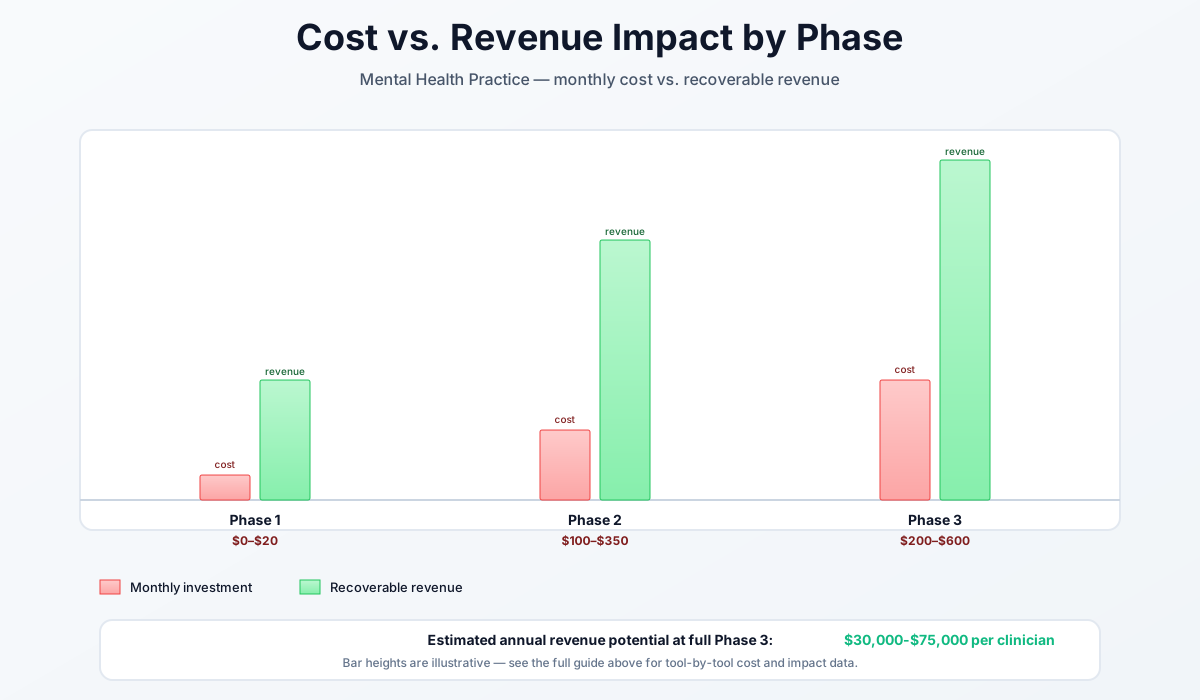
AI scribes are returning 5–9 of those hours per clinician per week. At a conservative $100/hour in recovered clinical time, that's $500–$900 per week in value created — at a tool cost of $19–$69/month.
Choosing the Right Scribe
Six tools are credible in 2026. The right one depends on volume, EHR, and specialty.
Mentalyc
Best for: Highest therapy-specific note accuracy (BIRP, DAP, GIRP, couples, family, group)
Built exclusively for therapists. Claimed 92% clinical terminology accuracy vs. Upheal's 87% in independent comparison. Supports 40+ therapy-specific note formats, treatment plan generation, and group/couples/family session notes. 14-day free trial with no credit card. Group practice plans add admin visibility for supervisor review of associate notes.
Upheal
Best for: All-in-one EHR + AI scribe + telehealth + billing at the highest volume tier
AI-native EHR combining ambient session notes, HIPAA telehealth, scheduling, and client billing in one platform. "Golden Thread" feature links clinical themes across sessions automatically. At 25+ sessions/week, the $69/month cap makes it the most cost-efficient option in the market. Insurance billing module launching summer 2026.
Blueprint
Best for: Combined AI scribe + measurement-based care for audit protection
Free Core plan includes full EHR, unlimited clients, and 500+ validated assessments (PHQ-9, GAD-7, PCL-5). $0.99/session unlocks AI scribe. "Alliance Genie" surfaces therapeutic relationship patterns and dropout risk. Series A funding ($9M) from major mental health investors. Best choice for practices facing payer audits requiring PHQ-9/GAD-7 in every note.
JotPsych
Best for: Psychiatrists, PMHNPs, and prescribers needing MSE + risk assessment depth
AI documentation built for psychiatry specifically — not adapted from primary care. Generates structured psychiatric intake notes with full MSE, DSM-5 diagnosis block, risk assessment, and auto-populated CPT codes. Consistently ranked among the top AI scribes for psychiatry in 2026 across multiple independent reviews. Overkill for therapy-only practices.
Volume determines the right pick:
- Under 12 sessions/week: Blueprint Plus at $0.99/session — you pay only for what you use.
- 12–25 sessions/week: Mentalyc's Pro plan at $69.99/month (monthly billing; lower on annual), or Twofold Health at $49/month on annual.
- 25+ sessions/week: Upheal's $69/month cap wins on price; Mentalyc group plans win on therapy-specific note quality.
- Already on SimplePractice and want zero new vendor: SimplePractice's AI Note Taker add-on at $35/month works, though it costs more per note at high volume.
- Psychiatrist or PMHNP: JotPsych at $135/month annually is purpose-built and worth the premium.
Commit to a 30-day test. Track documentation time in Week 1 and Week 4. If you're not saving at least 4 hours per week, switch tools. Most vendors offer 30-day money-back guarantees.
Measurement-Based Care: Free Audit Protection
Payers are tightening continued-authorization requirements. PHQ-9 and GAD-7 scores in every note are becoming the de facto standard. Missing standardized measures triggers chart audits and clawbacks averaging $2,000–$15,000 per audit event. Blueprint Core makes this problem disappear for free.
Activate auto-administration: clients receive a link 24 hours before each session to complete their measures on their phone. Results populate in your dashboard before the session starts. Then add a single sentence to your progress note template — the kind auditors specifically look for:
Client completed PHQ-9 (score: [X], [up/down] from [Y] last session) and GAD-7 (score: [X]) prior to session today. Scores indicate [mild/moderate/severe] [depression/anxiety] consistent with [treatment response / partial response / need for plan adjustment]. Treatment plan reviewed; [no changes / modifications noted below] consistent with current symptom severity and presenting concerns.
Set Blueprint's 90-day treatment plan review alerts. Stale plans are the second most common audit trigger after missing scores.
Administrative Writing That Eats Your Week
Prior authorization appeals, FMLA letters, ESA letters, psychoeducation handouts, court letters, directory profile copy — therapists spend 3–6 hours per week on writing that isn't a progress note. Claude and ChatGPT can draft most of it in minutes. The HIPAA rule is firm and non-negotiable: anonymize everything before pasting. Age range, occupation type, diagnosis, scores — never real names, dates of birth, or specific dates of service.
Write a clinical appeal letter for a denied prior authorization for continued outpatient psychotherapy (CPT 90837, 12 sessions). Client demographics (anonymized): [age range], [occupation type], [functional impairment]. GAD-7: [score], PHQ-9: [score], GAF: [score]. Payer denied citing [denial reason]. Client has completed [X] sessions with documented response: [describe trajectory]. Include DSM-5 diagnostic criteria for [diagnosis], clinical necessity language tied to functional impairment, and reference to APA treatment guidelines for [condition]. Output as a formal letter ready for clinician signature.
Rewrite my Psychology Today profile to attract clients struggling with [specific niche — e.g., perinatal anxiety, adult ADHD, OCD with ERP focus, EMDR for trauma]. My modalities: [list]. I am based in [city, state], practice [in-person/telehealth/hybrid], and my style is [warm/structured/collaborative/somatic-informed]. Current profile: [paste]. Rewrite under 300 words. Speak directly to a client searching for [niche] support. Specific over generic. Avoid the phrase "anxiety, depression, and life transitions."
Psychology Today appears as the first Google result for therapy searches 96% of the time. A niche-specific profile converts at 40–60% higher rates than the generic version most practices have. This is often the highest-ROI 20 minutes a practice owner spends all year.
Admin and Billing
Insurance Verification
Manual eligibility verification takes 10–20 minutes per prospective client, and behavioral health carve-outs — Optum BH, Magellan, Carelon, Anthem BCBS BH — are routinely missed by general eligibility tools. VerifyTreatment is built behavioral-health-specific: it verifies across 1,700+ payers in real time and surfaces the carve-out details, session limits, and prior auth requirements that Availity-style tools miss.
If you onboard fewer than 8–10 new insurance clients per month, your EHR's built-in eligibility check is probably sufficient. Above that threshold, VerifyTreatment earns its cost — though custom pricing requires a sales conversation, and a 30-day money-back guarantee reduces the procurement risk.
Headway, Alma, and the Network Rate Question
Headway and Alma (now part of Spring Health post-May 2026 merger) handle credentialing, billing, claims, and verification for participating providers. Headway's model is a spread: they negotiate rates with insurers and pay clinicians a contracted per-session rate (averaging roughly $107/hour nationally), keeping the difference rather than charging a direct fee. EHR, billing, scheduling, and telehealth are included for participating providers.
For early-career clinicians without established payer relationships, this trade is often straightforwardly fair — zero billing admin and turnkey credentialing at no upfront cost. For established practices with functioning billing workflows, run the math: what Headway pays per session on your most common payers versus your current direct-contract rates, minus your current biller cost (typically 5–9% of collections for an outsourced biller). If the rate differential exceeds $500/month in lost revenue, staying independent likely pencils out better.
One risk worth naming directly: no single payer or network should exceed 30–40% of gross revenue. Concentration above that level creates material vulnerability to contract renegotiation.
Heard — Bookkeeping for Private Practice
Solo therapists routinely miss $2,000–$6,000 per year in therapy-specific deductions that generalist accountants overlook: malpractice insurance (100% deductible), supervision fees, CEU courses, EHR subscriptions, professional association dues, home office square footage, the business portion of internet and phone.
Heard
Best for: Solo therapists missing therapy-specific tax deductions
Bookkeeping and tax service built only for therapists. AI categorizes transactions; the human bookkeeping team knows that EMDR training and supervision are business expenses. Published the 2026 Financial State of Private Practice Report. Best fit for solo practitioners; group practices with W-2 employees should look for a private-practice-specialized CPA instead.
Heard Lite at $129/month covers bookkeeping plus quarterly estimated tax calculation — the right starting tier for most solo clinicians. Group practices with W-2 employees should look for a private-practice-specialized CPA (TLDR Accounting or similar); Heard is built around self-employment structures.
A Note on Enterprise RCM
Waystar's AI revenue cycle management — predictive denial scoring, automated claim scrubbing, AI-drafted appeal letters — is enterprise-grade and priced accordingly (~$11,000/year minimum). For behavioral health group practices with 8+ clinicians and significant insurance claim volume, the math can work. For solo and small-group practices, it doesn't. Skip Waystar until you've cleared $1M+ in annual claims.
What Not to Deploy (And Why)
AutoNotes with real client sessions. Not a close call — AutoNotes does not sign BAAs, and their terms prohibit PHI uploads. The HIPAA-compliant marketing is not accurate.
Free-tier ChatGPT or Claude for identifiable client content. Free and Pro tiers don't include a default BAA. Use anonymized content only — age range, occupation type, diagnosis, scores — or use a purpose-built clinical scribe with a signed BAA in place.
General medical scribes for therapy documentation. Freed AI and similar tools lack therapy-specific note formats (BIRP, DAP, GIRP), MSE structure, risk assessment language, and PHQ-9/GAD-7 integration. At similar price points, behavioral-health-specific tools produce meaningfully better output.
Headway or Alma without modeling the rate math first. The trade is often excellent for new clinicians; for established practices it depends entirely on how Headway's contracted session rates compare to your current direct-contract rates minus biller cost. Compare per-session rates on your top three payers before signing anything.
AI intake without a tested crisis protocol. Any caller disclosing suicidal ideation, self-harm, or active safety concerns must route immediately to a live human or 988/911. Document the protocol, test it with simulated calls, and verify it before any real client interaction.
Getting Started Checklist
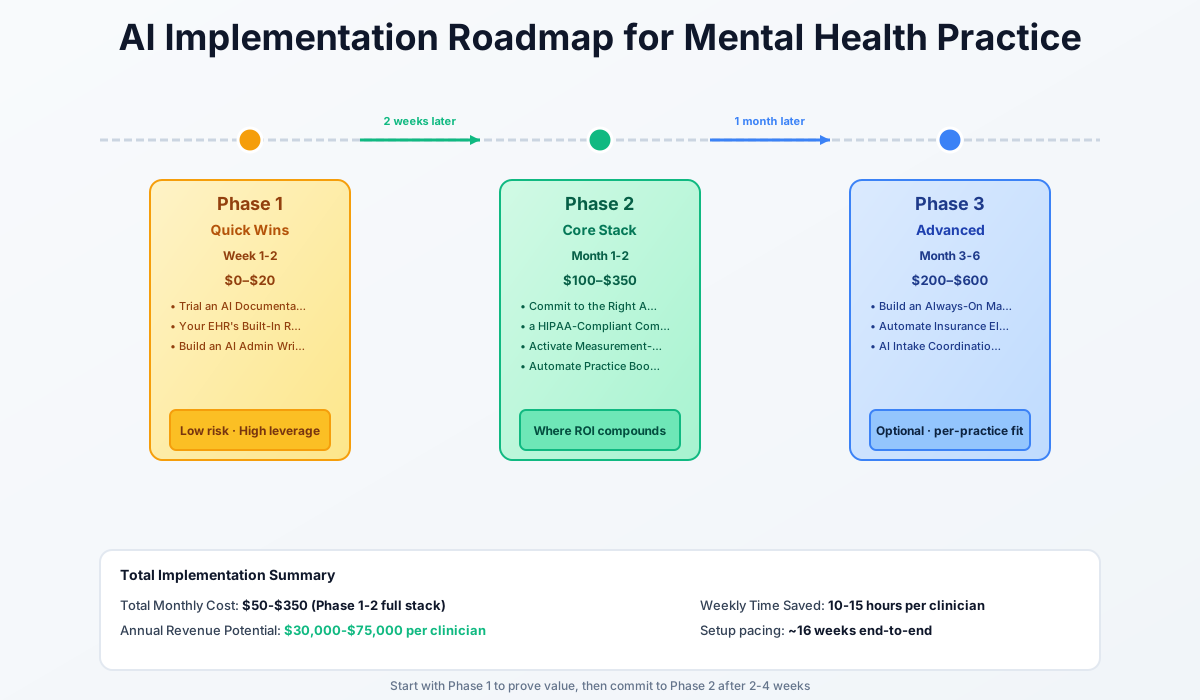
- This week: sign up for Blueprint Core (free) and activate PHQ-9/GAD-7 auto-administration for your active caseload
- This week: start a 14-day free trial of Mentalyc OR pay-per-session on Blueprint Plus — generate AI drafts for 5 real sessions and time the editing
- This week: configure 3-touch reminders (7 days / 48 hours / 2 hours) with two-way confirmation in SimplePractice or TherapyNotes
- This week: build a Google Sheet waitlist with name, phone, preferred clinician, availability — so two-way cancellations can actually backfill
- Week 2: add the AI documentation consent clause from this guide to your standard informed consent form
- Week 2: build the shared Google Doc 'AI Writing Prompts' library — start with PA appeals, Psychology Today profile, and FMLA letters
- Week 3–4: commit to your AI scribe based on volume math (Blueprint Plus, Mentalyc, Upheal, or JotPsych for psychiatry)
- Month 2: deploy Spruce Health Communicator ($49/mo) — port your number, configure auto-attendant with crisis resources, set message routing rules
- Month 2 (solo only): sign up for Heard Lite ($129/mo) and connect business checking + business credit card
- Month 3+: rewrite your Psychology Today profile for one specific niche; run monthly batched content sprints (1–2 hours) instead of daily posting
Frequently Asked Questions
How do AI session scribes handle the HIPAA separation between psychotherapy notes and progress notes?
The carve-out requires your private process notes to live in a designated record set logically and physically separate from progress notes, treatment plans, and outcome measures. Mentalyc, Upheal, Blueprint, and Twofold Health all distinguish between AI-generated progress notes (which clients can request) and process-note artifacts (which they cannot). Configure the separation explicitly at setup — most vendors default to progress notes only and require you to opt in for psychotherapy notes as a separate feature. Confirm the setup against the vendor's BAA and data retention documentation before going live.
Is it safe to use AI intake with a caller who might be in crisis?
No AI intake tool is equipped to conduct a safety assessment. They screen for logistics and scheduling criteria. Any deployment requires a documented escalation protocol that routes disclosures of suicidal ideation, self-harm, or imminent risk immediately — within seconds — to a live human, 988, or 911. Test this with simulated calls before the system ever touches a real prospective client. If the routing doesn't work instantly, don't deploy it.
How does AI scribe transcription interact with PSYPACT or Counseling Compact cross-state telehealth?
The compacts solve the licensure problem; they don't change the documentation requirement. Your scribe needs to capture the client's reported location at session start, because telehealth must comply with the law where the client is physically located. Most ambient scribes timestamp based on the clinician's session metadata — verify the vendor stores the client's reported state, not just yours, because that's what a licensing board will ask for.
I treat SUD clients. Does the standard HIPAA BAA cover everything I need?
Often not. 42 CFR Part 2 layers stricter consent requirements on top of HIPAA — written, specific consent for redisclosure, often even between clinicians at the same practice. A general HIPAA BAA is necessary but not sufficient for SUD documentation. Before deploying AI scribes across an SUD caseload, talk to a healthcare attorney about how the vendor's data flow maps to Part 2. Some practices solve this by carving out SUD cases from AI documentation entirely and dictating those notes manually.
Will payers accept AI-drafted notes in a chart audit?
Yes — with one important clarification. Your signature makes the note a clinician-authored note, and your signature certifies the content reflects what actually happened in session. Properly reviewed AI notes are often more audit-resistant than rushed handwritten notes because they consistently include the elements auditors look for: PHQ-9/GAD-7 scores, DSM-5 diagnosis with criteria, medical necessity language, treatment plan linkage. Read every line before finalizing. The note must reflect what you observed, not a plausible-sounding generic summary.
What happens to client records inside Headway or Alma if I leave the network?
Both networks allow record export, but the process is manual and the export format may not map cleanly to your next EHR's data structure — recurring appointment series, treatment plan history, outcome measure trends can all be affected. Get clarity on export terms before you onboard. Ask specifically: what formats are available, how long does it take, and are scheduled exports possible. This is a harder conversation to have after signing than before.
My caseload is full and I already have a long waitlist. Why bother with any of this?
Because documentation hours are a capacity ceiling, not just an annoyance. If AI scribes return 5–7 hours per week, that's 2–3 additional sessions you could see — or 5–7 hours of life back. The waitlist doesn't automatically convert better just because you're busy; the inquiry-to-booked rate and no-show rate still matter. And the compliance infrastructure — BAA-covered communication, audit-ready notes — matters more as your revenue grows, not less.
The compliance floor in mental health is high, but it's not the obstacle to AI adoption. If anything, it narrows the decision to a short list of tools that have done the compliance work correctly — which makes the choice easier, not harder. Start with the free Blueprint Core signup and the 3-touch reminder configuration this week. Both take under an hour combined. Add the AI scribe trial the following week. That's where 80% of the time savings live — and it all compounds from there.
If you're managing a physical therapy or chiropractic practice alongside a mental health panel, our guides for physical therapy clinics and chiropractic offices cover the crossover documentation and billing workflows in more detail.
More AI Implementation Guides
AI Tools for Home Health Care Agencies: 2026 Guide
A practical 2026 guide to AI tools for home health care agencies — HIPAA-safe automation for shift-filling, OASIS-E documentation, EVV, and claim denials.
AI Tools for Dermatology Practices: 2026 Guide
The best AI tools for dermatology practices in 2026 — cut prior-auth hours, reduce no-shows, and grow your cosmetic line, with a HIPAA-first rollout plan.
AI Tools for Massage Therapy Practices: 2026 Guide
How massage therapists use AI for SOAP notes, no-show defense, 24/7 phone answering, and retention — without breaking HIPAA, TCPA, or scope of practice
AI Tools for Optometry Practices: 2026 Guide
AI tools for optometry practices in 2026: HIPAA-safe scribes, ABB Verify, dual vision/medical billing, OCT AI, and a phased plan independents can run.
Best AI Chatbot & Lead Conversion Tools for Med Spas
Compare AI chatbots, lead conversion & generation tools for med spas. Capture missed calls 24/7, book online, recover $5K-$15K/mo in lost leads. See picks.
AI Tools for Physical Therapy Practices (2026)
The best AI tools for physical therapy practices in 2026. HIPAA-compliant solutions for documentation, scheduling, HEP delivery, and billing automation.
Keep exploring
See every AI implementation guide we've published for Healthcare, or browse the full library by industry or category. Looking for a specific platform? The AI tools directory indexes every product mentioned across our guides, and the comparisons hub puts the most-asked head-to-heads side by side.