
It is 2:47 a.m. The pager goes off in the bedroom of a third-generation funeral director in a small Ohio town. A hospice nurse in Springfield is calling — a family's mother just passed, and they need someone to come. The director, who buried two veterans yesterday and has a 9 a.m. arrangement conference, swings his legs over the edge of the bed and reaches for a notepad in the dark. He has done this on roughly 240 nights this year. His wife does not stir; she stopped stirring around 2018.
This is the part of funeral service nobody warned you about in mortuary school. Not the prep room, not the families, not the FTC Funeral Rule. The on-call calendar. The reason owners sell to consolidators is almost never the work itself — it is the 2:47 a.m. shift that never ends.
Most of what AI can do for a funeral home, it does in the moments around the human moments. It does not — and should not — replace the director at the kitchen table when a daughter is deciding what to put on her mother's prayer card. What it can do is make sure the director is awake, present, and not buried in paperwork when she walks in.
Consider where the time actually goes. An independent funeral home performing 150 services a year typically spends 4-8 hours per case on pure administrative work — re-keying the same decedent data across case management, state EDRS, the obituary CMS, Legacy.com, the insurance assignment portal, and QuickBooks. Across 150 calls, that is 600 to 1,200 hours annually on duplicate data entry before a single family has been genuinely served. The table below reflects industry patterns reported by NFDA member surveys and corroborated by Afterword's 2025 implementation data:
| Task | Current Avg. Time | With AI Tools | Hours Saved/Year (150 calls) |
|---|---|---|---|
| Obituary drafting (first draft) | 60–90 min | 8–12 min | 130–195 hrs |
| Case data entry (multi-system) | 4–8 hrs | 1.5–2.5 hrs | 375–825 hrs |
| Tribute video production | 2–3 hrs | 25–35 min | 213–319 hrs |
| Aftercare follow-up scheduling | 30–45 min | 5 min (automated) | 94–100 hrs |
| Review request & response | 20–30 min | 5–8 min | 56–66 hrs |
That is somewhere between 850 and 1,500 staff hours per year. In a four-person operation, that is real. It is also, largely, recoverable — not by cutting corners on care, but by cutting corners on clerical work.
This guide walks through the best AI tools for funeral homes in 2026: which are actually built for death care, what they cost, and a sensible order for rolling them out without blowing up your operation.
TL;DR — Start Here
Three moves that pay for everything else:
- Use ChatGPT or Claude (free) to draft obituaries — cut 1-3 hours per case down to 10 minutes.
- Run a 14-day free trial of Upfirst ($24.95/mo) to cover after-hours first calls so the on-call director can sleep.
- Set up Canva starting on the free plan, then upgrade to Pro ($15/mo) for the Brand Kit so prayer cards, social posts, and service programs look professional in 15 minutes, not 2 hours.
Combined cost in month one: $0 to $40 (Upfirst trial is free for 14 days; Canva free plan is $0 to start). Combined time recovered: 8-12 hours per week.
The Paperwork Behind Every Service
The average US funeral home is a family business doing $500K-$2M a year, performing 113-200 services annually at a blended $5,000-$8,000 per call. Margins are thin — IBISWorld pegs the industry at 10.3%, with single-location independents often under 6% — and the cremation shift has compressed them steadily. Cremation is now 63.4% of dispositions (NFDA 2025 Cremation & Burial Report), projected to hit 82.3% by 2045. A direct cremation pays $1,500-$3,000 instead of $8,000-$15,000 for a traditional burial, and the labor cost difference does not close the gap.
Then there's the paperwork floor. Each case sprawls across at least eight different systems: case management (Passare, SRS, Osiris), state EDRS, your obituary CMS, Legacy.com or Tribute Archive, the livestream platform, the tribute video tool, the insurance assignment portal at C&J or Express Funeral Funding, and QuickBooks. The same family and decedent data gets re-keyed into every one — before anyone has actually served the family.
Sitting underneath all of it is the regulatory floor. The FTC Funeral Rule (16 CFR Part 453) requires a specific itemized General Price List, a Casket Price List, an Outer Burial Container Price List, no package bundling, and explicit verbal and written disclosures. Penalties run up to $53,088 per violation. The FTC's 2024 proposed amendments would require online price posting, which means the price-shopping pressure already showing up in your call-share data is about to increase.
That is the world AI has to fit into. Not as a way to replace the human in the room. As a way to give the human their evenings back.
First: The Tools That Pay for Themselves in Week One
Four tools. Almost no cost. No IT involvement and no contract longer than a credit card statement. Most funeral home staff can implement all four in a single afternoon, and the combined time savings run 8-12 hours a week.
AI Obituary Drafting with ChatGPT or Claude
The office manager who currently spends 90 minutes per obituary staring at a family's handwritten notes is doing work a free chatbot handles in about 90 seconds. A 150-call funeral home burns through 150 to 450 hours per year on first drafts alone — two to three weeks of full-time labor.
Both ChatGPT (chat.openai.com) and Claude (claude.ai) are free with an account, and either handles this job well. A funeral-specific prompt with the right guardrails returns a draft the office manager can edit in five minutes and send to the family for approval the same afternoon.
I'm a funeral director. A family gave me these notes about their [mother/father/etc.]: [paste the family's notes here].
Please write a 300-word obituary in a warm, dignified tone. Use third person. Include a brief life summary, survivors, and a closing sentence about their legacy.
Do not include the exact date or time of death, the name of our funeral home, or specific cemetery names — I will add those. Do not use the phrase "passed away" more than once — vary with "died," "entered eternal rest," or similar.
If any survivor relationships are unclear from the notes, list them as placeholders in brackets for me to confirm.
Three things that separate the funeral homes doing this well from the ones who tried it once and quit:
- Save your ten best AI drafts as tone references. Paste one into the next prompt and say "match this tone and style." The output moves toward your house voice instead of generic ChatGPT.
- Always have the office manager review before the family sees it. AI occasionally hallucinates a survivor name or invents a job title that was never in the notes. The review step is not optional.
- Track time saved for the first 10 cases. You will want those numbers when a skeptical owner asks whether this is actually working.
AI After-Hours Phone Answering with Upfirst
A 2 a.m. first call that goes to voicemail is gone. The family does not call back — they scroll to the next Google result. At $6,000 blended revenue per call, one missed first call is worth roughly 240 months of Upfirst's entry-level plan.
Upfirst
Best for: Independent funeral homes covering after-hours first calls without a full answering service
AI-powered virtual receptionist configured for funeral homes. Handles inbound calls with a calm, compassionate voice, collects full first-call intake (decedent's name, place of death, family contact), books arrangement conferences directly into your calendar, and delivers a transcript plus AI summary after every call. Multilingual support is included. 14-day free trial with a real dedicated number — no credit card required.
What separates Upfirst from ASD — the human-agent gold standard, but priced for higher-volume firms — is the trial. You get a real phone number and 14 days to listen to every recording before you owe anything. Forward your main line to the Upfirst number during a defined after-hours window (say, 8 p.m. to 7 a.m. and weekends). If the AI captures complete first-call data and handles empathy correctly, keep it. If it stumbles on a dialect common in your service area, you know before you pay a dollar.
For owner-operators where the brand is "you," look at EternalVoice instead. They clone the director's actual voice from a 24-hour upload window so callers feel like they are speaking to you personally, even at 2 a.m. Uncomfortable for some directors, a perfect fit for others — it depends on whether families chose you because of you specifically, or because of the firm.
Configure the Escalation Trigger Before You Trust It
Every AI phone tool should escalate immediately to a live director when a caller sounds highly distressed, mentions an unattended death, or describes a body that needs urgent removal. Test this explicitly during your trial period. If the escalation trigger does not fire reliably, do not deploy the tool to your after-hours line.
Canva AI for Prayer Cards, Programs, and Social Posts
Prayer cards, memorial folders, register books, service programs, social media obituary posts, community event flyers — all of it is a template-fill problem that funeral homes are currently paying graphic designers or spending two hours on per service. They should not be.
Canva's free plan (canva.com) includes thousands of funeral-appropriate templates plus AI tools: Magic Write for copy, Magic Design for layouts, Background Remover for portrait photos. The Pro tier at $15/month (or $120/year) unlocks the Brand Kit, which locks fonts, colors, and logo across staff-created designs so the prayer card from Tuesday and the program from Friday look like they came from the same funeral home.
Spend two hours on a Tuesday afternoon building 3-5 reusable prayer card templates for your most common service types. Designate one staff member as the Canva owner. Every new service becomes a 15-minute fill, not a from-scratch design session. Most funeral homes that stick with this eliminate $300-$800/month in outsourced design costs within 90 days.
FuneralSpeech.AI for Family Eulogy Support
"Can you help us write something for the eulogy?" It is one of the most common arrangement conference requests, and it consumes 30-60 minutes per case for work that generates no revenue and sits well outside the director's job description.
FuneralSpeech.AI is a one-time $19 purchase. A family member answers a guided questionnaire about the deceased and gets a personalized 3-5 minute eulogy draft in about ten minutes. Buy it once, drop the link into your aftercare packet, mention it at arrangement conferences as a complimentary resource. You are not offloading grief support — you are removing 45 minutes of director time from every case where the family asks. The $19 pays for itself the first time you do not draft a eulogy at 11 p.m. on a Thursday.
Operational Automation: Months One Through Three
The tools above buy back time. This next group uses that recovered time to close three revenue leaks that every funeral home knows about and almost nobody fixes: tribute video production, preneed lead nurture, and aftercare follow-up. Budget here runs $100-$500/month, and every line item ties to revenue that is currently walking out the door.
Tukios with the AI Photo Engine: Tribute Video Production at Scale
Tribute videos fail in two ways. The family supplied 23 low-resolution photos and a blurry 1987 scan, and the chapel-projected result is something everyone politely ignores. Or the render fails 30 minutes before the service.
Tukios is among the leading tribute video platforms in funeral service, and their AI Photo Engine — launched in 2025 — attacks the first problem directly. It colorizes black-and-white photos, removes cluttered backgrounds, sharpens phone snapshots, and corrects exposure on over-flashed Polaroids. A staff member produces a polished tribute video in about 30 minutes that would have taken three hours a year ago.
One process change makes this pay off beyond time savings: collect photos at the arrangement conference, not 48 hours before the service. Hand the family a QR code linking to a secure upload portal and tell them "20-40 photos, any format, any era — low quality is fine, the AI handles it." A 150-call funeral home converting even 20 additional cremation families per year into tribute video buyers at $150-$350 each adds $3,000-$7,000 in annual revenue on top of the labor savings.
Preneed Email Sequences with Jasper AI
Ask any funeral director how often their seminar attendees get a follow-up email. The honest answer is almost never — not because anyone forgot, but because nobody on staff has four hours to write a three-email campaign.
Jasper AI
Best for: Funeral homes with no marketing staff who need consistent preneed nurture and community-education content
AI marketing platform that maintains your brand voice across email sequences, social posts, blog articles, and Google Ad copy. Train it once on your funeral home's tone, then generate a complete 3-email preneed nurture sequence in 20 minutes — and produce one community education blog post per month to build organic Google traffic without an agency retainer.
Spend 90 minutes training Jasper on your funeral home's voice — something like: "Independent family-owned funeral home serving [city] for [years]. Warm, caring, informative, never salesy. Never pressure, never rush, always put the family first." After that, generate the entire 3-email preneed sequence in one sitting.
Write a 3-email preneed lead nurture sequence for adults 65+ who attended our community pre-planning presentation at a local senior center.
Email 1 (day 0): Thank them for attending. Explain the benefits of pre-planning — peace of mind, protecting family, price guarantee — with zero pressure.
Email 2 (day 14): Address the 3 most common preneed objections: "I'm not ready," "what if I move," "what if the funeral home closes."
Email 3 (day 28): Invite to a complimentary private planning session. Create gentle urgency by noting prices increase annually. Do not be pushy.
Tone throughout: caring, informative, absolutely not salesy. Subject lines included for each email.
Load the three emails into Mailchimp's free tier (up to 250 contacts, 500 emails/month as of 2026 — enough for a small preneed list, but upgrade to a paid plan if your contact list exceeds 250; check Mailchimp's current pricing at mailchimp.com as rates have risen steadily). Set them to trigger automatically when a seminar attendee is added to the list. One additional funded preneed contract from this sequence, at $8,000-$12,000 in pre-funded future revenue, covers two full years of Jasper.
The same approach works across professional services with long consideration cycles. Both the accounting firm AI guide and the insurance agency AI guide use Jasper for client-nurture sequences. In death care, the tone calibration is what actually makes or breaks it.
Building a Consistent Aftercare Program
Fewer than 40% of funeral homes execute aftercare consistently. That is not a motivation problem — every director knows it matters. It is a calendar problem. The next-call family arrives and everything from the previous one gets pushed until it disappears.
You do not need a paid platform to fix this. You need four AI-generated letter templates, an email tool, and one person who owns the data entry.
- Use ChatGPT or Claude to draft four letters (30-day grief follow-up, 60-day grief resources, 90-day gentle preneed mention, first-anniversary remembrance) for your three most common service types — twelve letters total, about two hours of work.
- Load them into Mailchimp (free tier) as four automated sequences triggered by a "case close date" field.
- Assign one person — usually the office manager — to enter every family's email and case close date within 24 hours. This is the only step that breaks if you skip it.
- In the 30-day email, include a review request: "If our team supported your family well, a brief Google review helps other families in [city] find compassionate care when they need it most."
- In the 90-day email, drop a single sentence about preneed: "When you're ready to explore pre-planning for yourself or another loved one, our team is here with no pressure, just answers." No button. No urgency. One sentence.
The 28-35 Day Window Is Not Optional
Asking for a Google review 24 hours after the service is the single most common mistake in funeral marketing. Acute grief is the wrong moment. Industry research consistently identifies 28-35 days post-service as the window where grief has softened slightly, gratitude for good service is most accessible, and review response rates are highest. Set your automation to that window and do not deviate.
QuickBooks Online AI for Bookkeeping
Roughly 80% of funeral homes are already on QuickBooks. The 2025-2026 Intuit AI expansion adds transaction auto-categorization, payroll automation, and cash flow forecasting at no extra cost for existing subscribers. If your team is still exporting transactions from Passare or SRS and re-entering them manually, that is 2-4 hours a week spent on a problem a settings toggle now solves.
The configuration that actually matters: build 8-10 funeral-home-specific account categories — at-need service revenue, cremation, merchandise, preneed transfers, insurance assignment deposits, floral passthrough, prep room supplies, facility — and let the AI train for two weeks. Schedule a 60-day accountant review. Preneed trust withdrawals and insurance assignment passthrough amounts are the categories AI most commonly misclassifies, and those are the ones where errors matter most.
Platform Decisions: Months Three Through Six
This is where the funeral home stops patching individual workflows and starts making bigger decisions: platform migration, systematic reputation management, preneed pipeline software. Budget rises to $400-$900/month. Do not start here until the earlier tools are actually running — not planned, running.
Afterword Grace or Passare AI: The Case Management Decision
Re-entering the same decedent and family data into 6-10 systems per case is the single biggest administrative time sink in funeral home operations. AI case management is the only real fix. Two paths, depending on what you run today.
Already on Passare? Call your account rep and activate the AI Scanner and AI Obituary Writer. The AI Scanner works like this: photograph a handwritten worksheet with the Passare Mobile app, and it auto-populates all case fields. That is 20-30 minutes saved per case, no migration, no cutover risk.
On SRS, Osiris, Halcyon, or anything older? Look seriously at Afterword and its Grace AI — the 2025 NFDA Innovation Award winner. Photograph any worksheet and Grace builds the case file. Before each arrangement conference, Grace surfaces the family's prior case history (services, merchandise selected, payment status) so you walk in already knowing them. Aftercare automation runs from case close date without director involvement, and eSign document routing keeps a full audit trail for FTC compliance.
Either way, plan migration for September or October. Never January through March. Your busiest seasonal period is the worst time to learn a new system. Afterword's typical migration runs 4-6 weeks of parallel operation — you want every staff member through that curve before the winter peak.
Track the result in one number: data entry hours per case. Ten cases before, ten after. The target is dropping from 4-8 hours to under 2. For a 150-call funeral home, that is 300-900 hours per year recovered — the labor equivalent of half a licensed director, without the hire.
Systematic Google Review Growth with Birdeye or Podium
Families searching "funeral home near me" at 11 p.m. on a Sunday open Google, glance at the top three results, and call whoever looks most credible. If you have 12 reviews and the competitor across town has 67, you are not in that conversation at all.
Birdeye
Best for: Funeral homes serious about systematically growing Google review volume across one or more locations
Reputation platform that automates review solicitation at grief-appropriate timing (28-35 days), monitors reviews across 200+ platforms, detects fake reviews, and benchmarks your reputation against local competitors. AI-drafted review responses in your brand voice are available on the Growth plan ($349/mo) and above — the Starter tier covers monitoring and manual response tools. The funeral homes that systematically build to 50+ Google reviews at 4.7+ stars dominate at-need call share in their markets.
Podium
Best for: Funeral homes that also want a unified SMS inbox for family text messages and arrangement scheduling
AI customer messaging and reputation platform. Jerry 2.0 AI Employee responds to inbound family texts within 2 minutes, 24/7, with empathetic scripting. Automated review requests run via SMS (98% open rate vs. ~20% for email). Unified inbox combines text, web chat, and Google Business messages. SMS-forward approach matches families who do not answer unknown phone calls.
The choice comes down to your secondary use case. Birdeye if your only goal is review growth and competitor monitoring. Podium if you also want SMS to be your primary family communication channel — their Jerry 2.0 AI responds to inbound texts within 2 minutes, 24/7. Both connect to the major funeral case management platforms via Zapier.
One thing most funeral homes underestimate: respond to every negative review within 24 hours and every positive one within 48-72 hours. Google tracks response rate and response time. An unanswered 1-star review does more damage than the 1-star itself. When the inevitable difficult review lands, paste it into ChatGPT or Claude with this:
I'm the owner of a funeral home. A family left a 1-star Google review with this text: "[paste the exact review text]".
Please draft a professional, empathetic response under 150 words that:
- acknowledges their experience without admitting liability
- expresses our genuine commitment to serving families with dignity
- invites them to contact me directly at [phone/email]
Tone must be warm, not defensive, and not legalistic. Do not offer refunds or make specific promises. Do not argue any factual points publicly.
Homesteaders EnGauge for Preneed Pipeline
Most funeral homes track preneed in spreadsheets, miss follow-up windows, and have no systematic way to identify which living preneed holders need a price-update conversation before service costs outrun their contract values. A preneed contract funded at $6,500 in 2018 that now covers a $9,200 service is not a secured call — it is a shortfall billing waiting to happen.
Homesteaders EnGauge CRM, built on Salesforce, is funeral-specific preneed pipeline management with AI lead scoring, automated nurture sequences, and Einstein analytics. If you write preneed through Homesteaders Life, EnGauge is typically available as part of the carrier partnership — call your rep before assuming you need to pay separately. Homesteaders reports an average 60% increase in preneed production from firms that adopt the platform.
Two use cases worth the implementation on their own:
- Price-update identification. Pull a quarterly list of living preneed holders whose contract values are more than 15% below current service costs. Proactive conversation now, not an awkward shortfall billing later.
- Policy matching. EnGauge's 2026 integration with Homesteaders' policy system automatically links preneed policies to active cases — meaning a family that walks in without mentioning their loved one's pre-arrangement is flagged rather than falling through the cracks. Confirm current feature status directly with your Homesteaders rep, as this integration was rolling out in 2026.
OneRoom 2025 for Livestream Reliability
A frozen screen during a service generates an immediate 1-star review. Not a maybe. A remote grandchild watches grandpa's service through a buffering spinner at the most emotional moment the family will ever experience — that is not a technical hiccup, it is a failure the family will not forget. Livestreaming is now a standard expectation at 50%+ of NFDA-member firms, and failures that were forgivable in 2021 are not forgivable today.
OneRoom's December 2025 AI upgrade added real-time captions, Spanish translation, AI-generated service chapters, and key-moment highlights for replay navigation. Purpose-built funeral streaming infrastructure is more reliable than Facebook Live or YouTube Live, which were not designed for this use case.
One infrastructure detail that consistently surprises funeral homes: hardwired ethernet, not WiFi, with minimum 10 Mbps upload. A state-of-the-art streaming platform on a 5 Mbps WiFi connection still fails. Have your internet provider assess and upgrade the chapel before you switch platforms.
Where to Be Careful
Six mistakes funeral homes make with AI more often than anything else:
- Embalming, restorative art, and any licensed-director function stay entirely outside AI. The regulatory exposure — state board sanctions, OSHA, FTC — is real.
- Do not automate the arrangement conference itself. Chatbots in the room destroy trust. AI's role in arrangement is preparation beforehand and paperwork afterward. Never substitution.
- Do not implement everything at once. A small funeral home that tries to migrate platforms, launch AI phone answering, build preneed sequences, and rebuild tribute videos in one quarter will execute all of it poorly and abandon most of it within 90 days.
- Never let an AI obituary draft reach a family or publication without human review. AI occasionally invents survivors. Not rarely — occasionally. The review step is not negotiable.
- Do not treat Facebook as a primary online presence. Organic reach on Facebook averages 1-2% of followers, and engagement rates run below 0.2%. Families do not find funeral homes through Facebook. They find you on Google.
- Do not drop a general-purpose chatbot on your website without funeral-specific configuration. A bereaved family hitting a Drift bot trained on retail scripts will hang up and call whoever is next on the list. Use funeral-specific tools (Upfirst, EternalVoice, Axia AI) or configure a general platform extensively before it ever touches a family.
Getting Started Checklist
- Week 1: Create free ChatGPT or Claude account; test the obituary prompt on the next three cases; track time saved per draft.
- Week 1: Start a 14-day Upfirst trial (upfirst.ai/industries/funeral-home); forward your after-hours line; review every recording daily.
- Week 2: Sign up for Canva free; upload your logo and brand colors; build 3-5 reusable prayer card templates for your most common service types.
- Week 2: Purchase FuneralSpeech.AI ($19); add a one-paragraph eulogy resource to your aftercare packet.
- Month 1: Contact Tukios for a tribute video demo; set up the case management integration; institute QR-code photo collection at the arrangement conference.
- Month 1-2: Start Jasper AI's 7-day free trial (Creator plan, $49/mo monthly or $39/mo annual); train brand voice; generate the 3-email preneed sequence; load into Mailchimp free tier.
- Month 2: Draft four AI aftercare letter templates; load into Mailchimp; assign accountability for entering case close dates within 24 hours.
- Month 2: If on QuickBooks Online, activate AI categorization; set up 8-10 funeral-specific account categories; schedule 60-day accountant review.
- Month 3: Decide case management path: activate Passare AI (if existing user) or request an Afterword Grace demo.
- Month 3: Subscribe to Birdeye (Starter for review monitoring, Growth if you want AI-drafted responses) or Podium Core; configure 28-35 day review request automation.
- Month 4: Call your Homesteaders rep about EnGauge CRM access; import preneed leads if available.
- Month 5: Assess chapel internet infrastructure for OneRoom 2025 livestream upgrade; schedule platform demo.
- Month 6: Review the 7 success metrics (obituary time, missed call rate, review count, aftercare completion, preneed contracts, data entry hours, on-call wake-ups). Compare to baseline.
ROI Reality Check
ROI Snapshot
Monthly Cost
$200/mo
Time Saved
15hrs/week
Monthly Value
$8,100
ROI
3950%
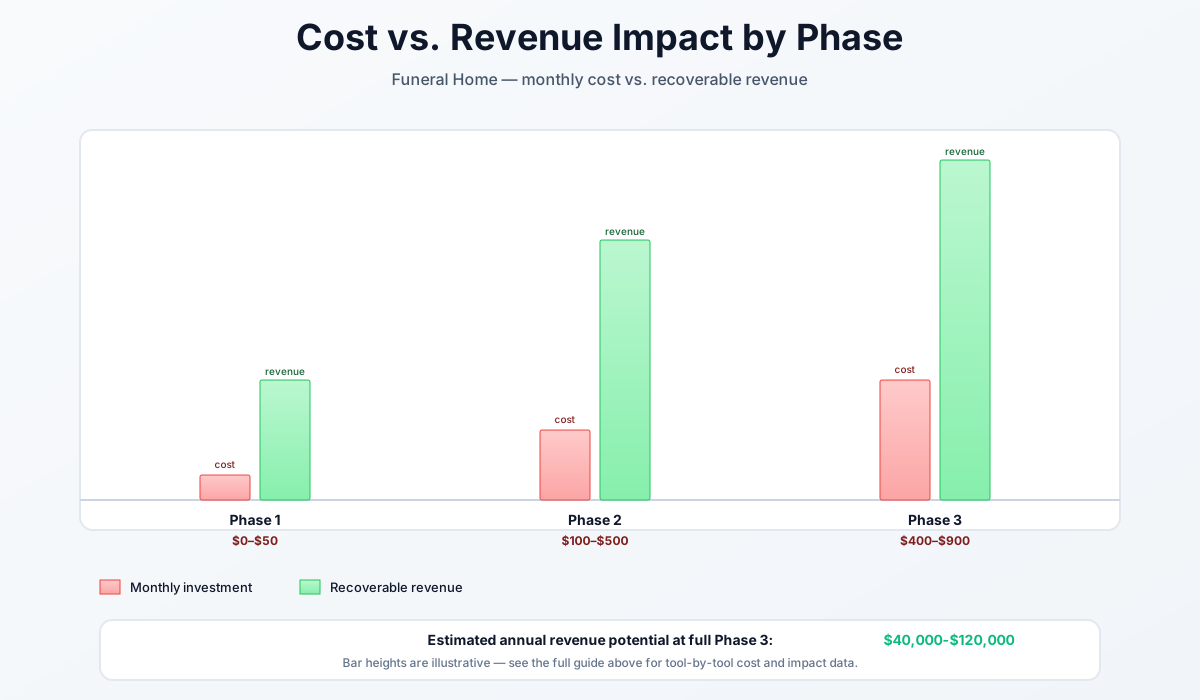
Weekly time recovered across the full implementation runs 15-25 hours. Annual revenue upside lands between $40,000 and $120,000 from captured at-need calls, preneed conversions, tribute video upsells, and reduced staff turnover from on-call relief. Monthly tool cost for the full stack tops out around $1,450. One number worth keeping in mind: at $6,000 average per call, a single additional at-need call recovered pays for three full years of every tool in the first two groups combined.
Here's how this rolls out — three phases, each with its own cost ceiling and impact target:

Here's a breakdown of the costs and expected returns:
Frequently Asked Questions
How does AI obituary writing handle the wildly different formatting requirements across newspapers and online platforms? It does not — and it should not try to. AI generates the dignified narrative text (300 words for the website, 150 words condensed for paid print). The office manager handles formatting and portal submission for each paper. For the major aggregators, Passare and Tribute Technology auto-syndicate from your case management anyway, so the obituary is written once and published everywhere.
Are automated post-service review request texts safe under TCPA when families never explicitly opted in to SMS marketing? Gray area at best, and not worth the exposure. Send review requests through the 30-day aftercare email, where consent is implied by the business relationship and unsubscribe is built in. If you use Podium, route review requests via email and reserve SMS for genuine transactional messages. Your counsel will thank you.
Can AI document scanners actually read messy handwritten first-call worksheets filled out at 3 a.m. in bad lighting? For reasonably legible handwriting in decent lighting, yes. Truly illegible scrawl or photos taken at sharp angles will trip both the Passare AI Scanner and Afterword Grace. Photograph the worksheet flat, well-lit, as soon as you are back at the funeral home. Realistically, the AI gets 80-90% of fields correct and the office manager spot-checks the rest. Neither vendor claims perfect accuracy under field conditions, and you should not expect it.
What happens to FTC General Price List compliance when an AI tool drafts service recommendations that do not match the GPL exactly? Any AI tool surfacing pricing to a family creates Funeral Rule exposure unless that pricing matches your current GPL exactly. Passare's AI Assistant and Afterword Grace both pull from your case management system, so compliance holds as long as your GPL there is current. The dangerous pattern is a general-purpose chatbot trained on a GPL document from 18 months ago. Every GPL update goes into every AI tool the same day. No exceptions.
Is voice cloning a funeral director's voice actually ethical — what happens if a grieving family discovers later they were speaking to an AI? Disclose it, and the concern disappears. A single line in your service agreement and on your after-hours voicemail greeting — "after-hours calls may be answered by our AI assistant, with urgent calls immediately transferred to the on-call director" — is sufficient. Families who know upfront are not deceived. Families who find out later write the 1-star review and do not come back. If transparency feels complicated, use a tool like Upfirst where the AI voice is clearly not you and the disclosure is obvious.
What about cross-referencing obituary feeds against a preneed book — does that raise privacy concerns? Published obituaries are public by definition. Cross-referencing public obituary feeds (Legacy.com, Tribute Archive, competitor websites) against your private preneed database is legally clean — you are matching your own records against publicly available information. The privacy lines are around state EDRS data, which most case management vendors do not have API access to anyway. Any vendor claiming EDRS-based death matching should be asked for the specific state authorization behind it.
Is AI going to replace the funeral director? No. And anyone telling you it will is selling something. Funeral service rests on human presence at the worst moment in a family's life — no software replicates that, and none of the tools in this guide attempts to. What changes is how much of the director's time gets eaten by re-keying data, drafting form letters, and managing photo libraries. The work that matters — sitting with a family, guiding them through decisions, being present — stays entirely with you.
You did not get into this work because you love paperwork. You got into it because somebody has to sit with the family when the worst thing happens, and you decided that somebody would be you. Every tool in this guide exists to protect that — to make sure that when the arrangement conference begins, you are not running on four hours of sleep and a to-do list you have not touched since Tuesday.
Start with the obituary prompt. Open ChatGPT this afternoon, paste it into the next case that comes in, and see what comes back. That single change buys you back an hour. Use the hour to walk the family out to their car instead of typing.
More AI Implementation Guides
AI Tools for Breweries: The 2026 Owner's Playbook
The best AI tools for breweries in 2026: cut TTB compliance time, tighten COGS, streamline taproom scheduling, and target release marketing — starting free.
AI Tools for Bookkeeping Services: 2026 Guide
Best AI tools for bookkeeping services in 2026: Automate categorization, reconciliation, and document chasing without hiring extra staff.
AI Tools for Marketing Agencies: 2026 Playbook
The best AI tools for marketing agencies in 2026. A phased plan to kill Hell Week reporting, scale content, and fix billable utilization without new hires.
AI Tools for Home Health Care Agencies: 2026 Guide
A practical 2026 guide to AI tools for home health care agencies — HIPAA-safe automation for shift-filling, OASIS-E documentation, EVV, and claim denials.
AI Tools for Dermatology Practices: 2026 Guide
The best AI tools for dermatology practices in 2026 — cut prior-auth hours, reduce no-shows, and grow your cosmetic line, with a HIPAA-first rollout plan.
AI Meeting Assistant Cost for Accountants in 2026
What does an AI meeting assistant cost for an accounting firm? Free tiers, per-seat pricing from ~$17/user/mo, and the real total for a 3-, 5-, and 10-person team, compared.
Keep exploring
Browse the full library by industry or category, see every product we cover in the AI tools directory, or read the head-to-head comparisons.