
The homeowner with a garage full of broken furniture and a weekend deadline does not wait for a callback. They pull up Google, tap the first three junk removal companies with decent reviews, and hire whoever answers, quotes a fair price, and can come soonest. That whole decision happens in about eight minutes — usually while you're standing in someone else's driveway, both arms full of a sectional couch, watching your phone buzz into voicemail.
That's where the business actually gets won or lost. Customers now expect the same instant, transparent experience they get from 1-800-GOT-JUNK's online booking and College Hunks' upfront pricing — and franchise chains collectively hold a significant share of the market. A two-truck independent can out-compete them on price and speed, but only if the phone gets answered and the quote lands right. Miss the call and the lead you paid $35-$80 to generate is gone. Quote wrong and you're repricing in the customer's driveway.
The best AI tools for junk removal companies don't fix the hauling. They fix the gap between the lead arriving and the truck rolling — the answered call, the accurate photo quote, the review that lifts your Local Service Ads rank, the route that skips the dead miles. This guide walks through exactly which tools to set up, in what order, with real pricing and prompts you can copy today. A meaningful share of your leads are already decluttering ahead of a move or a downsize — the after-hours capture playbook in our moving company guide and the unit-pricing tactics in our storage facility guide cover the adjacent side of that same customer's timeline.
TL;DR — Start Here
- ChatGPT Plus ($20/mo) — text-a-photo volume estimating so phone quotes match the actual pile, plus review replies and job posts written in seconds.
- AI phone answering (Dialzara ~$29/mo or Goodcall ~$59/mo) — the single highest-ROI tool in junk removal. Stop sending paid leads to voicemail.
- NiceJob ($75/mo) — automated review requests that compound your Google LSA rank and quietly lower your cost per lead.
How the Business Actually Works
Junk removal is operationally simple and margin-sensitive — a tricky combination. You charge by volume, a fraction of a truckload, with an average ticket somewhere between $200 and $800 depending on load size and market. A well-run shop nets 20-35%. Three costs chew on that spread constantly: labor (your largest controllable cost), fuel, and tipping fees, which run $40-$100+ per ton and eat 15-25% of revenue by themselves.
The whole game is throughput against those costs: how many jobs a crew completes per day, how accurately each one is quoted, how cheaply each load gets disposed of. A solo operator does $60K-$120K. A dialed-in two-truck shop does $150K-$300K. The difference is rarely the trucks — it's the systems around them.
The leaks are predictable. Owners on the truck miss 20-40% of inbound calls, and in a business where customers book whoever answers first, every missed call is a real job gone. Volume is hard to judge over the phone, so quotes come in wrong and crews reprice in the driveway, killing trust and close rate. Routes built on a whiteboard backtrack and burn fuel. Reviews trickle in randomly because nobody asks at the right moment — and reviews directly feed your Local Service Ads ranking, which sets your cost per lead.
If you run Workiz, Jobber, or Housecall Pro, you've already got the chassis. If you're on a whiteboard and a personal cell, that's fine — the phases below fix the worst bleeding first with tools that cost almost nothing, then build up from there.
AI Tools for Junk Removal Phase 1: Quick Wins (Stop the Bleeding This Week)
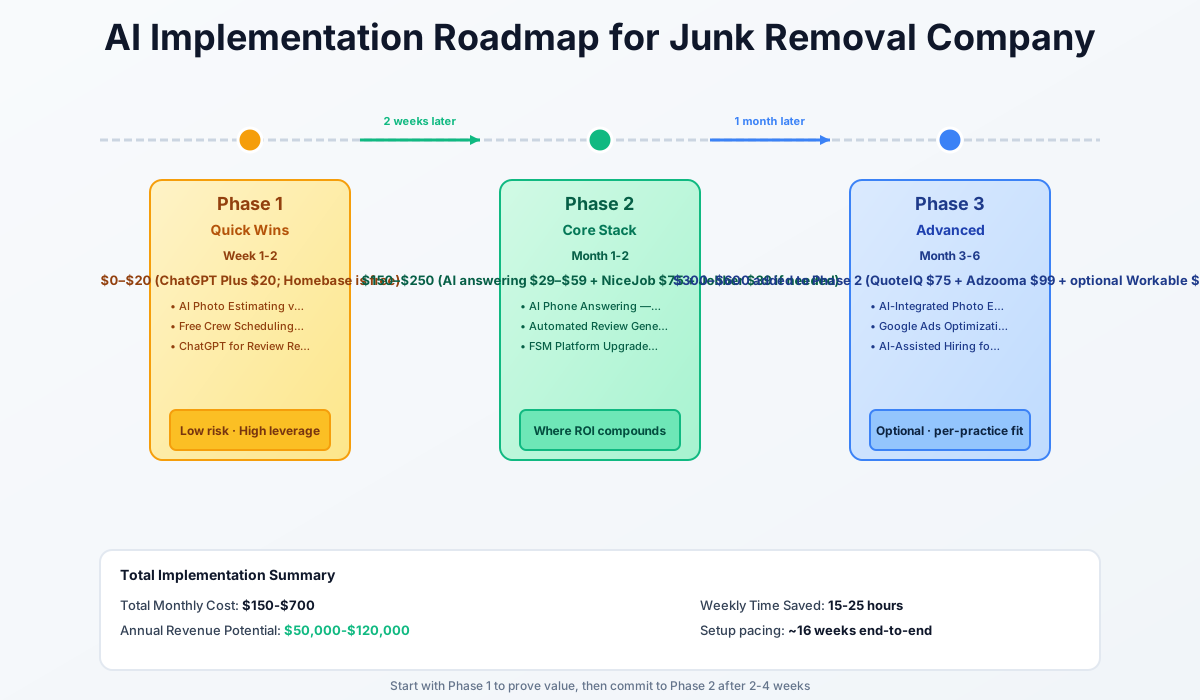
These three tools run between $0 and $20 a month and can be live by the end of an afternoon. You need a smartphone and a free ChatGPT account. Nothing here requires switching software or training a crew on something new.
Quote any pile from a photo with ChatGPT
You've been here: the customer described a "quarter truck," your crew shows up, and it's a half-truck of sectional plus a treadmill. You reprice on the spot. The customer thinks bait-and-switch, even though it isn't, and you've lost the goodwill before the job's started.
Ask the customer to text you a photo of the pile before you quote. Feed it to ChatGPT (GPT-4o has vision) with a saved prompt and you'll have a calibrated volume estimate and price range in under a minute. No new software — you're using a $20/month account that also handles review replies and job listings.
Look at this photo of a junk pile. Estimate the volume in cubic yards and what fraction of a standard 15-cubic-yard junk removal truck it fills. List any items you can identify that would incur extra disposal fees — appliances, mattresses, tires, electronics, paint, propane tanks, or concrete. Then suggest a price range for a junk removal company in [city, state] whose full-truckload rate is $[your full-truck price]. Give me a range, not a single number.
Three rules for making this work reliably. Quote a range — "Based on your photo we're looking at $275 to $350, and the crew confirms the exact price when they walk it" — never a single number. Put your real full-truck rate in the prompt so the AI calibrates to your market. And eyeball the heavy stuff yourself: concrete, appliances, mattresses carry disposal surcharges a photo can underprice. After two weeks, compare estimates to final invoices. Landing within 15% means the tool is paying for itself.
Quick Win
Save the prompt to your phone's notes app and pin the ChatGPT app to your home screen. The whole workflow — customer texts photo, you paste prompt, you call back with a price — takes under 60 seconds versus the 10-20 minutes a careful manual estimate eats.
Kill morning no-shows with free crew scheduling
A missing loader at 6 a.m. can wreck the entire day's route. When you're scheduling by group text, you find out about the no-show when the truck is already loaded and a customer is waiting. Homebase's free Basic plan covers up to 20 employees at one location, sends automated shift-reminder texts the night before, and tracks hours with GPS clock-in. Setup is about half an hour.
Homebase
Best for: Any shop still scheduling crews by text thread
The free plan is genuinely enough for most junk removal shops. The AI Scheduling Assistant builds the week from availability and work history, and automated shift reminders cut the morning no-show surprises that force route cancellations. Add the crew, build next week in the drag-and-drop calendar, and turn on reminders — that's the whole setup.
Homebase shows up across field-service guides for the same reason — it's the free scheduling backbone. It does the same job for cleaning services and landscaping companies, so if you run adjacent crews the workflow transfers.
Write reviews, job posts, and seasonal campaigns in seconds
Honest question: how long does it take you to write a Google review reply that doesn't sound like a corporate auto-response? Probably 5-10 minutes, and it still comes out generic. A job listing from scratch — longer. A spring-cleanout email — longer still. The same ChatGPT account you set up for estimating handles all of it in under a minute.
Write a professional, warm response to this Google review for my junk removal company [Company Name] serving [City]: [paste review]. Keep it under 100 words, thank them by first name, reference one specific detail from their review, and invite them to book again. Don't use phrases like "we strive" or "we apologize." Make it sound like a real person wrote it.
Write a job listing for a junk removal loader/driver in [City]. Pay: $[rate]/hour. No experience needed — we train. Be honest that it's physical outdoor work, but emphasize steady day-shift hours, team culture, workers' comp covered, and weekly direct deposit. Under 250 words. Skip filler like "passionate" or "rockstar."
Write a spring cleanout email for past junk removal customers who hired us in the last two years but haven't booked in six-plus months. Subject line plus 150-word body. We're offering $25 off any load this month. Friendly, local, not pushy — remind them what spring cleaning looks like (garage, attic, yard, moving season). Business name: [Name], serving [City].
Block 15 minutes every Monday for review replies, refresh your job post every few weeks so it stays near the top of Indeed, and send one seasonal campaign per quarter through your FSM's email tool or free Mailchimp. Always skim AI drafts before posting — especially review replies. The whole Phase 1 stack costs $20/month. The review habit alone starts nudging your LSA rank within a couple of months.
AI Tools for Junk Removal Phase 2: Growth Accelerators (Capture the Revenue You Already Paid For)
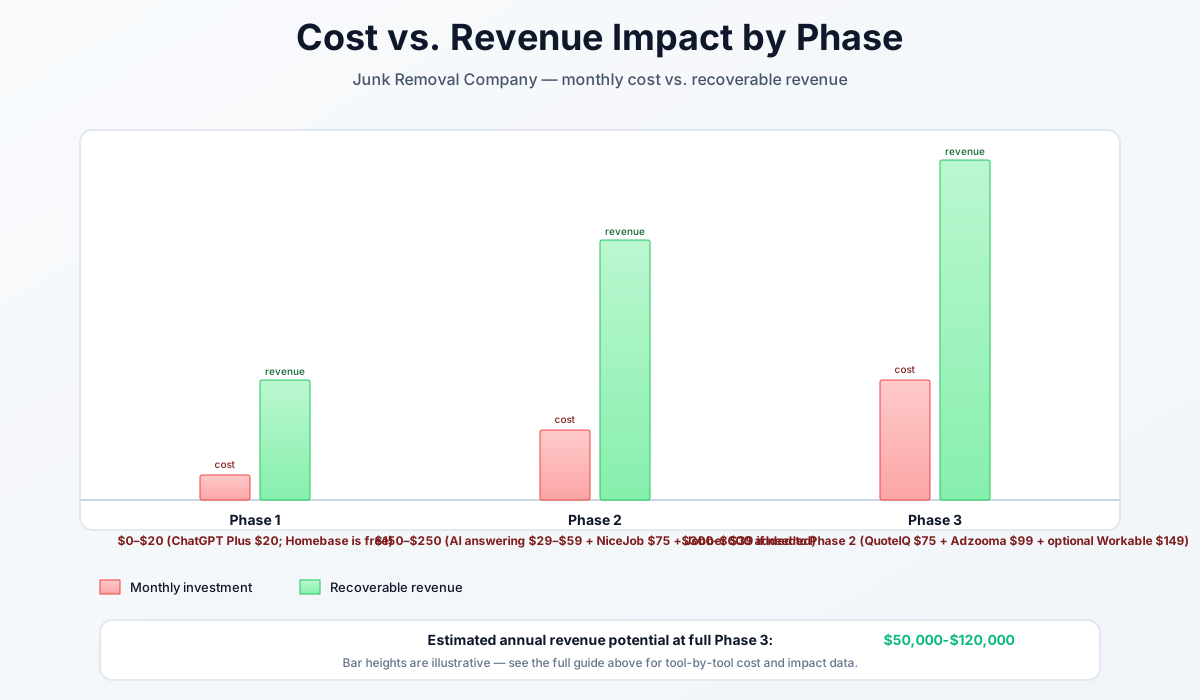
Phase 1 cleans up daily quality. Phase 2 plugs the biggest hole in the business: missed calls. Budget here is roughly $150-$400/month. A single captured estate cleanout pays for years of these tools.
AI phone answering — the highest-ROI tool in junk removal
It's 9 p.m. on a Sunday. A customer wants to clear out a garage before a weekend estate sale. She calls three junk removal companies. Two go to voicemail. The third — the one with an AI receptionist — says "Yes, we can haul that Saturday morning, roughly $200-$250. Want to book now?" She books.
Every call that goes to voicemail while you're on the truck is a lead you already paid $35-$80 to generate, handed straight to whoever picks up. An AI receptionist answers 24/7, screens on junk type and service area, handles pricing FAQs, and books into your calendar — then texts you the transcript.
Dialzara
Best for: Budget-conscious shops not yet on an FSM platform
The cheapest credible entry point, with a 7-day free trial and no credit card. 36 natural voices, spam-blocking with custom qualifying questions, and voicemail-to-text. FSM booking runs through Zapier rather than native connectors, so it's ideal if you're not yet on Workiz or Jobber. The same tool earns a spot in our HVAC company guide for the same reason — fast, cheap missed-call insurance.
Goodcall
Best for: Shops on Workiz, Jobber, or Housecall Pro that want native booking
Has a dedicated junk removal vertical — the AI is trained on industry terms, prohibited items, and volume-based pricing, and it books directly into Workiz, Jobber, Housecall Pro, and ServiceTitan without manual re-entry. A junk removal client (Bye Junk) reported a 25% revenue jump after rollout, largely from after-hours capture. This is the pick if you're already on an FSM platform.
Start with Dialzara's free trial — test call quality before spending anything. During setup, get three things right: your service-area zip codes, your pricing tiers (minimum, ¼, ½, ¾, full truck), and a prohibited-items list (hazmat, propane, paint, asbestos). Set escalation so large estate cleanouts or same-day urgent jobs ring your cell after screening. Forward your business line and watch the first two weeks of transcripts daily to catch gaps.
ROI Snapshot
Monthly Cost
$59/mo
Time Saved
12hrs/week
Monthly Value
$6,400
ROI
10747%
For a full per-minute and per-plan breakdown across the category, we ran the numbers in how much an AI receptionist costs. At the enterprise end, Avoca AI is the most capable platform in the space (it raised $125M at a $1B valuation in 2026), but it's sales-quoted and overkill until you're past roughly $300K in annual revenue.
Automate review requests and grow your LSA rank (NiceJob)
A shop with 150 recent reviews outranks one with 30 on Google Local Service Ads. More impressions at the same ad spend means a lower cost per lead. Most operators leave this to chance — crews ask verbally when they remember, which isn't very often. NiceJob fires an SMS request the moment a job is marked complete in your FSM. Text's ~98% open rate versus ~20% for email means you get far more reviews per job than verbal asks ever produce.
NiceJob
Best for: Any junk removal shop running Google LSA
Native integrations with Workiz, Jobber, and Housecall Pro; sends requests at the optimal moment after job close; auto-builds social-proof widgets for your site. Operators regularly report going from 5-10 reviews a month to 30-50 within 90 days. We point pest control and painting companies to the same tool — the LSA dynamics are identical across local home services.
One prerequisite: crews need to consistently mark jobs "complete" in the FSM app, because that status change is the trigger. Make it non-negotiable before setup. Point review requests at your Google Business Profile first — Yelp and Facebook are secondary for LSA. Check your review count at 60 days; the lift is usually obvious. If you want a unified text inbox and text-based payments on top of reviews, Podium does it — but at $289/month on an annual contract, it only pencils out for $300K+ shops that want the full communications hub.
Get on a real FSM platform (if you aren't yet)
Past 15-20 jobs a week, whiteboards and text threads stop working. Jobs fall through cracks. Routes wander. Payment tracking lives in a shoebox. A field service management platform is the chassis every Phase 2 and Phase 3 tool plugs into — built-in route optimization alone typically cuts fuel costs around 30% while fitting one more job per truck into the day.
Jobber
Best for: Owner-operators and 2-truck shops wanting a polished, well-supported platform
The most refined mobile experience for field crews, plus Jobber's 2025 AI features: an AI receptionist add-on, hands-free voice commands in the app (create a quote or adjust the schedule while you're on the truck), and AI-drafted quotes from past job history. 14-day free trial, no card required. Jobber anchors our car detailing and HVAC guides too — it's reliable connective tissue across field service.
FieldCamp
Best for: Solo operators wanting the fastest AI-first setup
AI-first and lighter to stand up than Workiz or Jobber. Auto-assigns the nearest crew, recalculates routes in real time as jobs shift, and confirms whether a booking address is in your service radius. Its published junk removal case study cites a 75% cut in admin time and a 50% lift in lead conversion from after-hours bookings.
Already on Workiz or Housecall Pro? Skip this section entirely and put the budget toward AI answering and NiceJob. When you do migrate platforms, import only the last 12 months of active customers — don't drag in years of dead data. Block 30 minutes for hands-on crew training so everyone can mark jobs arrived/complete, add before/after photos, and take payment in the app. Everything downstream depends on that process holding.
Here's a visual overview of the implementation phases:
Phase 3: Advanced AI Integration (Optimize Margin and Scale)
With calls answered, reviews building, and crews on a real platform, Phase 3 stops chasing leaks and starts improving margin and throughput on jobs you already run. Add these one at a time — they're more powerful but need more setup. Budget another $200-$500/month on top of Phase 2.
Self-serve photo booking (QuoteIQ)
The ChatGPT estimating workflow from Phase 1 works, but it's manual — photo in, prompt run, call back. At volume that back-and-forth adds up, and it can't capture the customer who wants to book at 11 p.m. without talking to anyone. An integrated estimator lets customers upload their own photos through your site or a text link, see their truckload tier and price instantly, and book and pay — no phone call, no owner involvement.
QuoteIQ
Best for: Owner-operators wanting AI photo estimating, CRM, and routing in one junk-specific platform
Purpose-built for junk removal. The customer texts a photo, the AI reads volume against local market pricing and returns an estimate in under 60 seconds, and truck-tier pricing (¼, ½, ¾, full) lets them self-select. Also bundles route optimization, 4K before/after documentation, and recurring-contract management. QuoteIQ shows up in our painting company guide for the same photo-estimating use case.
Before paying anything, validate accuracy. Run photos from your last 10 actual jobs through a per-estimate tool like WhatShouldICharge ($5/estimate, 5 free) and compare the AI's volume read to what the crew actually loaded — pay close attention to concrete, appliances, and mattresses. If you land within 15-20%, start QuoteIQ's trial, configure your tiers, and put the photo-booking link everywhere: your Google Business Profile, your homepage, and the after-hours auto-reply text. Customers won't use a booking flow they can't find. Target 30-50% of bookings coming in through self-serve within 90 days. Multi-truck shops that want capacity-aware dispatch built around photo volume should also demo ScaleYourJunk, which uses a "4-perspective" photo workflow.
Stop bleeding ad budget (Adzooma)
Spending $1,500-$5,000/month on Google? Somewhere between 20-30% of that is probably leaking into out-of-area zips, prohibited-item searches, and clicks with zero intent. A PPC agency runs $500-$2,000/month on top of ad spend. Adzooma's AI monitors campaigns, flags the waste, and automates bid adjustments — the free tier catches the biggest leaks at no cost.
Adzooma
Best for: Owners spending $1,500-$5,000/mo on Google who don't want an agency
AI opportunity engine flags weak keywords and bids across Google and Meta simultaneously. Start on the free tier, run the audit, and implement the top recommendations manually to verify they fit your market before upgrading.
The single highest-value manual move: add negative keywords specific to junk removal — "free junk removal," "dumpster rental," "self storage," "hazardous waste removal," and every city you don't serve. That step alone typically cuts 10-15% of wasted spend. Review your Search Terms report weekly and keep adding negatives; this is ongoing maintenance, not set-and-forget. Your NiceJob reviews are the bigger LSA lever, so run both in parallel.
AI-assisted hiring for multi-truck shops (Workable)
This one's only for shops running 3+ trucks who hire 8+ people a year. At that volume, hiring is relentless — posting to Indeed, sorting 200 applications for 2 reliable loaders, scheduling interviews, getting ghosted by candidates two days before start. Workable posts to 200+ job boards in one click, screens applicants with match scores against your criteria, and runs self-recorded video interviews so you only review the top 10-15% on your own time. It pairs with the ChatGPT-written job listing from Phase 1 — Workable distributes efficiently, but the copy still determines applicant quality, so write it well first. If you only hire once or twice a year, skip Workable and use Indeed's free Instant Match instead.
The industry-specific edge: disposal economics and dump-aware routing
This is where junk removal diverges hardest from every other field service, and where the deepest margin lives. Two specialized tools earn their place here.
Disposal-cost intelligence. Tipping fees are your largest variable cost, but most operators have zero visibility into which jobs, trucks, or material types are actually bleeding money. CurbWaste — built by a four-generation waste family — tracks disposal manifests, bakes dump-site waypoints directly into routes, and reports disposal cost per job and per material type. That's how you finally see that the cheap-looking $250 quarter-truck full of old CRT TVs and a fridge was a margin killer once e-waste and EPA Section 608 refrigerant-recovery fees hit. No general FSM tracks that regulatory cost. Especially worth it if you also run dumpster rentals.
Dump-aware route optimization. General FSM routing sequences customer stops. It usually doesn't treat the transfer station, scrap yard, and donation center as the planned waypoints they actually are — which is why crews make extra dump runs that destroy route density. NextBillion.ai is built for hauling fleets: it routes from your base, plans dump-site detours as part of the day rather than separate trips, and handles 50+ real-world constraints (truck weight limits, time windows, driver breaks, low-clearance roads). It prices per vehicle so a busy spring doesn't blow the budget. The industry benchmark for this type of optimization is a 25-30% fuel reduction. A solo operator doesn't need it. Once you're routing 3+ trucks and dump runs are eating your day, it pays for itself fast.
The disposal layer also doubles as marketing. Sorting loads for Habitat ReStore, Goodwill, and scrap yards lowers your tipping bill and gives you a genuine sustainability story for your Google Business Profile and review responses.
Build a disposal surcharge schedule before you automate quoting
Before any AI quoting flow goes live, write down your real disposal surcharges — appliances ($25-$50/unit, more with refrigerant recovery), mattresses ($15-$30), tires ($10-$20), e-waste — and confirm your photo tool applies them. Otherwise every specialty-item job quietly underquotes your true cost.
What to Avoid
Don't let AI make hazmat calls. AI can't reliably identify asbestos, appliance refrigerants requiring EPA Section 608 certification, or state-regulated e-waste from a photo. Use the crew training card below to build staff knowledge, keep a clear prohibited-items list, and keep "can we legally haul this?" a human decision. The fines and liability are real.
Don't quote a single number off a photo. Photo estimates land within 10-15% on standard mixed loads, but they're not precise to the dollar. Always frame it as a range the crew confirms on arrival. The problem you're solving is consistency, not perfection — right now crews show up to a "$200" job that's actually a $600 full truck.
Don't sign up for five tools at once. The failure mode here is half-configuring everything and abandoning all of it. Follow the phases. Add one tool, use it for two weeks, measure it, then add the next.
Don't skip crew training. The main reason FSM software fails in junk removal is crews ignoring the app. NiceJob only fires on a "complete" status. Routing only works on jobs in the system. Before/after photos only exist if crews take them. Block 30 minutes of hands-on training before anything goes live — without it, none of this works.
Create a quick-reference laminated card for junk removal crews on disposal categories. Sort each item into one of five columns: (1) Landfill OK, (2) Extra dump fee at transfer station, (3) Scrap metal/recycler, (4) Donate to Habitat ReStore or Goodwill, (5) Cannot accept — hazardous. Items: upholstered furniture, wood furniture, mattresses, box springs, refrigerators, washers/dryers, air conditioners, TVs, computers/monitors, tires, paint cans, propane tanks, concrete/brick, household trash bags, yard waste/brush.
Getting Started Checklist
Work top to bottom. Don't jump ahead — each phase earns the budget for the next.
- Set up a free ChatGPT account and save the photo-estimate prompt to your phone notes
- Run 5 past jobs through the photo prompt and compare estimates to your final invoices
- Create a free Homebase account, add your crew, and turn on shift reminders
- Block 15 minutes Monday to reply to reviews and refresh your job posting with AI
- Start a 7-day Dialzara trial (or Goodcall if you're on an FSM) and forward your line to test it
- Configure service-area zips, pricing tiers, and a prohibited-items list in your AI receptionist
- Confirm crews mark every job complete in the FSM, then connect NiceJob for automated reviews
- If you're still on a whiteboard, start a Jobber or FieldCamp trial and import your last 12 months of customers
- Write your disposal surcharge schedule for appliances, mattresses, tires, and e-waste
- Once Phases 1-2 are humming, add one Phase 3 tool — QuoteIQ, Adzooma, or dump-aware routing — and measure for two weeks
Here's a breakdown of the costs and expected returns:
Frequently Asked Questions
Can AI photo estimating accurately price heavy items like concrete and appliances that cost more to dump?
Partially — and this is exactly where to keep a human in the loop. AI volume reads are solid for standard mixed loads (furniture, boxes, general clutter) and land within 10-15%. But heavy and regulated items carry disposal surcharges a photo can't fully see: appliances with refrigerants need EPA Section 608 recovery, concrete is priced by weight, and e-waste has its own fee structure. Build a surcharge schedule into your pricing tiers, and always have the crew confirm the price on concrete, appliances, and mattresses before loading starts.
How do I stop an AI answering service from booking jobs with prohibited items like propane tanks or asbestos?
Configure a prohibited-items list during setup — propane tanks, paint, asbestos, other hazmat — alongside your service area and pricing tiers. Tools with a junk-removal vertical like Goodcall are trained to screen junk type and decline prohibited materials before booking. Set escalation so anything ambiguous routes to your cell rather than auto-booking. The AI handles the clean "haul my couch" calls. You handle the judgment calls.
Will an AI receptionist hurt my Google Local Service Ads lead quality or ranking?
No. LSA charges per lead and rewards fast response and strong reviews. An AI that answers every call in seconds — instead of voicemail — means you actually capture the leads you're paying Google for. The bigger ranking lever is review volume, which is why pairing AI answering with NiceJob works: more answered calls plus more reviews lifts your rank, which lowers your effective cost per lead over time.
What happens when the customer's phone photo doesn't match the actual pile on arrival?
This is why you quote a range and frame it as "the crew confirms on arrival." When the pile is bigger than the photo — someone forgot the garage — the crew gives the firm price after walking it, anchored to the range you quoted. That feels like confirmation, not a bait-and-switch. The photo also creates a record: you can show the customer exactly what they sent versus what's there. The goal is to shrink driveway repricing from 20-40% of jobs to under 10%.
Should I use a junk-removal-specific platform like QuoteIQ or a general FSM like Jobber?
Depends what you value. General FSMs (Jobber, Workiz, Housecall Pro) have deeper integration ecosystems, larger support communities, and more mature mobile apps. Junk-specific platforms (QuoteIQ, ScaleYourJunk) bake in photo estimating, truck-tier pricing, and capacity-aware dispatch built around volume rather than time slots. Many shops run a general FSM and bolt on a photo-estimating tool separately. Solo operator who wants everything in one cheaper package? QuoteIQ is worth a hard look. Scaling past two trucks and need ecosystem depth? Anchor on Jobber or Workiz.
Can AI route optimization factor in dump-site and transfer-station runs, not just customer stops?
Most general FSM platforms treat dump runs as an afterthought, which is how crews end up making extra trips that wreck route density. Dedicated hauling engines like NextBillion.ai and waste-specific platforms like CurbWaste treat the transfer station, scrap yard, and donation center as planned waypoints inside the day's route. For a 1-2 truck shop, your FSM's built-in routing is fine. Once you're at 3+ trucks and dump runs are eating your afternoons, a dump-aware route engine is where the next 25-30% of fuel savings lives.
You don't need the whole stack on day one. Start with the free ChatGPT account and the photo-estimate prompt this afternoon — you'll quote more accurately by your next job. Forward your phone to an AI receptionist this week and stop handing paid leads to the competitor that picked up while you were carrying a couch.
More AI Implementation Guides
AI Tools for Pressure Washing Businesses (2026 Guide)
The best AI tools for pressure washing businesses in 2026. Capture missed calls, quote via satellite, automate follow-up, and win more jobs without ad spend.
AI Tools for Pool Service Companies (2026 Guide)
The complete 2026 guide to AI tools for pool service companies — route density, chemistry dosing, AI phone answering, and a premium IoT monitoring tier.
Best AI Tools for Pest Control Companies (CSR & Routes)
AI CSRs, smarter routing, automated reviews & EPA-compliant chemical logs for pest control companies. Tool picks + step-by-step setup, starting free today.
AI Tools for Cleaning Services: 2026 Guide
Best AI tools for cleaning services in 2026. Cut admin hours in half, fill schedule gaps, convert more leads, and scale your team step by step.
Best CRM & AI Marketing Tools for Fence Companies
Compare CRM & AI marketing tools for fence companies. Cut quote turnaround from days to minutes, never miss a lead call, automate follow-up. Pricing inside.
Best AI Receptionist for Flooring Installers & Tilers
AI receptionist for flooring installers & tilers — capture every call 24/7, automate lead follow-up & marketing. Save 15+ hrs/week. See pricing & setup steps.
Keep exploring
See every AI implementation guide we've published for Trades & Contractors, or browse the full library by industry or category. Looking for a specific platform? The AI tools directory indexes every product mentioned across our guides, and the comparisons hub puts the most-asked head-to-heads side by side.