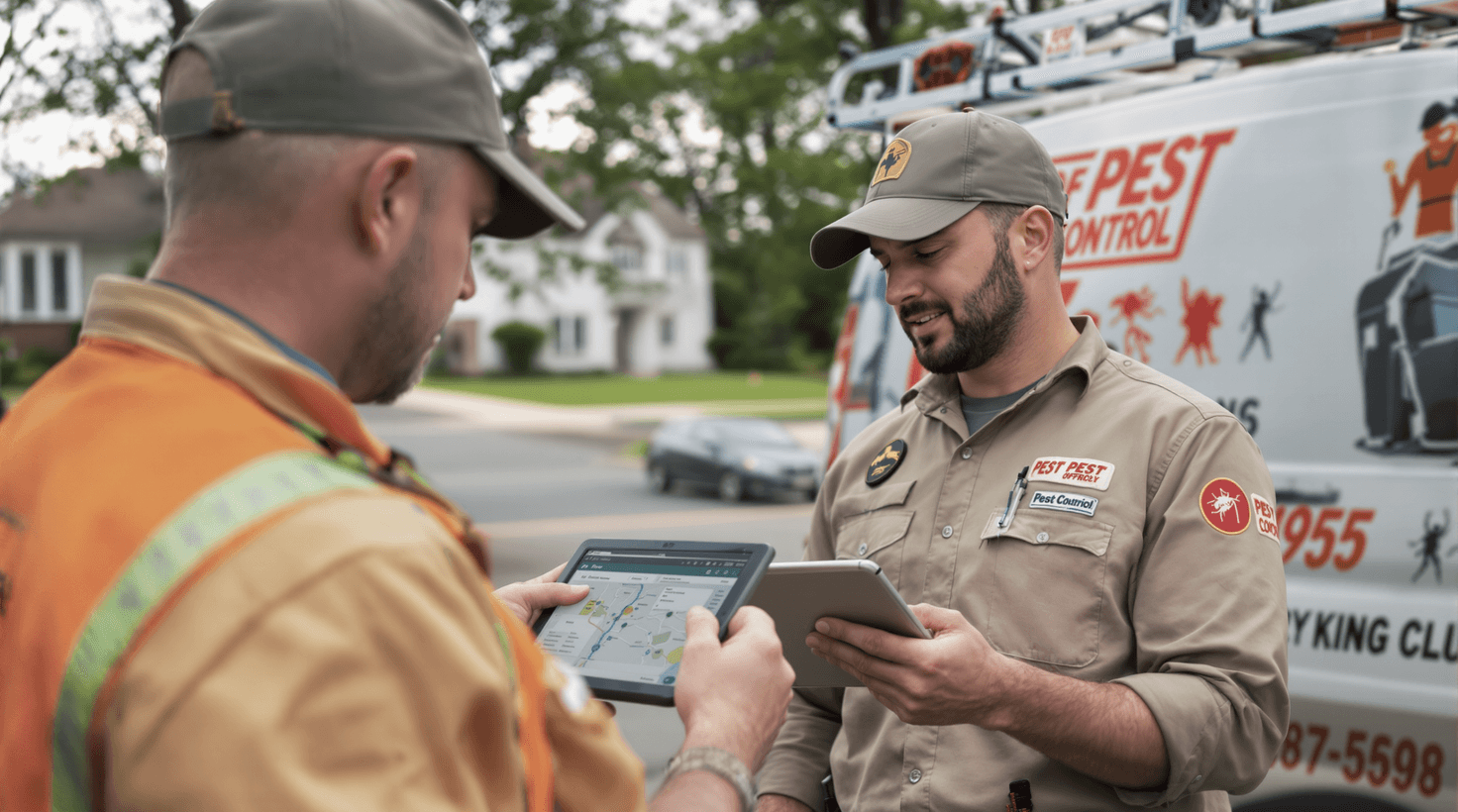
It's 7:43 on a Thursday in early May. Your last technician just rolled into the shop after a 9-stop day. The office phone has been silent since 5:30, when your office manager left to pick up her kids. Three voicemails are waiting — two from panicked homeowners, one with carpenter ants emerging from a kitchen baseboard, another with a wasp nest the size of a basketball over a back door.
The first homeowner already booked with a competitor at 6:11 PM. Their AI phone agent answered on the first ring, asked three questions, and put her on the schedule for 9 AM Friday. By the time you call her back at 8:30 the next morning, she has paid a $295 deposit somewhere else.
But here's what that story is really about: that homeowner wasn't a one-time cockroach call. She was a quarterly plan customer worth $650-900 a year for the next four to seven years. You didn't just lose a job. You lost a recurring account before it ever started.
That's where pest control AI pays off in 2026 — not in detection cameras or robotic technicians, but in answering the phone when you can't, running tighter routes, keeping chemical logs clean enough to survive an unannounced state inspector, and — most importantly — converting first-time callers into recurring subscribers and then keeping them there. This guide covers which tools move those numbers, what they cost, and what order to deploy them.
TL;DR — Top 3 Recommendations
- Use ChatGPT or Claude (free) today for review responses, marketing emails, and pest-specific service pages — saves 3-5 hours/week the first week.
- Deploy AI phone answering ($199-449/month) to capture the after-hours and overflow calls you're losing right now to faster competitors.
- Get on a pest-specific FSM platform — GorillaDesk ($49/mo) or Jobber ($39/mo) — and connect it to QuickBooks. Everything else builds on this foundation.
The Best AI CSR for Pest Control Companies
An AI CSR (customer service rep) for pest control is a phone agent that answers calls 24/7, asks the right triage questions ("Do you see them in the kitchen or the walls? How long has this been going on?"), books recurring-service appointments directly into your scheduling software, and captures leads while your techs are on routes and can't pick up. For pest control specifically, that 24/7 availability matters more than in most trades — infestations feel urgent, and homeowners who don't reach someone in the first hour typically move on to the next Google result.
Two tools already covered in this guide handle this well. NextPhone ($199/month flat) is purpose-built for pest control: it identifies pest type, qualifies urgency, and books directly into GorillaDesk, Jobber, or Housecall Pro with no per-minute billing during summer surge. Sameday AI ($449/month) adds a deeper triage layer — it separates a routine ant call from a termite swarmer emergency and routes the latter for priority dispatch, which matters when a commercial kitchen account calls at 9 PM before a health inspection.
Either one eliminates the scenario in the opening of this guide: the competitor who answered at 6:11 PM and collected the deposit before you called back in the morning.
The Recurring-Plan Math Nobody Talks About
Most pest control AI guides open with revenue bands and net margins. Skip that. The number that actually explains this business is the difference in lifetime value between a one-time caller and a recurring subscriber.
A customer who calls about a cockroach infestation, gets treated once for $185, and never hears from you again is worth $185. A customer who signs a quarterly prevention plan at $149/quarter is worth $596/year — and industry retention data puts the average recurring pest control customer at 4.5-6 years before attrition. That's $2,600-$3,500 in lifetime value from a single converted subscriber.
The companies compounding revenue year over year aren't winning more first calls. They're converting a higher share of those first calls into recurring plans, and they're losing fewer existing subscribers to silence and slow service.
Here's what that looks like by the numbers:
| Metric | Industry Range | Best-in-Class |
|---|---|---|
| One-time to recurring plan conversion | 18-28% | 38-45% |
| Annual recurring plan churn | 22-30% | 12-16% |
| Route stops per technician per day | 7-9 | 11-14 |
| Recurring vs. one-time LTV ratio | 14:1 | 19:1 |
| Missed call rate (small operators) | 30-50% | 8-12% |
Every tool in this guide ties back to those rows. The AI phone agent attacks the missed-call rate and the conversion number. Route optimization attacks the stops-per-day number. Automated review collection attacks the reviews-to-conversion funnel. The FSM platform ties it together and keeps chemical logs audit-ready.
Quick Wins — Free to $124/Month
These three moves cost essentially nothing, take less than 5 hours total to set up, and deliver visible results in the first week.
Use ChatGPT or Claude for Every Piece of Business Writing
You're spending 3-5 hours a week on writing tasks — or skipping them entirely because routes and dispatches are eating your day. Marketing emails don't go out. Google reviews accumulate without responses. Your website still has the same three generic pages from when you first launched.
Open chat.openai.com or claude.ai, create a free account, and start using AI as your on-demand copywriter. Five minutes per task, no writing skills required.
Write a 175-word promotional email for my pest control company warning homeowners that carpenter ant season is starting. Emphasize that carpenter ants nest inside structural wood and can cause damage that mimics termite activity if left untreated. Encourage booking a preventive perimeter treatment now, before swarms appear in the kitchen or bathroom. Business name: [YOUR COMPANY]. City: [YOUR CITY]. Include our 90-day satisfaction guarantee and a clear call-to-action to book online or call [PHONE]. Friendly tone, not salesy. End with a P.S. about our recurring quarterly plan saving customers ~30% versus reactive treatments.
Write a professional, friendly response to this Google review for my pest control company:
"[PASTE REVIEW HERE]"
Thank the customer by their first name, reference the specific pest issue or service they mentioned, and invite them to reach out if they ever need a follow-up. Keep it under 75 words. Mention our recurring service plan only if the review suggests they'd benefit from one (recurring pest pressure, multi-pest history). Otherwise just thank them warmly and sign off from [YOUR NAME / TEAM NAME].
Write a 350-word service page for a pest control company explaining our bed bug heat treatment services. Cover: how bed bugs spread (luggage, used furniture, multi-unit buildings), why DIY treatments and over-the-counter sprays consistently fail, what our heat treatment process looks like (target temp of 120-135°F, 6-8 hours), what we do for follow-up verification, and what the customer should do to prepare the home (laundry, declutter, pet plans). Location: [CITY, STATE]. Include a strong call to action to schedule a free inspection. Write at a 7th-grade reading level.
Save your best prompts in a Google Doc so your office manager and any future hires can use them. Time saved: 3-5 hours/week. Cost: $0.
Set Up Automated Review Collection
If you have fewer than 30 Google reviews or a rating below 4.5 stars, this is your highest-leverage early move. A pest control company with 80+ reviews and a 4.8 rating outranks and out-converts a competitor with better technical work but only 15 reviews. Google's local algorithm rewards review volume and recency — homeowners trust quantity more than they care to admit.
NiceJob
Best for: Pest control teams of 1-10 technicians
Reputation marketing platform that automatically sends a Google review request via text message after every completed job. Integrates directly with GorillaDesk, Jobber, and Housecall Pro — when a technician marks a job complete in the field, the customer gets a one-tap review link within two hours. AI-suggested responses for incoming reviews. Pest control companies report 3-5x more reviews per month after implementation.
Setup runs under an hour: sign up at get.nicejob.com, connect to your FSM, customize the message ("Hi [Name], thanks for choosing [Company] for your pest service today. If you have 30 seconds, we'd love your feedback: [Google Review Link]"), and set timing to 2 hours after job completion — fresh enough that the experience is vivid, late enough that the customer is no longer with the technician. Use the ChatGPT prompt above to respond to every review.
If you're already on Jobber's Grow plan ($199/month), built-in review requests are included — you may not need NiceJob separately. On a tighter budget, manually texting Google review links after each job costs $0, but most operators don't sustain that discipline past week two.
Businesses with 50+ reviews get 266% more inbound leads than those under 10. At a $250 average job value, getting from 15 to 50 reviews pays back NiceJob's $75/month many times over in the first 90 days.
Get on a Pest-Specific Field Service Platform
If you're managing scheduling on a whiteboard, a paper calendar, or a Google Sheet — this is the single biggest operational upgrade you can make. A field service management (FSM) platform combines scheduling, customer records, route optimization, invoicing, chemical tracking, and technician dispatch into one system that talks to itself.
GorillaDesk
Best for: Small pest control teams (1-5 technicians)
Purpose-built for pest control. AI-powered route optimization, automated text/email reminders, chemical usage tracking that meets most state recordkeeping requirements, auto-invoicing after job completion, and a mobile app technicians actually use. 14-day free trial, no credit card required. Plans scale by customer count: $49/mo (1 route), $165/mo (up to 600 customers), $375/mo (unlimited).
Jobber
Best for: Small to mid-sized operations (1-20 techs)
General home-service platform with built-in Jobber AI that drafts quotes, follow-up messages, and job descriptions. Polished UI, transparent pricing, integrations with QuickBooks, Stripe, and CompanyCam. 14-day free trial. Strong choice if you also run lawn or cleaning divisions; many of the same tools appear in our landscaping company AI guide.
GorillaDesk has pest-specific features (chemical tracking, restricted-use product documentation fields, applicator-aware scheduling) baked in. Jobber is broader and more polished — the better choice if pest control is one of several service lines. Both integrate with QuickBooks. Connect that integration on day one to eliminate double-entry invoicing and let job revenue flow into your books automatically.
For cross-shopping with peer trades, our HVAC company guide and plumbing business guide cover Jobber and Housecall Pro in detail.
ROI Snapshot
Monthly Cost
$49/mo
Time Saved
7hrs/week
Monthly Value
$3,760
ROI
7573%
Quick-wins total: $0-$124/month. Time saved: 10-15 hours/week. Measurable results within 7 days.
Growth Engine — Capturing Lost Revenue
Quick wins buy back hours and stop the most obvious leaks. This is where real revenue lives — capturing leads that currently disappear into voicemail, squeezing more jobs out of the same fleet, and building the content that keeps your phone ringing in months 6 and 12. Investment: $200-500/month. Expected return: $6,000-16,000/month.
AI Phone Answering — Stop Losing After-Hours Calls
This is the single highest-ROI move in this guide. If 60-80% of pest control leads go to the first company that answers, and you miss 15-25 calls per month — after hours, during lunch, while one line is in use — at $150-500 per job, you're losing $2,250-12,500/month. A purpose-built AI phone agent costs $199.
But the revenue math understates the real damage. A missed call at 7 PM on a Tuesday isn't just a lost one-time job. If your conversion-to-recurring rate on answered calls is 35%, and you miss 20 calls a month, you're potentially forfeiting 7 new recurring accounts every 30 days — roughly $4,500-$6,000 in annual recurring revenue per month of missed calls. That number compounds.
NextPhone
Best for: Pest control companies with 1-5 technicians
AI phone answering built specifically for pest control. Flat $199/month with unlimited calls — no per-minute billing or seasonal surge fees. Handles pest identification questions, qualifies urgency (active infestation vs. routine prevention), and books appointments directly into GorillaDesk, Jobber, or Housecall Pro. Call transcripts delivered every morning for owner review.
Sameday AI
Best for: Higher-volume operators wanting deeper urgency triage
AI Voice CSR with pest-specific training, built by a Y Combinator-backed home-services AI company. Differentiates routine prevention calls from emergency infestations and routes the latter for priority dispatch. Includes follow-up text confirmations and integrations with ServiceTitan, FieldRoutes, Jobber, and Housecall Pro. 14-day free trial; flat monthly rate covers unlimited routine calls during peak season.
Deployment is straightforward: provide your service menu (pests treated, zip codes, pricing ranges, urgency triage rules), connect to your FSM via Zapier so bookings flow into your calendar, and set call forwarding to route to AI after 3 rings during the day and directly after 6 PM and on weekends. Then run a real test call — pretend you just found termite swarmer wings on a windowsill. If the AI handles that with the right urgency and books a same-day or next-morning inspection, it's ready. Review transcripts each morning for the first two weeks; five minutes catches mistakes early before they cost you jobs.
For a typical 3-tech operation, capturing 10-20 missed calls per month at a $250 average puts $2,500-5,000 monthly into the P&L. ROI on a $199 tool: 12-25x.
Don't Skip the Test Call
Before going live with any AI phone system, call your own number and play a panicked homeowner who just spotted termite swarmers in the bathroom. If the AI can handle that scenario with the right urgency and book the inspection, it can handle anything. If it can't, fix the script before you flip it on.
Route Optimization — More Stops, Less Windshield Time
Your technicians spend 30-40% of every shift behind the wheel. With fuel above $4/gallon in many markets and each truck logging 100-200 miles a day, that's $800-2,000/month in fuel alone — plus the opportunity cost of 1-2 jobs per technician per day they can't fit because traffic ate the morning.
A well-optimized route does more than cut fuel costs. It's the mechanism by which you actually serve more recurring accounts without adding trucks. If the industry best-in-class is 11-14 stops per technician per day and you're averaging 7-9, closing that gap by even three stops per tech per day — on a 3-tech team — is 9 additional service calls daily. At $75-150 per recurring stop, that's $675-$1,350 in additional daily revenue from the same headcount.
If you set up GorillaDesk or Jobber in the quick-wins phase, you already have basic route optimization. Activate it, then enter accurate job durations for each service type — the optimizer needs these inputs:
- General pest interior + exterior: 30-45 minutes
- Termite WDO inspection: 60-90 minutes
- Bed bug heat treatment: 2-3 hours
- Mosquito barrier spray: 20-30 minutes
- Rodent exclusion: 60-120 minutes
- Wildlife exclusion (raccoons, squirrels): 90-180 minutes
If the optimizer thinks every job takes 30 minutes but termite inspections actually run 90, routes fall apart by lunch.
For companies running 3+ technicians with 8+ stops per day, a dedicated route optimization layer adds another 20-30% efficiency gain on top of basic FSM routing:
OptimoRoute
Best for: 3+ technicians with 8+ stops/day
Standalone route optimization that respects job duration, time windows, technician skills (not every tech is licensed for termite work or restricted-use products), and real-time traffic. Custom time-window constraints per stop — useful for re-entry interval rescheduling. 30-day free trial, no contract. A 5-driver operation runs ~$245/month.
FieldRoutes (covered in the competitive-advantage section below) reports pest control customers complete 21% more jobs per day after switching to its AI routing — and reduce technician drive time by 30-60 minutes daily. For a 4-tech team, even half that gain means 1-2 extra jobs per technician per day at $150-300 each, plus $300-600/month back in fuel. Conservative additional revenue: $2,000-5,000/month.
The same route-density math shows up in other stop-heavy home-service trades — our guide to AI tools for pool service companies covers the equivalent routing stack plus chemistry-dosing automation specific to pool routes.
AI-Powered Marketing Content at Scale
Your competitor ranking #1 for "pest control [your city]" has 30+ service pages, weekly social posts, and seasonal blog content. You have three pages and a Facebook post from last November. Content drives organic search traffic; organic search traffic is free leads — and unlike paid ads, content you publish this month keeps generating calls in month 18.
Use ChatGPT or Claude (free tier is enough for most operators) to build your highest-leverage content first:
- One service page per pest type — ants, termites, cockroaches, bed bugs, rodents, mosquitoes, spiders, wasps, wildlife. 8-12 pages at 300-500 words each.
- Four seasonal blog posts — spring (ant/termite swarms), summer (mosquito/wasp), fall (rodent migration indoors), winter (commercial accounts and prevention plans).
- Monthly "Pest of the Month" email — 150 words warning customers about the current seasonal threat, with a booking link. Mailchimp's free tier handles 500 contacts.
The third item is also your best recurring-plan retention tool. A customer who hears from you every month — with useful, locally specific content, not a generic newsletter — churns at roughly half the rate of a customer who only sees you when you show up to spray.
Write an 800-word blog post for a residential pest control company titled "Why Mice and Rats Move Indoors Every Fall — and How to Stop Them Before They Settle In." Cover: when rodent migration starts in [YOUR STATE], the top entry points in residential homes (garage door seals, pipe penetrations through siding, dryer vents, foundation cracks under crawl spaces), signs of rodent activity homeowners typically miss (gnaw marks on baseboards, droppings in attic insulation, grease rub marks along walls), why DIY snap traps and over-the-counter bait stations rarely solve an established colony, and what a professional rodent exclusion service involves. Close with a CTA to schedule a free exclusion inspection. Write for homeowners, not pest control professionals. Mention [YOUR CITY] 3-4 times for local SEO. Use H2 and H3 subheadings.
If volume justifies it, Jasper AI ($59/month) adds brand voice training so output sounds consistent. For most companies producing 4-8 pieces a month, free ChatGPT or Claude is enough.
Expect 3-6 months before content shows up in your call volume. But content compounds, and monthly emails convert one-time customers into recurring plans. Budget $1,000-3,000/month in attributable revenue once it ranks.
The Compliance Layer: EPA Re-Entry Intervals, RUP Logs, and Applicator Records
This is the section every generic pest control AI guide skips. It's also where your business is most exposed if a state inspector walks through the door.
Most FSM-level route optimizers (GorillaDesk, Jobber) treat every stop as a generic time block. They don't natively factor in pesticide re-entry interval (REI) requirements — the period after application during which a treated area can't be re-entered without PPE. If your technicians apply restricted-use products with a 4-hour or 24-hour REI, you need to either build those constraints into the schedule manually (block out re-entry windows on the customer's record before sending the optimizer to plan tomorrow) or move to a platform with native REI handling. PestPac is currently the most complete on that front; OptimoRoute supports custom time-window constraints per stop, which works as a competent workaround.
State pesticide applicator regulations require application records for 2-3 years depending on jurisdiction. Records must include the EPA registration number of every product applied, the application rate, target pest, location treated, date and time, and the licensed applicator's name. Paper logs are still legal in most states but they're audit-fragile — water damage, lost trucks, illegible handwriting, missing signatures. Digital records that auto-populate from your FSM are more defensible and faster to produce when an inspector calls.
GorillaDesk and PestPac both generate records that satisfy most state agriculture department audits. Before migrating between platforms, export your full chemical history as a CSV or PDF and verify with your state's pesticide regulatory office what format and retention period is required.
The compliance work isn't optional. The AI part is the structure: a system that captures application data at the moment of service, ties it to the right customer and applicator, and produces a clean printable record on demand.
Competitive Advantage — Month 4 and Beyond
These tools separate you from 90% of pest control companies in your market. They require the quick-wins and growth-engine phases to be running smoothly first. The temptation to skip ahead is real — resist it. The ROI from enterprise platforms comes from the data they inherit from your existing system. Switching with 90 days of history is far less valuable than switching with 18 months.
Upgrade to an Enterprise FSM Platform
If you've outgrown GorillaDesk or Jobber — 5+ technicians, multiple service lines, $500K+ annual revenue, commercial accounts — you need a platform with AI sales coaching, predictive demand forecasting, and comprehensive chemical compliance automation.
FieldRoutes
Best for: Growth-focused teams with 5-50 technicians
Cloud pest control platform from ServiceTitan with AI route optimization (21% more jobs/day in case studies), Sales Pro AI coaching that listens to phone reps and suggests real-time improvements to close rates, automated marketing workflows for customer reactivation and seasonal campaigns, and predictive analytics that forecast demand spikes from weather and historical patterns.
PestPac
Best for: Compliance-heavy operations with 10+ technicians
Enterprise pest control software from WorkWave with industry-leading chemical tracking and EPA compliance documentation, Wavelytics business analytics for revenue trends and operational bottlenecks, AI-driven email marketing, and drone inspection integration for hard-to-reach commercial accounts. The standard for companies servicing restricted-use pesticides at scale or commercial food-service accounts where regulatory documentation is non-negotiable.
FieldRoutes is the growth play — sales coaching, marketing automation, aggressive route AI. PestPac is the compliance play — chemical tracking, IPM logbooks for commercial accounts subject to FDA, USDA, or AIB audits. Both require a sales call for pricing. Negotiate hard, ask for waived setup fees and a 90-day exit clause.
One practical note on timing: the biggest ROI from any enterprise FSM comes from 12+ months of accumulated customer data, chemical history, and recurring service contracts. Switching platforms resets all of that, disrupts your team for weeks, and costs days of migration work. If you have 1-3 technicians, stay on GorillaDesk or Jobber and maximize them before evaluating an upgrade.
Comprehensive Reputation Platform
You're collecting reviews now, but your full online presence likely has gaps: inconsistent business hours across directories, no webchat on your website, no visibility into what customers are actually saying across platforms.
Birdeye
Best for: Multi-location pest control companies
All-in-one reputation platform: automated review collection across Google, Yelp, and Facebook; AI-generated review responses; business listings management across 50+ directories (so your address, hours, and phone are consistent everywhere); AI webchat that captures leads from your website 24/7; and sentiment analysis that surfaces operational issues before they become patterns. If three customers in a month mention "technician was late," Birdeye flags it as a routing problem rather than letting it sit hidden in raw review text.
Birdeye makes most sense for multi-location operators or single-location shops doing $300K+ revenue. For everyone else, NiceJob from the quick-wins phase plus diligent manual updates of your Google Business Profile, Yelp, and Apple Maps listings is more cost-effective — see our roofing company AI guide for parallel reasoning across adjacent trades.
Financial Optimization with QuickBooks AI
Pest control is deeply seasonal. If you're not forecasting cash flow by August to survive February, you're borrowing money or sweating payroll every winter.
QuickBooks Online
Best for: All pest control businesses
Industry-standard accounting with AI-powered receipt categorization (auto-assigns fuel, supplies, and chemical purchases), cash flow forecasting that predicts your position 30-90 days out, smart invoicing with automated payment reminders, and mileage tracking via the mobile app. Integrates with GorillaDesk, Jobber, FieldRoutes, and PestPac. The Plus plan ($99/month) adds project-based profitability tracking — assign revenue and expenses to individual jobs to see which services actually make money.
Pest-control-specific setup: create expense categories for chemicals/materials, fuel, vehicle maintenance, equipment, uniforms, licensing fees (applicator renewals and CEU costs), and insurance. Connect your FSM so completed jobs and payments sync automatically. Enable cash flow forecasting to predict slow-season gaps — run the forecast in August, not January. Use mileage tracking on the mobile app: at the 2026 IRS rate, each technician driving 100+ miles/day generates $20,000+/year in deductible mileage. Pull quarterly reports by service type — you may discover bed bug treatments are twice as profitable as general pest, which should change how you market and price.
ROI Snapshot
Monthly Cost
$99/mo
Time Saved
3hrs/week
Monthly Value
$2,600
ROI
2526%
What Not to Spend Money On
Don't sign with a done-for-you AI agency before trying self-service tools. Managed services like PEST AI charge $500-2,000+/month with long-term contracts. The same capabilities — phone answering, review management, content creation — assemble for $200-500/month using the individual tools above. Only consider an agency if you've tried self-service and genuinely can't spare 30 minutes a week to manage it.
Don't use AI for pesticide treatment recommendations. AI is excellent for marketing, scheduling, and operations. It is not qualified to recommend specific chemical applications, dilution rates, or treatment protocols. That's your state-licensed technicians' work, and using AI for treatment advice creates liability exposure that may violate applicator regulations.
Don't invest in AI pest detection cameras for residential yet. Connected camera systems with computer vision (piloted by Anticimex and Rentokil for commercial accounts) are interesting but unproven for small residential operators. Revisit in 12-18 months.
Don't switch FSM platforms every six months. Value compounds with accumulated customer data, chemical logs, and recurring contracts. Switching resets all of it. Commit for 12 months before evaluating alternatives.
Getting Started Checklist
- Create a free ChatGPT or Claude account today and respond to your three most recent Google reviews
- Sign up for NiceJob ($75/month) and connect it to your FSM, or start manually texting Google review links after every job
- If you're not on an FSM yet, start a 14-day free trial of GorillaDesk or Jobber and import your customer list
- Connect QuickBooks to your FSM on day one to eliminate double-entry invoicing
- Set up automated appointment reminders (text 24 hours and 2 hours before each job)
- Create service pages on your website for your top 3 pest types using the CopyablePrompt templates above
- Sign up for NextPhone ($199/month) or Sameday AI; configure after-hours forwarding and run a real test call before going live
- Activate route optimization in your FSM and enter accurate job durations for each service type
- Audit your chemical recordkeeping — verify your FSM's records meet your state's pesticide applicator requirements
- Send your first seasonal marketing email via Mailchimp using a ChatGPT-drafted template
- After 60 days, pull your metrics: missed call rate, review count, jobs per technician per day, days-to-payment
- Evaluate FieldRoutes, Birdeye, and QuickBooks Plus only after quick-wins and growth-engine results are measurable
Here's a breakdown of the costs and expected returns:

FAQ
Does AI route optimization account for re-entry intervals on EPA-restricted pesticides?
Most FSM-level route optimizers treat every stop as a generic time block — GorillaDesk and Jobber don't natively factor in pesticide re-entry interval requirements. If your technicians apply restricted-use products with a 4-hour or 24-hour REI, you need to either build those constraints into scheduling manually (block out re-entry windows on the customer's record before sending the optimizer to plan) or move to PestPac, which has dedicated REI compliance fields. OptimoRoute supports custom time-window constraints per stop, which is the practical workaround most operators use for scheduling follow-up verification visits after REI windows close.
Can an AI phone agent tell the difference between a general pest call and a termite emergency?
Yes, and getting it right is worth real money. Routine scenarios (ants in the kitchen, annual prevention renewal) versus urgent ones (termite swarmers, active rodent damage in commercial kitchens, cockroach infestation before a health inspection) need different responses — urgent calls trigger immediate text alerts to the owner or on-call technician, while routine calls book into the next available slot. Both NextPhone and Sameday AI let you define these triage rules during setup. Spend 30 minutes on that configuration upfront. The AI is only as smart as the rules you give it.
What happens to my chemical usage logs if I switch FSM platforms?
This is the biggest hidden cost of switching that nobody mentions during the sales call. Before migrating, export your full chemical usage history as a CSV or PDF and verify with your state's pesticide regulatory office (typically the Department of Agriculture) what format and retention period is required — most states require 2-3 years of records. PestPac has the most complete compliance export tooling. If you're moving from spreadsheets or paper to your first FSM, photograph or scan every paper log before it disappears in transit.
How do I keep AI-generated marketing content from sounding generic?
Always include your city, specific neighborhood names, local pest species, and regional context in every prompt. A blog post about "common household pests" could be from anywhere. A post about "why sugar ants invade Austin kitchens every March when soil temperatures hit 75°F" is obviously local and ranks better. Feed the AI local landmarks, HOA communities you service, and region-specific conditions — humidity in Gulf Coast markets, drought-driven rodent migration in the Southwest, German cockroach pressure in dense apartment markets. AI can't add local expertise it doesn't know about, but it weaves in everything you give it.
How does recurring-plan churn actually show up in the P&L?
It's slow enough that most operators don't notice it until it's a problem. If you start the year with 400 recurring accounts and churn 25% annually, you lose 100 accounts — but you're probably adding 100-120 new ones, so headcount looks flat. The damage is in the LTV math: those churned accounts had 3-5 years of recurring revenue ahead of them. Industry operators who've cut churn from 28% to 15% using monthly email touchpoints and proactive renewal calls report 18-22% revenue growth in year two without adding a single new customer. The tools that help most: automated renewal reminders in GorillaDesk or Jobber, monthly pest-specific emails via Mailchimp, and review-request timing (customers who leave a positive review churn at roughly half the rate of those who don't).
Will my state pesticide applicator license be affected by using AI in my business?
No. AI tools for scheduling, phone answering, marketing, and routing have no interaction with pesticide application in any regulatory sense. The one compliance intersection worth knowing: if your FSM generates application records, those records must meet your state's documentation requirements (product name, EPA registration number, application rate, target pest, location, applicator name, date and time). GorillaDesk and PestPac both generate records that satisfy most state Department of Agriculture audits. Confirm with your state regulator whether digital signatures are accepted in lieu of paper.
Is $199/month for AI phone answering worth it for a solo operator?
It depends on call volume, but the recurring-account math usually tips the answer to yes. If you're taking 5-10 inbound calls per day and missing 30-40% of them, NextPhone pays for itself by capturing one additional job per week. More importantly: if even one of those captured calls converts to a quarterly recurring plan, that's $596/year in recurring revenue that pays for three months of NextPhone. Below 3 calls per day, start with Google Business Messages (free) and a clear voicemail-to-text setup, then upgrade when volume justifies it.
The pest control companies pulling away aren't winning because their technicians are better at eliminating pests. They answer every call, pack routes with 11-14 stops instead of 7-9, convert first-time callers into recurring subscribers at twice the industry average, and then actually keep those subscribers through consistent follow-up. The tools in this guide address each of those four gaps. Start with the checklist: create a free ChatGPT or Claude account and respond to your three most recent Google reviews before the end of today. Everything else builds from there.
More AI Implementation Guides
AI Tools for Pressure Washing Businesses (2026 Guide)
The best AI tools for pressure washing businesses in 2026. Capture missed calls, quote via satellite, automate follow-up, and win more jobs without ad spend.
AI Tools for Junk Removal Companies: 2026 Owner's Guide
The 2026 guide to AI tools for junk removal companies — answer every call, quote a pile from a photo, optimize routes, and cut tipping fees. Start free.
AI Tools for Pool Service Companies (2026 Guide)
The complete 2026 guide to AI tools for pool service companies — route density, chemistry dosing, AI phone answering, and a premium IoT monitoring tier.
AI Tools for Cleaning Services: 2026 Guide
Best AI tools for cleaning services in 2026. Cut admin hours in half, fill schedule gaps, convert more leads, and scale your team step by step.
Best CRM & AI Marketing Tools for Fence Companies
Compare CRM & AI marketing tools for fence companies. Cut quote turnaround from days to minutes, never miss a lead call, automate follow-up. Pricing inside.
Best AI Receptionist for Flooring Installers & Tilers
AI receptionist for flooring installers & tilers — capture every call 24/7, automate lead follow-up & marketing. Save 15+ hrs/week. See pricing & setup steps.
Keep exploring
See every AI implementation guide we've published for Trades & Contractors, or browse the full library by industry or category. Looking for a specific platform? The AI tools directory indexes every product mentioned across our guides, and the comparisons hub puts the most-asked head-to-heads side by side.