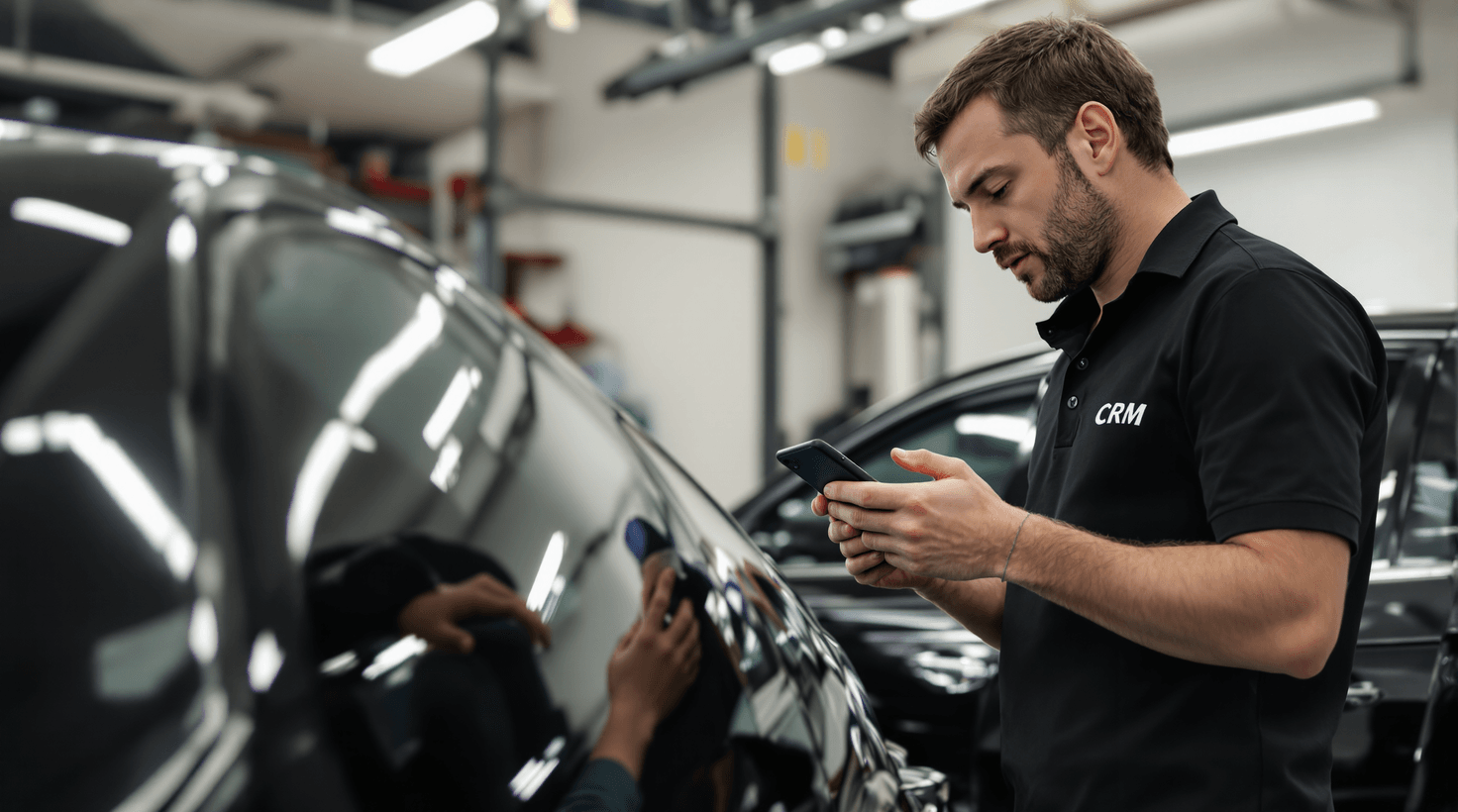
It's 11:47 a.m. on a Tuesday. You're elbow-deep in the back of a 2019 Tacoma, working a brush around the seat tracks where the previous owner's labrador shed for six years. Your phone buzzes on the dash — third Instagram DM in an hour asking "how much for a full detail?" Two missed calls on voicemail. A Google review notification you haven't opened. And in 90 minutes you're supposed to be 14 miles north for a ceramic coating consult, except your noon appointment just texted asking if you can swing by today instead.
You can either keep detailing or keep up with the business. Not both.
That tension is sharper for mobile operators than anyone else in the trades. You don't have a front desk, a waiting room, or a slow Tuesday to catch up on admin. Your office is a van doing 30 mph between stops, and every time you pull over to answer a booking inquiry, you've just made the next client five minutes late. The queries driving traffic to this page — "best mobile detailing CRM," "detailing scheduling app," "how to stop losing leads on the road" — aren't curiosity searches. They're frustration searches.
This guide is built around that specific reality. The tools here were chosen because they work on a phone between stops, integrate with how mobile detailers actually run their day, and pay back their cost quickly enough that you don't need to run a spreadsheet to justify them. We start with the free stuff you can set up this afternoon and build toward the infrastructure that lets you scale past your own capacity.
TL;DR — The 3 Highest-Impact Moves
- Automate Instagram DM responses with ManyChat ($29/mo) — capture pricing inquiries when you can't put down the polisher.
- Switch to a detailer-specific CRM with AI booking — Urable ($70/mo) or Jobber ($29-$149/mo solo) cuts no-shows 30-50% and proactively fills slow days.
- Plug NiceJob ($75/mo) into your CRM for automated review collection — most shops jump from 1-3 reviews/month to 15-25 within 90 days.
The Best CRM for Ceramic Coating and Detailing Shops
If you sell ceramic coatings, paint correction, or recurring maintenance plans, you need more than a booking app — you need a detailing CRM that tracks the coating warranty, schedules the maintenance washes that protect it, and follows up when a customer is due. The detailer-specific options that handle this well are Urable ($70/mo) and OrbisX ($100/mo), both built around the detailing workflow, with Jobber ($29–$149/mo) the strongest general field-service CRM if you also run mobile routes. The thing that separates a real detailing CRM from a generic scheduler is warranty-and-recoat tracking — off-the-shelf tools don't model it.
Why a ceramic coating business specifically needs CRM software:
- A coating is a multi-year relationship, not a one-time sale. That $1,200 coating comes with annual inspections and maintenance washes. A CRM that schedules them automatically turns one job into a $2,000+ lifetime customer.
- Warranty terms are a built-in follow-up engine. The CRM knows the coating's anniversary and prompts the recheck — protecting your warranty exposure and re-booking the customer in the same move.
- Quoting a ceramic package is different math than a wash-and-wax. Detailing CRMs price by service tier and vehicle condition, so the on-site quote is fast and accurate instead of a guess you regret.
The free and entry-level tools below plug the lead leak first; the CRM is the foundation that makes coating revenue repeatable.
The Mobile Detailer's Actual Problem
The U.S. car wash and auto detailing market is estimated at roughly $18-19 billion (IBISWorld, 2026), with around 175,000-176,000 workers spread across roughly 60,000 mostly small operations. Margins can run healthier than most home-service trades on premium services — gross margins commonly cited in the 60-80% range on labor-heavy work, with ceramic coatings landing around 55-70% gross — though actual take-home varies widely by market and overhead. A solo mobile operator can clear $80K-$150K, a fixed shop $200K-$1M+. The economics work.
What breaks mobile operators specifically isn't their craft — it's three operational realities that fixed shops don't face in the same way:
Booking is entirely asynchronous. Fixed shops have a phone and a person to answer it. A mobile tech has a phone sitting on a dashboard vibrating while they're under a car with compound on their hands. Every unanswered DM, missed call, or slow quote response is a lead that went to whoever was faster — not whoever was better.
Route math is unforgiving at scale. Once you're running 4+ stops a day, inefficient routing isn't just annoying — it's money. Poor routing commonly costs mobile operators hundreds of dollars a month in wasted fuel, plus missed appointment slots when the day's schedule falls apart. That's before you factor in the "are you on your way?" texts that eat another 20 minutes.
The repeat rate gap is enormous. Retention varies widely across the industry — ad hoc, one-off customers churn fast, while shops running subscription or membership-style maintenance plans report retention well above that. The difference isn't price or quality — it's follow-up. Most mobile detailers have no system for it, so the customer who paid $175 in March doesn't come back until October when their car is disgusting and they Google "detailer near me" again. A customer retained at 3-4 visits a year is worth $600-$2,000 annually. That's the real number.
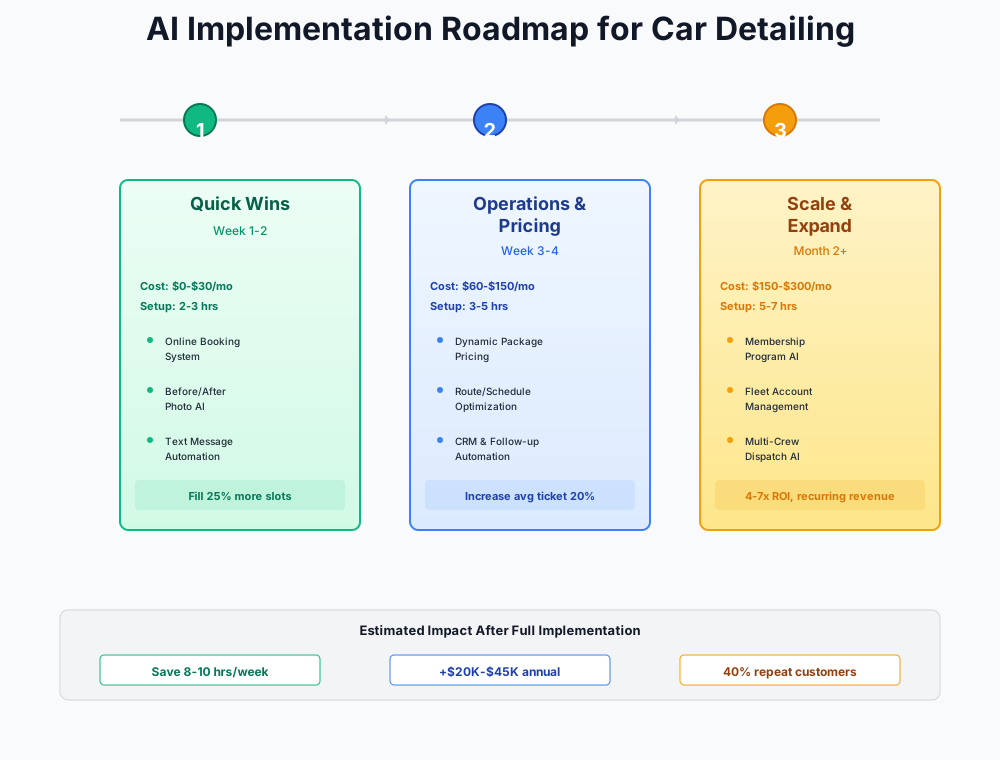
The tools that follow are sequenced to solve these three problems in order: first plug the lead leak, then fix the booking and routing foundation, then scale past your own capacity.
Stage 1: Plug the Lead Leak (Week 1-2, $0-$15/mo Total)
Three moves, free to cheap, that target the revenue you're losing right now — missed Instagram DMs, no follow-up to past customers, and a marketing presence that goes dark every time you have a full week on the van. Total cost: $0-$15/mo. Setup time: one afternoon.
Move 1: Build Your Customer Communication Library with ChatGPT or Claude
You already know you should text the customer who just paid $175 for a full detail. You just don't do it, because composing a message from scratch on a phone with compound on your fingers between stops is enough friction to skip it every single time.
A free AI assistant builds your entire follow-up library in 20 minutes. You save them once as iPhone Text Replacements (or in your CRM), and from then on, sending the right message takes two taps.
I run a car detailing business called [Your Business Name] in [City, State]. Create 8 text message templates I can copy-paste into my phone, each under 160 characters:
(1) Post-service thank you with embedded Google review link (2) 24-hour follow-up checking that they're satisfied with the work (3) 3-month reminder that they're due for their next maintenance detail (4) 6-month win-back text for lapsed customers (5) Spring season promotion (paint correction + ceramic coating push) (6) Winter interior detailing promotion (for slow months in northern states) (7) Referral request offering $25 credit for a friend's first detail (8) Ceramic coating maintenance reminder for customers who got coated 12+ months ago
Make them sound like a real person texting, not a corporate mass message. Include placeholders for [Customer Name] and [Vehicle].
Drop the output into your phone's Text Replacement settings (iPhone: Settings → General → Keyboard → Text Replacement) so typing ;detailthx auto-expands into your full thank-you template. Set a recurring 15-minute Friday reminder to send re-engagement texts to anyone in your CRM who hasn't booked in 90+ days.
Time saved: 3-4 hours/week. Revenue recovered: $500-$2,000/month from re-activated customers. Cost: $0.
Don't Skip the Send Step
Generating templates and never actually sending them is the #1 way detailers waste this. Put a recurring calendar block on your phone — 15 minutes every Friday morning, or whenever your slowest day is. Use that block to scan your last 90 days of jobs and send the appropriate follow-up to anyone you haven't touched.
Move 2: Automate Your Instagram DMs with ManyChat
If Instagram is one of your top lead sources — and for ~80% of detailers, it is — every DM you don't answer in 15 minutes is probably a lost booking. Detailing is one of the most DM-driven service categories on Instagram because the before/after format is native to the platform. The downside: you're constantly fielding "how much for a [random vehicle]?" while you're inside another vehicle.
ManyChat's free plan lets you test the platform but caps at 25 active contacts per month — enough to learn the tool, not enough to run it as your primary DM channel. The Pro plan at $29/mo (annual billing) or $39/mo (month-to-month) removes that ceiling and is the practical entry point for any detailer actively getting Instagram inquiries. It lets you build keyword-triggered auto-responses: when someone DMs "pricing," they get your service menu and a booking link before they have time to message a competitor.
ManyChat
Best for: Detailers whose primary lead source is Instagram DMs
The Instagram and Facebook DM automation platform. Build keyword triggers that auto-send pricing menus, service descriptions, and booking links the moment someone asks. In ManyChat's published case study with Gold's Gym, Instagram-driven booking volume rose 9x after adding DM automation. Works with Instagram Business or Creator accounts (not Personal).
The workflow that matters most for detailers is comment-to-DM. When someone comments "🔥" or "info" on your latest before/after Reel, ManyChat auto-DMs them your service menu. You catch leads who would never have reached out otherwise. Set this on every transformation post you publish.
Setup time: 1-2 hours. Time saved: 4-6 hours/week. Revenue recovered: $1,000-$3,000/month from captured leads.
If you've also built a Shopify-backed retail or merch component to your shop, the same DM-automation playbook scales — see how boutique retailers use ManyChat for product discovery for a sister-industry view of what the deeper flows look like.
Move 3: Batch a Month of Social Content in 1 Hour
You already know consistent Instagram posting drives leads. You just don't have time to post consistently. The fix isn't discipline — it's batching. Spend one hour a month creating content, then let Buffer auto-publish it on the schedule you set.
The stack:
- Canva (free) for before/after comparison graphics — search "before after comparison" templates and drop your photos in
- ChatGPT or Claude (free) for caption batches
- Buffer (free, 3 channels) for scheduling Instagram, Facebook, and Google Business Profile
Write 20 unique Instagram captions for a car detailing business. Each caption is for a before/after transformation post. Mix these tones evenly:
- 5 educational (explain what was done — paint correction, clay bar, ceramic coating, etc.)
- 5 excited/celebratory (focus on the transformation result)
- 5 with a clear call-to-action to book ("DM 'detail' for a quote" or "link in bio")
- 5 that tell a short story about the vehicle's owner or condition
Include 10-15 relevant hashtags per post (mix big and niche — #carDetailing alongside #ceramicCoatingChicago etc.). Keep each caption under 150 words. Vary opening hooks — don't start two captions the same way.
The trick most detailers miss: post to Google Business Profile too. GBP posts appear directly in local search results and drive calls. Buffer's free plan supports it. Most of your competitors aren't doing this, so it's an outsized SEO move for almost no extra effort.
For mobile detailers building a content engine on transformation videos, OpusClip (free tier with watermark; $15/mo unwatermarked) automatically slices a 5-10 minute timelapse into 5-10 ready-to-publish Reels — caption, hashtags, and viral-score included. Detailing transformations are some of the highest-performing content on the platform; OpusClip lets one shoot become a week of posts.
Stage 2: Build the Booking and Routing Foundation ($100-$300/mo)
Stage 1 stops the bleeding. Stage 2 builds the operational backbone that a mobile detailing business actually needs to run — a purpose-built CRM that handles booking and follow-up automatically, a review engine that doesn't depend on you remembering to ask, and route optimization that turns your daily planning from a 45-minute problem into a 5-minute one. These tools typically pay for themselves inside the first month.
The Mobile Detailing CRM Decision
Most detailers cobble together Google Calendar, an Instagram inbox, text threads, and memory. That works at 5 jobs a week. At 12-15 stops a week — which is where a solo mobile operator can comfortably live — it starts collapsing. Booking conflicts, forgotten follow-ups, no-shows with no reminder chain, and a customer list that exists only in your phone contacts.
The fix is a CRM built for vehicle-care businesses. Three features are non-negotiable for mobile operators specifically:
- Online self-booking with real-time calendar availability — customers book without you answering the phone; you're not interrupted between stops
- Automated multi-touch reminders (3 days out, 24 hours, 2 hours) that cut no-shows 30-50% without you lifting a finger
- AI follow-up that fills slow days proactively — scans your calendar for open slots and texts past customers to fill them before you even notice the gap
The three tools that come up most in the detailing community are Urable, OrbisX, and Jobber. Here's how they actually differ for a mobile operator:
| Feature | Urable | OrbisX | Jobber |
|---|---|---|---|
| Built for detailing/PPF/tint | Yes — terminology and reporting are detailing-native | Yes — automotive-specific | Broader field service, detailing vertical |
| AI booking robot for slow-day fill | Yes (standout feature) | Luna AI assistant | Copilot AI (Grow plan) |
| VIN/plate scanning | No | Yes (AI-powered) | No |
| Route optimization (mobile) | No built-in | No built-in | Yes (Connect plan+) |
| Pricing (solo, monthly) | $70-$183/mo | From $100/mo | $29-$149/mo |
| Best for | Pure-play mobile detailers | Tech-forward operators who want AI-native intake | Multi-service or growing shops |
Urable
Best for: Detailers and mobile operators wanting a purpose-built CRM with strong follow-up automation
Built specifically for auto detailing, ceramic coating, window tinting, and PPF businesses. Express ($70/mo) covers automated messaging and inventory tracking. Pro ($110/mo) adds online booking, QuickBooks integration, and profit analytics. Enterprise ($183/mo) adds video inspections and recurring billing for membership programs. The standout is Urable's AI booking robot, which scans your calendar for slow days and automatically texts past customers to fill open slots.
OrbisX
Best for: Tech-forward detailers who want AI-native automation including VIN scanning
Automotive-specific CRM built for detailers, tinters, and PPF installers. Powered by Luna, an AI assistant that handles client follow-ups, writes sales scripts, and creates estimate visuals. Includes AI-driven VIN scanning and license plate detection for accurate vehicle records, plus automated supplier purchase orders when inventory runs low.
Jobber
Best for: Growing detailing shops (2-10 techs) wanting a proven platform with strong AI features
Leading field service management platform with a dedicated auto detailing vertical. Jobber Copilot (included on the Grow plan at $149/mo for a solo operator) is an AI business assistant that flags upsell opportunities, writes marketing copy, and provides growth recommendations. AI Receptionist add-on ($29/mo) answers calls 24/7. Jobber reports that users of its AI features grow 90% faster than non-users.
The short version: if you're 100% detailing/PPF/tinting and want the fastest setup, start with Urable. If you anticipate adding pressure washing or window cleaning, Jobber's broader ecosystem is the safer long-term bet. OrbisX wins if vehicle intake documentation (VIN scanning, AI-assisted photo capture) is a priority — particularly useful for ceramic coating shops where pre-existing damage disputes are a real risk. For how the same Jobber playbook plays out in a turn-based service environment, see the auto repair shop guide.
ROI Snapshot
Monthly Cost
$70/mo
Time Saved
6hrs/week
Monthly Value
$3,950
ROI
5543%
Automate Google Reviews to 5x Your Volume
You detail 15-25 vehicles a week. If 30% of those customers left a Google review, you'd add 20-30 reviews a month. Most detailing businesses add 1-3. The difference isn't quality — it's that most shops ask verbally and inconsistently, while the operator with 200 reviews has a system that asks every customer, every time, without needing to remember.
A detailing business with 50+ Google reviews gets 3-5x the call volume of one with 10. Reviews compound. They're permanent. They're the single biggest factor in whether your Google Business Profile shows up in the local 3-pack when someone searches "mobile detailer near me." This is not a nice-to-have.
NiceJob plugs directly into Jobber and HousecallPro (and via Zapier into most CRMs), detects when a job is marked complete, and sends a personalized review request via text and email within 2 hours. If the customer doesn't respond, it follows up 3 days later — automatically, without any action from you.
NiceJob
Best for: Detailers using Jobber or HousecallPro who want hands-off review automation
Review automation widely used by detailing businesses. The $75/mo Reviews plan handles automated requests, social proof widgets, and integrations. The $125/mo Pro plan adds AI-generated review responses, referral campaign automation, and competitor reputation insights. Documented cases of detailing businesses going from 10 to 100+ Google reviews within 6 months.
The Pro tier ($125/mo) is worth it if you receive enough reviews that responding to each manually becomes its own time sink. It uses AI to draft replies you approve before they post — same voice every time, no missed reviews.
Don't Buy Podium or Birdeye Yet
Both are built for multi-location operators — Podium no longer publishes pricing at all (sales-quote only; expect $400+/mo in practice) and Birdeye's public range runs $299-$449+/mo per location, though its pricing page is now quote-gated too. NiceJob accomplishes the same core function — automated review requests — at a fraction of that cost. Save Podium and Birdeye for when you have 3+ shops or a real reputation problem to manage at scale.
Route Optimization: The Mobile Operator's Invisible Cost
Fixed-shop operators can skip this. For everyone else running 3+ stops a day, route planning is likely costing more than you realize.
Manual planning burns 30-60 minutes every morning. A single cancellation forces a full replan. Customers in the far suburb you wedged between two jobs in the same neighborhood mean 40 minutes of unnecessary driving. Add it up over a month and you're looking at $200-$400 in fuel and 1-2 lost booking slots per week — capacity that evaporates not from a slow market but from a suboptimal spreadsheet. OptimoRoute plans your day in under 5 minutes and re-optimizes in real time when something changes.
OptimoRoute
Best for: Mobile detailers running 3+ stops per day
AI-powered route planning for mobile service businesses. Optimizes multi-stop routes considering traffic, time windows, job duration, and tech skills. Real-time re-optimization when jobs are added, cancelled, or delayed. Includes customer-facing live ETA tracking. Lite at ~$35/driver/mo (annual billing); Pro at ~$44/driver/mo adds real-time tracking, customer notifications, and analytics. 30-day free trial, no credit card required.
The customer-facing live ETA feature is the underrated payoff. Mobile detailing customers chronically text "are you on your way?" — automated tracking links eliminate the question and make you feel as professional as the local big-box service. Mobile service businesses report saving 2-3 hours a week on planning and cutting fuel costs 15-25%.
If you're already on Jobber's Connect plan ($99/mo solo, annual billing), its built-in route optimization is good enough that paying separately for OptimoRoute may be redundant. For solo mobile operators not on Jobber, OptimoRoute Lite at around $35/mo (annual) is the right entry point. The same tool shows up in the pest control guide as the standard route engine for any service business with daily multi-stop logistics.
Stage 3: Scale Beyond Your Own Capacity ($200-$500/mo)
You've plugged the lead leak and built the booking foundation. At this stage the question shifts from "how do I stay organized?" to "how do I grow without working more hours?" These tools answer it: an AI receptionist that captures every call you can't take from the van, quoting that locks in upsells automatically, training infrastructure that survives staff turnover, and financial reporting that tells you which services are actually making money versus which ones just feel busy.
AI Phone Receptionist — Capture Every Call
A human receptionist runs $40,000-$50,000/year. An AI receptionist runs $79-$200/month and doesn't need parking. For a mobile detailer who misses 30-50% of inbound calls because they're physically inside a vehicle, this math is straightforward.
Each missed call is a potential $150-$800 booking that goes to whoever picked up. Multiply that by a full week and you're looking at $2,000-$5,000 in lost revenue sitting on voicemail. My AI Front Desk (now also branded "Frontdesk" on its site, same product) is purpose-built for service businesses including detailing — it answers calls 24/7, knows your service menu and pricing, books directly into your calendar, and texts you a summary of every call.
My AI Front Desk
Best for: Solo mobile detailers and small shops losing leads to missed calls
AI phone receptionist designed for service businesses. Answers calls 24/7, provides pricing info, books appointments directly into your calendar, collects vehicle and contact info, and texts you a call summary. Also includes an AI web chatbot and an SMS texting agent for two-way customer conversations. Small businesses miss 25%+ of inbound calls on average — this closes that gap. Under $1,200/year vs. $40K-$50K for a full-time human receptionist.
The hybrid approach wins: AI handles overflow and after-hours; you keep your personal number for VIP fleet contacts. For a parallel field-service take, see the HVAC guide.
AI-Assisted Quoting to Stop Underpricing Yourself
Here's the actual math: if you book 15 jobs a week at $150 and consistently miss the $300 paint correction upsell on half of them, you're leaving $1,125/week on the table — not because customers wouldn't pay, but because the upsell conversation didn't happen. That's not a pricing problem. It's a quoting workflow problem.
QuoteIQ's AI Estimator generates market-accurate quotes from photos and job descriptions and automatically surfaces relevant upsells based on vehicle and service. Customer books a full exterior detail, the system suggests paint correction. They book paint correction, it surfaces ceramic coating. The upsell becomes the default prompt, not something you remember to offer when you're not tired.
QuoteIQ
Best for: Detailers struggling with inconsistent pricing or who routinely undercharge
Field service management platform with a standout AI Estimator. Upload photos and job details, get a quote in seconds with built-in upsell recommendations. InstaQuote lets customers self-quote from your website. AI Estimator now ships bundled at every tier, starting with Essentials at $29.99/mo for solo operators; Max at $699/mo includes all AI features and unlimited users. 14-day free trial, no credit card required.
The QuoteIQ playbook also appears in the painting company guide for a parallel use in a different service trade.
Video-Based Training with Loom AI
Honest question: if your best tech quit tomorrow to start their own operation — and in detailing, that's when, not if — how many weeks would you spend rebuilding their knowledge? How many times have you explained the same clay bar technique to someone new?
Loom solves the training documentation problem that most detailing shops never get around to solving. Record each process once — clay bar, paint correction, ceramic coating application, interior deep clean, vehicle intake procedure — and Loom's AI auto-generates titles, chapters, summaries, and transcripts. New hires watch on their own time. Your SOPs live in a library, not in your head.
Loom
Best for: Multi-tech detailing shops standardizing quality across techs
Screen and camera recording tool with AI-generated titles, summaries, chapters, and transcripts. The Free plan limits recordings to 5 minutes (enough for individual technique videos) and 25 stored videos. Business + AI at $20/user/month (annual billing) removes limits. Detailers use it to record SOPs once and reduce repetitive 1-on-1 training time.
Record one per day during your normal workflow. Priority order: vehicle intake (with photo procedure), exterior wash, clay bar, single-stage correction, multi-stage correction, ceramic coating application, interior deep clean, engine bay, quality walk-around, and before/after photo capture.
AI Bookkeeping with QuickBooks Online + Intuit Assist
Run the Profit and Loss by Service report in QuickBooks once and your pricing strategy will change. Most detailers discover their basic interior cleans are barely profitable — materials, travel time, setup — while ceramic coatings and paint corrections carry the entire P&L. They've been marketing the wrong services. That single monthly report reshapes how you advertise, how you quote, and which services you push in slow months.
QuickBooks Online with Intuit Assist AI automatically categorizes transactions, predicts which fleet clients will pay late, and sends strategically timed payment reminders without you chasing anyone. It integrates directly with Jobber, Urable, Square, and Stripe — invoices sync when you mark a job complete. Simple Start is $38/month (Intuit runs frequent 50%-off promotions for the first three months — check current pricing on their site).
Most detailers spend 3-6 hours a week on invoicing and reconciliation. With QuickBooks connected to your CRM, that drops to under an hour. Tax season stops being a scramble. The same AI bookkeeping logic applies across service-trade categories — the auto parts store guide covers how Intuit Assist handles an inventory-heavy operation differently.
A Few Things Worth Saying Directly
GoHighLevel is not a detailing CRM. At $97/month (Starter plan) plus usage-based fees for AI, SMS, and phone features that typically add $20-$150/month on top, it's a marketing automation platform that requires 20+ hours to configure — designed for agencies, not for someone who details cars for a living. The detailers who buy it usually abandon it within 60 days and go back to texting from their phone. Start with Urable, OrbisX, or Jobber. If you genuinely outgrow those tools and you know exactly which automations you need, revisit GoHighLevel then.
AI paint defect detection hardware isn't there yet for most operators. The high-resolution camera systems that scan vehicle surfaces for swirl marks and scratches are real, and they work — but professional units cost $2,000-$10,000. Unless you're running 10+ ceramic coatings a week, the ROI math doesn't close. Wait 12-24 months for prices to drop. In the meantime, a disciplined iPhone photo intake workflow (4 angles plus any visible damage, stored in iCloud Photos or Google Drive with EXIF metadata intact) solves the liability problem at zero cost.
Paid ads before 50 reviews is burning money. Detailers spend $500-$2,000/month on Google and Meta campaigns while their Google Business Profile has 9 reviews and two stock photos. The ad brings the click. The profile kills the conversion. Get to 50+ reviews, post to GBP weekly for 60 days, and have ManyChat capturing your Instagram DM traffic before you spend a dollar on ads. Fix the conversion rate before buying the traffic.
The customers worth keeping aren't the ones automation should handle. Your $1,500 ceramic coating client should get a personal text from you, not a NiceJob sequence. Your fleet manager should get a quarterly call, not an automated check-in email. AI earns its value by clearing the noise so you have bandwidth for the relationships that actually drive referrals. The detailers who grow fastest use automation to be more personal with high-value customers, not less — because they're not buried in follow-up tasks for the $85 maintenance wash clients.
Getting Started Checklist
Don't try to do everything at once. Here's the order that actually works:
- This week: sign up for ChatGPT or Claude (both free) and generate your 8-template follow-up library — save them as iPhone Text Replacements
- This week: switch your Instagram to a Business account and connect it to ManyChat (use the free plan to learn the interface, then upgrade to Pro at $29/mo annual or $39/mo monthly when you're ready to go live with DM automation); build your first comment-to-DM and keyword-trigger flow
- This week: create one before/after Canva graphic and schedule it through Buffer's free plan to Instagram, Facebook, and Google Business Profile
- Week 2: pick one CRM (Urable for pure-play detailing, Jobber if you want broader integrations, OrbisX if VIN scanning matters) and start the free trial
- Week 2: import your existing customer list from your phone or old scheduler into the new CRM
- Week 3: configure automated 3-day, 24-hour, and 2-hour appointment reminders in your CRM
- Week 3: connect NiceJob to your CRM (or activate Urable Pro's built-in follow-up sequences) — start collecting reviews automatically
- Week 4 (mobile only): start an OptimoRoute trial and run one full week of optimized routes alongside your manual planning to see the difference
- Month 2: layer in My AI Front Desk for after-hours call coverage; test it with 5-10 friend calls before going live
- Month 2: trial QuoteIQ for AI-assisted quoting with built-in upsell suggestions
- Month 3: record your first 10 Loom training videos, one per day during normal workflow
- Month 3: connect QuickBooks Online to your CRM and run your first Profit & Loss by Service report
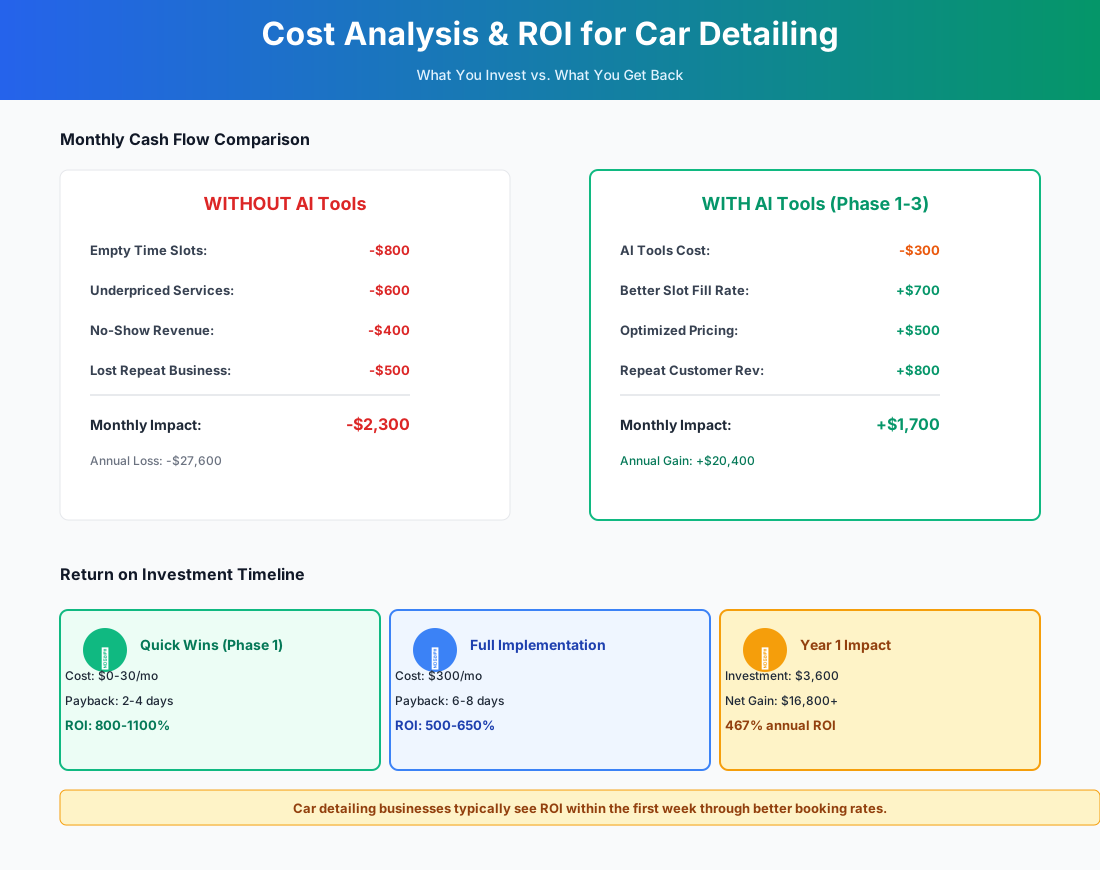
Don't move to the next stage until the current one is producing results you can see in your numbers. If your repeat rate hasn't budged after 60 days of Stage 1 follow-up texts, the issue isn't the tools — it's that you're not actually sending them. Fix the habit before adding more software.
FAQ
I'm a solo mobile detailer with 8 clients a week. Is it too early to use a CRM?
Not if you want to grow past 8 clients. The operators who wait until they're overwhelmed to set up a CRM spend their first six months on the new platform rebuilding the customer history they never captured. Start with Urable Express at $70/month or OrbisX's flat-rate plan when you're still small enough to configure it properly. By the time you hit 15 jobs a week, the automated reminders and booking flow are already paying for themselves.
Can AI route optimization actually account for the time variance between a basic wash and a 6-hour ceramic coating?
Yes — but only if you enter accurate per-service durations. OptimoRoute, Jobber's built-in optimizer, and Urable all let you define durations at the SKU level. The failure mode is detailers who set a single average ("most details take 2 hours") and then watch their schedule cascade into late arrivals on coating days. Set realistic durations per service tier, add a 15-minute buffer between mobile stops for unexpected setup, and re-optimize the moment a job runs long. Most operators undershoot ceramic coating durations by 20-30%.
How do AI vehicle intake photos hold up in pre-existing damage disputes?
They shift the conversation in your favor — not necessarily in court, but in the moment a customer claims you scratched their car. The standard that holds up best: timestamped photos at intake (4 angles minimum, close-ups on any visible damage) stored somewhere the timestamp can't be altered. Urable Enterprise's video inspection and OrbisX's intake workflow both create that trail automatically. If you're using iPhone photos, store them in iCloud Photos or Google Drive — both preserve EXIF metadata. Texting photos to yourself strips the timestamp data.
What's the ROI timeline on automating Google review collection?
Faster than most operators expect. NiceJob's documented cases show detailing businesses going from 10 to 100+ Google reviews within 6 months. The conversion improvement on your Google Business Profile usually shows up within 60-90 days — more calls, more booking link clicks, better placement in the local 3-pack. At $75/month, NiceJob typically pays for itself within the first 2-3 additional bookings it generates from improved search visibility.
How do I use AI tools to fill the 30-50% winter revenue drop in northern states?
Three moves that stack. Use Urable's AI booking robot or OrbisX's Luna to scan your calendar for slow days in November-February and auto-text past customers with interior-only promotions (interior work is weather-independent). Use ChatGPT to draft a 4-message winter campaign: a January "post-holiday interior reset," a February pre-Valentine's Day detail, a March "spring prep" paint correction early-bird. Then pivot your Buffer-scheduled social content to interior before/afters and road-salt protection posts — your feed stays active even on snowed-out weeks when you'd otherwise go silent.
Can ManyChat push customers toward ceramic coating without feeling like a sales pitch?
Build the flow as a qualifier, not a pitch. Trigger it on the keyword "coating" and ask three questions: (1) what vehicle, (2) new or already showing swirl marks, (3) maintenance-free protection or just gloss enhancement. The flow then surfaces the appropriate service tier — paint sealant for gloss-only, full correction + ceramic for protection-focused. Customers experience it as expert guidance, not upselling. The conversion lift comes from matching the right product, not from pushing the most expensive one.
Do AI tools help with EPA Clean Water Act compliance for wash water runoff?
Indirectly. No software keeps you compliant — the reclamation hardware and discharge permits are still on you. Where AI earns its keep: Loom for recording your water reclamation inspection routine so techs can follow it consistently, and ChatGPT or Claude for drafting your SDS-compliant chemical handling SOPs. Urable, Jobber, and HousecallPro all support custom checklists where techs confirm inspection steps at each stop. The paper trail an EPA inspector asks for is the problem AI actually solves here.
The tools on this page are only useful if you actually implement them. Every week you run without automated reminders, a review engine, or a booking system is another week of no-shows you'll apologize for, reviews you'll forget to ask for, and leads that go to the detailer who answered faster.
Start with the free templates. Get one ManyChat flow live on your Instagram. Schedule one week of social posts tonight. That's it — that's Stage 1 done. The time investment is one afternoon. The revenue impact typically shows up in 30 days or less.
The detailers who run the best-reviewed, most-booked operations in their markets aren't necessarily the ones with the best technique. They're the ones who built systems around their craft so the craft could speak for itself.
More AI Implementation Guides
AI Tools for Tire Shops: Complete 2026 Owner's Playbook
The best AI tools for tire shops in 2026 — capture after-hours leads, raise your service attachment rate, and recall customers before they buy at Discount Tire.
AI for Auto Parts Selling: Pricing & Personalization
AI in auto parts selling: personalized suggestions, fitment matching, real-time pricing automation & B2B ordering. Save 15+ hrs/week. See picks & pricing.
Best AI Car Wash Software & CRM Tools for Owners
AI car wash tools and budget CRM picks for owners. Capture missed calls, cut membership churn, predict equipment failures, and automate billing — see pricing.
AI Tools for Auto Repair Shops: Calls, Quotes & DVI
Best AI tools for auto repair shops in 2026: capture missed calls, automate digital inspections, and speed up estimates. Real pricing and setup steps inside.
AI Tools for Breweries: The 2026 Owner's Playbook
The best AI tools for breweries in 2026: cut TTB compliance time, tighten COGS, streamline taproom scheduling, and target release marketing — starting free.
AI Tools for Bookkeeping Services: 2026 Guide
Best AI tools for bookkeeping services in 2026: Automate categorization, reconciliation, and document chasing without hiring extra staff.
Keep exploring
See every AI implementation guide we've published for Trades & Contractors, or browse the full library by industry or category. Looking for a specific platform? The AI tools directory indexes every product mentioned across our guides, and the comparisons hub puts the most-asked head-to-heads side by side.