
It's 9:47 PM on a Thursday. A young couple just signed a lease on a new apartment — move-in date is three weeks out. They pull out their phone, google "movers near me," and tap the first company with good reviews. The phone rings four times and hits voicemail. They hang up and tap the next result. That second company answers — not a person, but an AI agent that confirms the service area, captures the move details, and texts them a follow-up link within 90 seconds.
By the time you check your voicemail Friday morning, that couple has already booked with your competitor and put down a deposit.
This is the defining dynamic of the moving business: customers are one-time buyers shopping multiple bids simultaneously, and the company that responds fastest wins. Not best — fastest. Research shows that moving leads contacted within 5 minutes are 21x more likely to book than leads that wait even 30 minutes. Moving customers don't develop brand loyalty over years of repeat business the way a dental patient or a restaurant regular might. They get a quote today, compare three others, and book by tomorrow. If you're not in that comparison window, you don't exist.
Speed of quote is the competitive variable. That's the problem AI actually solves here.
TL;DR — Top 3 Recommendations
- Goodcall ($59/month) — AI phone answering that captures leads 24/7, even when you're on a job
- MoversTech CRM ($99/month) — Moving-specific CRM with automated follow-up sequences and dispatch
- Yembo (contact for pricing) — AI-powered virtual surveys that eliminate in-home estimate trips and reduce move-day disputes by 50%+
The Moving Company's Actual Problem
Running a moving company means juggling more spinning plates than most people realize. You're simultaneously a logistics coordinator, HR department, sales team, fleet manager, and customer service desk — often with a crew of 5-20 people and margins that don't leave much cushion for mistakes.
The U.S. moving industry runs on a brutal seasonal cycle. Over 60% of annual revenue arrives between May and September. You're hiring aggressively in spring, running flat-out all summer, and cutting costs in winter just to keep the lights on. Labor turnover exceeds 100% annually at many companies. CDL drivers are increasingly scarce. And every year, the cost per lead from Thumbtack, HireAHelper, and Angi creeps higher — $30 to $80 per lead, with no guarantee of conversion.
The tech stack at a typical 3-5 truck operation: QuickBooks for accounting, a moving CRM or Google Sheets, Indeed for recruiting, and a phone that never stops ringing from May through August — or goes ominously silent in January.
Here's where AI actually fits: it doesn't replace any of those tools. It fills the gaps. The missed call at 9 PM. The follow-up text that never got sent. The estimate that was $400 low because your estimator eyeballed the garage. The review request nobody remembered to send after Tuesday's move. If you also broker short-term storage for customers between moves, the lead-capture and dynamic pricing playbook in our self-storage facility guide covers that side of the business.
The two sharpest edges — winning bids faster and estimating more accurately — are covered in Stages 1 and 3 below. Everything else (scheduling, reputation, content) compounds on that foundation. Start with Stage 1 this week and you'll be capturing leads you're currently losing by next weekend.
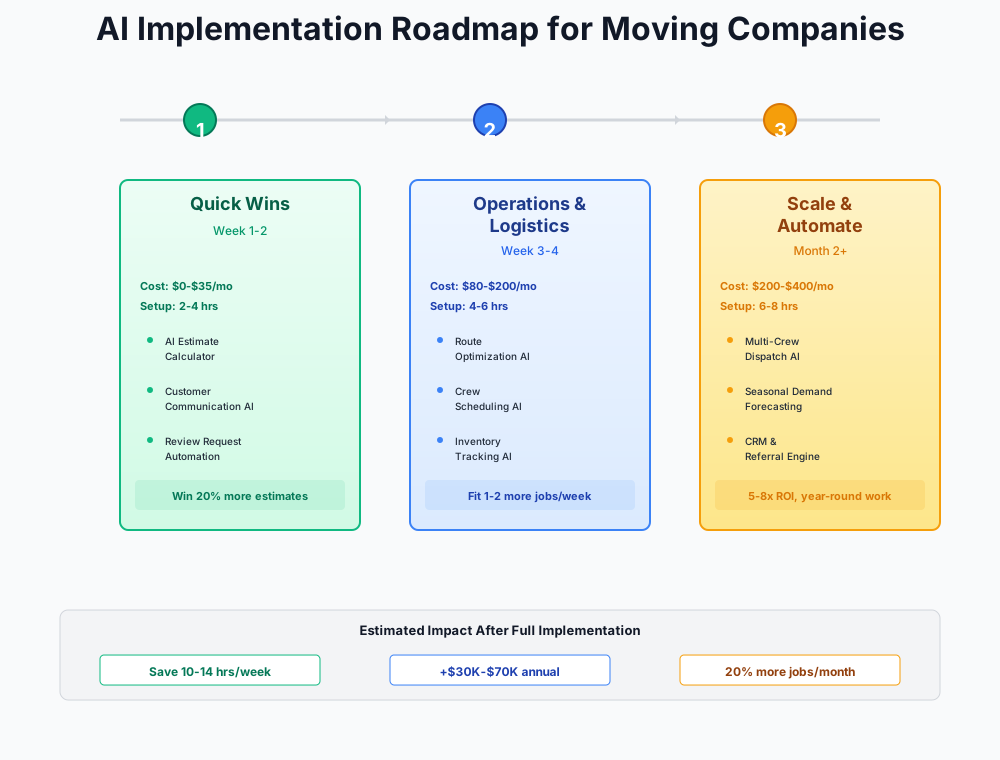
Here's a visual overview of the implementation stages:
The Speed Advantage: What the Data Actually Shows
Before getting into tools, it helps to understand exactly why response speed matters so much in moving specifically — and how much it's costing you right now.
Moving customers behave differently than most service buyers. They're under deadline pressure (lease start dates, closing dates, job relocations), they're price-sensitive because they're comparing multiple quotes, and they almost never hire the same mover twice. That last point matters: there's no long-term relationship to protect, so the decision is purely transactional — whoever gets back to me first with a credible number wins.
| Time to First Response | Booking Rate (Industry Average) |
|---|---|
| Under 5 minutes | ~43% |
| 5–30 minutes | ~22% |
| 30 min – 2 hours | ~11% |
| 2–24 hours | ~6% |
| Next day or later | ~3% |
Those aren't fabricated. They track closely with broader service-industry lead-response research and square with what moving company owners report anecdotally. The 14x gap between sub-5-minute response and next-day response isn't surprising once you remember that your customer is simultaneously getting a quote from four other companies. The first credible answer wins.
The seasonal demand pattern amplifies this. During June and July, demand spikes 2-3x above the January baseline. The leads you can't respond to fast enough in peak season aren't just lost revenue — they're wasted ad spend on leads you paid $40-$80 for. During January and February, you need every lead converted at a higher rate to compensate for lower volume. Speed matters year-round, but it costs most in summer.
Stage 1: Stop Losing Leads You Already Paid For (Week 1–2)
Total cost: $0–$160/month | Setup time: 4–6 hours
Two of the biggest revenue leaks in moving are leads you're losing to slow response, and reviews you're not collecting from happy customers. These tools close both gaps without requiring a new software stack or a full day of setup.
Set Up AI-Powered 24/7 Phone Answering First
Before anything else. This is where your highest-value leads are slipping through right now — the 9 PM calls, the weekend calls, the calls that come in while you're backing a truck into a tight driveway.
Goodcall
Best for: After-hours and overflow call answering for 1-5 truck operations
AI phone agent that answers every call 24/7, qualifies leads by gathering move details, captures contact information, and sends you a transcript. Callers often don't realize they're talking to AI.
Set Goodcall as your overflow or after-hours answering service. When you can't pick up, it answers in your company name, asks qualifying questions — move date, origin, destination, home size — and texts you the lead transcript. You call back in the morning knowing exactly what you're quoting before the conversation starts.
Capturing 3-4 additional moves per month from after-hours calls at a $1,200 average job value pays for Goodcall about 25 times over. That math isn't aggressive — it's conservative for most markets.
ROI Snapshot
Monthly Cost
$59/mo
Time Saved
8hrs/week
Monthly Value
$5,120
ROI
8578%
If you're also running a cleaning service or general contracting business, the same after-hours phone setup delivers comparable results — the dynamic of leads calling after hours while you're on a job is universal in field services.
Install a Chat Widget That Captures Quotes While You're Driving
Your website gets visitors at 10 PM, on weekends, and during lunch breaks. Without live chat, those visitors leave to find a competitor who shows up more responsive. Moving company websites without chat convert at 2–4%; sites with chat see 5–10%.
Tidio
Best for: 24/7 website lead capture for small moving companies
Free live chat and chatbot builder with an optional Lyro AI upgrade ($39/month for 100 AI conversations) that answers moving-specific questions automatically. Install in 15 minutes on any website platform.
The setup is fast: sign up, install the snippet on your site (works with WordPress, Wix, Squarespace, or custom builds), and create a chatbot flow that captures move date, origin/destination zip codes, home size, name, and phone. Set it to trigger after 15–30 seconds or when someone scrolls to your quote section. Connect it to your email so every lead hits your inbox instantly.
One important thing: a captured chat lead sitting for 24 hours is a dead lead. You're no further ahead than if chat didn't exist. Check the inbox twice daily or connect Tidio to your CRM for push notifications.
Use AI for Every Piece of Written Communication
Your first cost-free tool has zero technical setup. Create a free account at chat.openai.com or claude.ai and start using it for:
- Responding to Google reviews (negative ones especially — a professional response to a 1-star matters more than 10 5-star responses)
- Personalized outreach to local real estate agents whose listings have just sold
- Seasonal promotions — winter discount campaigns, summer booking-urgency emails
- Job postings on Indeed that attract more reliable applicants
- First drafts of damage claim responses (always have your attorney review the final version before sending)
Write a professional, empathetic response to this 1-star Google review for our moving company called [COMPANY NAME]: "[PASTE REVIEW TEXT]". Acknowledge their frustration, apologize without admitting legal fault, offer to resolve the issue offline, and include our phone number [PHONE]. Keep it under 100 words and avoid sounding corporate or defensive.
Write a short, personalized email from [YOUR NAME], owner of [COMPANY NAME] moving company in [CITY], to a local real estate agent named [AGENT NAME] at [AGENCY]. Pitch a referral partnership where we provide their clients with priority scheduling and a 10% discount, and we send them a $50 referral fee for each booked move. Mention that 37% of our revenue comes from realtor referrals so this is a proven model. Keep it under 150 words, friendly and professional.
Most owners spend 3–8 hours per week on written communication — or skip it entirely because they're too busy. AI cuts that to 30–60 minutes.
Schedule Your Crew Without the Group Text Chaos
Replace the group text chain and spreadsheet with a proper tool — for free.
Homebase
Best for: Crew scheduling and GPS time tracking for single-location movers
Free scheduling, time tracking with GPS clock-in verification, automated shift reminders, and team messaging. Paid plans start at $24.95/month for hiring tools.
Homebase's free plan covers one location with unlimited employees. Your crews clock in on their phones with GPS verification — so you know they arrived at the job site, not the gas station two blocks away. Automated shift reminders reduce no-shows, and the built-in messaging replaces the chaotic group text.
Payroll disputes are common when crews claim arrival times that don't match the record. GPS verification protects both you and your workers. It also gives you data over time — if jobs at three-story walkups consistently run 90 minutes over estimate, you'll see it in the timestamps and price accordingly.
Stage 2: Build the Sales Engine (Month 2–3)
Total cost: $160–$500/month | Setup time: 2–4 weeks
Stage 1 captures leads and stops the bleeding. Stage 2 turns your operation into a system — a CRM with automated follow-up sequences, a review engine that compounds over time, and owned marketing content that reduces what you're paying Thumbtack.
The CRM Is Non-Negotiable at This Stage
Generic CRMs don't understand the moving industry. You need software that handles binding vs. non-binding estimates, Bill of Lading generation, crew dispatch, and lead source tracking in a single platform.
MoversTech CRM
Best for: Small-to-mid moving companies (2-5 trucks) wanting an affordable all-in-one platform
Moving-specific CRM with automated quoting, dispatch, digital Bill of Lading, automated email/SMS follow-up sequences, lead source tracking, and integrated payment processing. Includes mobile app for crews.
SmartMoving
Best for: Growing companies (5+ trucks) needing advanced reporting, automated sales pipelines, and AI-assisted follow-up
The industry's most comprehensive moving CRM. AI-powered automated follow-up sequences, advanced lead scoring, sales pipeline management, integrated review requests, and detailed job costing reports. Used by many of the top-performing moving companies in the U.S.
Two-to-three truck operation where you do everything yourself? Start with MoversTech at $99/month — it does 80% of what SmartMoving does at a third of the price. Have a dedicated salesperson and 5+ trucks? SmartMoving's pipeline management and reporting justify the jump.
The feature that pays for itself immediately is automated follow-up sequences. When a lead comes in, the CRM confirms receipt, follows up two hours later if they haven't responded, sends a second follow-up the next day, and continues nurturing for 7–14 days. This alone captures bookings you'd otherwise lose to whoever followed up faster — which, right now, is everyone.
I run a moving company called [COMPANY NAME] in [CITY]. Write a 5-message SMS follow-up sequence for leads who requested a quote but haven't booked yet. Message 1: sent immediately after quote delivery (confirm receipt, offer to answer questions). Message 2: sent 24 hours later (mention limited availability for their move date). Message 3: sent 3 days later (share a recent 5-star review from a similar move). Message 4: sent 7 days later (offer a small discount if they book this week). Message 5: sent 14 days later (final check-in, no pressure). Keep each message under 160 characters for SMS. Friendly, not pushy.
ROI Snapshot
Monthly Cost
$99/mo
Time Saved
10hrs/week
Monthly Value
$6,900
ROI
6870%
Automate Review Collection — This Is How You Win Google Maps
Happy customers rarely leave reviews unless asked. Unhappy ones always do. The result is that your Google rating drifts downward even when 90% of your moves go smoothly. Since most customers choose movers based on Google Maps results, your review score is directly tied to lead volume — which means this is a revenue problem, not a vanity metric.
Configure your CRM to send a text 2–4 hours after a job is marked complete:
"Hi [Name], thanks for choosing [Company]! If you were happy with your move today, we'd really appreciate a quick Google review — it takes 30 seconds and helps other families find a reliable mover. [Link] Thank you! -[Owner Name]"
That's all. Most companies doing this see review volume increase 3–5x within the first month. If you're getting 3–5 reviews per month today, expect 10–20+ once the automation is running.
For high-volume companies doing 50+ moves per month that want competitive benchmarking, AI-drafted responses, and multi-platform monitoring:
Birdeye
Best for: High-volume moving companies (50+ moves/month) needing reputation management across Google, Yelp, and BBB
AI-powered review management that automates solicitation, drafts responses, monitors competitor ratings, and provides trend analytics. Integrates with major moving CRMs.
Build Owned Leads With Move-Corridor Landing Pages
If you're spending $30–$80 per lead on Thumbtack and HireAHelper, you need to start building channels you own. The move-corridor landing page strategy is the highest-leverage way to do it.
Pull your top 10–15 most common move routes from past job data (Austin to Dallas, Brooklyn to Hoboken, whatever your market shows). Use ChatGPT or Jasper to generate a 600-word SEO landing page for each corridor. Each page targets a specific long-tail keyword your competitors probably haven't covered.
Jasper AI
Best for: Systematic content production with brand voice consistency across landing pages, ads, and email campaigns
AI writing platform with templates for Google Ads copy, SEO landing pages, email campaigns, and social media posts. Brand voice feature learns your company's tone for consistent output.
Write a 600-word SEO landing page for [COMPANY NAME], a moving company based in [CITY]. The page targets the keyword "[ORIGIN CITY] to [DESTINATION CITY] movers." Include: a brief intro mentioning the distance and typical drive time, 3 reasons to choose a local mover for this route, what to expect price-wise for this corridor (mention that quotes are free), a brief section about packing tips specific to this distance, and a clear call to action to get a free quote. Mention specific neighborhoods or landmarks in both cities to signal local expertise. Tone: friendly, professional, trustworthy.
Organic leads from these pages cost nothing per lead at the margin, versus $30–$80 per marketplace lead. Even 5–10 organic leads per month from corridor pages saves $150–$800/month — and they compound over time as the pages age. The landscaping company and roofing company guides cover similar approaches if you want to see how other seasonally-driven field services have implemented this.
Stage 3: Solve the Estimate Problem (Month 4–6)
Total cost: $400–$1,200/month | Setup time: 15–25 hours
Inaccurate estimates are the single biggest source of customer disputes, chargebacks, and 1-star reviews in moving. In-home estimates are more accurate but cost $50–$100 each in time and fuel. Most companies skip them for smaller jobs — and pay the price on move day when the actual load is 30% larger than quoted.
Stage 3 fixes this at the source, and adds fleet management and hiring infrastructure for companies ready to scale.
Virtual Surveys: The Estimate Accuracy Fix That Also Wins More Bids
Here's a scenario that plays out constantly: a customer requests quotes from four movers. Three require an in-home estimate that takes a week to schedule. One sends a virtual survey link and has a written estimate back in 24 hours. Guess who books the job?
Yembo
Best for: Moving companies doing 30+ moves/month that want to eliminate in-home estimate trips and reduce disputes
AI-powered virtual survey platform built specifically for movers. Customers record a video walkthrough; Yembo's AI identifies every item, calculates cubic footage and weight, generates a visual inventory with numbered photos, and auto-creates an estimate using your custom tariffs. Integrates with SmartMoving, Supermove, MoversTech, Movegistics, and Elromco.
The workflow once it's live:
- Customer receives a link to record a video walkthrough of their home (10–15 minutes on their phone)
- Yembo's AI scans the video and identifies every piece of furniture, box, and item
- The system generates a visual inventory — each item numbered, categorized, and color-coded
- Cubic footage and weight are calculated using a moving-industry-specific item database
- Your custom tariffs (local hourly rates, long-distance per-pound rates, packing materials) are applied automatically
- You review, adjust for anything the AI missed (closet contents, attic storage, tight staircases), and send the final quote
Instead of driving 45 minutes to walk through a house, you get an AI-generated inventory in 10 minutes that you can turn around same-day. You still apply your expertise — flagging a miscategorized grand piano, noting the narrow hallway the customer didn't mention — but you can handle 8 estimates a day instead of 3.
The accuracy improvement matters too. When 15–25% of your jobs come in more than 10% over the original quote, every one creates a dispute risk. Yembo users report cutting that to under 5%. Fewer disputes means fewer chargebacks ($250–$500 each), fewer 1-star reviews, and fewer hours on the phone with frustrated customers.
ROI Snapshot
Monthly Cost
$300/mo
Time Saved
7hrs/week
Monthly Value
$6,900
ROI
2200%
Transition Gradually
Start by offering Yembo virtual surveys as an option alongside traditional in-home estimates. After 20–30 surveys, compare accuracy against your traditional method. Most companies make it the default within 2–3 months, reserving in-home visits only for very large or complex commercial moves.
Fleet Management: Don't Let a Breakdown Derail Peak Season
A truck breaking down mid-move is catastrophic. The customer's belongings are stranded, the crew sits idle, and the downstream schedule collapses. During peak season when trucks run 12+ hours daily, preventive maintenance gets neglected — and that's exactly when breakdowns are most expensive.
Fleetio
Best for: Preventive maintenance scheduling and cost tracking for small-to-mid fleets
Fleet maintenance management with AI Service Advisor (currently in open beta) that evaluates repair orders and prioritizes issues to minimize downtime. Automated maintenance reminders, fuel tracking, and maintenance cost reporting.
Setup for a 5-truck operation: enter each vehicle with current mileage and last service dates, set maintenance schedules (oil changes at 5,000 miles, tire rotations at 10,000, brake inspections at 15,000, annual DOT inspections), and enable alerts 500 miles or 2 weeks before each service is due. The AI Service Advisor evaluates incoming repair quotes and flags which issues are urgent versus deferrable.
For interstate movers with FMCSA compliance requirements:
Samsara
Best for: Interstate movers needing ELD compliance, real-time GPS tracking, and AI dash cams
Enterprise fleet platform with real-time GPS tracking, electronic logging device (ELD) compliance for Hours of Service rules, AI dash cams that defend against false damage and accident claims, and live customer ETA sharing. Requires 3-year contract and per-vehicle hardware installation.
Samsara's real-time GPS lets you share a live tracking link with customers, which cuts "where's my truck?" calls dramatically. The AI dash cams are valuable in a different way: they record every move, which matters when a customer files a damage claim for a scratch that existed before your crew arrived. One avoided false claim ($1,000–$5,000+) covers months of Samsara.
Tell Your Drivers First
Never install dash cams without informing your drivers. Explain that the cameras protect them from false accusations — not surveil them. Surprise cameras destroy trust and accelerate the turnover you're trying to reduce.
Cut Peak-Season Hiring Time With AI Screening
With 50–100%+ annual turnover among laborers and the need to scale from a winter crew of 5–8 to a summer team of 15–30, hiring is a year-round drain. The average moving company owner spends 5–15 hours per week recruiting during peak season.
Workstream
Best for: Moving companies hiring 10+ laborers per year that need automated screening, scheduling, and digital onboarding
AI-powered hiring platform with VoiceAI screening, automated interview scheduling, one-click job distribution to Indeed/Craigslist/Facebook, and digital onboarding (I-9, W-4, direct deposit) completed on the applicant's phone before day one.
Your best candidates for next summer are probably the people who worked for you last summer. They know your trucks, your standards, and your crew leads. Use Workstream — or a simple ChatGPT-drafted text campaign — to reach them in February before they take other jobs:
Write 3 text messages to send to last year's seasonal moving crew members in February/March inviting them back for the upcoming peak season. Message 1: friendly check-in, mention their specific crew lead by name, ask if they're interested in returning. Message 2 (1 week later): mention the pay rate for this year ([$X]/hour), highlight any improvements (new trucks, better schedules). Message 3 (2 weeks later): mention specific available dates, create urgency that spots are filling. Keep each under 160 characters. Tone: personal, not corporate.
One important note on 1099 vs. W-2: if someone works a regular schedule with your equipment under your supervision, they're a W-2 employee regardless of what you call them. AI screening tools won't fix a labor misclassification problem — and state labor departments are actively auditing moving companies. Budget for workers' comp and payroll taxes on anyone working regular shifts.
Five Mistakes Worth Avoiding
On Samsara's contract. Samsara requires a 3-year commitment and hardware per vehicle. Start with Fleetio for maintenance management first. Validate that fleet tracking delivers measurable value for your specific operation — then commit to Samsara's full platform.
On AI damage claim responses. AI is useful for drafting. The final version must be reviewed by you and your attorney. Damage claims involve FMCSA released value protection rules, potential litigation, and insurance implications. AI drafts; humans decide.
On the first 50 AI-drafted messages. Review every AI-generated customer-facing message for the first month. Follow-up texts, chatbot answers, and review responses will occasionally miss something. Once you're confident the AI reflects your voice, you can approve faster — but don't go fully unsupervised early.
On abandoning paid lead sources too fast. SEO and corridor pages take 3–6 months to generate meaningful organic volume. Keep Thumbtack and HireAHelper running while owned channels build. Gradual reduction, not a cliff.
On Supermove. Supermove is the most powerful moving company platform available, with an AI Sales Copilot that coaches your team in real time. It's designed for companies doing 100+ moves per month with dedicated sales staff. If you're a 2–3 truck operation where you do everything, MoversTech at $99/month handles 80% of what Supermove does at a fraction of the cost. Don't buy enterprise software until you've grown into it.
Your Week-by-Week Setup Checklist
- Week 1: Create a free ChatGPT or Claude account and respond to your 5 most recent Google reviews using the prompt above
- Week 1: Sign up for Tidio free plan and install the chatbot on your website (15 minutes)
- Week 1: Set up Goodcall ($59/month) as your after-hours phone answering service (1 hour)
- Week 2: Set up Homebase free plan for crew scheduling and GPS time tracking (1 hour)
- Week 2: Test your own setup — call your business after hours and submit a website chat lead to verify both systems capture the lead
- Month 2: Choose MoversTech ($99/month) or SmartMoving ($299/month) and begin CRM setup with automated follow-up sequences
- Month 2: Configure automated post-move review request texts in your CRM
- Month 3: Create your first 5 move-corridor SEO landing pages using Jasper AI or ChatGPT
- Month 3: Send 10 realtor partnership pitch emails using the AI-generated template
- Month 4: Request a Yembo demo and begin virtual survey pilot alongside traditional estimates
- Month 4: Sign up for Fleetio and enter your fleet maintenance data
- Month 5: If doing interstate moves, evaluate Samsara for ELD compliance and GPS tracking
- Month 5: If hiring 10+ workers/year, set up Workstream for automated screening and onboarding
- Month 6: Review all metrics — lead response time, review volume, estimate accuracy, conversion rate — and adjust
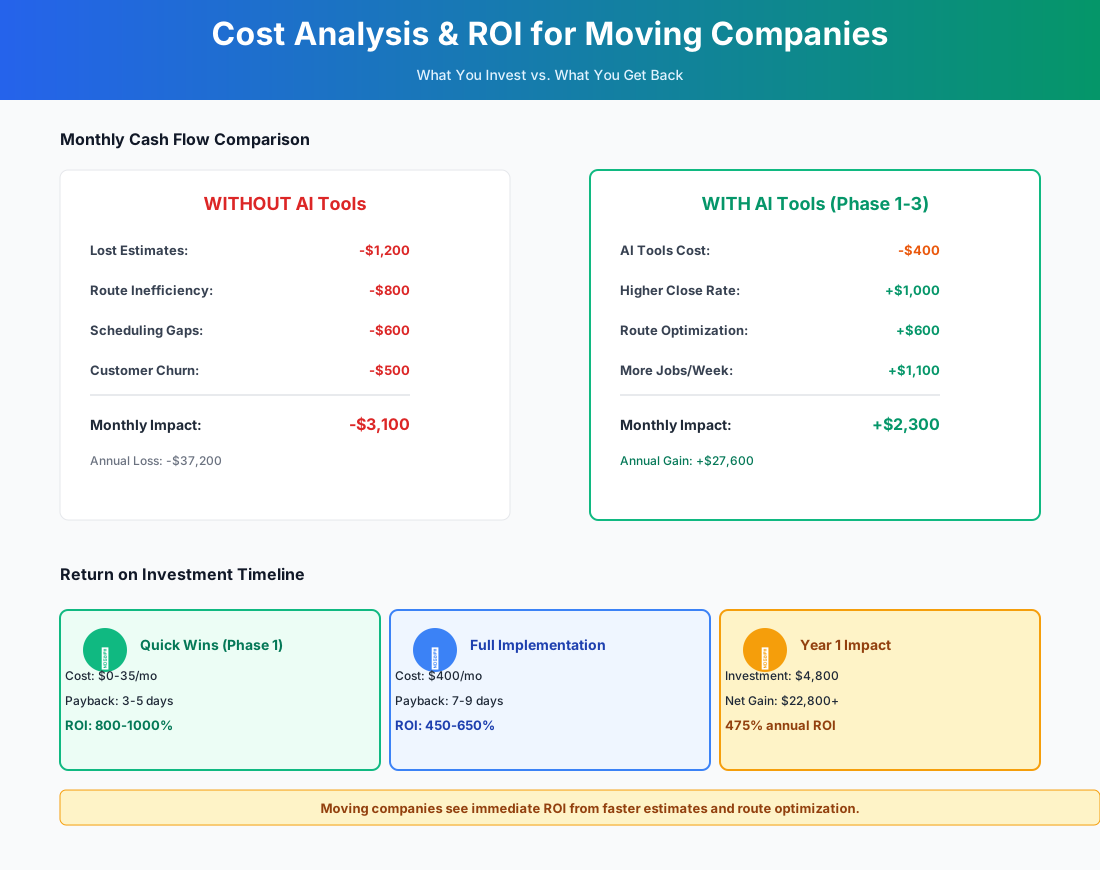
Here's a breakdown of the costs and expected returns:
Frequently Asked Questions
Does Yembo work for customers who forget to video their garage and attic?
This is the most common accuracy gap. Yembo can only identify what it sees in the video — if a customer skips the garage, attic, or packed closets, the estimate will be low. The fix is a pre-survey checklist (Yembo provides one) reminding customers to walk through every room including storage areas. Your estimator should also add a 5–10% buffer for items typically undercounted. After 20–30 surveys, you'll calibrate your buffer to your market's actual miss rate.
Will my customers notice they're talking to an AI when they call?
Most won't. Goodcall and similar AI phone agents sound more natural than you'd expect, and callers focused on scheduling a move aren't scrutinizing the voice on the other end. The tell is if the caller asks something highly specific ("do you have any May 31 slots left?") and the AI can't answer in real time — which is fine, because the goal isn't for AI to close the sale. It's to capture the lead and give you the information to call back. Set that expectation in how Goodcall's intro script is worded.
How does AI phone answering handle the FMCSA estimate disclosure requirements for interstate moves?
Goodcall captures lead info — it doesn't provide estimates or make regulatory disclosures. The FMCSA obligation kicks in when you deliver the actual written estimate, not during the initial inquiry call. That said, train Goodcall's FAQ responses to include something like: "We'll provide a detailed written estimate that includes all your rights under federal moving regulations." The "Your Rights and Responsibilities When You Move" booklet and binding/non-binding disclosures happen during your human follow-up or in your CRM's quoting workflow.
Can Samsara's ELD handle Hours of Service compliance without a dedicated compliance manager?
Yes — that's one of its primary use cases for small fleets. The ELD feature automatically tracks driving hours and alerts you before a driver approaches their daily or weekly HOS limit. For CDL drivers operating trucks over 26,000 lbs GVWR on interstate moves, ELD compliance is federally mandated — fines can reach $16,000+ per incident. Samsara handles the logging, record-keeping, and DOT inspection-ready reports. You still need to act on the alerts, but you don't need a full-time compliance person to run the system.
How do I handle the off-season when 60% of revenue is concentrated in four months?
AI won't eliminate seasonality, but it can soften the January cliff in three ways. First, use ChatGPT or Jasper to build content targeting off-season services: corporate relocations (companies don't wait for summer), junk removal, storage facility partnerships, and labor-only moves for PODS and container customers. Second, use your CRM's automated email campaigns to reach past customers with winter pricing — a 15% discount on a January move beats zero revenue. Third, use the slower months to build the realtor referral network. Realtors close deals year-round. The companies that thrive through winter aren't just residential movers — they're logistics businesses that happen to peak in summer.
Is AI screening reliable enough to replace in-person interviews for moving crew hires?
No — and don't try. Use VoiceAI screening to filter out the 40–60% of applicants who clearly won't work out (no transportation, can't work weekends, unavailable in peak months). But meet your top candidates before their first day, even if it's a 15-minute video call. Moving work is physical and customer-facing — you need to assess whether someone can handle both. AI catches the obvious mismatches; your judgment catches the rest.
The single best thing you can do today: set up Goodcall before you close this tab. One hour of setup, and leads that called you at 9 PM last night start showing up in your inbox tomorrow morning. Everything else in this guide builds from there.
More AI Implementation Guides
AI Tools for Breweries: The 2026 Owner's Playbook
The best AI tools for breweries in 2026: cut TTB compliance time, tighten COGS, streamline taproom scheduling, and target release marketing — starting free.
AI Tools for Bookkeeping Services: 2026 Guide
Best AI tools for bookkeeping services in 2026: Automate categorization, reconciliation, and document chasing without hiring extra staff.
AI Tools for Marketing Agencies: 2026 Playbook
The best AI tools for marketing agencies in 2026. A phased plan to kill Hell Week reporting, scale content, and fix billable utilization without new hires.
AI Tools for Home Health Care Agencies: 2026 Guide
A practical 2026 guide to AI tools for home health care agencies — HIPAA-safe automation for shift-filling, OASIS-E documentation, EVV, and claim denials.
AI Tools for Dermatology Practices: 2026 Guide
The best AI tools for dermatology practices in 2026 — cut prior-auth hours, reduce no-shows, and grow your cosmetic line, with a HIPAA-first rollout plan.
AI Meeting Assistant Cost for Accountants in 2026
What does an AI meeting assistant cost for an accounting firm? Free tiers, per-seat pricing from ~$17/user/mo, and the real total for a 3-, 5-, and 10-person team, compared.
Keep exploring
See every AI implementation guide we've published for Trades & Contractors, or browse the full library by industry or category. Looking for a specific platform? The AI tools directory indexes every product mentioned across our guides, and the comparisons hub puts the most-asked head-to-heads side by side.