Here's a number that doesn't show up on most PT practice dashboards: plan completion rate — the percentage of patients who finish their full prescribed visit course. Industry-wide, it hovers around 55–65%. Roughly one in three patients referred to outpatient PT quits mid-plan.
That dropout isn't just a clinical problem. A patient prescribed 18 visits who cancels after 9 leaves you with half the revenue, a disrupted schedule, and outcomes data you can't use for MIPS. Multiply that across a practice seeing 150 active patients, and the economics become impossible to ignore. The table below puts the math in concrete terms.
| Scenario | Visits per plan | Completion rate | Avg. revenue per completed plan | Monthly revenue at 30 new plans/mo |
|---|---|---|---|---|
| Baseline (no automation) | 16 | 58% | $1,040 | $18,096 |
| With AI reminders + HEP tracking | 16 | 74% | $1,040 | $23,088 |
| Difference | — | +16 pts | — | +$4,992/mo |
Improving plan completion by 16 percentage points — a realistic target with the right tools — adds nearly $5,000 a month at a modest practice volume. That's the case for AI in PT. Not a flashy pitch about robots. Just patients actually finishing what their physician sent them to you to do.
TL;DR: Top 3 Recommendations
- WebPT Copilot — AI-assisted documentation that cuts SOAP note time by 50–70% while maintaining Medicare audit-ready specificity
- Weave — All-in-one patient communication (reminders, recall, reviews, two-way texting) that reduces no-shows and mid-plan dropouts
- PhysiTrack — AI-powered home exercise program delivery with built-in adherence tracking and patient engagement monitoring
What Makes PT Operationally Distinct
PT clinics share surface-level similarities with other healthcare practices — insurance billing, HIPAA, scheduling headaches — but the operational model has a few quirks that shape which AI tools actually matter.
First: visit-dependent revenue. A dental practice completes most of its revenue in a single appointment. PT typically spreads revenue across 8–20 visits over 4–12 weeks. Every cancellation mid-plan is compounded revenue loss, not just a one-day problem. The patient who ghosts after visit 6 of a 16-visit plan cost you more than just that one missed slot.
Second: referral-source relationships. Most PT patients arrive via physician referral — orthopedic surgeons, primary care, pain management, sports medicine. Your relationship with the referring physician determines your volume. When your discharge summaries are detailed, timely, and clinically useful, referrers notice. When they're generic or late, referrers route patients elsewhere. AI tools that speed up documentation and improve outcome reporting have a referral-pipeline benefit that never shows up in ROI calculators.
Third: documentation-per-visit intensity. Every PT session requires a complete SOAP note with CPT-specific time tracking, medical necessity justification, and functional outcome data — not just a brief progress note. A therapist treating 14 patients a day faces 3–5 hours of documentation. That time pressure drives burnout and is the primary reason experienced PThs leave private practice.
The tech stack in most outpatient clinics revolves around the EMR: WebPT leads with roughly 40% market share, followed by Clinicient (Greenway), Jane App, and Net Health (Optima). Billing runs either through the EMR's integrated RCM or outsourced to PT-specific billing companies at 5–8% of collections. Home exercise programs are still delivered via printed handout sheets in a surprising number of clinics — that's changing fast, and the adherence data explains why.
Compliance and Privacy First
HIPAA and Business Associate Agreements
Every AI tool that touches protected health information (PHI) — patient names, appointment dates, diagnoses, treatment notes, insurance details — must sign a Business Associate Agreement (BAA) with your practice. No BAA, no deal.
This means general-purpose AI tools like ChatGPT's free tier, Claude's free tier, and Google Gemini's consumer version cannot be used for any task involving PHI. You can use them for generic content: writing job postings, drafting social media captions, creating patient education templates without real patient details. But pasting a patient's name or treatment history into a consumer AI tool is a HIPAA violation carrying fines of $100–$50,000 per incident, up to $1.5 million per year.
The tools recommended in this guide — WebPT, Weave, Jane App, PhysiTrack, MedBridge — are all HIPAA-compliant and will provide a signed BAA. For general AI tools used clinically, you need enterprise tiers: OpenAI's ChatGPT Enterprise, Anthropic's Claude for Work, or Otter.ai Enterprise (which requires the Enterprise plan specifically for healthcare — the Business plan does not include a BAA).
HIPAA Red Line
Never paste patient names, dates of birth, diagnosis codes, or treatment details into ChatGPT, Claude, or Gemini consumer/free tiers. Use these tools only for generic, non-PHI content. For clinical documentation AI, use only HIPAA-compliant, BAA-signed platforms like WebPT Copilot or Otter.ai Enterprise.
The 8-Minute Rule and AI Documentation
Medicare's 8-minute rule is the most audited billing component in outpatient PT. Timed CPT codes (97110 Therapeutic Exercise, 97140 Manual Therapy, 97530 Therapeutic Activities, and others) must be billed in 15-minute units, with each unit requiring a minimum of 8 minutes of direct, skilled, one-on-one contact:
- 8–22 minutes = 1 unit
- 23–37 minutes = 2 units
- 38–52 minutes = 3 units
- 53–67 minutes = 4 units
AI documentation tools like WebPT Copilot embed 8-minute rule calculations directly into the note-writing workflow. The AI tracks documented treatment times, flags when a note's time allocation doesn't support the units billed, and alerts you before you submit a claim that would fail an audit. That's not just a time-saver — it's a compliance layer that passive review can't replicate at scale.
Plan of Care Recertification Tracking
Medicare requires the referring physician to sign a new plan of care every 90 calendar days. Miss the recertification window and every claim submitted after day 90 gets denied. In practices treating 150–300 active patients, tracking these manually is how billing coordinators develop anxiety disorders.
AI-powered EMR platforms now automate this entirely. WebPT and Jane App both flag upcoming deadlines 14–21 days in advance, auto-generate the recertification document, and route it to the referring physician for signature. This alone can prevent thousands of dollars in denied claims per quarter — and it strengthens your referral relationship, because physicians appreciate the seamless communication loop rather than a frantic fax on day 88.
MIPS and Outcome Reporting
The Merit-based Incentive Payment System (MIPS) under Medicare's Quality Payment Program ties your reimbursement rate to outcome measure documentation. PT practices must report on measures like FOTO (Focus on Therapeutic Outcomes) or LEFS (Lower Extremity Functional Scale). Incomplete or late data triggers a payment penalty of up to 9% on all Medicare claims.
Without automation, outcome measure collection compliance hovers around 40–60%. With AI-prompted workflows — where PhysiTrack or MedBridge GO sends the questionnaire to the patient's phone before each visit — practices report 85–95% compliance. That gap is real money.
State Practice Act Considerations
Forty-nine states and DC have different rules about PTA supervision ratios, telehealth billing, dry needling scope, and direct-access evaluation rights. AI doesn't change your state's practice act, but it can enforce compliance automatically. If your state requires the supervising PT to co-sign PTA notes within 24 hours, your EMR's AI workflow should flag unsigned notes before they become billing problems.
Patient Communication and Plan Adherence
Keeping Patients in Their Plan of Care
Most PT practices think about no-shows as a scheduling problem. They're actually an adherence problem. A patient who cancels visit 7 of 16 and never reschedules didn't just miss a slot — they've abandoned a plan their physician ordered. The triggers are predictable: inconvenient reminder timing, friction in rescheduling, no perceived progress, or simply life getting in the way without anyone following up.
Weave
Best for: All-in-one patient communication for PT clinics
Weave consolidates appointment reminders, two-way texting, automated recall campaigns, online review requests, and VoIP phone service into one platform. For PT practices, the key features are multi-touch reminder sequences (email 1 week out, text 2 days out, text 2 hours before) and an intelligent waitlist that automatically fills canceled slots by texting patients on your ASAP list. Integrates with WebPT, Jane App, and most major PT EMRs.
Weave is deployed across healthcare verticals — dental practices, chiropractic offices, and veterinary clinics use it for overlapping reasons. In PT, the automated waitlist feature carries extra weight because schedule density doesn't just affect today's revenue; it affects whether a patient stays on track with their plan.
Practices using automated multi-touch reminder sequences typically cut no-show rates from 15–18% down to 5–8%. On a 12-patient-per-day schedule at $100 average reimbursement, that's roughly one to two extra visits per day that stay on the books.
ROI Snapshot
Monthly Cost
$249/mo
Time Saved
8hrs/week
Monthly Value
$3,000
ROI
1105%
Online Scheduling and Digital Intake
67% of patients prefer digital scheduling over phone calls. PT scheduling is more complex than booking a cleaning: you need to match the patient to the right therapist, confirm the appointment type matches their plan of care, and verify that authorization has remaining visits.
Jane App
Best for: PT clinics wanting elegant online booking with insurance billing built in
Jane App is a practice management platform popular among PT, OT, and multidisciplinary rehab clinics. Its online booking portal lets patients self-schedule within the parameters you define (specific therapist, appointment type, available slots). The intake form builder collects health history, consent, and insurance info digitally before the visit — eliminating clipboard forms. Jane's billing module handles electronic claims submission with built-in CPT code libraries for rehab.
One implementation note worth flagging: restrict self-booking to evaluation appointments and follow-up visits only. Don't let new patients book directly into a treatment slot without an evaluation first — it creates clinical and billing problems that take longer to untangle than the convenience is worth.
Home Exercise Programs and Adherence Tracking
The printed HEP handout — that photocopied sheet of stick-figure exercises patients lose before they get home — is one of the biggest failure points in outpatient PT. Research shows only 35–50% of patients perform their home exercises as prescribed when given paper handouts. Non-adherence extends treatment duration, worsens outcomes, and directly drags down your plan-completion numbers.
PhysiTrack
Best for: AI-powered HEP with patient engagement tracking
PhysiTrack lets therapists build video-based home exercise programs from a library of 5,000+ exercises, assign them to patients via app, and track adherence in real time. The AI component monitors which patients are completing their exercises and flags non-adherent patients for follow-up. It also collects patient-reported outcomes (NPRS pain scales, functional measures) between visits, giving you data for MIPS reporting and clinical decision-making without eating into visit time.
MedBridge GO
Best for: HEP + continuing education + patient engagement in one platform
MedBridge GO combines a massive exercise library (8,000+ exercises with HD video), patient engagement tracking, outcome measure collection, and — uniquely — a built-in continuing education platform for your therapists. The HEP builder uses AI to suggest complementary exercises based on the diagnosis and current program. Patients receive their program via app or email with video demonstrations they can follow at home.
Write a friendly email to a physical therapy patient named [NAME] who just started their home exercise program on PhysiTrack/MedBridge. Explain how to access the app, why doing the exercises between visits matters for their recovery, and reassure them that they can message their therapist through the app if an exercise causes pain. Keep it under 200 words and use an encouraging, non-clinical tone.
The adherence numbers are hard to argue with: clinics using digital HEP platforms with tracking report 60–75% exercise completion rates, versus 35–50% with paper handouts. Faster functional improvement, fewer total visits, better discharge outcomes, higher patient satisfaction scores — and a measurable bump in plan-completion rate.
The PhysiTrack adherence dashboard is also your early-warning system. A patient whose HEP completion drops from 80% to 20% over two weeks is telling you something before they cancel. A proactive check-in call at that point — from the therapist, not an automated text — is the highest-value intervention most practices aren't making.
Automated Review Requests and Referral Relationships
Google reviews drive new patient acquisition for PT practices — 84% of patients trust online reviews as much as personal referrals. Weave automates review requests via text 1 hour after each visit. Practices using this consistently double their monthly review volume within 90 days.
But there's a second, less-discussed audience for your online reputation: referring physicians. A busy orthopedic surgeon Googles your practice before referring a post-op patient just like a patient does. Forty strong reviews with responses beats ten reviews with silence.
Write a warm, professional response to this Google review for our physical therapy clinic: "[PASTE REVIEW]". Thank the patient by first name only. Mention that our team is glad to hear about their progress. Do NOT confirm any specific diagnosis, treatment, or health condition (HIPAA). Invite them to reach out if they ever need us again. Keep it under 80 words.
Write a professional, empathetic response to this negative Google review for our physical therapy clinic: "[PASTE REVIEW]". Do NOT confirm or deny that the reviewer is a patient. Do NOT reference any treatment, diagnosis, or clinical details. Express genuine concern, invite them to contact our clinic manager directly at [PHONE], and briefly mention our commitment to every patient's experience. Keep it under 100 words and avoid being defensive.
Clinical Documentation
How many hours per week does your practice spend on SOAP notes? Ask your therapists. The typical answer is somewhere between "too many" and a number that ends in a sigh.
AI-Assisted SOAP Notes
The average PT spends 15–25 minutes per patient on documentation — that's 2.5–6 hours per day on a typical caseload. And these aren't simple progress notes. PT documentation must include skilled intervention justification, functional outcome measures, treatment time per CPT code (for the 8-minute rule), and plan-of-care progress. Every one of those elements is an audit target.
WebPT Copilot
Best for: PT-specific AI documentation with built-in compliance checks
WebPT Copilot is an AI documentation assistant built directly into the WebPT EMR. It listens to (or reads) your treatment session notes and generates SOAP documentation that includes CPT-specific time tracking, 8-minute rule validation, functional outcome integration, and Medicare medical necessity language. Because it's built into WebPT — the dominant PT EMR — there's no integration hassle. The AI suggests documentation language that meets payer requirements while maintaining clinical accuracy.
Beyond saving time, WebPT Copilot actively prevents audit failures. The AI flags notes where treatment time documented doesn't support the units billed, where medical necessity language is too vague for Medicare standards, where functional outcome measures haven't been updated within required intervals, and where plan-of-care recertification is approaching or overdue.
PT practices using AI-assisted documentation consistently report 50–70% reduction in note-writing time. On a caseload of 12 patients per day, that's 1.5–3.5 hours recovered per therapist per day. Some practices use that time to see additional patients. Others use it to go home at a reasonable hour. Both are legitimate outcomes.
Write a template for the subjective section of a physical therapy initial evaluation note for a patient presenting with [CONDITION: e.g., lumbar radiculopathy, rotator cuff tear, post-TKA]. Include prompts for: mechanism of injury, symptom behavior (aggravating/easing factors), functional limitations (ADLs, work, recreational activities), prior treatment history, and patient goals. Format as a fillable template, not a completed note. Do NOT include any real patient information.
Outcome Measure Collection
MIPS compliance requires standardized outcome measure collection at evaluation, interim assessments, and discharge. The most common PT outcome measures — LEFS, DASH, NDI, Oswestry, NPRS — take 3–8 minutes for the patient to complete. If administered on paper during visit time, they eat into billable treatment minutes. Skip them, and your MIPS compliance tanks.
PhysiTrack and MedBridge GO solve this by sending outcome measures to patients digitally before their visit. The patient completes the questionnaire on their phone at home the night before, and scores auto-populate into the clinical dashboard. No paper, no visit-time lost, and 85–95% collection rates instead of the 40–60% most practices achieve manually.
That outcome data also feeds your referral relationships. When you send a physician a discharge summary that includes validated functional score improvement — "Patient's LEFS improved from 42 to 68 over 14 visits" — that's a different conversation than a generic letter. Physicians who see clinical results in their patients route more patients.
Telehealth for Follow-Up
PT is inherently hands-on, but telehealth plays a legitimate role in follow-up visits — particularly for HEP progression checks, post-discharge wellness visits, and rural patients with long drive times. Most states now allow PT telehealth billing, though reimbursement rates and modifiers vary.
Jane App includes a built-in HIPAA-compliant video module at no additional cost. WebPT integrates with platforms like Doxy.me (free HIPAA-compliant tier available). PhysiTrack is developing motion-capture features that let therapists assess exercise form remotely through the patient's phone camera, with AI-scored movement quality feedback.
Billing and Revenue Cycle
The back office is where invisible revenue leaks live — denied claims, slow verifications, missed recertification deadlines, and aging accounts receivable. Most of what you're losing here is recoverable.
Insurance Verification Automation
Every new PT patient requires verification before their first visit: active coverage, PT benefits, visit limits, authorization requirements, copay and coinsurance, and whether the plan requires a physician referral (even in direct-access states, many plans still require one for coverage). Via phone or payer portal, this takes 15–30 minutes per patient.
WebPT's integrated eligibility verification pulls benefits automatically for connected payers. Jane App offers similar functionality. For practices wanting a standalone solution, Availity (free for providers) connects to most major commercial payers and Medicare for real-time eligibility checks.
Automated verification cuts the per-patient check from 15–30 minutes to 1–3 minutes. On a practice seeing 8–12 new patients per week, that's 2–5 hours of front desk time returned each week — time that can go toward authorization follow-ups, recall outreach, and the other tasks that actually require a human.
Claims Submission and Denial Management
PT claims deny on first submission at a rate of 10–15%. Common culprits:
- Authorization expired or visit limit exceeded — most common, most preventable
- Incorrect modifier usage — particularly the GP modifier required on all PT claims and the 59 modifier for distinct procedural services
- Medical necessity documentation insufficient — the note didn't justify continued skilled care
- Timely filing deadline missed — especially on workers' comp and auto claims with shorter filing windows
AI billing platforms scrub claims before submission, catching coding errors, missing modifiers, and documentation gaps. WebPT's billing module includes pre-submission claim scrubbing. For practices that outsource billing, PT-specific RCM companies like Kareo ($150–$350/mo) and AdvancedMD offer AI-enhanced claim scrubbing that catches issues before they become denials.
Quick Win: Track Your Denial Rate
Pull a report from your billing system for the last 90 days. Calculate: (denied claims ÷ total claims submitted) × 100. If your denial rate is above 8%, you're leaving money on the table. AI claims scrubbing typically cuts denial rates by 30–50%, which on $40,000/month in insurance collections could mean $1,200–$3,000/month in recovered revenue.
Authorization and Visit Tracking
Many insurance plans cap PT visits at 20–30 per year, and some require prior authorization before treatment begins. Losing track of remaining authorized visits means either stopping treatment mid-plan (bad for the patient) or treating past the authorization and absorbing denied claims (bad for your practice).
WebPT, Jane App, and most modern PT EMRs track authorized visits and display remaining counts in the patient chart. AI adds a predictive layer: estimating when a patient's authorization will run out based on their visit frequency and plan of care, and auto-generating extension requests 2–3 weeks before the current auth expires. Proactive auth management also prevents the treatment gaps that break a patient's momentum and increase mid-plan dropout risk.
Financial Visibility
For bookkeeping and financial tracking, QuickBooks Online ($35–$99/mo) remains the standard for PT practices. Its Intuit Assist AI now auto-categorizes transactions, predicts cash flow, and flags late payments. Most PT EMRs integrate natively with QuickBooks, syncing invoice and payment data automatically.
Create a monthly financial review checklist for a physical therapy practice owner. Include: collections rate vs. benchmark (should be 95%+), aging AR buckets (current, 30, 60, 90+ days), denial rate by payer, average revenue per visit, visits per day per therapist, cost per visit, payroll as percentage of revenue (benchmark: 55-65%), and marketing ROI. Format as a numbered checklist with the benchmark target next to each item.
Implementation Priorities
Skip the blanket "avoid enterprise tools" advice. The right sequence for PT is specific to where your revenue is leaking.
Fix plan completion and documentation burden first. These are where PT clinics lose the most money relative to effort. Weave for adherence-focused communication and WebPT Copilot for documentation will outperform any other combination for most practices in the first 90 days.
Add HEP automation second. PhysiTrack or MedBridge GO extends the first investment: better home exercise adherence directly supports plan completion, and the outcome data feeds both MIPS compliance and your referral relationship communications.
Billing automation third. Once your schedule is running at higher utilization and your notes are cleaner, claim scrubbing and denial management will have more revenue to protect. Doing it in reverse order optimizes a system that's still leaking.
Don't use consumer AI for patient data. ChatGPT free, Claude free, and Gemini consumer versions are not HIPAA-compliant. Use them for marketing content, job postings, and generic templates only.
Don't add overlapping communication platforms. Weave already handles reminders, two-way texting, reviews, and recall. Adding Birdeye or Podium on top is wasted money.
Don't implement AI documentation before your EMR workflows are stable. If your therapists are working around broken templates and inconsistent charting, AI documentation amplifies the mess.
Getting Started Checklist
- Audit your current HIPAA compliance — confirm BAAs are signed with every vendor that touches PHI, especially new AI tools for physical therapy practices
- Check your EMR (WebPT, Jane App, etc.) for built-in AI features you're not using yet
- Calculate your current plan-completion rate, no-show rate, and denial rate — these are your baseline numbers
- Sign up for ChatGPT or Claude (free) and use them this week for one non-PHI task: a review response, a job posting, or a social media post
- Demo Weave for patient communication automation — request a PT-specific walkthrough
- Set up PhysiTrack or MedBridge GO for digital HEP delivery — start with your next 5 new patients
- If on WebPT, ask your rep about Copilot for AI documentation assistance
- Automate outcome measure collection by sending LEFS/DASH/NDI digitally before appointments
- Pull a 90-day denial report and identify your top 3 denial reasons — fix those before adding AI billing tools
- Set a 30-day calendar reminder to review your plan-completion rate, no-show rate, and denial rate against your baseline
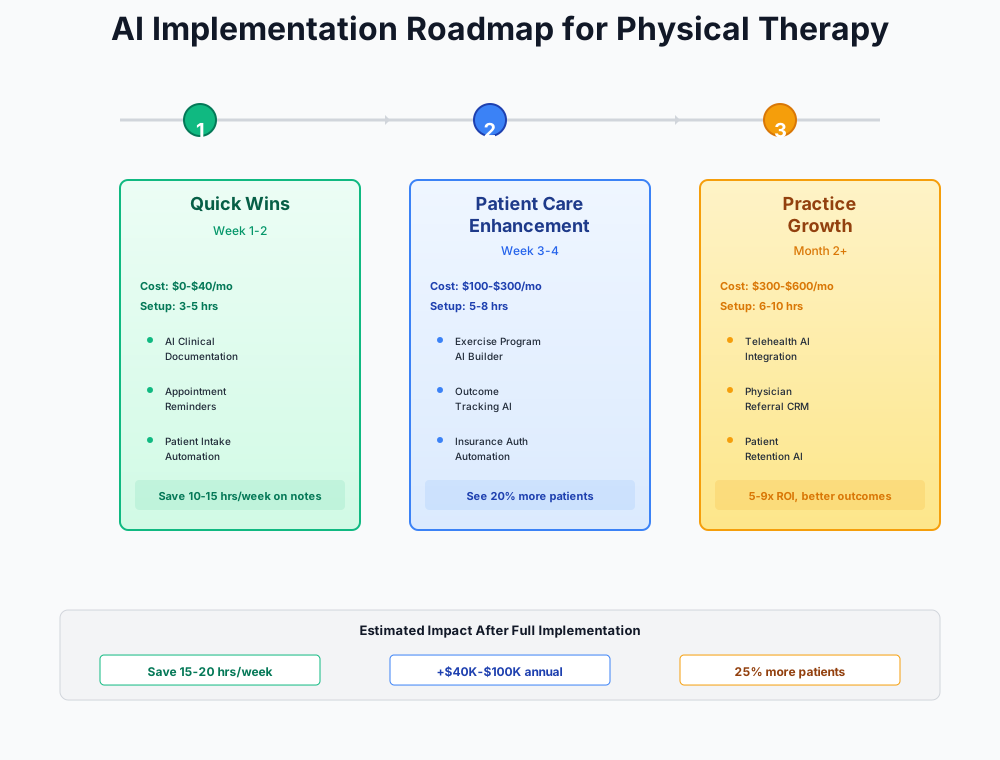
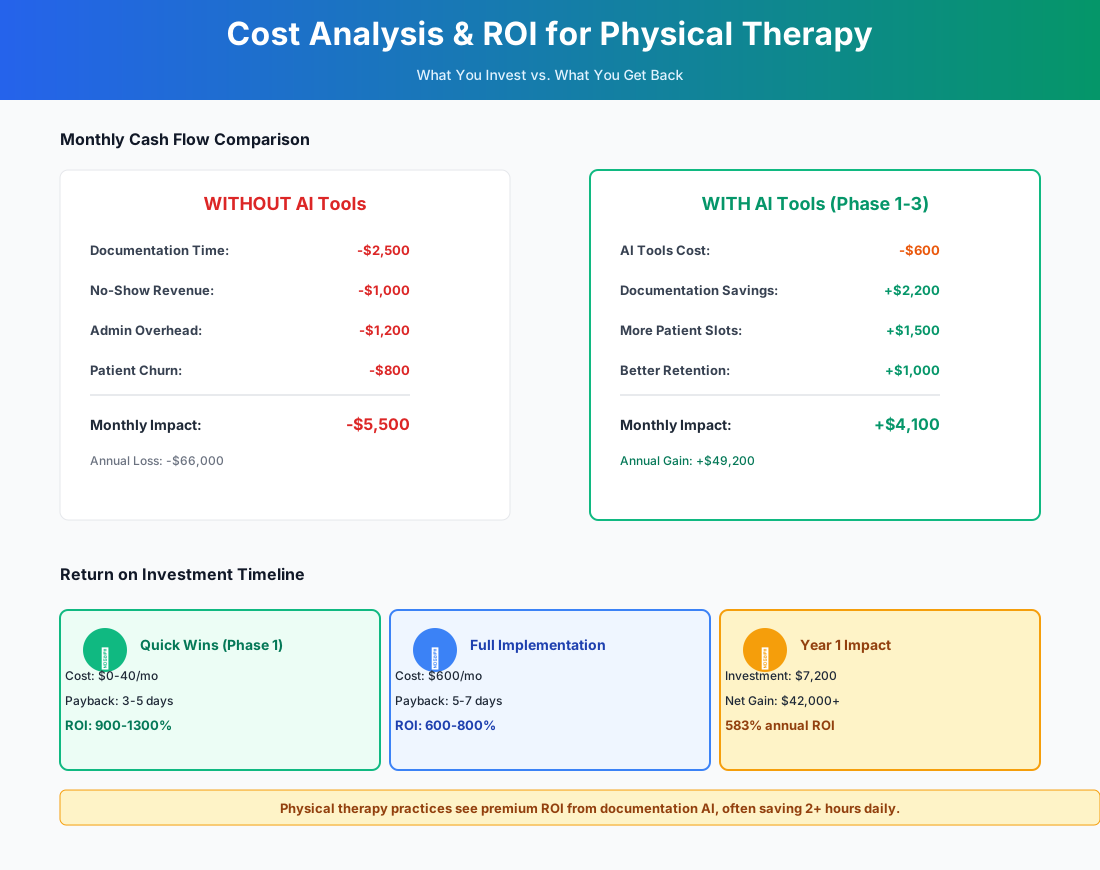
Here's how this rolls out in terms of cost and impact over time:
FAQ
Can AI documentation tools actually handle the 8-minute rule, or is that marketing?
Not marketing — this is one of the strongest concrete use cases. WebPT Copilot specifically tracks treatment time per CPT code within the SOAP note, validates that documented minutes support the billed units, and flags discrepancies before claim submission. If you've ever had a post-payment audit demand recoupment because your notes didn't clearly document 8 minutes of skilled one-on-one care per billed unit, AI documentation with built-in time validation is a genuine operational upgrade. The compliance layer runs automatically on every note, not just the ones your billing coordinator reviews.
How do I handle patients who don't have smartphones for digital HEP delivery?
PhysiTrack and MedBridge GO both support email-based HEP delivery with web-browser access — no app download required. For patients without email or digital access (typically 10–15% of a PT caseload, skewing elderly), these platforms also generate printable PDF exercise sheets with QR codes linking to video demonstrations. You lose the adherence-tracking benefit for those patients, but exercise quality improves meaningfully over stick-figure handouts. That said, for a 75-year-old post-TKA patient who doesn't own a smartphone, a printed sheet with a personal phone check-in from the therapist will still outperform a passive app notification.
My PTA handles most of my daily visits. Does AI documentation change anything for PTA billing compliance?
Yes, and it matters. In most states, PTA documentation must clearly identify the PTA as the treating provider, the supervising PT must co-sign within a state-mandated timeframe (often 14–30 days, though some states require 24-hour co-signature), and the note must reference the PT's established plan of care. Configure your AI documentation tool to auto-populate the PTA's credentials, flag the co-signature requirement, and block claim submission until the supervising PT has reviewed and signed. WebPT handles this natively. If your EMR doesn't enforce PTA co-signature workflows, that's a compliance gap to close before adding AI to the mix.
Can AI predict which patients are about to drop off their plan?
PhysiTrack's adherence dashboard flags patients whose HEP completion drops below 50% — and that's a reliable predictor of upcoming cancellations, usually by 1–2 weeks. Some EMRs are building predictive models using visit frequency patterns, appointment change history, and outcome measure trends to surface at-risk patients earlier. The technology is real but still maturing. The more important point: the signal only matters if someone acts on it. A direct call from the treating therapist ("I noticed you missed your exercises this week — how are you feeling?") will retain more patients than any automated follow-up sequence.
We switch to PhysiTrack mid-year. What happens to our MIPS data?
MIPS reporting requires continuous data for the full performance period (January 1 – December 31). Pre-switch data must still be submitted. Both PhysiTrack and MedBridge GO allow manual entry of historical outcome scores collected before implementation. The critical rule: don't let the platform switch create a gap in reporting. Export existing outcome data before migrating, import it into the new platform, and verify continuity with your MIPS submission registry before the October submission deadline.
Is there AI that helps with physician referral communication?
Not directly — no AI tool currently automates physician relationship management the way Weave handles patient communication. But the indirect answer is yes. AI documentation that produces cleaner, faster discharge summaries with validated functional outcome data is your most effective referral relationship tool. A discharge letter that takes your therapist 4 minutes to finalize (rather than 25) and includes objective LEFS or DASH score progressions is more compelling to a referring orthopedic surgeon than a generic narrative. The time savings from WebPT Copilot effectively funds better referral communication.
The PT practices that build durable referral pipelines in 2026 aren't necessarily the ones with the best manual therapists or the most equipment. They're the ones whose patients actually complete their plans — and whose referrers see the outcome data to prove it. Start with the plan-completion math in the table at the top of this guide. Figure out what a 10-point improvement in completion rate is worth to your practice. Then work backward to the tools that move that number.
If you're also managing a chiropractic office or a multidisciplinary rehab clinic, the documentation and billing tools overlap significantly — the compliance considerations are nearly identical. Practices that also offer massage therapy alongside PT will find the rebooking and SOAP-note workflow in our massage therapy AI guide maps closely onto the same table-hours economics.
More AI Implementation Guides
AI Tools for Home Health Care Agencies: 2026 Guide
A practical 2026 guide to AI tools for home health care agencies — HIPAA-safe automation for shift-filling, OASIS-E documentation, EVV, and claim denials.
AI Tools for Dermatology Practices: 2026 Guide
The best AI tools for dermatology practices in 2026 — cut prior-auth hours, reduce no-shows, and grow your cosmetic line, with a HIPAA-first rollout plan.
AI Tools for Mental Health Practice: 2026 Therapist Guide
Best AI tools for mental health practices in 2026: HIPAA-compliant scribes, measurement-based care, no-show reduction, and intake automation for therapists.
AI Tools for Massage Therapy Practices: 2026 Guide
How massage therapists use AI for SOAP notes, no-show defense, 24/7 phone answering, and retention — without breaking HIPAA, TCPA, or scope of practice
AI Tools for Optometry Practices: 2026 Guide
AI tools for optometry practices in 2026: HIPAA-safe scribes, ABB Verify, dual vision/medical billing, OCT AI, and a phased plan independents can run.
Best AI Chatbot & Lead Conversion Tools for Med Spas
Compare AI chatbots, lead conversion & generation tools for med spas. Capture missed calls 24/7, book online, recover $5K-$15K/mo in lost leads. See picks.
Keep exploring
See every AI implementation guide we've published for Healthcare, or browse the full library by industry or category. Looking for a specific platform? The AI tools directory indexes every product mentioned across our guides, and the comparisons hub puts the most-asked head-to-heads side by side.