
A patient starts care with a 24-visit treatment plan for a lumbar subluxation. They come three times a week for two weeks, feel better, and cancel. They're gone. The acute pain is handled and they have no reason to return — at least not one they can articulate. You know they'll be back in six months with the same complaint, likely worse. But for now, the slot is empty, the plan is incomplete, and roughly $1,800 in scheduled revenue walked out the door.
Multiply that by the number of times it happened last month.
This is the defining revenue problem in chiropractic: not new-patient acquisition, not billing denials — it's plan-completion drop-off. Industry estimates put mid-plan attrition at 35–45% for acute care patients, and the average uncompleted plan represents $1,200–$2,400 in unrealized collections. For a solo practice running 40 active care plans at any time, even a 30% drop-off rate means $14,000–$29,000 in scheduled revenue that never materializes each month.
AI doesn't fix this by itself. But it does three things that move the needle: it captures patient-specific outcome data that makes mid-plan progress visible to patients (so they don't feel "cured" after week two), it automates the follow-up that your front desk doesn't have time to do manually, and it removes the documentation burden that keeps you too busy to run a tight scheduling operation.
This guide covers every AI tool worth using in your chiropractic practice in 2026, organized around the workflows that matter most: plan completion and retention, intake and no-show reduction, documentation, and billing. Every recommendation was vetted against the specific realities DCs face — CPT codes 98940–98942, AT modifier compliance, Medicare LCD requirements, and the particular economics of a care-plan-driven practice.
TL;DR — Top 3 Recommendations
- DoraScribe (free) or ChiroTouch Rheo (included with subscription) — Cut SOAP note time by 50–92%. Start this weekend.
- TalkForce AI (per-minute pricing; contact for quote) — 24/7 AI phone agent that books appointments and eliminates missed calls.
- SPRY (visit-based pricing; contact for quote) — All-in-one AI platform with claim scrubbing, eligibility verification, and documentation that reduces denials by up to 75%.
Before Anything Else: What AI Can and Can't Touch
Every AI tool that processes, stores, or transmits Protected Health Information — patient names, dates of birth, diagnoses, treatment notes, insurance details — must have a signed Business Associate Agreement with your practice before it goes live. This is a federal HIPAA requirement, not a best practice. OIG and CMS scrutiny of chiropractic billing — particularly AT modifier misuse and maintenance-care miscoding — has been on a sustained upward trend for several years running. Getting this wrong before you start costs more than the tools save.
The line for your team is simple:
- HIPAA-compliant tools (ChiroTouch Rheo, DoraScribe, ChiroScribe, SPRY, Weave) — safe for patient data once the BAA is signed.
- General-purpose AI (ChatGPT, Claude, Gemini) — never input anything that identifies a patient. Use these only for templates, marketing copy, job postings, and business strategy. If you wouldn't shout it across the waiting room, don't paste it into a general AI tool.
Violations almost always come from front desk staff who don't understand the distinction. A staffer pastes a patient's name and diagnosis into ChatGPT to draft a recall email — that single action is a reportable breach. Make this the first training conversation before any tool goes live.
State scope-of-practice rules add another layer. Before using any AI tool that touches clinical decision-making, verify its outputs align with your state board's scope. ChiroUp's evidence-based protocols are informational, not diagnostic — the clinical judgment is yours, and you need to document that distinction explicitly for Medicare patients.
Audit Red Flag: Cloned Notes
If an auditor finds 50 consecutive SOAP notes with identical objective language, your practice faces recoupment demands of $10K–$50K+. Always review AI-generated notes for patient-specific details before signing.
The Plan-Completion Problem — And Where AI Fits
Here's a number worth sitting with: practices that actively measure plan completion rates average 58–65% plan adherence. Practices that don't measure it average around 45%. The difference isn't patient demographics — it's whether the practice has a system.
| Plan Completion Rate | Est. Monthly Revenue Retained | Annual Impact (40 active plans avg) |
|---|---|---|
| 45% (no system) | ~$25,200 | baseline |
| 58% (reminders only) | ~$32,500 | +$87,600/yr |
| 70% (reminders + outcome tracking) | ~$39,200 | +$168,000/yr |
| 80% (full AI-assisted retention) | ~$44,800 | +$235,200/yr |
Assumes average plan value of $1,600 (18-visit plan at $89 avg reimbursement), 40 concurrent plans. Estimates are illustrative benchmarks.
The practices hitting 70–80% completion share three traits: they show patients their own outcome scores (so "feeling better" doesn't translate to "I'm done"), they use automated mid-plan check-ins to catch cancellation intent before it becomes a missed appointment, and they have a system that flags plans approaching drop-off risk. None of that happens by accident. Most of it can be automated.
Outcome Tracking as a Retention Tool
How many hours did your office manager spend last week chasing down patients who "felt better" and stopped booking? That question has a known answer: the average chiro CA spends 4–6 hours per week on manual retention follow-up, and it still doesn't prevent 35–40% of plans from going incomplete.
ChiroUp's built-in outcome assessments change the dynamic at the point of care rather than after. Run the Oswestry Disability Index at intake and again at the 4-week re-evaluation. Print the comparison and hand it to the patient. When a patient sees their own functional improvement quantified — "You went from a 48% disability score to a 22%" — the conversation about continuing care shifts from you convincing them to them understanding why.
ChiroUp Essentials
Best for: Evidence-based protocols, patient education handouts, and outcome assessments
Provides evidence-based treatment protocols for every chiropractic diagnosis, generates patient-friendly education handouts you print and hand over during Report of Findings, and automates outcome assessments (ODI for low back, NDI for neck, PROMIS). Also generates MD referral letters to systematically build physician referral relationships. The patient education handouts alone can improve case acceptance by 10–20%.
For Medicare patients, ChiroUp's outcome assessments produce the measurable improvement scores that LCD requirements demand. Run them at intake, 30 days, and 90 days; embed the scores in your SOAP notes. This is the strongest protection you have against audit recoupment — and it doubles as a retention tool because patients who see progress on paper continue care at much higher rates.
Write a patient-friendly explanation for a chiropractic treatment plan:
Diagnosis: [e.g., lumbar subluxation at L4-L5 with radiating pain] Recommended plan: [e.g., 3x/week for 4 weeks, then 2x/week for 4 weeks, then 1x/week for 4 weeks] Key findings: [e.g., reduced range of motion, positive orthopedic tests, X-ray findings]
Write at a 7th-grade reading level. Explain WHY this frequency matters using a simple analogy (like physical therapy or braces). Address the common objection: "I feel better, why do I need to keep coming?" Keep it under 200 words.
Lapsed-Patient Reactivation
The average chiropractic patient completes 6–8 visits and disappears when acute pain resolves — even though 70–80% are candidates for wellness care. Each lost wellness patient represents $1,500–$5,000 in lifetime value.
Patient Pilot by The Smart Chiropractor
Best for: Done-for-you email lifecycle automation (new, active, lapsed patients)
Fully automated email campaigns across three lifecycle stages: new patient onboarding, active patient retention, and lapsed patient reactivation. Content is professionally written and chiropractic-specific — zero writing required from you. Includes compliance-protected reactivation offers through a ChiroHealthUSA partnership. Note: The Smart Chiropractor restructured this as an add-on that requires the Care Plan Pro Growth base plan rather than a standalone subscription.
If ~$158/month is outside your current budget, start manually with this:
I run a chiropractic practice. Write a 3-email reactivation sequence for patients who haven't visited in 90+ days.
Email 1: Friendly wellness check-in — ask how they're feeling, no hard sell Email 2: Educational content about the benefits of maintenance chiropractic care for [common condition]. Include 2 statistics. Email 3: Offer a complimentary wellness evaluation with a clear call-to-action to book.
Each email should be under 150 words, written at an 8th-grade reading level, and warm but not pushy. Do NOT include any patient-specific health details — these are templates.
Send via your EHR's built-in email feature or Mailchimp (note: Mailchimp removed automated sequences from its free plan in June 2025, and the free tier was cut further in January 2026 — automation now requires the Standard plan at $20+/mo; you can send manually on the free tier or upgrade for automated drip sequences). Segment your list: patients who dropped after 2 visits need a different message than those who completed a full plan and just drifted.
Scheduling, Intake, and No-Show Reduction
A 15% no-show rate costs a busy solo practice $500–$1,500 per week in empty slots. The math on fixing it is straightforward: two automated text reminders (48 hours out and 2 hours out) drop no-shows from 15–20% to 5–8% at most practices — recovering 4–8 additional patient visits per week. At $85–$110 per visit, that's $340–$880 weekly for a $50–$100/month tool.
AI Phone Coverage and After-Hours Booking
Your front desk misses calls during peak adjustment hours. Every missed call is a potential new patient who dials the next chiropractor on Google.
TalkForce AI
Best for: Practices missing calls during busy hours
AI voice agent that answers inbound calls 24/7, books appointments directly into your scheduling system (ChiroTouch, Jane App, SKED), and sends confirmation texts. Handles FAQs about services, insurance panels, and hours. Configure it with your practice's specific details — the AI needs to know what you accept and offer.
Setup takes 2–3 hours: configure your practice hours, services, insurance panels, and common FAQs, then set call forwarding so overflow and after-hours calls route to TalkForce. Test by calling your own number. Within one week, you'll see exactly how many calls you were missing — most practices are surprised by the number.
For practices that want phone, texting, reminders, and review requests in one platform, Weave replaces your entire phone system and adds deep EHR integrations.
Weave
Best for: All-in-one patient communication replacing phone + texting + reminders
Combines AI-enhanced phone system, two-way texting, automated appointment reminders, missed-call auto-text, online payments, and review requests. Deep integrations with ChiroTouch, Jane App, ChiroFusion, ECLIPSE, and CHIROSPRING. Used by 40,000+ customer locations. If you're also considering tools from our dental practice guide or physical therapy guide, Weave works across all three specialties.
ROI Snapshot
Monthly Cost
$100/mo
Time Saved
6hrs/week
Monthly Value
$3,480
ROI
3380%
Website Lead Capture
Your website gets visitors at 10 PM who want to book but won't fill out a contact form. A chiropractic-specific chatbot captures those leads in real time and routes them straight to your scheduler.
ChiroBot AI
Best for: Low-cost 24/7 lead capture on your website, Facebook, and Instagram
Purpose-built for chiropractic practices. Submit your website URL, and the team builds and installs the chatbot within 2 business days — zero technical work from you. Connects to your online scheduling system so leads can book immediately. Deploys across your website, Facebook, and Instagram simultaneously.
The key: connect ChiroBot to your online scheduler so leads can book in the same session. If they can't book immediately, you lose more than half of them.
AI SOAP Note Generation
For most DCs, this is where AI earns its keep fastest. If you're spending 10–15 hours a week on documentation, a good ambient scribe recovers 5–12 of those hours — time you're currently finishing at home.
If you're already on ChiroTouch:
ChiroTouch Rheo
Best for: Existing ChiroTouch users — no additional cost
Ambient AI scribe built directly into ChiroTouch EHR. Listens to patient-provider conversations and auto-generates full SOAP notes in real time. Also includes AI intake summarization and chart summaries. Claims up to 92% reduction in documentation time. Launched August 2025 — enable it in your ChiroTouch settings at no extra charge.
If you're not on ChiroTouch, or want to test before committing:
DoraScribe
Best for: Risk-free AI documentation testing — no credit card required
General-purpose AI medical scribe with chiropractic-specific templates. Free tier gives you 20 transcripts/month — enough for one full week on a 4-day schedule. Records patient visits, transcribes in real time, and generates structured SOAP notes. EHR-agnostic: copy/paste into ChiroTouch, ChiroFusion, or any system.
For practices that need chiropractic-specific features from day one:
ChiroScribe
Best for: Solo DCs who want purpose-built chiropractic SOAP note AI with superbill generation
Converts natural speech into structured chiropractic SOAP notes in under 60 seconds. Learns your documentation style over time. Includes AI treatment plan generation, CPT code suggestions, and superbill auto-generation. HIPAA compliant with AES-256-GCM encryption.
A practical path: sign up for DoraScribe's free tier this week. Record 5–10 patient visits and compare the AI output to what you'd have typed at 9 PM. If you're saving 30+ minutes per day after a week, continue. If you're on ChiroTouch, enable Rheo instead — it's already included. Evaluate ChiroScribe's superbill generation only if your billing workflow specifically needs it.
Medicare documentation is where most practices stumble with AI-generated notes. Use this to audit your output before trusting it at scale:
Review this AI-generated SOAP note for a Medicare chiropractic claim:
[PASTE YOUR AI-GENERATED NOTE HERE]
Check for:
- Is the AT modifier correctly applied to CPT codes 98940-98942?
- Does the subjective section include patient-specific complaints (not boilerplate)?
- Does the assessment include medical necessity language for active/corrective treatment?
- Are measurable outcome metrics (pain scale, ROM, functional improvement) documented?
- Is there a clear distinction between active treatment and maintenance care?
Flag any gaps that could trigger a Medicare denial or audit finding.
Billing and Revenue Recovery
Your practice bills approximately $723K per year but collects only ~$450K. That 37% gap is mostly preventable. The three biggest contributors: claim denials from documentation errors, eligibility surprises when visit limits reset, and slow-moving aged receivables that become uncollectable. AI addresses all three, but the highest-ROI entry point is claim scrubbing.
Claim Scrubbing and Denial Management
SPRY
Best for: All-in-one AI platform: EHR + billing + claim scrubbing + eligibility verification
AI-native clinic management platform built specifically for chiropractic and rehab. Combines EHR, SOAP notes, insurance eligibility verification, CPT coding with AT modifier compliance checks, AI claim scrubbing, and denial tracking. SPRY moved from a flat monthly rate to visit-based pricing (Essentials and Plus tiers priced per full-time provider by visit volume — contact SPRY for a current quote). Integrates with Office Ally, Waystar, and Availity clearinghouses. Per SPRY's own data, reports up to 75% reduction in claim denials and up to 40% reduction in charting time — treat these as vendor benchmarks, not guaranteed outcomes.
For practices that want serious denial-prevention capability without switching EHRs, Waystar's AltitudeAI (accessed through your existing clearinghouse integration) predicts denial propensity before submission and automates appeal packets — saving roughly 16 minutes per appeal. It's typically accessed through ChiroTouch or ChiroFusion's clearinghouse connection rather than as a standalone purchase.
Before investing in any billing tool, understand your current denial pattern:
I run a chiropractic practice. Here are my claim denial statistics from the last 90 days:
Total claims submitted: [number] Total denied: [number] Top denial reason codes:
- [code and description, e.g., CO-50 Medical Necessity]
- [code and description]
- [code and description]
Average reimbursement per visit: $[amount] Percentage of Medicare vs. commercial vs. cash patients: [breakdown]
Calculate: (1) my annual revenue lost to denials, (2) which denial reasons are preventable with AI claim scrubbing, and (3) which require documentation changes I should make upstream. Prioritize the fixes by dollar impact.
Eligibility Verification
Benefits change every January when deductibles reset. Patients switch jobs without telling you. Commercial payers cap chiropractic visits at 12–20 per year, and your front desk finds out when the 13th claim bounces. SPRY and Weave both offer real-time eligibility verification.
The protocol that prevents most surprises: verify every new patient before their first visit; re-verify all active patients in the first two weeks of January; run a manual check for any patient within two visits of their known plan cap. Practices that verify before every visit see a 30–50% reduction in eligibility-related denials, which typically represent 3–5% of total claims.
When Claims Do Get Denied
Draft a Medicare appeal letter for a chiropractic claim denied for medical necessity (reason code CO-50).
Patient details (use placeholders — no real PHI):
- Diagnosis: Lumbar subluxation at L4-L5
- Confirmed by: X-ray showing [specific finding]
- Positive orthopedic tests: [list tests]
- Functional limitation: Oswestry Disability Index score of [score] at intake
- Treatment provided: CPT 98941 (spinal manipulation, 3-4 regions) with AT modifier
- Number of visits to date: [number]
Reference your applicable Local Coverage Determination for Chiropractic Services (LCD numbers vary by MAC jurisdiction — use the one that applies to your region; common examples include L37254 and L37387). Include the specific policy language that supports medical necessity for this case. Professional tone, under 500 words.
Financial Visibility
QuickBooks Online with Intuit AI Agents
Best for: Automated transaction categorization, reconciliation, and financial dashboards
AI auto-categorizes transactions (insurance payments, co-pays, supply costs), reconciles bank accounts, and generates invoice reminders for outstanding patient balances. Claims to accelerate payment by 5 days on average. Enable the AI Accounting Agent in Settings if you're on Essentials tier or higher.
Every Monday, spend 30 minutes with your AI-generated financial summary. Reconcile QuickBooks against your EHR billing reports monthly — insurance payments post in both systems and must match. Set patient balance alerts for anything over 90 days; aged receivables beyond that point become nearly uncollectable.
My solo chiropractic practice collected $[amount] last month with [number] new patients, [number] total visits, and $[amount] in accounts receivable over 60 days. My overhead is [percentage] of collections. My denial rate is [percentage].
Compare these numbers to 2026 chiropractic industry benchmarks. Where am I above average? Where am I below? What are the 3 highest-impact areas I should focus on to increase profitability? Be specific with dollar estimates.
Common Mistakes Worth Avoiding
Don't switch your entire EHR just to access AI features. Migrating from ChiroTouch to SPRY — or anywhere else — is a 2–4 week disruption that affects scheduling, billing, and records simultaneously. Add standalone AI tools (ChiroScribe, DoraScribe) alongside your existing system first. Switch EHRs only if you have grievances beyond AI capability.
Don't sign annual contracts before testing. Podium, Birdeye, and Solutionreach all require annual commitments that are hard to exit. Use free trials and month-to-month plans first.
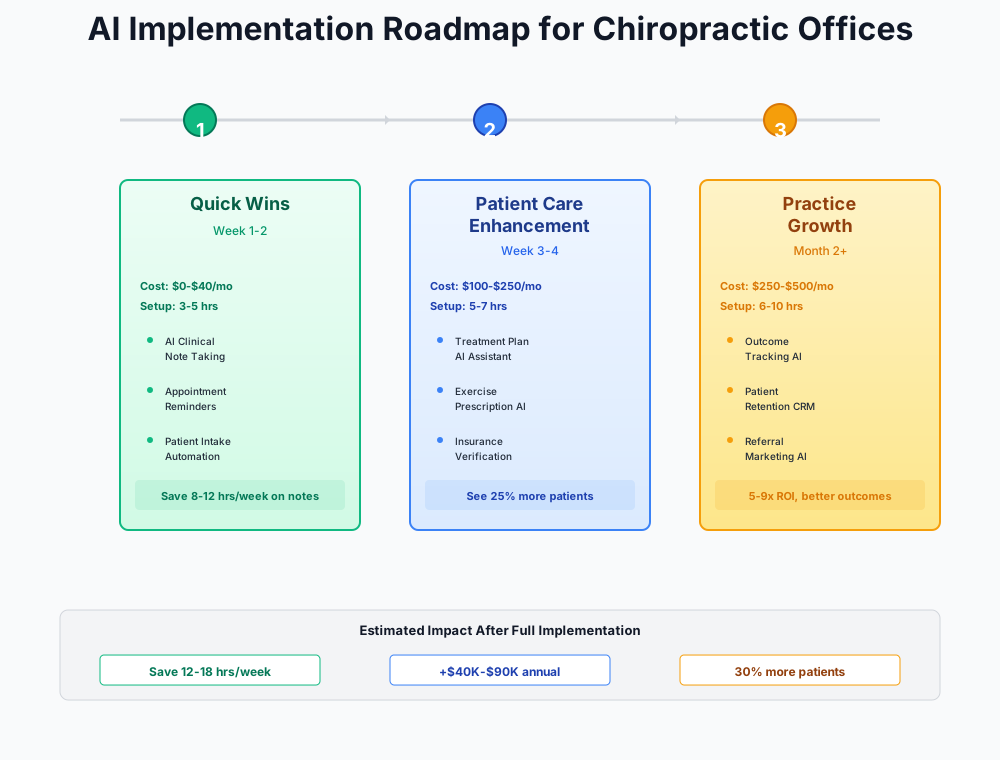
Don't deploy five tools in the same month. That overwhelms your staff and guarantees partial adoption across the board. Start with AI SOAP notes for a full week. Add patient communication in week three. Layer billing automation after that. The tools work better when your team has absorbed each one before the next arrives.
Getting Started Checklist
- Run a denial analysis on your last 90 days of claims — what's your denial rate and top 3 reason codes?
- Pull your no-show rate from your EHR — this is your baseline to measure improvement
- Sign up for DoraScribe's free tier (20 notes/month) — test AI SOAP notes on 5–10 patients this week
- If you're on ChiroTouch, enable Rheo AI Scribe in settings (it's already included — no extra cost)
- Train all staff: NEVER paste patient names, DOBs, or diagnoses into ChatGPT or Claude
- Start TalkForce AI's free trial — route after-hours calls to the AI agent and track how many leads it captures
- Configure automated text reminders (48 hours + 2 hours before appointments) in your EHR or Weave
- Pull your lapsed patient list (90+ days since last visit) and send a 3-email reactivation sequence
- Sign up for ChiroUp's free trial and hand out one patient education sheet during your next Report of Findings
- Schedule a 30-minute Monday morning financial review using QuickBooks AI-generated reports
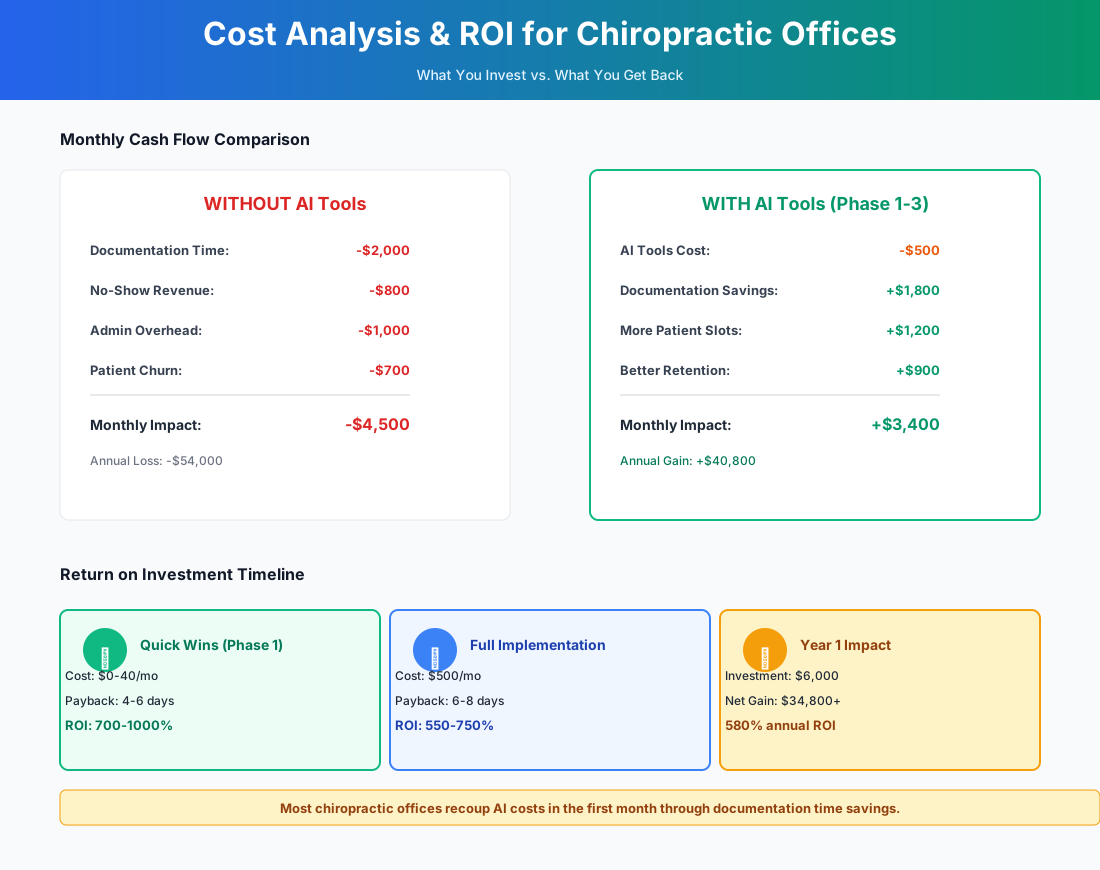
Here's how the implementation typically sequences — early weeks on documentation, then communication, then billing:
Frequently Asked Questions
Can AI SOAP note tools handle Medicare AT modifier compliance and LCD documentation requirements?
The chiropractic-specific tools can — with caveats. ChiroTouch Rheo and ChiroScribe both generate notes with AT modifier placement and medical necessity language, but you must verify every note before signing. The AI produces a structured first draft; clinical accuracy and compliance responsibility remain yours. Test specifically with a Medicare lumbar subluxation case and check the output against your applicable LCD requirements before trusting the tool at scale.
What happens if my DoraScribe or ChiroTouch Rheo connection drops mid-visit?
They handle outages differently. Rheo is cloud-based within ChiroTouch — if your internet drops, the ambient scribe stops recording and you finish that note manually. DoraScribe records locally on your device and syncs when reconnected, so a brief outage doesn't lose your recording. For practices in areas with unreliable internet, DoraScribe's local-first approach is the safer bet. Either way, keep a paper SOAP template accessible as a backup.
How do I prevent AI-generated notes from triggering a cloned documentation audit flag?
Use ambient scribes (Rheo, DoraScribe) that transcribe actual patient conversations rather than template-based generators. Since every patient describes their symptoms differently, the subjective section varies naturally. For the objective section, dictate actual examination findings per visit rather than accepting default values. A simple audit: pull your last 10 AI-generated notes and read the Assessment sections side by side. If they're nearly identical, you have a problem. The fix is adding a dictated sentence of specific clinical reasoning to each note before you sign.
Does SPRY's claim scrubbing work with payers that impose chiropractic-specific visit limits?
Yes, with one important caveat. SPRY's real-time eligibility verification checks remaining visit counts before the appointment, and the claim scrubbing flags submissions that would exceed a known visit cap. But payer rules change frequently — UnitedHealthcare announced in May 2026 that it will eliminate prior authorization for select chiropractic services by the end of 2026 as part of a broader 30% cut to prior-auth requirements, and the specific CPT codes affected haven't been published yet. No AI tool updates instantly. Run manual eligibility checks for any patient within two visits of their known cap, and re-verify all active patients after the January 1 reset when deductibles and visit counts restart, and again once UHC publishes its final list of affected codes.
Will adding AI tools make it harder to train a new CA when staff turn over?
Honestly, it makes it easier. Instead of teaching a new hire your paper-based recall process, your manual reminder scripts, and your documentation workflow from scratch, you point them at an automated system. TalkForce AI handles calls without CA intervention. Automated reminders run without manual effort. The CA-facing tools in this guide (ChiroBot lead follow-up, eligibility verification) take 1–2 hours to learn, not weeks. The practices that suffer most from turnover are those with the most manual, undocumented processes — which is exactly what AI replaces.
What if I'm shifting toward cash-based or membership care to reduce insurance dependence?
Cash-based practices have different AI priorities: billing automation and claim scrubbing become less relevant, but patient retention becomes everything — because there's no insurance-mandated visit schedule keeping patients accountable. Focus on Patient Pilot (~$158/mo combined with its required Care Plan Pro Growth base plan) for lifecycle email automation, ChiroBot AI ($49/mo) for 24/7 lead capture, and Weave ($199+/mo) for membership payment processing and recall. For membership pricing strategy, ChatGPT works well for modeling tiers: prompt it with your zip code, competitor pricing ranges, and average visit frequency. If you're also exploring wellness-adjacent services, our med spa guide covers AI tools for membership and package-based healthcare models in more detail.
Is AI going to replace my front desk staff?
No. And anyone who tells you it will is selling something. TalkForce AI handles overflow and after-hours calls — it doesn't eliminate the need for a CA who can manage a full schedule, handle insurance disputes, and read the room with an anxious new patient. What AI does is take the repetitive, interruptive tasks (reminder calls, basic FAQs, after-hours voicemails) off their plate so they can focus on the interactions that actually require a person.
Start with DoraScribe. Record your next five patient visits, compare the AI output to what you'd have typed at 9 PM, and see what you're dealing with. Most DCs make their decision within a week. From there, work through the checklist above at a pace your staff can absorb — documentation first, communication second, billing last.
Your patients come in for the adjustment. The rest should run itself.
Running a physical therapy or veterinary practice with similar compliance and documentation needs? Our physical therapy guide and veterinary clinic guide cover the same ground for those settings.
More AI Implementation Guides
AI Tools for Home Health Care Agencies: 2026 Guide
A practical 2026 guide to AI tools for home health care agencies — HIPAA-safe automation for shift-filling, OASIS-E documentation, EVV, and claim denials.
AI Tools for Dermatology Practices: 2026 Guide
The best AI tools for dermatology practices in 2026 — cut prior-auth hours, reduce no-shows, and grow your cosmetic line, with a HIPAA-first rollout plan.
AI Tools for Mental Health Practice: 2026 Therapist Guide
Best AI tools for mental health practices in 2026: HIPAA-compliant scribes, measurement-based care, no-show reduction, and intake automation for therapists.
AI Tools for Massage Therapy Practices: 2026 Guide
How massage therapists use AI for SOAP notes, no-show defense, 24/7 phone answering, and retention — without breaking HIPAA, TCPA, or scope of practice
AI Tools for Optometry Practices: 2026 Guide
AI tools for optometry practices in 2026: HIPAA-safe scribes, ABB Verify, dual vision/medical billing, OCT AI, and a phased plan independents can run.
Best AI Chatbot & Lead Conversion Tools for Med Spas
Compare AI chatbots, lead conversion & generation tools for med spas. Capture missed calls 24/7, book online, recover $5K-$15K/mo in lost leads. See picks.
Keep exploring
See every AI implementation guide we've published for Healthcare, or browse the full library by industry or category. Looking for a specific platform? The AI tools directory indexes every product mentioned across our guides, and the comparisons hub puts the most-asked head-to-heads side by side.