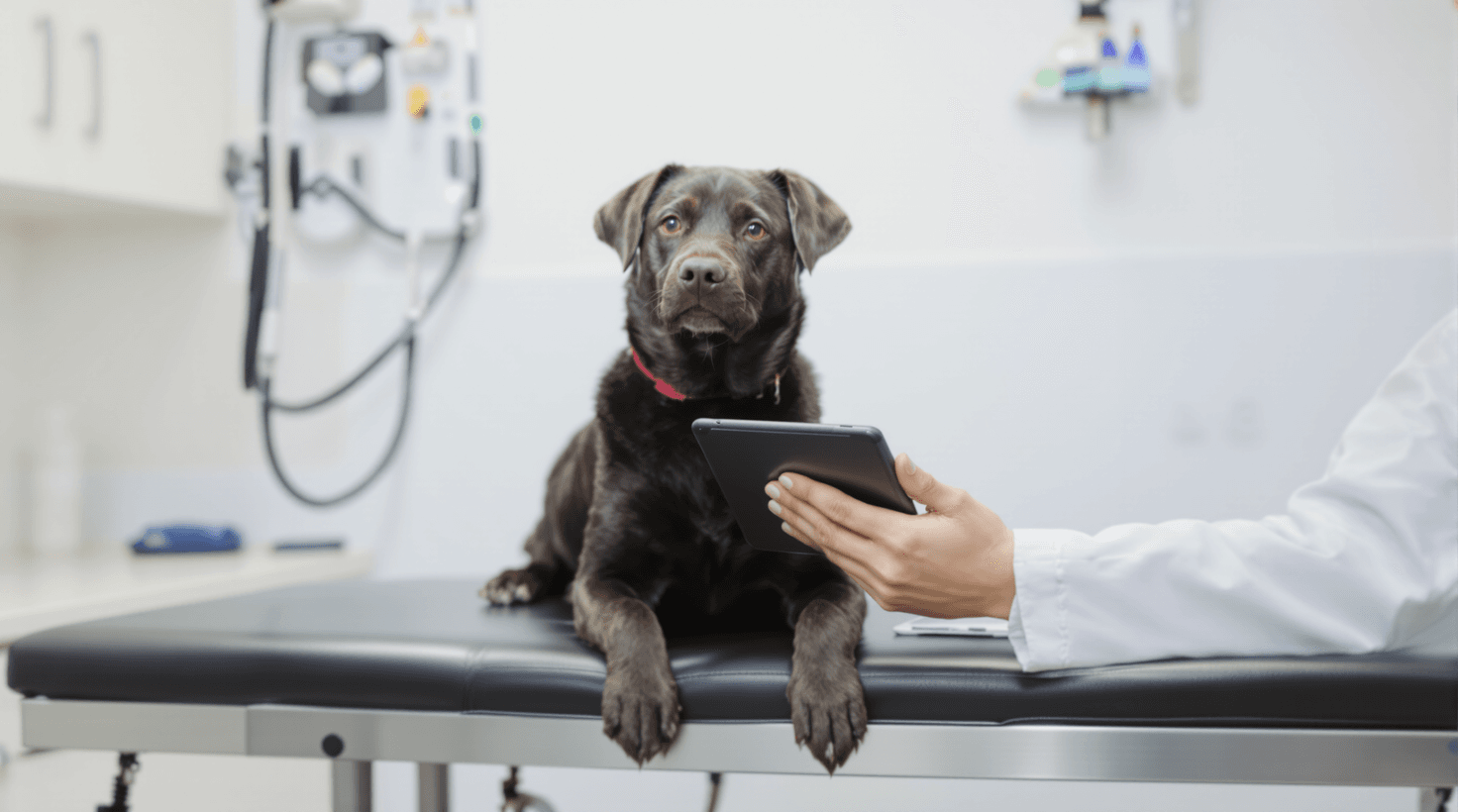
Picture Monday morning at a 3-DVM small animal practice. The overnight emergency line caught four calls. Two were true crises — one was a dog who ate a sock, one was a cat who "looked different." The other two were vaccine refill questions that could have been handled by a text. Nobody from the practice heard any of them until 8 AM.
That's the core challenge in running a veterinary clinic: every incoming communication feels roughly equal in urgency until it isn't. Your front desk can't triage at phone-scale. Your DVMs are already charting at 9 PM to keep up with patient volumes. And in the background, 30-50% of your active patient base is overdue for a vaccine, a dental, or an annual exam — patients who will quietly drift to another practice if no one follows up.
AI doesn't solve the emotional weight of this work. But it's remarkably good at the three problems that compound burnout fastest: after-hours call capture, appointment triage, and recall compliance. That's the lens for this guide.
TL;DR — Top 3 Recommendations
- Talkatoo ($99/mo per DVM) — Veterinary-specific AI scribe that cuts SOAP note time by 80%. Highest ROI tool in this guide.
- PetDesk (free basic tier) — Automated appointment reminders and two-way texting that drops no-show rates from 15% to 5-8%.
- VetCove (free for clinics) — AI-powered purchasing platform that compares prices across distributors and reduces medication waste.
The Recall Gap Is Costing You More Than No-Shows
Most practices obsess over no-shows. Understandable — an empty slot at 2 PM is visible and immediate. But the bigger revenue leak is quieter: patients who were due for a wellness exam four months ago and never came back because nobody reached out.
Industry benchmarks put recall compliance — the percentage of patients who complete their recommended annual or semi-annual care — at 40-55% for the average practice. That means nearly half your active patient base is drifting. Each lapsed wellness visit represents $150-$350 in foregone preventive revenue. Across a 1,500-active-patient practice, closing the recall gap by 15 percentage points is worth $33,000-$78,000 per year. That's not a rounding error.
| Metric | Typical Practice | With AI Automation | Difference |
|---|---|---|---|
| Recall compliance rate | 42% | 58-65% | +16-23 pts |
| No-show rate | 12% | 5-8% | -4-7 pts |
| After-hours calls captured | 35% | 80-90% | +45-55 pts |
| DVM documentation time/day | 2.5 hrs | 0.5-1 hr | -1.5-2 hrs |
| Case acceptance rate | 54% | 65-70% | +11-16 pts |
The tools that move these numbers aren't exotic. They're communication platforms, scribes, and an inventory tool that's free. Here's how to deploy them without disrupting your clinical workflows.
Compliance First — What Actually Applies to You
Before any tool goes live, your team needs a clear picture of the regulatory landscape. Veterinary practices aren't subject to HIPAA — that law applies to human health information — but that doesn't mean client data is unprotected. State consumer privacy laws (CCPA in California and equivalents now active in 15+ states) cover the personally identifiable data you collect: names, addresses, email addresses, payment information, and the sensitive details that sometimes surface during euthanasia consultations.
Your medical records are governed by state veterinary practice acts. Most require 3-7 years of retention. A valid veterinarian-client-patient relationship (VCPR) must exist before treatment, and AI tools that interact with clients must never imply that a diagnosis or treatment recommendation is being made outside an established VCPR.
Controlled substances sit in their own category entirely. DEA regulations require perpetual inventory logs for Schedule II substances (ketamine, hydromorphone) and biennial physical inventory for Schedules III-V (butorphanol, tramadol, phenobarbital). No AI tool can automate away the DVM's signature requirement on controlled substance logs. Don't let any vendor tell you otherwise.
- Data encryption: Client and patient data must be encrypted in transit (TLS 1.2+) and at rest (AES-256)
- Data residency: Confirm where your data is stored and that the vendor doesn't use your clinic's data to train public AI models
- Access controls: The tool must support role-based access (DVM vs. technician vs. front desk) matching your practice's permission structure
- Data export: You must be able to export or delete client data upon request — especially if you operate in a CCPA-covered state
- Controlled substance separation: Any inventory tool must handle DEA-scheduled drugs in a dedicated module with audit trails, not commingled with general inventory
One rule applies to every staff member from day one: never put client names, pet names, addresses, or any identifiable details into ChatGPT or any general-purpose AI tool. These platforms aren't designed for clinical data. Use them for generic content — social posts, job descriptions, client education templates with no identifying details filled in. For anything involving patient records, client communication, or clinical data, use veterinary-specific tools with documented data handling practices.
A receptionist drafting a response to a client complaint in ChatGPT — including the client's name, the pet's name, and the treatment context — has just sent protected consumer data to a third-party model. Train your team on this boundary at onboarding. Reinforce it quarterly.
After-Hours Call Capture: The 65% You're Currently Missing
A caller who hits voicemail at a veterinary clinic is gone roughly 62% of the time. They call the next practice on the list. If that call was about a dog who ate something, the stakes are higher than a lost scheduling opportunity.
The fix isn't answering every call — it's routing every call correctly. Urgent calls need an immediate path to a human or an emergency referral. Routine calls need self-service options good enough that the client doesn't feel abandoned.
Weave
Best for: Practices wanting phone, text, reviews, and payments in one system
Weave combines an AI-enhanced phone system with two-way texting, automated review requests, and payment processing. The veterinary implementation focuses on call routing that distinguishes emergencies from routine inquiries — which is the critical configuration step most practices skip. If you've looked at Weave for a dental or physical therapy practice, the core platform is the same; the routing logic needs to be rebuilt for veterinary urgency tiers.
Before you go live with any AI phone system, build the emergency escalation path explicitly. These calls route to a live staff member — never to AI, never to voicemail:
- Any ingestion or suspected toxicity ("my dog ate...")
- Breathing difficulty, seizure, trauma, uncontrolled bleeding
- Any caller who sounds distressed or is crying
- "Hit by car," "not moving," "collapsed"
Test this path weekly. Assign one staff member each morning to verify the emergency routing is functional. A missed emergency isn't a customer service miss — it's a patient outcome issue.
Thank you for calling [Clinic Name]. We're currently closed. If this is a life-threatening emergency, please press 1 to be connected to [Emergency Clinic Name] at [number], or go directly to [address]. For appointment scheduling, medication refills, or general questions, press 2 and our AI assistant can help you right now — or leave a message and we'll call you back first thing tomorrow.
For after-hours calls that aren't emergencies — appointment scheduling, medication refill questions, vaccine record requests — an AI system that captures the request and queues it for morning follow-up recovers a significant portion of what would otherwise be lost. Most practices implementing Weave or similar systems report capturing 80-90% of after-hours contacts versus the 35% they were capturing with voicemail alone.
Appointment Reminders and Recall: Closing the Compliance Gap
How many patients in your active database are overdue for vaccines, annual exams, or dental cleanings? Run that report in your PIMS right now. Most practices find the number is somewhere between 30% and 50% of their active patient base. That's not a documentation problem — it's a communication problem.
PetDesk
Best for: Clinics wanting an all-in-one client communication platform
PetDesk integrates with most major veterinary PIMS to automate appointment reminders via text and email, enable two-way texting, and offer online booking. The free tier handles basic reminders — enough to cut no-shows meaningfully on its own. The Professional tier adds an AI receptionist that handles calls, texts, and scheduling from a single platform, which is where the recall automation really opens up.
Vet2Pet
Best for: Practices that want built-in loyalty programs alongside communication
Vet2Pet adds appointment reminders, two-way messaging, and a pet owner loyalty rewards program. The engagement features — birthday messages, milestone tracking, points for visits — help convert one-time clients into regulars, which matters for recall compliance more than a single reminder sequence does.
A three-touch appointment reminder sequence outperforms any single reminder by enough to justify the setup time:
- 7 days before: Email with appointment details and prep instructions (fasting protocols, bring a stool sample, etc.)
- 2 days before: Text — short, with a confirm/reschedule link so clients don't have to call
- 2 hours before: Final text with a one-tap confirmation option
Enable two-way texting. One-way reminders underperform by about 40% because clients can't respond without calling.
For recall, the sequence is different — it's about bringing lapsed patients back, not confirming existing appointments:
- 30 days overdue: Friendly email with a direct booking link. Mention what's due specifically (rabies booster, FVRCP, annual bloodwork).
- 60 days overdue: Text — slightly more direct. Include the online scheduling link.
- 90 days overdue: Final outreach with a low-friction incentive (free nail trim with the visit, complimentary wellness screening).
Write a friendly, warm email to a pet owner whose [dog/cat] named [Pet Name] is overdue for their annual vaccines and wellness exam. It's been [X months] since their last visit. Mention the specific vaccines that are due, why staying current matters for their pet's health, and make it easy to book by including a link. Keep the tone caring — not guilt-inducing. Under 150 words. Sign from [Clinic Name].
One configuration step that cannot be skipped before launching any automated messaging: the deceased patient filter. Scrub your patient database and confirm every deceased patient is correctly flagged and excluded from all automated campaigns. Sending a cheerful vaccine reminder for a pet that has passed away is the single most damaging mistake in veterinary client communication. One grieving client who receives that reminder will tell 20 people. Verify this by searching for 5-10 known deceased patients and confirming none appear in your recall lists.
AI Scribe: The Fastest DVM Time Recovery Available
If you implement one thing from this guide, make it the AI scribe.
"Pajama time" — the industry term for the 1.5-3 hours DVMs spend charting after clinic hours — is the most direct contributor to burnout in veterinary medicine. It's also a revenue problem: unsigned notes delay invoicing, and incomplete documentation creates compliance risk with controlled substance logs.
Talkatoo
Best for: DVMs who want voice-to-text with veterinary-specific accuracy
Talkatoo is built specifically for veterinary medicine. It recognizes breed names, drug names (Cerenia, Apoquel, Convenia, Metacam), veterinary abbreviations, and species-specific terminology without configuration. Speak naturally during or after the exam; it generates structured SOAP notes ready for review. Most DVMs report 90-95% accuracy immediately, improving to 97%+ after customizing the drug dictionary with their top 20-30 medications.
Scribenote
Best for: DVMs who prefer ambient listening over dictation
Scribenote listens to the entire appointment conversation and auto-generates the SOAP note from that interaction. No dictation — just talk to your client and patient normally. Particularly effective for DVMs who find dictation breaks their clinical flow or who see a high volume of multi-issue appointments.
Start with Talkatoo's free trial on five routine appointments — wellness exams, vaccine visits. Don't start with complex or multi-problem cases; let the system learn your speech patterns on predictable material first. Add your top 20 drug names to the custom dictionary before the first session. If you're saving 5+ minutes per note after a week, subscribe. For a DVM seeing 20-25 patients per day, that's 1.5-2.5 hours saved daily.
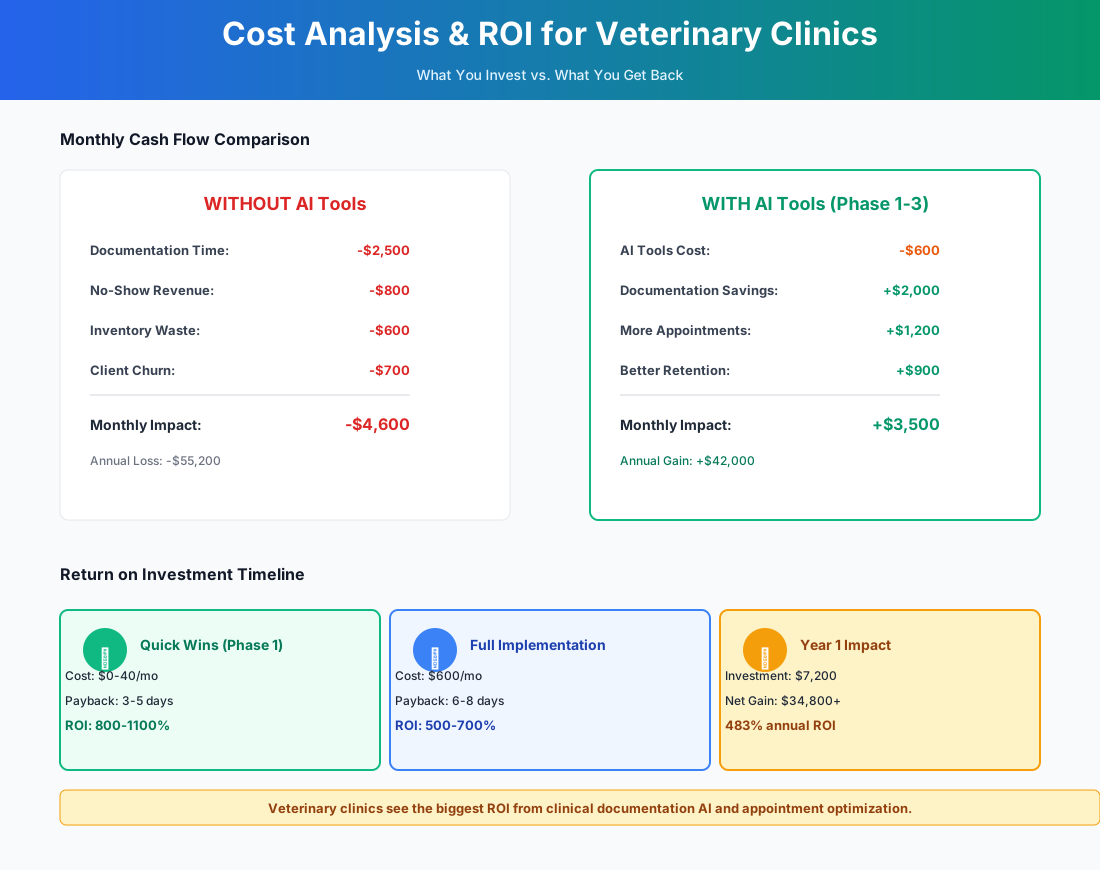
ROI Snapshot
Monthly Cost
$99/mo
Time Saved
10hrs/week
Monthly Value
$5,200
ROI
5153%
Every note the scribe generates is a first draft, not a final record. Verify drug dosages, patient weights, and clinical findings before signing. Build a "trust but verify" culture from the first day of use — AI documentation errors are no more consequential than a transcriptionist typo if you're reviewing, and far more consequential if you aren't.
AI Diagnostic Support: The Middle Path on Radiographs
Solo practitioners and newer DVMs face a daily judgment call: send an ambiguous radiograph to a board-certified radiologist ($75-$150 per read, 24-48 hours), or make the call yourself and move on. AI diagnostic tools create a third option — an instant second read that's often enough to increase confidence on common findings without waiting for a specialist.
SignalPET
Best for: Practices wanting instant AI second opinions on radiographs
SignalPET provides AI-powered veterinary radiology analysis with instant structured reports and annotated images. It integrates with your digital radiography system via DICOM and highlights suspected findings — fractures, foreign bodies, masses, cardiomegaly. The value is clearest for common presentations where the AI adds confidence, not for unusual or subtle pathology where specialist referral is still the right call.
Use SignalPET as a second read for the first two weeks — run your own interpretation first, then see what the AI flags. This builds calibration: you learn where the tool is reliable and where it flags false positives for your patient population. Don't integrate it into your primary workflow until you have that calibration.
Track two metrics to evaluate whether it's paying for itself: additional findings caught that you initially missed, and radiologist referrals avoided because the AI analysis gave sufficient confidence. If SignalPET prevents even 3-5 specialist referrals per month, it covers its cost. If it's catching findings you missed on 5+ studies per month, it's earning its keep clinically.
One practical note: SignalPET requires an internet connection. Have a fallback protocol for outages. Your clinical judgment is the primary diagnostic tool — AI is the assist. If connectivity drops mid-appointment, proceed with your read and queue the images for AI review when it returns. Never delay patient care waiting for an AI result.
Inventory and Purchasing: VetCove Is Free, Use It
A 3-DVM practice carries $30,000-$100,000 in pharmaceutical and supply inventory at any given time. Manual management leads to expired medications ($2,000-$8,000 per year in typical waste), stockouts at inconvenient moments, and 3-5 hours of staff time weekly on ordering and reconciliation.
VetCove
Best for: Every veterinary practice — there's no reason not to use this
VetCove compares prices across your distributors (Covetrus, MWI, Patterson) in real time, sets automated reorder alerts based on historical usage, and tracks your purchasing history. It's free for clinics — revenue comes from the distributors. Connect your accounts and run a price comparison on your top 30 dispensed medications. Most practices find meaningful savings within the first week.
Controlled substance inventory deserves its own workflow, separate from everything else. VetCove and general inventory tools handle non-controlled stock. DEA-scheduled drugs need:
- Perpetual inventory logs for Schedule II substances (ketamine, hydromorphone)
- Biennial physical inventory for Schedules III-V (butorphanol, tramadol, phenobarbital)
- A DVM's physical signature on all controlled substance logs — no electronic shortcut exists for this requirement
- Documented reconciliation between dispensing records and physical counts, with discrepancies investigated and written up
Keep controlled substance tracking inside your PIMS's dedicated module (Cornerstone and AVImark both support this). A DEA audit that finds commingled or incomplete records carries fines of $10,000+ per violation and potential license suspension. This is not the place to cut corners.
Case Acceptance: Better Explanations, More Revenue
Case acceptance rates average 50-60% in veterinary medicine. That means for every two recommended procedures, one gets declined or deferred. Often the reason isn't cost — it's that the client didn't understand what the procedure involved or what they were risking by waiting.
AI can't make the cost conversation more comfortable. But it can make the value conversation much clearer. Use ChatGPT to build a library of client-friendly treatment explanations for your 10 most-declined procedures — dental cleanings, pre-anesthetic bloodwork, mass removals, abdominal ultrasounds:
Write a warm, empathetic explanation for a pet owner about why we recommend [dental cleaning under anesthesia / bloodwork panel / mass removal / ultrasound] for their [dog/cat]. Explain what the procedure involves in plain language, what we're looking for, the approximate cost range of $[X-Y], and the risks of delaying. No medical jargon. Include what recovery looks like. Under 200 words.
Print these as handouts or embed them in estimate emails. When a client receives a $600 dental estimate alongside a plain-language explanation of how dental disease progresses to kidney and cardiac damage — rather than just "your dog needs a dental" — acceptance rates climb. Practices using structured treatment explanations report 15-25% improvement in case acceptance, which translates to $3,000-$8,000 per month in additional revenue for a 3-DVM practice.
Review management follows similar logic. 92% of pet owners read Google reviews before choosing a veterinarian. Responding to every review professionally — especially negative ones — signals engagement to prospective clients. Use ChatGPT to draft responses in under two minutes, but keep one rule: never confirm that someone is a client or reference any medical details in a public response.
Write a warm, genuine response to this 5-star review of our veterinary clinic. Thank them specifically for what they mentioned. Reference their pet by name if they mentioned it, but do NOT confirm any medical details, diagnoses, or treatments. Keep it under 75 words and sign off with our clinic name.
Review: "[paste review here]"
Write a professional, empathetic response to this negative review of our veterinary clinic. Acknowledge their frustration without being defensive. Do NOT confirm they are a client or discuss any medical details publicly. Invite them to call us directly at [phone number] to discuss their concerns. Keep it under 100 words.
Review: "[paste review here]"
If you also run a retail component — prescription food, supplements, preventives — the inventory and client communication patterns in our pet store guide cover the e-commerce and loyalty side in more detail. And if you're thinking about how AI handles sensitive client interactions in adjacent health fields, our mental health practice guide covers the communication ethics in depth.
Implementation Order
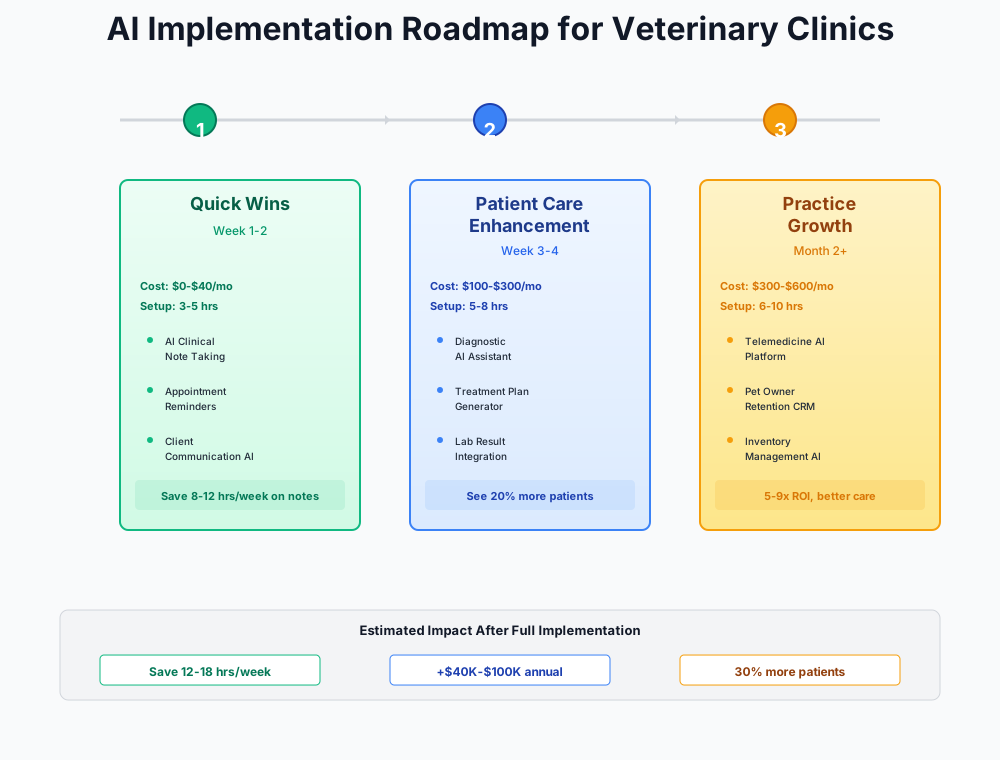
Don't implement everything at once. Your team needs 2-4 weeks to adapt to each new tool before adding the next. Here's the sequence that produces the fastest results with the least disruption:
Weeks 1-2: Communication foundation
- Enable automated reminders in your existing PIMS (free, 30 minutes to configure)
- Set up PetDesk free tier or configure your PIMS reminder sequences with the 3-touch timing
- Establish the general-purpose AI boundary with your entire team
- Start a Talkatoo free trial on routine appointments only
Weeks 3-6: Clinical and phone
- Subscribe to Talkatoo if the trial delivered time savings
- Implement Weave or equivalent for after-hours call capture
- Build emergency escalation routing before going live
- Connect VetCove to your distributor accounts
After day 45: Growth tools
- Activate recall automation sequences in PetDesk (after deceased patient filter is verified)
- Launch treatment explanation library for top 10 declined procedures
- Evaluate SignalPET if your practice does significant diagnostic imaging
- Audit your PIMS reminder settings — enable any built-in automated reminders you haven't activated (cost: $0, time: 30 minutes)
- Create a free ChatGPT or Claude account and draft your first 3 content pieces: a client education handout, a social media post, and a technician job posting
- Build your AI Prompt Library — a shared Google Doc where your team saves prompts that work well
- Establish the General-Purpose AI Boundary rule with your entire team: no client names, pet names, or identifiable info in ChatGPT/Claude — ever
- Track your baseline metrics for 2 weeks before implementing anything: no-show rate, calls answered vs. missed, DVM documentation hours, case acceptance rate
- Sign up for PetDesk (free tier) or configure your PIMS reminders with a 3-touch sequence (7 days, 2 days, 2 hours before appointment)
- Start a Talkatoo free trial and test it on 5 routine appointments — customize the drug dictionary with your top 20 medications
- Scrub your patient database: flag all deceased patients and verify they're excluded from any automated communications
- Run a PIMS report for overdue patients — identify how many active clients are past due for annual exams, vaccines, or dentals
- Sign up for VetCove (free) and connect your distributor accounts — compare pricing on your top 30 dispensed medications
- Request demos from PetDesk Professional and Weave — evaluate AI phone answering with your specific PIMS integration
- Set a 30-day review meeting to compare metrics against your baseline and decide which next tools to activate
Frequently Asked Questions
Our internet goes down regularly. Which of these tools still work offline?
Talkatoo caches audio locally and syncs when connectivity returns — you won't lose a dictation during an outage. Scribenote works similarly. SignalPET requires internet for AI analysis; if it drops mid-appointment, complete your own read and queue the images for AI review later. Never delay patient care waiting for an AI result. If unreliable connectivity is a recurring issue, a cellular failover connection ($50-$100/month) is worth it specifically to protect your phone system and scribe tools.
How do we handle controlled substance logs alongside AI inventory tools?
Keep them completely separate. VetCove and general inventory tools handle non-controlled stock only. DEA-scheduled drugs stay in your PIMS's dedicated controlled substance module, with perpetual logs for Schedule II substances, biennial inventory for Schedules III-V, and a DVM's physical signature on all logs — there's no AI shortcut for that requirement. A DEA audit that finds commingled records can mean $10,000+ per violation.
Can the AI scribe tell "Labrador" from "laboratory" — or "Cerenia" from similar-sounding words?
Yes, consistently. Veterinary-specific scribes are trained on clinical records, not general speech, and reliably differentiate veterinary terminology from common homophones. Accuracy depends more on your microphone than on the model — a $30-$75 directional USB headset in a noisy clinic outperforms a room mic in a quiet office. Expect 90-95% accuracy out of the box, 97%+ after two weeks with a customized drug dictionary.
Should we tell clients we're using AI?
Add a single line to your client welcome packet: "We use AI-assisted tools to improve the accuracy and speed of our recordkeeping and follow-up." That's honest, it's complete, and it answers the question most clients won't ask but some will. For clinical notes, the DVM's review and signature make the record official — same as it would be with a human scribe. Most clients respond better to the practical outcomes ("faster callbacks, better follow-up") than to the technical details.
We're thinking about switching our PIMS. Should we factor AI features into that decision?
Only if you already have strong non-AI reasons to switch. Every tool in this guide integrates with Cornerstone, AVImark, eVetPractice, and Shepherd. PIMS migrations take 3-6 months, cause productivity drops during transition, risk data loss, and demoralize staff who just learned the previous system. Shepherd ($200-$400/month) has solid built-in AI communication features worth evaluating at your next contract renewal — but "better AI features" alone isn't worth a migration. The disruption cost is real.
What's the one mistake practices make most often with AI communication tools?
Skipping the deceased patient filter before launching automated messaging. Every tool that sends outgoing messages — reminders, recall sequences, birthday greetings — must be configured to exclude deceased patients. Verify this before any campaign goes live by searching for 5-10 known deceased patients and confirming none appear in your send lists. One grieving client who receives a cheerful reminder about their late pet's overdue vaccines will tell everyone they know.
Start with whatever is already in your PIMS. Log in today, check your reminder settings, and turn on what's already there. That single action — free, 30 minutes — will likely cut your no-show rate this week. The rest of this guide builds on that foundation.
More AI Implementation Guides
AI Tools for Home Health Care Agencies: 2026 Guide
A practical 2026 guide to AI tools for home health care agencies — HIPAA-safe automation for shift-filling, OASIS-E documentation, EVV, and claim denials.
AI Tools for Dermatology Practices: 2026 Guide
The best AI tools for dermatology practices in 2026 — cut prior-auth hours, reduce no-shows, and grow your cosmetic line, with a HIPAA-first rollout plan.
AI Tools for Mental Health Practice: 2026 Therapist Guide
Best AI tools for mental health practices in 2026: HIPAA-compliant scribes, measurement-based care, no-show reduction, and intake automation for therapists.
AI Tools for Massage Therapy Practices: 2026 Guide
How massage therapists use AI for SOAP notes, no-show defense, 24/7 phone answering, and retention — without breaking HIPAA, TCPA, or scope of practice
AI Tools for Optometry Practices: 2026 Guide
AI tools for optometry practices in 2026: HIPAA-safe scribes, ABB Verify, dual vision/medical billing, OCT AI, and a phased plan independents can run.
Best AI Chatbot & Lead Conversion Tools for Med Spas
Compare AI chatbots, lead conversion & generation tools for med spas. Capture missed calls 24/7, book online, recover $5K-$15K/mo in lost leads. See picks.
Keep exploring
See every AI implementation guide we've published for Healthcare, or browse the full library by industry or category. Looking for a specific platform? The AI tools directory indexes every product mentioned across our guides, and the comparisons hub puts the most-asked head-to-heads side by side.