
Here's the real fight: Chewy retains 77% of autoship customers year over year. Not because their kibble is better than yours. Because the reminder arrives before the customer runs out of food, the click to reorder takes four seconds, and there's no reason to get in the car.
That's the structural problem independent pet stores face. Chewy isn't beating you on product knowledge, community trust, or the ability to tell a customer that their French Bulldog's chronic ear infections might be a protein sensitivity — not an infection at all. They're beating you on timing, convenience, and automated retention. The stores that survive and grow are the ones who stop treating this as a product problem and start treating it as a technology problem.
The three defensible moats for independent pet retail in 2026: recurring consumables revenue through your own auto-ship or timed reorder programs, local search visibility that converts "pet store near me" into foot traffic before Chewy gets the browser tab, and digital loyalty that captures manufacturer frequent buyer reimbursements you're currently leaving on the table. This guide covers the AI tools that build all three.
TL;DR — Top 3 Recommendations
- Astro Loyalty ($29/month) — Digitize manufacturer frequent buyer programs and stop losing reimbursement money to paper punch cards
- Klaviyo (free up to 250 contacts) — Automated "time to reorder" emails that beat Chewy at its own game
- eTailPet ($99/month) — The only POS built specifically for independent pet stores, with 160,000+ pre-loaded products and integrated loyalty
The Consumables Opportunity Most Pet Stores Miss
A dog owner who buys a 30-lb bag of Blue Buffalo every six weeks is worth roughly $650/year in food alone — before treats, toys, supplements, or grooming. Lose that customer to Chewy autoship, and you need more than ten new $60 transactions just to replace what you had.
The repeat-purchase interval for consumables tells you exactly when to send the nudge:
| Product category | Avg. repeat interval | Signal to watch |
|---|---|---|
| Dry dog food (25–30 lb bag) | 5–7 weeks | 4.5 weeks post-purchase |
| Dry cat food (10–16 lb bag) | 6–8 weeks | 5 weeks post-purchase |
| Cat litter (40 lb box) | 3–4 weeks | 2.5 weeks post-purchase |
| Flea/tick prevention (3-month supply) | 90 days | 75 days post-purchase |
| Prescription diet (15 lb bag) | 3–4 weeks | 2.5 weeks post-purchase |
Klaviyo's Predictive Next Order Date automates this. After two or three purchase cycles per customer, it learns individual consumption patterns — Customer A burns through a 25-lb bag in five weeks, Customer B takes eight. It sends the reorder nudge for each one at the right time, personalized, with a "we have it in stock and can set one aside" message that Chewy's fulfillment center structurally cannot match.
Klaviyo
Best for: Automated email and SMS marketing for pet stores with an online presence
AI predicts Customer Lifetime Value and churn risk. Predictive Next Expected Order Date triggers reorder campaigns before customers run out of pet food. Segments customers by pet species, breed, and purchase frequency. One pet food retailer with 9,459 subscribers generates over $159,000/month in Klaviyo-attributed revenue.
Write a friendly email from [Store Name], an independent pet store, to a customer named [NAME] who bought a 25-lb bag of [BRAND] [PRODUCT] for their [PET TYPE] about [X] weeks ago. Remind them they're probably running low, mention that we have it in stock and can set one aside for pickup, and offer a small incentive (10% off their next bag of treats with purchase). Keep it under 120 words and conversational — like a text from a friend, not a corporate email.
The three automated flows worth building first, in order of ROI:
- Predicted reorder reminder — timed to when they'll run out based on past purchase intervals
- Win-back sequence — triggered when a regular customer goes quiet for 45–60 days, with a 10–15% incentive to return
- Welcome series — when someone joins your loyalty program: store story, breed-specific nutrition tip, first-purchase discount, across three emails over two weeks
A pet store running these three flows on Klaviyo's free tier (up to 250 contacts) can reasonably expect $500–$2,000/month in attributed revenue before paying a dollar for the platform.
Local Search Is Your Other Moat
Chewy can't show up in "pet store near me" results. That search — and its variants ("pet food store [city]," "independent pet store [neighborhood]") — is exclusively yours to win. But winning it takes more than having a Google Business Profile. It takes active optimization, consistent review volume, and content that signals local relevance.
Write a Google Business Profile description (750 characters max) for [Store Name], an independent pet store in [City, State]. We specialize in [premium/natural/raw] pet foods, offer free nutrition consultations, and carry products for dogs, cats, fish, reptiles, and small animals. We also offer [grooming/boarding/training if applicable]. Include these keywords naturally: independent pet store [City], pet food [City], [specialty like "raw pet food" or "holistic pet food"] [City]. Tone: warm, professional, community-focused.
Publishing two to four blog posts per month on breed-specific nutrition topics drives local SEO in a way that paid ads can't replicate. People search "best food for golden retrievers" and "labrador weight management diet" constantly. When your article ranks and shows your store is ten minutes away, that reader walks in pre-sold on your expertise. ChatGPT or Claude can draft these posts in under ten minutes from a simple prompt.
Write a 400-word blog post for my independent pet store website titled "Best Food for Golden Retrievers: What Your Local Pet Store Recommends." Include: 3 common nutritional needs specific to Goldens (joint support, skin/coat health, weight management), 2 ingredient types to look for, 1 ingredient to avoid, and a call-to-action to visit our store for a free nutrition consultation. Tone: knowledgeable but approachable, like talking to a friend who happens to be a pet nutrition expert.
Reviews compound this effect. Print a QR code linking to your Google review page, place it at the register, and train staff to mention it after a good interaction. Use ChatGPT to draft review response templates so you're responding to every review within 24 hours — Google's algorithm notices response rate and recency.
Canva Pro
Best for: Social media graphics and in-store signage
Magic Studio AI generates professional pet store graphics from text prompts. Background Remover cleans up product photos instantly. Magic Resize turns one design into Instagram, Facebook, TikTok, email, and print versions with a click. Pet-specific template packs are available in the Canva marketplace.
If you also run a grooming operation alongside retail, our dedicated AI tools guide for dog grooming businesses covers grooming-specific scheduling and pricing tools in much more detail.
The Paper Punch Card Problem (And the $29/Month Fix)
How many manufacturer frequent buyer programs do you carry? Fifteen? Twenty? Multiply that by the average number of active customers per program. That's hundreds of active punch-card relationships you're tracking on paper — cards that get lost, forgotten, or shoved in a purse never to return.
Here's the margin reality: the "buy 12, get 1 free" structure is funded by manufacturer wholesale pricing. That free bag isn't a gift — you've already paid for it in the per-bag cost. When a card goes missing and the customer gives up, you've subsidized a free bag you'll never collect.
Astro Loyalty
Best for: Automating manufacturer buy-12-get-1-free programs for independent pet retailers
Digitally tracks frequent buyer programs across 200+ pet food brands (Royal Canin, Blue Buffalo, Orijen, Acana, Stella & Chewy's, etc.). Replaces paper punch cards entirely. Astro Offers connects manufacturers directly to your store with free promotional offers. Consumer mobile app lets customers check their progress toward free bags.
At a conservative 10% card-loss rate across 300 active punch-card relationships, that's 30 lost reimbursements per year. At $50/bag average reimbursement, you're leaving $1,500 on the table annually — on a $29/month tool that costs $348/year.
ROI Snapshot
Monthly Cost
$29/mo
Time Saved
6hrs/week
Monthly Value
$1,980
ROI
6728%
The secondary benefit is the data layer. Once programs go digital, you can see which customers are active, which have lapsed, and which brands drive the most loyalty engagement. That visibility informs purchasing decisions and shelf-space allocation in ways a shoebox of paper cards never could.
The POS Question: Why Generic Software Costs You Money
Square and Clover are excellent tools for coffee shops. They don't know what a manufacturer frequent buyer program is. They can't track customer pet profiles. They don't come pre-loaded with 160,000 pet product SKUs.
eTailPet
Best for: Independent pet stores wanting an all-in-one POS built for pet retail
Pre-loaded catalog of 160,000+ pet products eliminates manual data entry. Built-in Astro Loyalty integration for seamless frequent buyer tracking. Grooming appointment scheduler. Real-time inventory sync between in-store and online. Customer pet profiles linked to purchase history — so you can pull up that Mrs. Rodriguez buys grain-free salmon for her French Bulldog before she even reaches the counter.
For multi-location stores or those needing more advanced analytics, Lightspeed is the alternative worth evaluating:
Lightspeed Retail
Best for: Multi-location pet stores with complex inventory and omnichannel needs
Advanced reporting and AI-powered product performance insights. Smart reordering based on historical sales. 70+ integrations including QuickBooks, Mailchimp, and Google Shopping. Trusted by 165,000+ businesses. Not pet-specific, but highly configurable for pet retail with custom categories and attributes.
One underappreciated feature in eTailPet: the customer pet profile. When a staff member can pull up a customer's profile and see that their Frenchie is on a limited-ingredient diet before the customer even reaches the counter, that's not just good service — it's the kind of interaction that makes "just ordering online" feel like a downgrade. A 2,000-contact Klaviyo list connected to eTailPet's purchase data is also how you stop sending cat food promotions to dog owners.
High-SKU Inventory: The Photograph-to-Catalog Tool
Syncrostore's SyncroAI does something genuinely useful: photograph a pet product and the AI identifies the brand, animal type, size, and creates a complete inventory entry automatically. For stores carrying 2,000+ SKUs where entering a new shipment of 50 products could take an hour — this cuts that data entry time by 60–70%.
Syncrostore with SyncroAI
Best for: High-SKU pet stores wanting to speed up product entry with AI image recognition
Photograph a product and AI auto-identifies brand, animal type, size, and creates the inventory entry. AI-powered customer profiling tracks pet preferences. Automatic product categorization by animal type and dietary need. Potentially free for qualifying merchants.
The caveat: AI demand forecasting tools are only as good as the data underneath them. Get 6+ months of clean sales history into your POS before evaluating forecasting add-ons. Bad data in means bad reorder suggestions out — and overstock on prescription diets has real carrying costs.
Staff, Services, and the Back-of-House Stack
Scheduling — Homebase's free tier covers up to 20 employees at one location, which is more than enough for most single-location pet stores. AI schedule builder auto-generates based on availability and role, with conflict detection for overtime risks.
Homebase
Best for: Small pet stores needing free scheduling, time tracking, and payroll integration
AI schedule builder auto-generates schedules based on availability and role requirements. Conflict detection flags overtime risks. GPS time clock for clock-in/out. Free tier covers up to 20 employees at one location — more than enough for most independent pet stores.
Homebase is one of the most popular tools among independent bookstores for the same reasons it works here: free, easy to start, and it integrates with Square, Clover, and QuickBooks.
Customer communication — Feed Lyro your FAQ, product catalog, and the 20 most-asked questions your staff fields. When someone visits your site at 9 PM and asks whether you carry Stella & Chewy's freeze-dried raw, Lyro answers instead of that question sitting until you open.
Tidio with Lyro AI
Best for: Pet stores with a website or online store wanting 24/7 automated customer support
Lyro AI agent resolves up to 67% of customer questions automatically — product availability, store hours, pet food ingredients, return policies. Multi-channel inbox covers live chat, Instagram, Facebook Messenger, and WhatsApp. Start with the free plan (50 AI conversations/month) to test it.
Grooming and boarding — If you run services alongside retail, breed-specific pricing is the lever most stores underuse. A standard poodle groom takes roughly 2.5 hours. A beagle takes 45 minutes. Flat-rate pricing on both means you're losing $40+ in labor on every doodle and husky.
Gingr
Best for: Pet stores with grooming, boarding, or daycare operations
AI-powered pricing automatically adjusts by breed, size, and coat condition — no more flat-rate grooming that loses money on doodles and huskies. Online self-booking with real-time groomer availability. Automated text/email reminders cut no-shows by 30-50%. Pet report cards with photos after each visit (owners love sharing these on social media — free marketing).
Bookkeeping — QuickBooks Plus adds inventory tracking with COGS analysis at $99/month, which is worth it once you're running eTailPet or Lightspeed and want to see actual margin by category (food vs. accessories vs. services). Simple Start at $35/month handles basic expense categorization with AI-assisted transaction matching.
QuickBooks Online
Best for: Pet store bookkeeping with AI transaction categorization and inventory COGS tracking
AI automatically categorizes expenses across inventory, utilities, marketing, and payroll. Cash flow forecasting using historical patterns. Anomaly detection flags unusual transactions. QuickBooks Plus ($99/month) adds inventory tracking with COGS analysis — critical for understanding margins on food vs. accessories vs. services.
The birthday and adoption anniversary program is worth calling out separately. If your POS captures pet birthdays, automate birthday emails through Klaviyo with a free treat bag waiting in-store for any purchase. The emotional impact — a birthday message for their dog with something waiting at your counter — creates loyalty that discount codes cannot replicate.
Write a fun, warm email from [Store Name] to a customer whose [dog/cat] named [PET NAME] is turning [AGE] years old this week. Include: a birthday wish for the pet, a mention of an in-store birthday treat bag we've set aside for them (free with any purchase), and a 15% off coupon code for a birthday splurge on toys or treats. Add a P.S. inviting them to share a birthday photo on Instagram and tag us. Keep it under 100 words.
If you're also running a retail boutique alongside your pet store — selling pet apparel, accessories, or gifts — our guide to AI tools for boutique retail stores covers the retail merchandising and inventory strategies that apply to your non-food product lines.
A Few Things Worth Skipping (For Now)
Paid reputation platforms like Birdeye start at $299/month. Before spending that, print a QR code linking to your Google review page, place it at the register, and train staff to mention it after a positive interaction. Draft review response templates in ChatGPT. That combination gets you 80% of the benefit at $0/month — and you can revisit paid platforms after your review volume is already healthy.
Don't use AI to give veterinary or medical advice. AI can help write pet care content, but never use AI-generated text to diagnose health issues, recommend medications, or make specific dietary claims for medical conditions. Direct health questions to a veterinarian. If you have a referral relationship with a local vet practice, our veterinary clinic AI guide covers how clinics are using AI on their end — useful context for building that partnership.
Connected tools matter more than individual tools. eTailPet + Astro Loyalty + Klaviyo + Homebase creates an ecosystem where a purchase triggers loyalty credits, email automation, and labor analytics simultaneously. Disconnected point solutions create manual export/import cycles that defeat the purpose.
Getting Started Checklist
- Create a free ChatGPT or Claude account and batch-write this week's social media captions (30 minutes)
- Sign up for Astro Offers (FREE) at astroloyalty.com — activate manufacturer promotions for every brand you carry
- Set up Homebase free tier — add your employees, enter availability, and generate next week's schedule with AI
- Take 15 product and store photos this week for social media content
- Sign up for Later (free) and schedule 5 posts for the month using AI-generated captions
- Print a Google review QR code and place it at your register and grooming station
- Export your customer email list from your POS and sign up for Klaviyo (free up to 250 contacts)
- Set up Klaviyo's welcome series and reorder reminder automations
- Request an eTailPet demo to evaluate whether a pet-specific POS upgrade makes sense for your store
- If you offer grooming, sign up for Gingr's free trial and test online booking with 5 existing clients
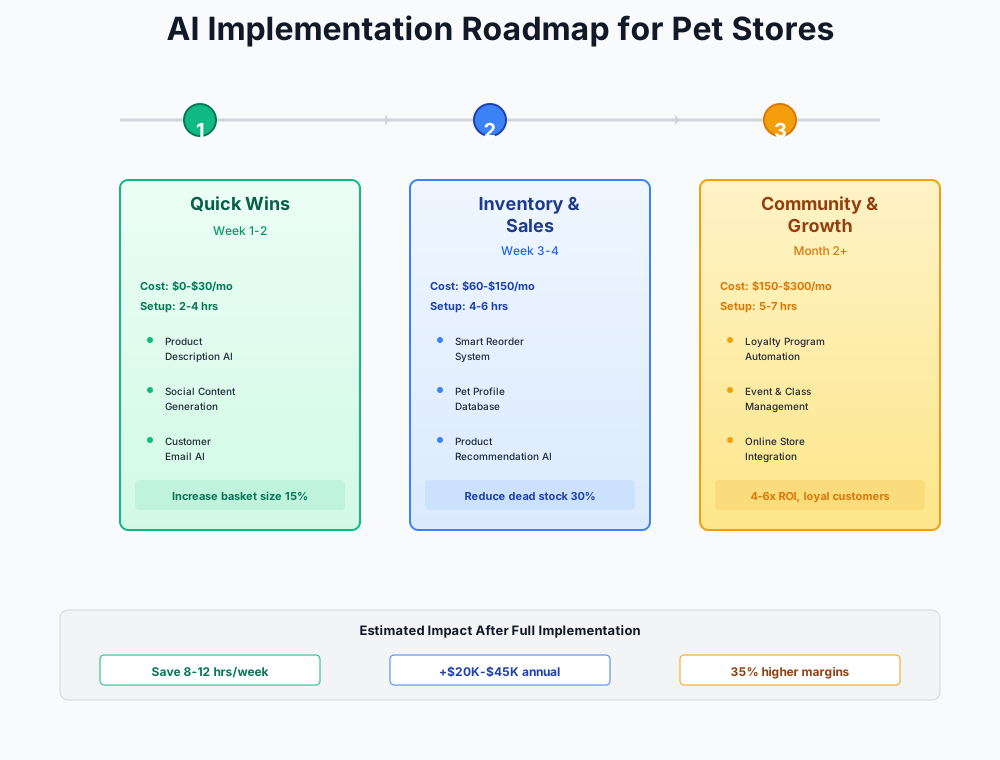
Items 1–6 are this week, all free, combined three to four hours. Items 7–8 are next week. Items 9–10 are month-two evaluations.
Frequently Asked Questions
Do manufacturer frequent buyer reimbursements sync automatically with Astro Loyalty, or is there still manual filing?
For most major pet food brands — Astro works with 200+ — they handle the manufacturer relationship directly and process reimbursements on your behalf when a customer earns a free bag. No claim filing. For brands outside the network, you'll still submit manually, but Astro provides digital proof-of-purchase records that replace the paper trail. Check with your specific distributor (Phillips, UNFI, etc.) about whether they accept Astro's digital records.
My customers expect a fixed price list for grooming. How does breed-based dynamic pricing work in practice?
Post base prices by size category on your website and in-store — those are your starting prices. Then add clear language: "Final price may vary based on coat condition, matting, and breed-specific grooming time. Your groomer confirms at check-in." Gingr lets you display price ranges ($55–$75 for a medium dog) rather than a single number. Most customers accept this when it's explained simply — a matted Goldendoodle and a smooth-coated Beagle are genuinely different amounts of work, and customers understand that.
What happens to my Astro data if I switch POS systems?
Nothing happens to it. Astro is a standalone platform — customer data, frequent buyer progress, and program history live in Astro's cloud, not inside your POS. Connect it to eTailPet tomorrow and everything carries over. That portability is actually one of the strongest arguments for going digital: your loyalty data isn't trapped in your point-of-sale contract.
Does Klaviyo's reorder prediction actually account for the fact that a 30-lb bag lasts different households different amounts of time?
Yes — and this is where it beats generic email marketing tools. Klaviyo learns each customer's individual purchase interval, not a product average. After two or three cycles, it knows Customer A burns through that bag in five weeks and Customer B takes eight. The accuracy improves with each cycle. For new customers with no history yet, set a manual flow at the category average (four to six weeks for a 25-lb bag) and let the model take over after the second purchase.
Is there liability risk in training a chatbot to answer questions about pet food ingredients and allergens?
Not if you stay on the right side of the line. Train Tidio's Lyro AI on ingredient lists, guaranteed analyses, and manufacturer-provided allergen statements — factual product information, same as what's printed on the bag. That's fine. Where it gets risky: letting the chatbot recommend specific foods for medical conditions. Program those queries to route to a human: "That's a great question that depends on your vet's guidance — one of our nutrition specialists can help during store hours." The rule of thumb is the same in-store as it is in the chatbot: share product facts freely, refer medical questions to veterinarians.
Half my customers never give me an email. How do I build a useful profile on in-store-only shoppers?
Phone number is the better ask at checkout. Less friction than email for someone who just wants to buy food and leave. Astro Loyalty and eTailPet both support phone-number lookup. When they're in the system, capture the pet's name and breed during the first visit — ten seconds — and you've turned an anonymous transaction into a relationship you can market to. For the 20–30% who decline entirely, don't push. Some people just want to buy a bag of food and get on with their day.
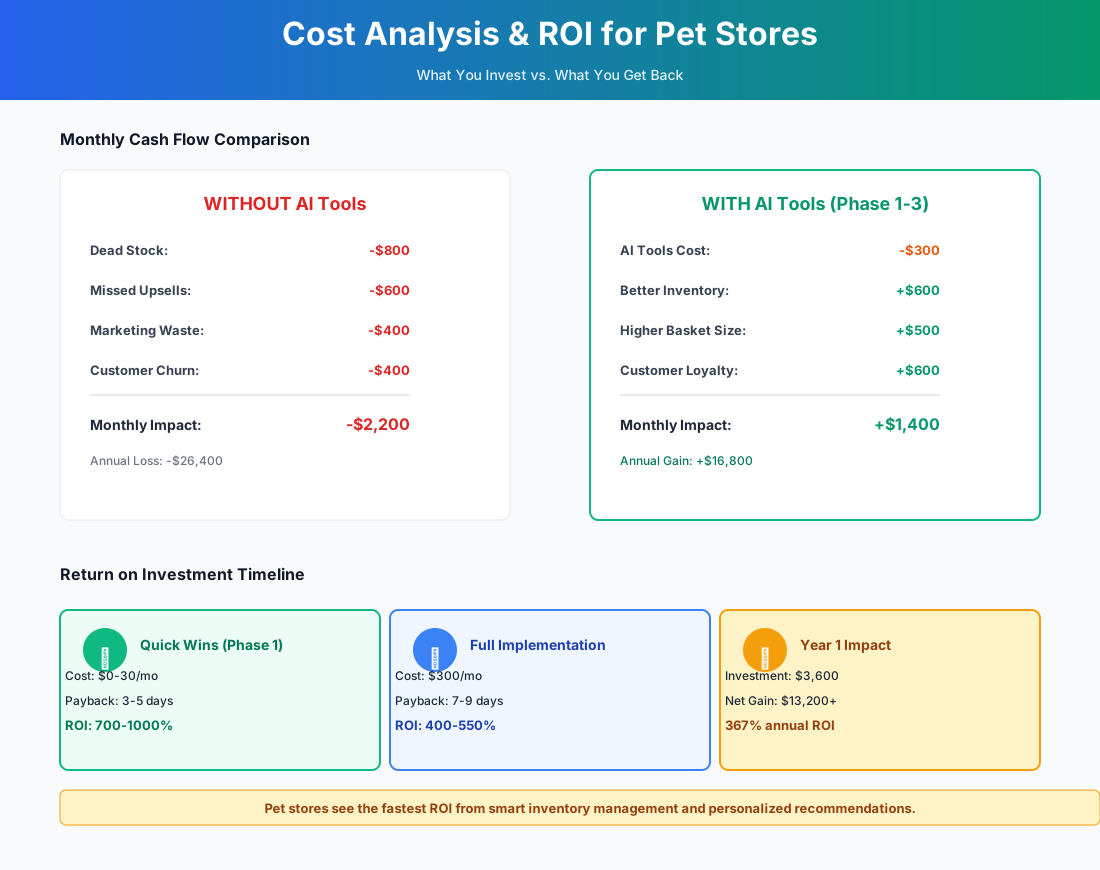
The independent pet store isn't going anywhere. But the gap between stores running connected digital tools and stores running paper punch cards and generic POS software gets wider every year. Astro Loyalty, Klaviyo, and eTailPet together cost less than $230/month and address the three things most likely to lose a loyal customer to Chewy: a missed reorder reminder, a lost punch card, and an anonymous transaction that nobody followed up on.
More AI Implementation Guides
Best AI Tools for Independent Bookstores (2026)
Compare the best AI tools for independent bookstores in 2026: cut content creation from 15 hrs to 5, slash event no-shows by 40%, and out-market Amazon.
Best AI Tools & Examples for Boutique Retail Stores
See real AI applications for boutique retail stores: cut dead stock 30%, automate Instagram captions, and build customer loyalty. Free setup checklist inside.
AI Tools for Breweries: The 2026 Owner's Playbook
The best AI tools for breweries in 2026: cut TTB compliance time, tighten COGS, streamline taproom scheduling, and target release marketing — starting free.
AI Tools for Bookkeeping Services: 2026 Guide
Best AI tools for bookkeeping services in 2026: Automate categorization, reconciliation, and document chasing without hiring extra staff.
AI Tools for Marketing Agencies: 2026 Playbook
The best AI tools for marketing agencies in 2026. A phased plan to kill Hell Week reporting, scale content, and fix billable utilization without new hires.
AI Tools for Home Health Care Agencies: 2026 Guide
A practical 2026 guide to AI tools for home health care agencies — HIPAA-safe automation for shift-filling, OASIS-E documentation, EVV, and claim denials.
Keep exploring
See every AI implementation guide we've published for Retail, or browse the full library by industry or category. Looking for a specific platform? The AI tools directory indexes every product mentioned across our guides, and the comparisons hub puts the most-asked head-to-heads side by side.