The Wrong Part Is the Real Competitor
Industry studies peg wrong-fitment returns at 15–25% of all auto parts transactions. In dollar terms, each return burns 20–30 minutes of counter staff time plus restocking labor — and it hands your customer a reason to try AutoZone next time. The chains aren't winning because they're cheaper on everything. They're winning because they've built systems that reduce the embarrassment of handing someone the wrong brake pads for a 2014 Silverado with the factory Brembo package.
The good news isn't that AI will magically solve fitment. It's narrower and more actionable than that: AI can capture the tribal knowledge your best counter person carries in their head — the mid-year production changes, the trim-level caliper upgrades, the VIN decoder shortcuts — and put it somewhere new employees can actually access it. That's where the real gain is.
This guide is organized around the three places where AI pays off fastest in parts retail: catalog knowledge and fitment accuracy, trade account efficiency, and online discoverability. If you're also carrying slow-moving inventory and running delivery routes by gut feel, there's a section for that too — but fitment is the spine.
Where to Start — Top 3 Picks
- ChatGPT/Claude (free) — build counter training guides that cut your return rate from 18% toward 10–12%
- PartsTech (free tier) — get trade accounts ordering digitally instead of tying up your phone lines
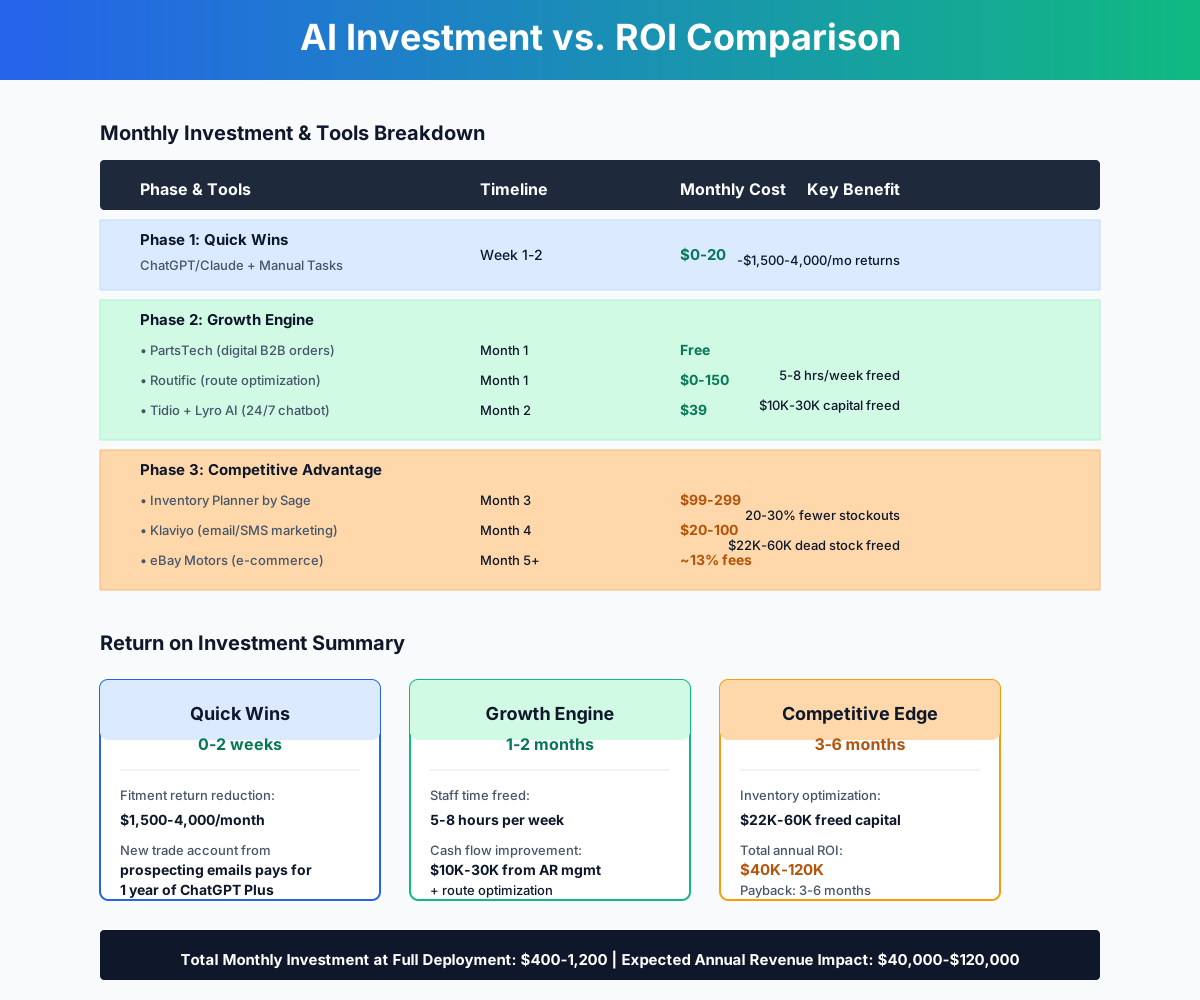
- Inventory Planner by Sage ($99–$299/mo) — forecast demand by SKU and stop bleeding capital into dead stock
How AI Is Changing Auto Parts Selling
AI is being used in auto parts selling across four areas that directly affect revenue: fitment and compatibility lookup (so customers get the right part the first time), conversational assistants that handle "will this fit my 2015 F-150" questions online or after hours, demand forecasting that matches inventory levels to actual vehicle population in your market, and automated copy generation for online listings and catalog descriptions that would otherwise take days of manual work.
The practical upshot for an independent store: these aren't enterprise projects. The tools that handle all four of those categories are already named in this guide and most have free tiers. ChatGPT handles training guides and listing copy. PartsTech moves B2B ordering from phone calls to a clean digital channel. Inventory Planner by Sage forecasts by SKU so you stop overbuying slow-movers and stocking out on fast ones. DocsBot AI sits on your website after hours and fields compatibility questions — capturing the lead even when your counter is closed.
The common thread is that AI in auto parts retail is almost never about replacing your parts catalog or your experienced staff. It's about making both of those things more accessible: to customers who search online at 9 PM, to new counter hires who haven't built up fifteen years of fitment memory, and to mechanics who would rather click a button than wait on hold.
The Fitment Problem Is More Expensive Than You Think
Here's the number most shop owners don't track: what does a wrong-part return actually cost?
Walk through it once. The mechanic calls back, frustrated. Your counter person looks up the original order, pulls the correct part, creates a return, restocks the wrong one, and — if you run deliveries — sends a driver back out. Conservatively, that's 25 minutes of counter labor ($8–10 at loaded cost), potential delivery cost ($5–15), and a transaction that now has negative margin. Do that 8–12 times a day and you're looking at $50,000–$90,000 in annual labor waste from fitment errors alone.
| Return scenario | Staff time | Estimated labor cost | Frequency (3-bay shop) |
|---|---|---|---|
| Phone callback + re-lookup | 8 min | $2.60 | 4–6x/day |
| Counter exchange, part in stock | 22 min | $7.20 | 3–5x/day |
| Return + re-delivery | 35 min + driver | $18–28 | 1–3x/day |
| Return + special order (wrong trim) | 45 min + order | $25–35 | 1–2x/day |
Most fitment errors trace to the same three failure modes: counter staff who didn't ask the right follow-up question, catalog lookups that don't flag mid-year production changes, and trade account mechanics who gave incomplete vehicle info over the phone. AI can address all three — not by replacing your catalog, but by making your staff better and your communication tighter.
AI Does Not Replace Your Parts Catalog
ChatGPT and Claude don't have access to real-time ACES/PIES catalog data. They will confidently give you a wrong part number. Use AI for training, communication templates, and analysis — use your EPICOR, WHI, or Snap-on catalog for actual fitment lookups. A wrong part recommendation that causes a vehicle failure creates liability that dwarfs any time savings.
Counter Efficiency: Turning Institutional Knowledge Into a System
Your best parts specialist is probably 50-something. They know that the 2013–2014 Ram 1500's front caliper bracket changed partway through the '14 model year. They know which European import lines have 6-week lead times from WorldPac. They know that when a customer says "2008 Silverado 2500," the next question has to be about the diesel vs. the 6.0 gas because the AC compressor applications are completely different.
That knowledge is irreplaceable. It's also not written down anywhere, which means when that person retires — and statistically they will within the next decade — training their replacement takes 6–12 months of shadowing and guessing.
Building a Fitment Knowledge Base With AI
ChatGPT / Claude
Best for: Training materials, fitment checklists, and review responses
Use the free tier to generate vehicle-system training guides, fitment verification checklists, and customer communication templates. Counter staff can pull these up on their phone between customers to verify unfamiliar fitment scenarios. Never use it for actual part number lookups — that's what EPICOR is for.
Think of this as a one-time documentation sprint. Sit down with your most experienced counter person for two hours. Have them talk through the top 10 fitment traps they see weekly — the questions they've learned to ask that new hires don't know to ask. Feed those into ChatGPT and ask it to build a structured reference guide from the raw notes.
I'm training a new counter staff member at an independent auto parts store. Create a structured training guide explaining the key components of a vehicle's braking system (rotors, pads, calipers, master cylinder, brake lines, hardware kits), what symptoms indicate which components need replacement, and common fitment mistakes to avoid when looking up brake parts. Include: trim-level differences that change caliper size (e.g., Brembo packages on trucks), the mid-year production change trap, and 10 questions customers typically ask with answers. Format as a reference card that can be printed and kept behind the counter.
Create a step-by-step fitment verification checklist for an auto parts counter employee processing a brake pad order. The checklist should cover: VIN decode steps (where to find the 8th character for engine code), trim-level questions that affect fitment, how to identify if the vehicle has a towing package (which changes rotor diameter), and the 3 most common mistakes that cause wrong-part returns on brake jobs. Make it a printable checklist with checkboxes.
Generate guides for your top six vehicle systems — brakes, suspension, cooling, electrical, ignition, drivetrain — and save them as Google Docs or a back-counter binder. This is a 2–3 hour project. The payoff is a 30–40% reduction in fitment errors from new counter hires within 60 days.
Expected impact: 3–5 hours/week saved on returns processing, plus $1,500–$4,000/month in recovered revenue from cutting your return rate by a third. Cost: $0.
Getting Trade Accounts Off the Phone
If your best mechanics are still calling in orders, you're solving a solved problem the hard way. Every phone order ties up your counter for 5–10 minutes — that's time you're not spending with the walk-in customer who needs help now, and it's a vector for miscommunication that leads directly to returns.
PartsTech
Best for: Eliminating phone-order chaos from trade accounts
Join as a supplier, connect your inventory feed from your POS, and set pricing tiers for different trade account levels. When your shops order through PartsTech, you get a clean digital order instead of a garbled phone call — no miscommunication, no interruptions to walk-in service, no "I said the 5.3L not the 6.2L" callbacks.
This tool connects directly to the workflow we cover in our auto repair shop guide — if your trade account shops are already using PartsTech to manage their parts procurement, getting your store on the platform means their orders route to you digitally instead of tying up your phone lines.
Setup takes about half a day: sign up as a supplier, connect your inventory feed, configure pricing tiers (wholesale, preferred, standard), and reach out to your top five trade accounts. Shops using Tekmetric or Shop-Ware are likely already on the platform. For holdouts, try this approach: when they call in an order, process it, then text them a screenshot of how the order would have looked on PartsTech. "Next time you can do that in 30 seconds without waiting on hold." The switch usually happens within a week.
Expected impact: 5–8 hours/week of counter time freed from phone order intake. Fewer miscommunications mean fewer returns.
Online Discoverability: Competing Where Independents Are Invisible
Only 35–45% of independent parts stores have any e-commerce presence. Meanwhile, the auto parts search queries accruing to this page — "ai in auto parts selling," "best parts store near me," "discount brake pads [city]" — tell a clear story: your future customers are looking online before they ever step through your door. The stores that show up, win the visit. The ones that don't, lose it before it starts.
AI-Generated Listing Copy for eBay Motors and Your Catalog
Your slow-moving inventory — parts that haven't turned in 12+ months — isn't dead. It's inventory without distribution. An eBay Motors buyer in another state might need exactly that remanufactured power steering rack you've had on the shelf for nine months. The barrier isn't demand. It's that writing 50 product listings takes 10 hours.
Write 5 eBay Motors product listings for the following auto parts. For each, include: a keyword-optimized title (under 80 characters), a 100-150 word description highlighting key features and DIY installation notes, and compatible vehicle years/makes/models. Parts: 1) [Part name, number, fitment] 2) [Part name, number, fitment] 3) [Part name, number, fitment] 4) [Part name, number, fitment] 5) [Part name, number, fitment]. Use terms like "direct fit," "OEM replacement," and include what tools are needed for installation.
Batch-generate 20–50 listings per session. What takes 10 hours manually takes about 2 hours with AI. Start with your slowest-moving inventory — this turns trapped capital into a national sales channel. Price to account for eBay's 12.9% final value fee.
For stores generating $5,000+/month from eBay, evaluate RevolutionParts (starting around $299–$500/month depending on plan) for a dedicated auto parts storefront with built-in fitment search and multi-channel syndication across eBay, Amazon, and your own website.
Winning the Local Search Conversation
AutoZone and O'Reilly have dedicated teams responding to Google reviews. Most independents have 30–50 reviews and respond to maybe half. Here's what that costs you: businesses that respond to all reviews see meaningfully higher click-through from local search results, because Google's algorithm treats review engagement as a quality signal and potential customers read owner responses before deciding where to drive.
Set up Google Business Profile notifications. When a review comes in, paste it into ChatGPT with a prompt asking for a response that mentions the specific part or service. Personalize one detail. Post it. Two minutes instead of fifteen. Over 90 days, that practice compounds into a review profile that looks nothing like a chain store's canned responses.
Time saved: 1–2 hours/week. The local search lift takes 60–90 days to show up in impressions, but it doesn't require any ongoing spend to maintain.
B2B Prospecting to Land New Trade Accounts
How many repair shops within your delivery radius opened in the last 18 months that you haven't called on? Most owners know they should prospect more. Most don't because writing outreach emails feels awkward and time-consuming.
Write a brief, personable outreach email from an independent auto parts store owner to [Shop Name], a local auto repair shop specializing in [European vehicles / diesel trucks / general repair]. We offer same-day delivery within 15 miles, competitive pricing on NAPA, WorldPac, and LKQ stock, and experienced counter staff who can source hard-to-find parts for [their specialty]. Focus on their actual pain points: waiting on hold with chain suppliers, getting wrong parts and eating the downtime, and slow delivery on urgent jobs. Keep it under 150 words. Don't sound like a marketing email — sound like a neighbor introducing themselves.
One new trade account spends $500–$2,000 per week. A single conversion from a 15-email batch covers a year of ChatGPT Plus in the first week. Build the relationship before you automate it — in-person visit first, then AI-assisted follow-up to maintain frequency.
Operations: Where Margin Lives
Loyalty Marketing That Runs Itself
Most of your walk-in customers are invisible after the transaction. No email, no phone number, no way to send them a rotor deal three months after they bought brake pads. The chains have loyalty programs with millions of members. You have a punch card nobody uses.
The prerequisite isn't a marketing tool — it's a habit. Train every counter person to ask one question on every transaction: "Can I grab your email for your receipt and any exclusive deals?" Without 100+ addresses, the automation has nothing to work with.
Klaviyo
Best for: Behavior-triggered email and SMS campaigns for both retail and trade accounts
AI-predicted customer lifetime value, purchase-timing triggers, and churn modeling. When a customer buys brake pads, automatically send a rotors discount 3 months later. When a trade account's order frequency drops, flag them at-risk and trigger a win-back text.
If you've read our guide on AI tools for boutique retail stores, you'll recognize Klaviyo — but the auto parts application is different. Retail boutiques trigger campaigns around fashion seasons and browsing behavior; auto parts stores trigger around vehicle maintenance cycles and purchase history by system. A customer who bought coolant in July probably needs a thermostat check by November.
Set up these four flows first: a welcome sequence with 10% off next purchase, a spring maintenance campaign in March (oil filters, air filters, wiper blades), a trade account nurture email twice a month, and a win-back text for any trade account that goes 30 days without ordering. That's a half-day of setup that runs indefinitely.
ROI Snapshot
Monthly Cost
$35/mo
Time Saved
3hrs/week
Monthly Value
$3,300
ROI
9329%
SMS Beats Email for Auto Parts
Text messages have a 98% open rate vs. 20–25% for email. Use SMS for time-sensitive deals and trade account alerts ("Your order is ready for pickup"). Save email for longer content like maintenance guides and product education.
After-Hours Lead Capture
Your store closes at 6 PM. DIY customers search for parts at 9 PM. Without a way to capture those leads, they end up on AutoZone.com or Amazon — and once they've bought from there, they rarely come back to the physical store.
DocsBot AI
Best for: 24/7 AI chatbot trained on your parts catalog and policies
Train it on your catalog PDFs, fitment guides, and store policies. It answers after-hours questions about part compatibility, availability, and pricing — and captures contact info for leads you follow up on the next morning. The 75% AI resolution rate means three out of four questions are handled without staff time.
Start with Tidio's free plan (50 live-chat conversations/month) to test the concept before committing to DocsBot. Set up 10 FAQ responses covering your most common questions: hours, return policy, delivery area, how to find the right part, accepted payment methods. Configure the bot to collect customer name, email, phone, and vehicle info before attempting fitment questions.
Expected impact: 2–4 hours/week saved on phone calls for basic questions, plus $1,000–$3,000/month from capturing 5–10 after-hours leads per week that would have gone to competitors.
AI Route Optimization for B2B Deliveries
Your delivery driver's route planning shouldn't depend on gut feel and Google Maps. With delivery costs at 1–3% of revenue, even small efficiency gains compound across 250 delivery days a year.
Routific
Best for: Optimizing daily B2B delivery routes with real-time reoptimization
Uses 179 machine learning models to calculate optimal delivery sequences. When an urgent order comes in mid-route, add it to the active route and Routific re-optimizes automatically. Driver mobile app includes turn-by-turn navigation and proof of delivery capture. Customer SMS notifications tell repair shops when their delivery is 10 minutes away.
The free tier (100 orders/month, unlimited drivers) covers most single-location stores. Users report 25–40% reduction in mileage and drive time. For stores with appointment-based stops or time-window constraints, our car detailing business guide covers OptimoRoute as an alternative worth evaluating.
Proof of Delivery Matters
Enable Routific's proof-of-delivery photo capture. When a repair shop claims they didn't receive a part, you have timestamped GPS coordinates and a photo. This pays for itself the first time it prevents a disputed delivery charge.
AI Demand Forecasting and Inventory Optimization
If 15–25% of your inventory value is in dead stock — and statistically, it is — and your total inventory is worth $200,000, you have $30,000–$50,000 in capital doing nothing. Meanwhile, you're stocking out on brake pads during the spring maintenance rush because reorder points live in your parts manager's memory.
Inventory Planner by Sage
Best for: SKU-level demand forecasting and automated purchase order generation
Forecasts demand using your historical sales data, automatically generates purchase orders optimized by vendor minimums and lead times, and flags excess inventory before it becomes dead stock. Configure seasonal patterns for your spring/fall maintenance peaks, summer cooling season, and winter battery surge.
Implementation: export 12–24 months of sales history from your POS by SKU, start the 14-day free trial, connect to your existing system (QuickBooks, Shopify, or CSV import), and set service level targets — 98% fill rate on fast-movers, 90% on medium, 80% on slow. The first purchase order recommendations Inventory Planner generates are worth comparing to what you'd have ordered manually; most stores find they've been over-buying mid-tier SKUs and under-buying fast-movers by a significant margin.
ROI Snapshot
Monthly Cost
$199/mo
Time Saved
6hrs/week
Monthly Value
$7,100
ROI
3468%
The Dead Stock Quick Win (Free)
Before investing in Inventory Planner, do the free version: export your slow-movers from your POS, paste the list into ChatGPT, and ask it to create a prioritized liquidation plan with eBay listing headlines and discount strategies. This one-time analysis can unlock $5,000–$25,000 in trapped capital.
QuickBooks AI for Trade Account AR
If you're already on QuickBooks (and 85%+ of auto parts stores are), upgrading to Essentials ($85/month) or Plus ($140/month) adds AI agents that handle bookkeeping tasks eating your evenings.
QuickBooks Online Essentials/Plus
Best for: AI-powered expense categorization, AR management, and cash flow forecasting
The Payments Agent analyzes your AR aging and automatically sends payment reminders to trade accounts at optimal times. The Accounting Agent auto-categorizes expenses and learns from your corrections. The Finance Agent (Plus/Advanced) predicts cash flow crunches before they happen — critical when large distributor payments create tight periods.
Expected impact: 3–5 hours/week saved on bookkeeping. $1,000–$3,000/month from faster AR collection on trade accounts.
Three Traps Worth Naming Explicitly
Chatbot fitment lookups. It keeps coming up because counter staff will try it: using ChatGPT to look up a part number because it's faster than EPICOR. Don't let this become a habit. General-purpose AI doesn't have live ACES/PIES data. "Confidently wrong" is the default for part number questions.
Scaling digital ordering before your inventory feed is clean. Sending a mechanic a digital confirmation for a part you don't actually have — because your inventory feed updated six hours ago and a walk-in just bought your last one — is worse than a phone order. Before you promote PartsTech to your best accounts, confirm your feed update frequency and add a small safety buffer on critical SKUs.
Enterprise tools at independent-store scale. ToolsGroup ($20,000+/year), Onfleet ($599/month), and Pricemoov (enterprise pricing) are built for multi-location distributors. Starting there because you read a trade publication that profiled a 50-location chain is how stores end up with expensive software nobody uses. Inventory Planner, Routific, and Klaviyo are built for your scale and deliver most of the same outcomes.
Getting Started: 90-Day Rollout
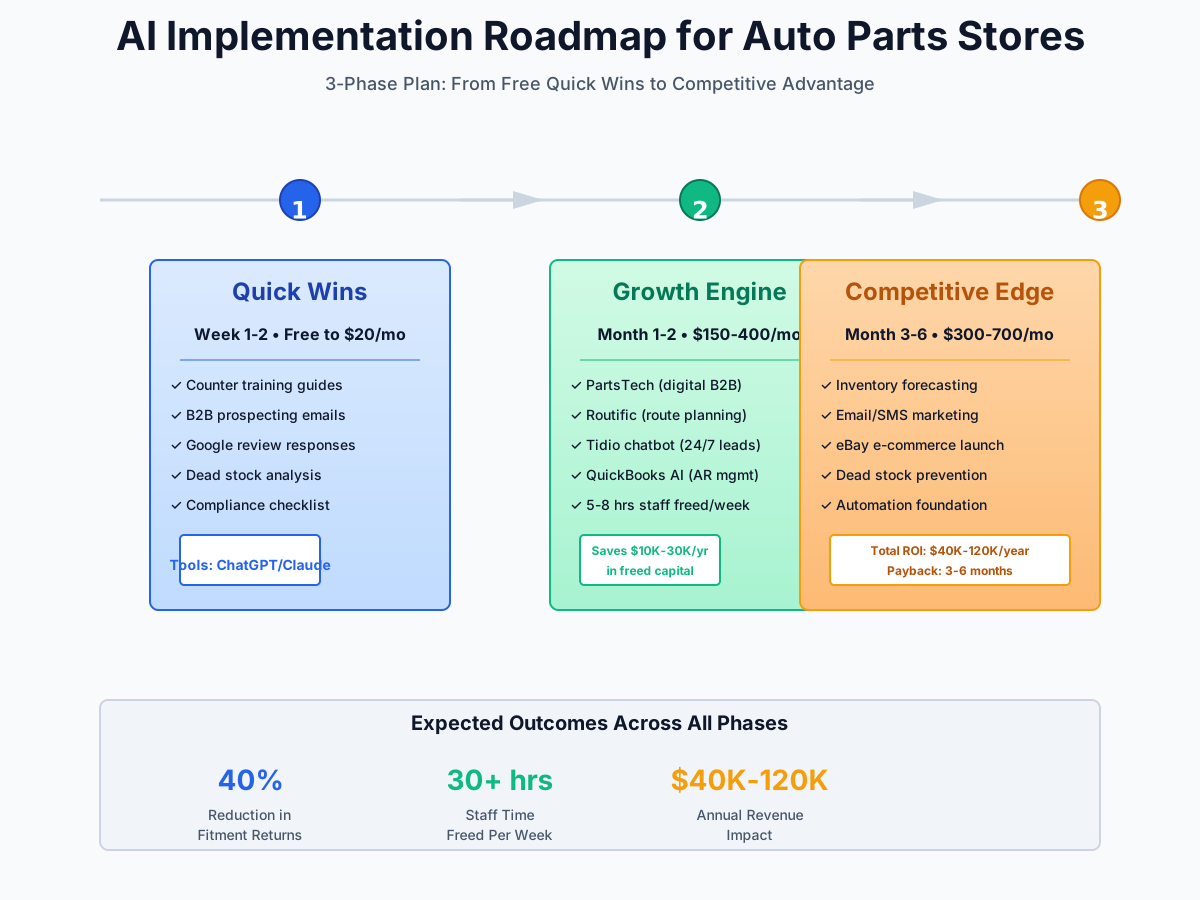
- Sit down with your most experienced counter person and document their top 10 fitment traps
- Use ChatGPT to build training guides for your top 6 vehicle systems (2-3 hours)
- Print fitment verification checklists and put them behind every counter station
- Start tracking your return rate weekly in your POS — you need a baseline before you can measure improvement
- Sign up for PartsTech as a supplier and connect your inventory feed
- Confirm your inventory feed update frequency — fix lag before going live with trade accounts
- Contact your top 5 trade accounts to see if they're already on PartsTech
- Sign up for Routific free tier and run delivery routes through it for one week
- Export your slow-moving inventory (12+ months no sale) and run an AI-powered liquidation analysis
- List your top 50 slow-movers on eBay Motors using AI-generated product descriptions
- Google every repair shop within your delivery radius you don't currently supply — start sending 3-5 prospecting emails per day
- Turn on Google Business Profile review notifications and respond to every review within 24 hours
- Train every counter person to capture customer email at point of sale
- Sign up for Klaviyo free tier and build your first welcome email flow
- Evaluate upgrading QuickBooks to Essentials or Plus for AI agents
- Generate an OSHA/EPA compliance checklist tailored to auto parts retail and post it in your back office
Frequently Asked Questions
Can AI fitment tools replace our EPICOR or WHI catalog system?
No — and this question comes up enough that it's worth being blunt. General-purpose AI doesn't have access to real-time ACES/PIES catalog data and will give you a confident wrong answer. Purpose-built fitment search like Algolia's Auto Parts Solution works on top of your catalog data to improve accuracy, not replace the catalog itself. Your EPICOR or WHI stays the source of truth. AI's job is to help your staff catch human errors before they become returns.
How do we handle core returns tracking when AI generates our purchase orders?
Inventory Planner generates reorder recommendations — it doesn't track cores owed. You'll still need your POS system's core tracking module (RevParts and Windward both have this) or a manual log to reconcile core charges against distributor credits. Think of it as a division of labor: the AI handles when and how much to reorder; your existing system handles what you owe back. Don't conflate the two.
What happens to PartsTech orders when our POS inventory feed lags behind actual stock?
This is the biggest operational risk of digital B2B ordering, and it has to be solved before you go live. If your feed updates hourly but a walk-in just bought your last water pump, a mechanic can get a confirmed digital order for a part you no longer have. Fix: push inventory updates as close to real-time as your POS allows, and set a small safety buffer on critical SKUs — show 2 available when you actually have 3. A stale feed is worse than phone orders. Sort this out first.
Does AI route optimization account for core pickups on the return leg?
Routific optimizes stop sequences — it doesn't inherently know that Stop #3 has three cores to pick up before your next distributor return shipment. Handle this by adding core pickup as a task note for each stop; the driver sees it in the mobile app. For stores with heavy core volume, tag stops with estimated pickup weight so Routific can factor vehicle capacity into route planning. It's a 30-second input per stop during route setup.
Our mechanics prefer calling. How do we get them to switch to PartsTech without damaging the relationship?
Don't push. Start with your tech-forward shops — the ones on Tekmetric or Shop-Ware. They're likely already using PartsTech and just don't know you're a supplier. For holdouts, try this: next time they call in an order, process it normally, then text them a screenshot of the PartsTech equivalent. "Next time you can do this in 30 seconds without hold time." PartsTech's own data shows that shops who switch to digital ordering don't go back. The transition happens when mechanics see the time difference firsthand.
What's the OSHA exposure for a parts store that hasn't audited its SDS compliance?
Real and expensive. OSHA's Hazard Communication Standard requires Safety Data Sheets for every hazardous chemical on your shelves — brake cleaner, carb cleaner, starting fluid, battery acid, antifreeze, and more. A single "other-than-serious" violation runs up to $16,550; willful violations reach $165,514 per instance (2026 adjusted penalties). Use ChatGPT to generate a compliance checklist, but verify against your state's specific requirements — they vary. Print it, assign responsibility, and audit monthly.
The fitment return rate is the most actionable number in this guide. If you don't know yours, start tracking it this week in your POS. If you know it and it's above 15%, the counter training guides cost nothing to build and pay back within 60 days. That's where the ROI starts — not with software, but with documented knowledge.
Running a practice with a retail component alongside your auto parts operation? Our guides for optometry practices and veterinary clinics cover inventory and e-commerce AI for mixed-revenue businesses.
More AI Implementation Guides
AI Tools for Tire Shops: Complete 2026 Owner's Playbook
The best AI tools for tire shops in 2026 — capture after-hours leads, raise your service attachment rate, and recall customers before they buy at Discount Tire.
Best AI Car Wash Software & CRM Tools for Owners
AI car wash tools and budget CRM picks for owners. Capture missed calls, cut membership churn, predict equipment failures, and automate billing — see pricing.
AI Tools for Auto Repair Shops: Calls, Quotes & DVI
Best AI tools for auto repair shops in 2026: capture missed calls, automate digital inspections, and speed up estimates. Real pricing and setup steps inside.
Best Mobile Detailing CRM & Car Detailing Software
Compare the best mobile detailing CRM & auto detailing software — all-in-one booking, automated reviews, 30-50% fewer no-shows. See pricing & setup steps.
AI Tools for Bookkeeping Services: 2026 Guide
Best AI tools for bookkeeping services in 2026: Automate categorization, reconciliation, and document chasing without hiring extra staff.
AI Tools for Marketing Agencies: 2026 Playbook
The best AI tools for marketing agencies in 2026. A phased plan to kill Hell Week reporting, scale content, and fix billable utilization without new hires.
Keep exploring
See every AI implementation guide we've published for Trades & Contractors, or browse the full library by industry or category. Looking for a specific platform? The AI tools directory indexes every product mentioned across our guides, and the comparisons hub puts the most-asked head-to-heads side by side.