
A customer walked into your store last Saturday, spent twenty minutes with your best associate getting fitted for running shoes, learned she's a mild overpronator who needs a stability shoe, thanked everyone warmly — and then bought the exact pair on Amazon for eleven dollars less before she got to her car. That is the competitive reality for an independent sporting goods store in 2026: you provide the expertise, and a marketplace with no rent, no fitting bench, and no local soccer-league relationships captures the transaction.
That squeeze is only getting tighter. Dick's and Academy keep expanding, direct-to-consumer brands are pulling their best SKUs onto their own sites, and Amazon now sells practically every commodity item you stock at a price you physically cannot match on gross margins of 30–38%. Chains like Modell's and Bob's Stores didn't survive it. The ones that are thriving are leaning harder into the two things a marketplace can't fake: local service and expertise.
That's exactly where AI helps — not by turning your store into a chatbot, but by giving you back the hours you're losing to manual inventory counts, paper team-order forms, and marketing you never get around to, so you can spend them on the floor where your advantage actually lives.
TL;DR — Top 3 Moves
- Build AI product-knowledge cheat sheets (free, this week) so seasonal hires sell like veterans instead of ringing up guesswork.
- Turn on AI demand forecasting inside the POS you already pay for (Lightspeed Seasonality Forecasting) to stop the overstock-and-stockout cycle that's quietly eating your margin.
- Automate team and uniform order intake to reclaim the 10–20 hours a week that size forms, artwork proofs, and payment-chasing swallow every pre-season.
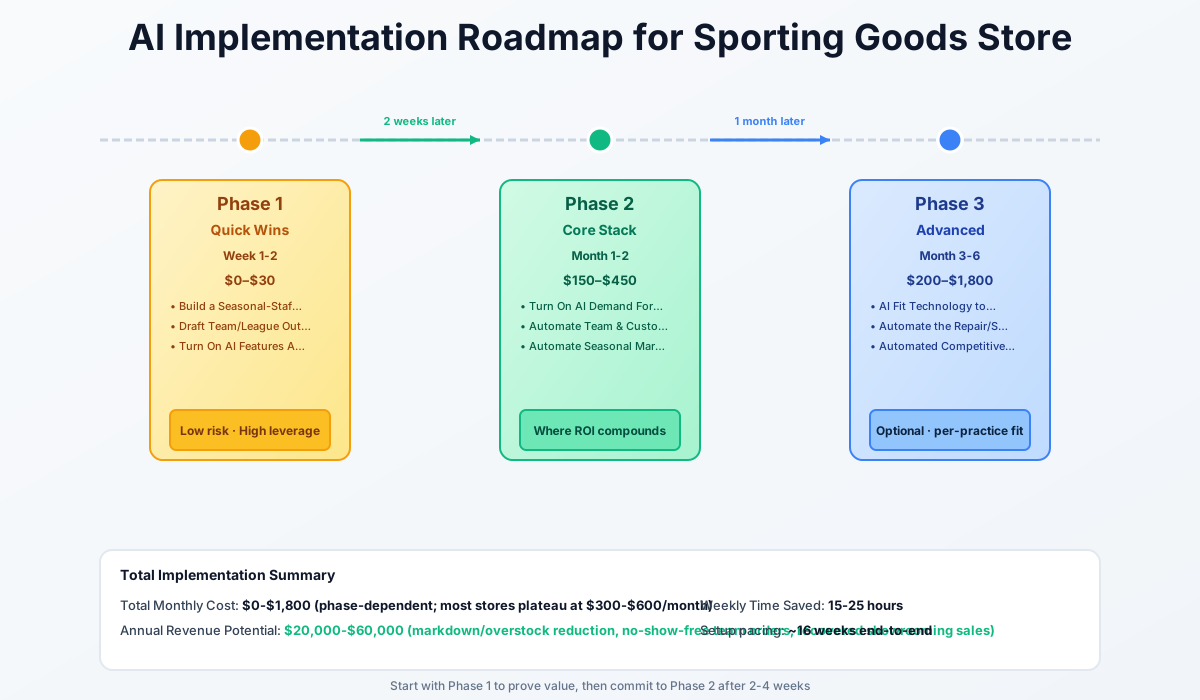
This guide follows the real competitive pressures an independent faces. We start by naming the threat concretely, then move through differentiation, loyalty and retention, and back-of-house efficiency — with specific tools, real pricing, and copy-paste prompts throughout. A typical 4–16 employee store can realistically free up 15–25 hours a week and recover $20,000–$60,000 a year in margin, while keeping software spend in the $300–$450/month range through the first two phases.
Understanding Your Sporting Goods Store
You are not running a generic retail shop, and the AI advice written for "small business owners" mostly doesn't fit you. Your inventory isn't a flat list of products — it's a size/color/width matrix where a single running-shoe model might span 60 variants, and getting the men's 10.5 wide right matters more than the total unit count. Your calendar isn't a steady hum; it's a series of cliffs tied to the school-sport schedule, where back-to-school (August–September) and holiday (November–December) carry the year and team pre-order deadlines cluster right before each season starts.
Your staff mix is unusual too. You run a lean core team of experienced sellers plus a wave of seasonal hires — and industry surveys consistently find that a large share of retail associates get only a few hours of formal training before they're on the floor, with seasonal hires typically getting even less. In most retail that's survivable. In yours it's existential, because the whole reason a customer pays your price instead of Amazon's is that your associate can actually fit a glove, size a ski boot, or explain the difference between a neutral and a stability shoe.
Then there's the part no national chain has to touch at your level of intimacy: the team and league business. You're collecting sizes, names, and numbers from 30 kids on a travel-soccer roster, proofing decoration artwork with a coach over text, coordinating screen printers, and chasing down the three parents who still haven't paid — all before a hard season-opener deadline. It's some of your highest-margin, stickiest revenue, and it's drowning in manual work.
Across the industry, about 80% of sporting goods leaders report higher inventory peaks year over year, with the average peak up roughly a third, and more than half call overstocking a persistent problem. That shows up on the bottom line — Dick's Sporting Goods, the industry's biggest player, reported a double-digit percentage drop in quarterly net income in 2026 partly tied to inventory write-downs, and independents face the same markdown pressure at smaller scale. Tariffs and inflation keep pushing COGS up. Every one of those pressures is a place where better information — which is what AI actually delivers — turns into recovered cash.
Competitive Threat Assessment: Where Amazon and the Big Boxes Actually Hurt You
Before buying a single tool, get honest about which parts of your business are genuinely at risk and which are defensible. Not every SKU is worth fighting for, and spending AI budget defending the wrong ones is how independents go broke slowly.
Commodity SKUs are a losing battle — stop fighting on price. Standard footballs, basic resistance bands, white athletic socks, generic water bottles, common replacement grips — anything a customer can search by exact model number and buy identically elsewhere. On these, Amazon and Walmart win on price every time, and chasing them to the bottom just trains your local customers to see you as overpriced. The data backs this: on thin 30–38% gross margins, a $11 Amazon discount on a $120 shoe is a margin you literally cannot match. These items earn their shelf space only as convenience stock and attachment sales, not as price battlegrounds.
Showrooming is the most direct threat to your core. This is the scenario from the opening: a customer uses your expertise and fitting service, then buys online. It specifically attacks footwear and higher-ticket hardgoods — exactly the categories where your fitting skill is the value. Every showroomed sale is doubly painful because you paid the labor cost of the fitting and got none of the revenue.
DTC brands are pulling your best products in-house. Nike, major running brands, and specialty equipment makers increasingly steer customers to their own sites and apps, sometimes restricting wholesale allocation of the exact hero products that drove traffic to independents. You can't out-Nike Nike, so your assortment edge has to come from curation and the brands that still value the dealer channel.
Where you actually win — and where AI should concentrate. The defensible territory is anything requiring a human: expert fitting, local team and league accounts, equipment service (stringing, bike and ski tuning, skate sharpening), and community relationships with schools and clubs. These are recurring, higher-value, and structurally impossible for a marketplace to replicate. Notice the pattern: your moat is service and relationships, and every pressure above is a reason to free up labor from back-office drudgery so your people can spend it there.
Watch Out
The instinct when a big box opens nearby is to compete on price and selection — the two games you will always lose. The stores that survive do the opposite: narrow the assortment to what they can sell with expertise, and double down on service and team accounts. Use AI to make that pivot cheaper, not to try to match Amazon's catalog.
If you want to see how other physical-goods retailers are handling the same marketplace pressure, our guide for boutique retail stores and AI tools for pet stores cover parallel playbooks for curation and loyalty against the same giants.
Differentiation Through AI: Amplifying What Marketplaces Can't Copy
This is where AI earns its keep for an independent. Your expertise is real but it's trapped in a few people's heads and lost the moment a seasonal hire or a slow night interrupts it. AI's job here is to make your knowledge scalable, your fitting provably better, and your local voice loud enough to matter — all things Amazon structurally cannot do.
Make Every Associate Sell Like a Veteran (Free, Start This Week)
The single highest-ROI move in this entire guide costs nothing. Most seasonal hires get only a few hours of formal training before they're on the floor, and that gap is precisely what erodes the consultative-selling edge that justifies your existence. You fix it by building a small library of one-page, category-specific cheat sheets with a free AI chat tool — compressing what used to take a full shift of shadowing into a ten-minute read that lives on a tablet at the register.
Create a 1-page cheat sheet for a brand-new seasonal sales associate explaining the difference between stability, neutral, and minimalist running shoes — who each is best for, 2-3 example models we carry, and 3 questions to ask a customer to figure out which category fits them. Write at a reading level appropriate for a first-shift employee with zero running background.
Swap the category and your actual model names, and repeat for your four highest-volume categories — baseball gloves, ski boots, racquets, cleats, whatever drives your floor. The non-negotiable step: have your most experienced associate fact-check every sheet against the vendor spec sheet before anyone uses it, because general AI models can get specific sizing and material facts wrong, and a confidently wrong answer to a customer is worse than "let me check."
ChatGPT / Claude
Best for: Cheat sheets, outreach emails, and social captions at near-zero cost
The workhorse of Phase 1. The free tier is plenty for building a cheat-sheet library, drafting team-outreach emails, and batching a week of social captions. Upgrade to a paid tier only if you hit usage limits. The owner has to actually build and maintain the library — but the payoff is 2–3 fewer hours a week of managers getting pulled off tasks to answer basic floor questions.
Do this and you'll likely recover 2–3 hours a week of manager time that used to go to answering basic floor questions. The bigger win is harder to measure: seasonal staff who can run a credible fitting conversation in week one instead of week four, which is the whole reason a customer pays your price instead of clicking "buy" on Amazon.
Turn Fitting Into Something Amazon Physically Cannot Offer
Showrooming thrives when the only thing separating your fitting from an online guess is the associate's word. A foot-scanning system changes that math. The Aetrex Albert scanner takes a 10-second 3D and pressure scan, and the FitAI software turns it into a specific cross-brand size and arch-support recommendation plus a printed or emailed fit report the customer takes home. Now the in-store visit is the product — a data-backed answer to "why this exact shoe" that no website can hand them.
Aetrex Albert Scanner + FitAI
Best for: Footwear-heavy and running-focused stores
3D/pressure foot-scanning hardware paired with AI fit software, deployed in 3,000+ stores from Foot Locker to independent running specialists. The scan produces a concrete fit report that turns a showrooming risk into a reason to buy now. Meaningful upfront cost (~$3–5K all-in), so the ROI math only works for stores where footwear is a major revenue share — skip it if you're mostly hardgoods, apparel, or team sales.
This is a Phase 3 investment — don't buy it until your inventory and team-order chaos is under control — and it's revenue protection, not time savings. Recapturing even 10–15% of previously-showroomed footwear sales can be worth $500–$2,000/month depending on your footwear volume. Calculate your own footwear revenue share before committing to the hardware; if footwear is a sideline, the cheat sheets above are the lower-fidelity version of the same idea.
Give Your Local Voice the Volume It Deserves
Marketing is always the first thing cut when the floor gets busy, which means you consistently miss your own planned seasonal peaks. AI removes the blank-page friction that makes you skip it. A single 20-minute Monday session can produce a week of social captions, and one template per sport season covers your team-outreach emails.
Write 3 short Instagram caption options (under 125 characters each) announcing that [brand] baseball bats just arrived in stock, for a local sporting goods store audience of youth-league parents and high school players. Include one with urgency, one with a question hook, and one straightforward announcement. No hashtag spam — max 3 relevant hashtags.
Always add one specific local detail before posting — the league name, the coach, the try-out date — so it reads like a neighbor wrote it, not a template. That specificity is the whole point; it's the thing a national chain's social team can't replicate for your town.
Customer Loyalty & Retention AI: Owning the Relationship
Acquiring a customer in a high-competition market is expensive; the economics only work if they come back. Your repeat-purchase advantage is that you know the local sports calendar better than any algorithm — you know the soccer-cleat buyer will need a bigger size before spring try-outs and the ski family will reappear before first snow. AI lets you act on that timing automatically instead of hoping they wander back in.
Time Campaigns to the School-Sport Calendar Automatically
Because your promos are planned months ahead, email is where AI pays off fastest. Klaviyo — already common in this vertical — uses predictive segmentation to flag customers likely to buy before their next sports season based on past purchase timing, plus AI send-time optimization and subject-line generation to lift open rates without a marketing hire.
Klaviyo
Best for: Seasonal campaign timing around back-to-school, ski season, and holiday
Email/SMS platform with AI send-time optimization and predictive segmentation that's genuinely useful for a calendar-driven business. Segment soccer-cleat buyers to hit them before try-outs and ski buyers before first snow, rather than blasting the whole list. The Composer AI campaign-builder is still in beta as of 2026 — use the reliable send-time and segmentation features now; don't wait for it.
Write an email subject line plus 3 short body paragraphs for a back-to-school cleats and shin-guards sale at [store name]. Audience: parents of youth soccer players. Tone: helpful local expert, not pushy. Include a soft urgency note tied to try-out dates, and mention our in-store fitting service as the reason to buy here instead of online.
Feed the draft into Klaviyo or Mailchimp and schedule it 6–8 weeks ahead of each peak. Better-timed, better-targeted sends can be worth $1,500–$4,000/month during seasonal peaks versus sporadic blasts — a 10–20x return on the tool cost at most list sizes.
ROI Snapshot
Monthly Cost
$150/mo
Time Saved
3hrs/week
Monthly Value
$2,800
ROI
1767%
Respond to Reviews Without a Platform You Can't Afford
Reviews drive local discovery, but consistent responses eat time. You have two honest paths here, and the right one depends on your size. A solo store can respond directly in Google Business Profile using a free AI draft; a multi-location or high-call-volume store may justify a paid platform — but tread carefully on cost.
Write a warm, specific response to this 5-star Google review: "[paste review text]". Thank the customer by first name if given, reference the specific detail they mentioned, and invite them back for [seasonal event or service]. Keep it under 50 words.
Watch Out — Podium Pricing
Podium is a capable review-and-messaging platform, but at roughly $399–600/month once AI add-ons and SMS volume are included, it's disproportionate for a single-location independent. ReviewTrackers ($59–89/month) covers AI-drafted responses at a fraction of the cost, and the free prompt above covers it for $0 if you'll do it weekly. Don't buy the enterprise tool to solve a solo-store problem.
If service is part of your business, loyalty also lives at the repair bench — a customer who gets a friendly "your skis are tuned and ready" text is a customer who comes back. More on automating that in the efficiency section below.
Operational Efficiency: The Back-of-House AI That Protects Margin
This is where the biggest dollar recovery hides. Your two most expensive operational problems — inventory imbalance and the team-order grind — are both information problems, which is exactly what AI is good at.
Stop the Overstock-and-Stockout Cycle With AI Forecasting
The single most-cited pain point in this industry is overstocking slow movers while bestsellers sell out — dead stock ties up cash, and the bestseller stockouts send customers straight to Amazon. The fix is demand forecasting that reads your actual sell-through by size/color/width, and the lowest-friction version is probably already inside the POS you pay for.
Lightspeed AI + Seasonality Forecasting
Best for: Stores already on Lightspeed Retail
Lightspeed's native AI layer, launched January 2026, adds a plain-language "ask your data" assistant ("which cleats sold through fastest in August?") plus a Seasonality Forecasting module built specifically for the Sporting & Outdoor Goods vertical. It reads data you're already generating — zero migration. Lightspeed reports merchants using Insights see ~26% fewer days out of stock on top sellers. Needs 1–2 full seasons of clean history to forecast well; confirm which tier it's on with your rep before buying.
If your inventory system of record isn't Lightspeed, you have alternatives — but match the tool to where your data actually lives:
Prediko
Best for: Stores whose ecommerce runs on Shopify
AI inventory forecasting and PO automation built for Shopify, with size/color-matrix-aware demand planning for apparel and footwear. Vendor claims 93–97% forecast accuracy (treat as a vendor claim). The catch: it's Shopify-only, so it doesn't help if your real system of record is Lightspeed, RICS, or Windward rather than your website.
EasyReplenish
Best for: Single-location stores wanting a dedicated reorder-point tool
AI reorder-point calculation and seasonality-aware replenishment aimed at SMBs that don't want a full ERP switch. Unit-based pricing can climb fast for a store carrying thousands of matrix SKUs, and integration with sporting-goods POS platforms isn't independently verified — confirm compatibility with your specific POS before committing.
Whichever you choose, the discipline matters more than the tool: run the first recommendation set against your gut-feel buying plan and compare before trusting it, and don't fully automate purchase orders for the first 2–3 cycles. A bad pre-season order can't be easily undone. Track days-out-of-stock on your top 20 SKUs for 60 days as your baseline, and even a partial version of Lightspeed's claimed 26% improvement means fewer lost sales and fewer margin-killing clearance markdowns. If it prevents even one dead-stock writeoff per season, the tool pays for itself several times over.
For a deeper look at inventory forecasting in a parts-and-SKU-heavy retail context, our auto parts store guide walks through the same matrix-inventory challenge.
Automate the Team & Uniform Order Grind
Ten to twenty hours a week. That's what team and league orders cost you during peak season once you add up manual size collection via paper and texts, artwork proofing back-and-forth, and the thankless job of tracking who paid and who picked up. Errors mean reprints and missed season deadlines. A dedicated team-store platform moves all of that off spreadsheets.
Chipply (Chipply One)
Best for: Stores with meaningful team/league business
Team-store platform that automates online store setup, size/color collection, art placement onto mockups, and auto-generated sorting sheets and packing slips. "Chipply One" (March 2026) unifies the online team store with in-store POS and fulfillment — potentially removing one of the two systems you reconcile by hand each season. The automation is more rules-based than generative, but it directly attacks the 10–20 hr/week drain. Confirm the current setup fee and percentage terms in writing before the season crunch.
DecoNetwork
Best for: Stores wanting built-in design/mockup tools
All-in-one team-store and decorated-apparel platform with AI-assisted mockup generation and production-status tracking visible to both shop and customer. Published tiers run $199-$399/month plus a one-time license fee ($999-$2,999 depending on tier) — confirm current numbers directly since plans and included staff seats change. Worth comparing against Chipply's setup-fee-plus-percentage model if you want design-studio tools built into the front end rather than bolted on.
Pilot with a smaller, forgiving team account first — not your biggest, highest-stakes one — and let the real-time vendor inventory sync handle size availability instead of you checking stock per order. Expect to cut team-order coordination from 10–20 hours down toward 4–8 hours a week in peak season, plus fewer reprint costs and faster turnaround that can win accounts away from national online team-store chains. One honest caveat: if team sales are a small slice of your revenue, delay this investment and keep using an AI-drafted intake form in the meantime.
Write a friendly, concise email from [store name], a local sporting goods store, to the athletic director at [school name] offering to handle this year's varsity soccer uniform order. Mention our 3-week turnaround, in-house artwork proofing, and that we're a local business (not a national online team-store chain). Keep it under 150 words and end with a specific call to action to schedule a 15-minute call.
Automate the Repair Bench — If Service Is Real Revenue
If stringing, bike tuning, ski mounting, and skate sharpening are a meaningful share of your business, the service queue is a hidden time sink: manual pickup-reminder calls, no customer visibility into status, and inconsistent pricing across technicians. A dedicated service-bench tool with AI-drafted pickup texts and automatic service-history lookup fixes the consistency problem.
Deelo
Best for: Bike-service-heavy stores
All-in-one platform built for bike shops (adaptable to ski/board benches) with POS, serialized inventory, a Field Service work-order module, and an AI assistant that drafts pickup messages in your shop's voice, summarizes work orders into invoice line items, and pulls prior service history for consistent quoting. Built primarily for bikes, so test carefully if ski/snowboard tuning is your bigger line — and check whether your current POS's native work-order module already covers this before switching platforms.
A free Starter tier makes this easy to test on a subset of work orders before you commit. Expect 3–6 hours/week saved on pickup reminders and quote-consistency rework in service-heavy stores — but skip it entirely if service is a minor sideline.
Turn On the AI You're Already Paying For
Before buying anything new, audit two tools you likely already have. QuickBooks Online's Intuit Assist can auto-categorize transactions and answer plain-language cash-flow questions like "how much cash will I have in 60 days if I place the ski-season PO now?" — directly relevant to your seasonal cash-flow timing. And Homebase's Plus tier adds AI auto-scheduling that fills tournament-weekend shifts against your labor budget, plus an AI hiring assistant for fast seasonal ramp-up.
Homebase
Best for: Scheduling and seasonal hiring in one platform
Workforce platform common in this vertical. The Plus tier's AI auto-scheduling directly addresses variable, traffic-driven shift lengths around tournament weekends, and the AI hiring assistant posts to Indeed/ZipRecruiter/Facebook in one click for seasonal pushes. AI scheduling only unlocks at $70/month — only upgrade if tournament-weekend scheduling is a recurring headache. If you have a large seasonal headcount, compare against When I Work's per-user pricing ($2.50–$8/user/mo).
QuickBooks Online (Intuit Assist)
Best for: Seasonal cash-flow planning and bookkeeping cleanup
The dominant bookkeeping tool in this vertical already includes AI categorization and cash-flow Q&A at no extra fee on the right tier. The most useful features (AccountingAI, cash-flow summaries) need Essentials ($85/mo) or higher — weigh that upgrade against the hours saved during the pre-season buying crunch.
What to Avoid
A few expensive mistakes that catch independent sporting goods stores specifically:
- Don't fully automate purchase orders in year one. Forecasting needs 1–2 full seasons of clean history to be trustworthy. Review AI recommendations against your own judgment for several buying cycles first — a bad pre-season order ties up cash you can't get back.
- Don't buy Aetrex fit-scanning hardware if footwear is a minor part of your mix. At $2,995 upfront plus $50/month per scanner for FitAI software, the ROI only works for footwear-heavy stores. For a mostly-hardgoods or team-sales shop, that capital belongs in Phase 2 instead.
- Don't switch your core POS just to get one AI feature. Several tools (Deelo, Prediko) require platform switches or are Shopify-locked. Check whether your existing POS already has — or is about to launch — a comparable feature before eating a migration.
- Don't buy enterprise analytics or shelf-recognition platforms (Trax, RetailNext) built for multi-location chains, or Podium for a single location. You'll pay for capability you can't use.
- Don't chase commodity-SKU price wars. No AI repricer fixes a structural margin disadvantage against Amazon on identical products. Compete on service, not on matching a marketplace's price.
Getting Started Checklist
Work this in order. Don't start Phase 2 until Phase 1 habits are genuinely routine for your team.
- Pick your 4 highest-volume categories and build an AI product-knowledge cheat sheet for each (free, this week)
- Have your most experienced associate fact-check every cheat sheet against vendor spec sheets before use
- Batch one week of social captions and a team-outreach email template with ChatGPT or Claude
- Audit your QuickBooks and Homebase tiers — turn on AI features you're already paying for
- Confirm whether Lightspeed Seasonality Forecasting is live on your current tier (or trial Prediko if your ecommerce is on Shopify)
- Track days-out-of-stock on your top 20 SKUs for 60 days as your forecasting baseline
- Pilot a team-store platform (Chipply) with one smaller, forgiving team account
- Set up Klaviyo seasonal segments and schedule your next peak campaign 6-8 weeks ahead
- Only after Phases 1-2 are stable: evaluate Aetrex fit tech (if footwear-heavy) and Deelo (if service-heavy)
The best next move is the free one. Open ChatGPT or Claude right now, paste the cheat-sheet prompt from above, swap in your top category, and you'll have the first piece of your seasonal-training library before you finish your coffee. Everything else in this guide builds on that first hour.
Here's how this rolls out — three phases, each with its own cost ceiling and impact target:
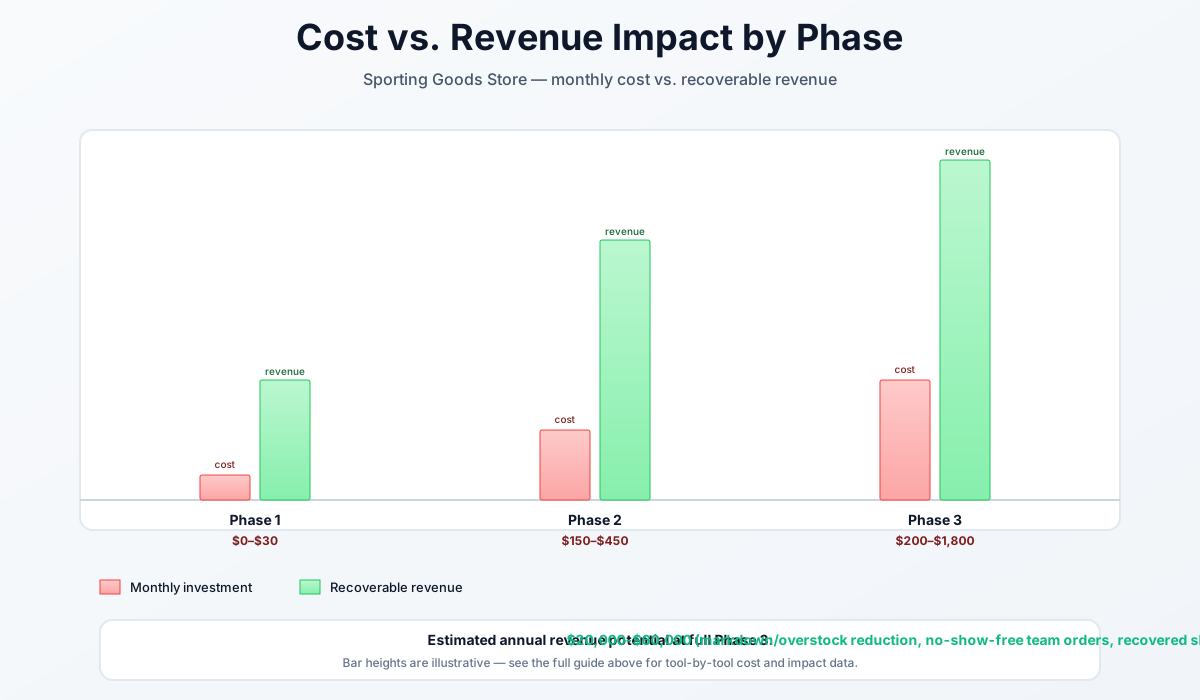
Here's a breakdown of the costs and expected returns:
Frequently Asked Questions
Will AI inventory forecasting work for a store carrying thousands of size/color/width matrix SKUs, or is it built for simpler catalogs?
It works, but the quality depends entirely on clean sell-through history at the variant level. Tools like Lightspeed Seasonality Forecasting and Prediko are specifically built to forecast at the size/color/width grain rather than the parent-product level, which is what you need. The real constraint isn't the matrix complexity — it's whether you have 1–2 full seasons of accurate sales data in the system. If you've been running on spreadsheets or just migrated POS, give it a season of clean data before trusting the forecasts.
If a customer gets fitted using our Aetrex scan and still buys the recommended shoe online, did we waste the money?
Partly — which is why the fit report matters more than the scan. The scanner only recaptures showroomed sales if your associates are trained to hand over the printed fit report as the closing move ("here's your exact size and arch profile — we have it in stock right now"), framing the in-store visit as the thing that ends the shopping, not the thing that starts it. Treated as a gimmick, it's wasted money. Treated as the actual sales close, it recaptures an estimated 10–15% of previously-showroomed footwear sales. Measure your footwear conversion rate before and 90 days after to see your real number.
Can an AI repricer help me compete with Amazon on commodity sporting goods?
Mostly no. It only helps in one narrow case: you also sell those commodity items on Amazon, eBay, or Walmart under your own listings, and you want a tool like BQool ($25/mo) to adjust prices automatically without dropping below your cost floor. It does nothing for your in-store pricing or your website, and no repricer fixes a structural cost disadvantage against a marketplace selling the identical SKU. If you don't sell on third-party marketplaces, skip this and put the energy into service instead.
How do I handle MAP (minimum advertised price) restrictions when brands won't let me discount their gear?
MAP limits your advertised price, not your creativity. AI can't override a MAP agreement, but it can help you compete within one — use AI-drafted bundle offers (shoe + fitting + insoles), loyalty rewards, and service add-ons that create value without breaking the advertised price. Klaviyo's segmentation lets you promote in-store-only or members-only pricing on MAP items to your email list, which is typically allowed where public advertising isn't. Read each brand's MAP policy carefully; the enforcement varies widely by vendor.
We sell firearms and ammunition — does using AI tools create any compliance risk with our FFL or ATF recordkeeping?
Keep AI out of anything regulated, full stop. NICS background checks, your bound book, and ATF recordkeeping stay inside compliant, purpose-built systems — never paste a customer's firearm-transaction details into a general AI chat tool. Everything in this guide (cheat sheets, forecasting on your non-firearm inventory, marketing, team orders) lives entirely outside that regulated side of the business, which is exactly why it's safe to use. If a new tool ever touches firearm inventory or customer records, check with your compliance advisor before you adopt it, not after.
Our team-order deadlines are brutal and non-negotiable — what happens if the automation fails right before a season starts?
This is exactly why you pilot a team-store platform on a smaller account first, not your biggest one, and well before peak season — so any workflow gaps surface when the stakes are low. Keep your manual process documented as a fallback for the first season, and don't migrate your highest-stakes accounts until the platform has survived a full real order cycle. The automation reduces errors and reprints over time, but during the transition season, run the new system alongside your old checklist rather than trusting it blind against a hard season-opener deadline.
More AI Implementation Guides
AI Tools for Bicycle Shops: The 2026 Owner's Playbook
The best AI tools for bicycle shops in 2026 — cut 'is my bike ready?' calls, automate tune-up reminders, and fix inventory risk without replacing your POS.
AI Tools for Thrift & Consignment Stores (2026 Guide)
The best AI tools for thrift and consignment stores in 2026. Cut intake time, prevent double-sales, and win back shoppers from Poshmark and ThredUp with automation.
AI Tools for Jewelry Stores: 2026 Owner's Playbook
The best AI tools for jewelry stores in 2026. Turn on what you already pay for, fix clienteling, clear dead stock, and win against online marketplaces.
Best AI Tools for Independent Bookstores (2026)
Compare the best AI tools for independent bookstores in 2026: cut content creation from 15 hrs to 5, slash event no-shows by 40%, and out-market Amazon.
Best AI Tools & Examples for Boutique Retail Stores
See real AI applications for boutique retail stores: cut dead stock 30%, automate Instagram captions, and build customer loyalty. Free setup checklist inside.
AI Tools for Pet Stores: Chatbots & Price Tracking
Independent pet stores: AI Shopify chatbots, price tracking tools, smart inventory, and loyalty automation. Beat big-box chains with this step-by-step plan.
Keep exploring
See every AI implementation guide we've published for Retail, or browse the full library by industry or category. Looking for a specific platform? The AI tools directory indexes every product mentioned across our guides, and the comparisons hub puts the most-asked head-to-heads side by side.