
Half your studio's revenue problem isn't teaching quality. It's what happens between classes.
A student takes her first Yin class on a Tuesday evening. She's sore in a good way. She means to come back. On Wednesday nobody reaches out. Thursday passes. By the following Tuesday she's booked a trial at the studio two miles away that sent her a text the next morning. You lost a member — probably worth $1,200 over the next year — not because your class was worse, but because you were too busy to follow up.
Multiply that by every trial student who doesn't convert, every membership that lapses quietly, every class that runs at 40% capacity while a different time slot turns people away. That's not a yoga problem. That's a systems problem — and most yoga studio owners are solving it with spreadsheets, group texts, and sheer willpower.
This guide covers exactly which tools to use, in what order, to fix it. The first step costs nothing.
TL;DR — Top 3 Recommendations
- Use ChatGPT or Claude (free) to draft all your emails, class descriptions, and social content — saves 5–8 hours/week immediately
- Activate the churn prediction feature you're already paying for in Mindbody or Glofox — it flags at-risk members before they cancel
- Set up a 3-email automated welcome sequence in Klaviyo (free tier) to convert trial students into members — studios see conversion rates jump from 25% to 50%+
Where Yoga Studios Actually Lose Money
Before getting into tools, it's worth looking at the numbers that drive the recommendation order. These benchmarks come from studio operators and platform data across Mindbody and Glofox users — not industry guesses.
| Metric | Typical Studio | Well-Optimized Studio |
|---|---|---|
| Class fill rate | 42–55% | 68–78% |
| Drop-in → member conversion | 22–28% | 48–56% |
| Membership vs. class-pack LTV (12 mo) | Members: $1,400 / Packs: $380 | Members: $1,600 / Packs: $520 |
| Monthly membership churn | 9–13% | 5–7% |
| Failed payment recovery rate | 35–50% | 72–85% |
The gap between a typical studio and a well-optimized one isn't about studio size, location, or even teaching quality. It's almost entirely systems: who gets a follow-up, when, how, and whether payments get chased automatically. Every tool in this guide targets one of those rows.
Writing and Communication: The Fastest Win Available
Sign up for ChatGPT or Claude right now — both free, both set up in under two minutes. This is genuinely where to start, not because it's the most important thing on the list, but because it's the fastest way to get a visible win and understand what AI-assisted work actually feels like.
Every week you're spending 5–10 hours on writing tasks that aren't complicated — they're just relentless. Email newsletters, class descriptions, workshop promos, Instagram captions, review responses, new-student follow-ups. A well-prompted AI handles them in seconds. The blank-page problem disappears.
ChatGPT
Best for: Email sequences, class descriptions, review responses
The most widely used AI writing tool. The free tier covers every writing task a yoga studio owner faces. Use it for newsletters, workshop descriptions, welcome emails, social captions — edit the output to match your voice before posting.
Here's a prompt that turns a 45-minute newsletter into a 90-second draft:
Write a monthly newsletter for my yoga studio, [Studio Name], for [Month]. Include:
- New class addition: [describe class, time, instructor]
- Upcoming workshop: [topic, date, price]
- Seasonal wellness tip related to [season/theme]
- A brief member spotlight for [member first name] who [accomplishment] Tone: warm, grounded, community-focused. Not corporate. Under 400 words. End with a single clear CTA to book a class.
Write 5 yoga class descriptions for my studio's website and booking app. Each should be 60-80 words, inviting but specific about what to expect. Include difficulty level and who it's best for.
Classes:
- Vinyasa Flow (intermediate) — dynamic, breath-linked movement
- Gentle Hatha (beginner-friendly) — slower pace, longer holds
- Yin Yoga (all levels) — deep stretching, 3-5 minute holds
- Hot Power Yoga (advanced) — 95°F room, athletic sequencing
- Restorative (all levels) — props-supported, nervous system regulation
Our studio personality: [describe your vibe — e.g., "laid-back, slightly irreverent, no incense-and-chanting stereotypes"]
Studios that use AI for writing typically reclaim 5–8 hours per week. More consistent follow-up emails convert more trial students into paying members — studios report $500–$2,000/month in retained revenue from this alone. Setup is two minutes; after that, it becomes part of how you work.
Don't Post AI Content Raw
Always edit AI drafts to sound like you. Add student names, inside jokes, references to that thing that happened in class on Thursday. Your community can smell generic content. AI handles the blank-page problem — you add the soul.
Batching Social Media in 30 Minutes a Week
If you're currently posting reactively — rebuilding each Canva graphic from scratch, spending 5–10 hours a week — Buffer's free plan fixes this in one Monday morning session.
Thirty minutes. Instagram, Facebook, and one other channel: planned, captioned, and scheduled for the week. Posting times optimized automatically.
Buffer
Best for: Social media scheduling with built-in AI caption writer
Buffer's free tier includes AI-powered caption generation, best-time-to-post scheduling, and basic analytics. Connect Instagram, Facebook, and one more channel. Generate captions, schedule everything Monday morning, and don't think about social media again until next week.
How to set it up:
- Sign up for Buffer and connect your Instagram, Facebook, and one other channel
- Block 30 minutes every Monday as your "content batch" time
- Use Buffer's AI to generate 5–7 captions for topics like "benefits of yin yoga," "what to bring to your first class," and "meet our instructor"
- Open Canva Free, search "yoga" templates, customize 5–7 matching graphics
- Upload to Buffer, pair with captions, and let "Best Time to Post" auto-schedule
- After two weeks, review analytics — double down on what gets engagement
Consistent posting drives 20–30% more profile visits. Most studios see 2–5 new trial students per month from this channel alone.
Create 7 Instagram captions for a yoga studio. Mix of:
- 2 educational (yoga tips, pose breakdowns, breathwork benefits)
- 2 community/behind-the-scenes (studio life, instructor intros)
- 2 promotional (upcoming workshop, intro offer, class schedule)
- 1 inspirational (yoga philosophy, mindfulness, without being preachy)
Studio name: [Name]. Location: [City]. Vibe: [describe]. Each caption 80-150 words. Include 5-8 relevant hashtags per post. No generic motivational quotes.
Answering the Same 10 Questions: Automate It
How many times this week did someone email or call to ask what to wear to their first class? Where to park? Whether the intro offer includes Hot Yoga? You know the answer because you've said it a hundred times.
Tidio's free AI chatbot handles this automatically, around the clock, and captures leads from visitors who would otherwise just close the tab.
Tidio
Best for: Website chatbot with AI-powered FAQ answering and lead capture
Tidio's free plan includes an AI chatbot (Lyro) that learns from your FAQ content and answers visitor questions automatically. Works on WordPress, Squarespace, and Wix. Captures names and emails from interested visitors before sending them to your booking page.
To get it running:
- Sign up at tidio.com and install the widget on your website (10 minutes — code snippet or plugin)
- Build a welcome flow: greet visitors, ask if they're new or returning, offer quick links to schedule, pricing, and intro offer
- Feed Tidio's Lyro AI your FAQ content: class schedule, pricing packages, intro offer details, parking info, what to bring, cancellation policy
- Set up lead capture: when someone asks about trying a class, collect their name and email before directing them to your booking page
- Review unanswered questions weekly to improve the chatbot's knowledge base
Expect 2–3 hours back per week on repetitive inquiries, and 3–5 additional leads per month that would have otherwise bounced. If you're also looking at how other service businesses use website chatbots, our guide for dance studios covers a similar Tidio setup for class inquiries.
ROI Snapshot
Monthly Cost
$0/mo
Time Saved
12hrs/week
Monthly Value
$3,180
ROI
Infinity%
Converting Drop-Ins into Members: The Highest-Leverage Work in Your Studio
This is the row in the table at the top that matters most. Typical studios convert 22–28% of drop-ins and trial students to memberships or packs. Well-optimized studios hit 48–56%. The difference is almost entirely the follow-up sequence — not the teaching, not the price, not the lobby.
Klaviyo automates this entirely. Build the sequence once, and every new student gets a personalized email and SMS follow-up without you lifting a finger.
Klaviyo
Best for: Automated email/SMS sequences triggered by student behavior
Klaviyo integrates directly with Mindbody and connects to Glofox/WellnessLiving via Zapier. Build automated flows triggered by first-class attendance, class pack expiration, and membership milestones. The free tier (250 contacts, 500 emails/month) is enough for most small studios getting started.
Your 3-email welcome sequence:
- Day 1: Warm thank-you + what to expect next + link to your schedule
- Day 4: Class recommendation based on what they tried + social proof ("Join 150+ members who practice with us weekly")
- Day 8: Intro offer reminder with gentle urgency ("Your intro rate expires in 7 days — lock it in")
Add one SMS touchpoint on Day 2: "Hey [Name]! We loved having you in class. Any questions about our schedule? Just reply to this text." Text messages get 3–5x higher response rates than email for this kind of outreach.
Second automation worth building immediately: "class pack expiring" — triggers when a student's pack has 1–2 classes remaining, prompting them to renew or upgrade to an unlimited membership. This single automation is responsible for a meaningful chunk of the membership vs. pack LTV gap in the table above.
Write a 3-email welcome sequence for a new yoga student at [Studio Name].
Email 1 (send day after first class): Warm thank-you, acknowledge they tried [class type]. Mention one thing that makes our studio different: [your differentiator]. Link to class schedule. Under 120 words.
Email 2 (send day 4): Recommend a complementary class type based on what they tried. Include a brief testimonial or social proof stat. Under 120 words.
Email 3 (send day 8): Remind them their intro offer ([describe offer]) expires soon. Create gentle urgency without being pushy. Include direct booking link. Under 100 words.
Tone: personal, warm, like a text from a friend who happens to own a yoga studio. No corporate language. Use first name personalization.
Converting 5–10 more trial students per month adds $750–$2,000 in new recurring revenue. The time savings — 3–4 fewer hours per week on manual follow-up — are almost secondary to that number.
ROI Snapshot
Monthly Cost
$45/mo
Time Saved
4hrs/week
Monthly Value
$2,060
ROI
4478%
The Churn Feature You're Probably Not Using
Open your Mindbody, Glofox, or WellnessLiving admin dashboard right now. On Mindbody it's called Clients At Risk — it's under Marketing. On Glofox it's the At Risk Report under Reports. On WellnessLiving, look for Isaac AI. On Walla it's WallaPredict.
The odds are good you've never turned it on.
Members who drift away rarely announce it. They quietly stop booking, then cancel. By the time it shows up as missing revenue, you're already playing from behind — winning back a lapsed member costs 5–7x more than catching one who's drifting. These features exist precisely to catch that drift early.
Studios running on Glofox will find this overlaps with what we cover in the gym and fitness studio guide — the main difference is that yoga's highest-risk segment tends to be drop-in students who bought a class pack and let it sit, not lapsed monthly members.
What to do with the data:
- Enable the feature in your admin dashboard (some platforms require a quick support ticket to activate)
- Review your first at-risk list — you'll typically see 15–30 members flagged that you hadn't noticed
- For high-risk members: send a personal text within 24 hours. Not an automated one. "Hey [Name], we've missed you — everything okay? I saved a spot for you in Thursday's 6 PM Vinyasa if you're free."
- Set a 15-minute Monday ritual to review the list and send 5–10 personal messages
- After 30 days, layer in an automated Klaviyo email for medium-risk members as a safety net
Personal Touch Over Automation for At-Risk Members
For your highest-risk members, a personal text from the owner or their favorite instructor is 3–5x more effective than an automated email. Ask how they're doing. Offer flexibility — a different class time, a freeze. Don't lead with a discount. That trains people to wait for deals and erodes margins over time.
Retaining 3–5 members per month who would have cancelled preserves $450–$1,000 in recurring revenue — and it costs nothing extra if you're already on a platform tier that includes churn prediction.
Recovering Failed Payments Automatically
How many members are quietly in payment limbo right now? The math on a 150-member studio: at a 10% failure rate and $150/month average, that's $2,250 that didn't get collected this billing cycle. Most studios either chase these manually or just don't. Both approaches cost money.
The fix is a one-time setup: configure your platform's automatic retry settings and a dunning sequence in Klaviyo. Build it once, then leave it running.
- In Mindbody/Glofox payment settings, configure automatic retry: Day 1, Day 3, and Day 7 after initial failure
- Build a 3-step dunning sequence in Klaviyo:
- Day 0: "Your payment didn't go through — here's a one-click link to update your card (takes 30 seconds)"
- Day 3: "Just checking in — your membership is paused until we can process payment"
- Day 7: "Last chance to keep your membership active — update your card or reply and we'll help"
- Add an SMS on Day 1 — texts get 3–5x higher response rates for payment updates
- Always include a direct link to update payment info. Every extra click costs you 20–30% of recoveries
Keep Dunning Emails Friendly
Most failed payments are accidental — an expired card, a bank flag. Keep the tone helpful, not punitive. "We want to make sure you don't lose your spot" works better than "Your account is past due."
Studios typically recover 60–80% of failed payments once this system is running — that's $400–$2,000 per month in revenue that was leaking silently. Setup takes 2–3 hours one time, then it handles itself.
After-Hours Lead Capture: The 40–60% You're Currently Missing
Someone searches "yoga studio near me" at 9:15 PM on a Sunday. They find your site, read about your intro offer, and call. Nobody answers. They move to the next result on the list.
That's a predictable, fixable loss. An AI receptionist answers those calls, texts, and chats around the clock, books intro classes, and keeps the lead instead of losing it.
My AI Front Desk
Best for: After-hours phone, SMS, and chat coverage with booking capability
Handles phone calls, texts, and web chats 24/7. You input your schedule, pricing, intro offer, and FAQs during onboarding. Configure call forwarding so calls go to your real front desk during business hours and to the AI after hours. Connects to Mindbody/Glofox via Zapier for automatic booking. Our hair salon guide walks through the same setup if you want another implementation example.
Key setup steps:
- Complete the onboarding wizard with your studio info, schedule, pricing, and FAQs
- Configure call forwarding: business hours to front desk, after hours to AI
- Test it yourself — call after hours pretending to be a new student
- Connect to your booking system via Zapier so AI bookings create real reservations
- Review conversation logs weekly and update the AI's knowledge base
Most studios see 5–10 new students per month from after-hours capture — worth $750–$2,000 monthly.
ROI Snapshot
Monthly Cost
$65/mo
Time Saved
3hrs/week
Monthly Value
$1,920
ROI
2854%
Building a Teacher Training Operation That Doesn't Run on Chaos
Teacher training is your highest-margin revenue line — $2,000–$4,500 per student, 10–20 students per cohort. It's also, for most studio owners, the most operationally chaotic thing they run. Applications land in Google Forms. Curriculum lives scattered across Dropbox and email threads. Attendance gets tracked in a spreadsheet that causes anxiety every time a Yoga Alliance renewal comes up.
Kajabi replaces that patchwork with one platform. The AI course builder generates a module outline from your training description — treat it as a starting point, not a finished product, and customize it with your actual curriculum. Session recordings auto-transcribe into study guides. The enrollment pipeline handles applications, contracts, payments, and welcome materials automatically.
Kajabi
Best for: Teacher training program delivery, enrollment, and marketing
Kajabi's AI course builder generates a module outline from your training description. Upload session recordings and get auto-transcribed study guides. Built-in enrollment pipeline handles applications, contracts, payments, and welcome materials. One platform replaces your Google Forms, Dropbox, email threads, and Facebook group.
Yoga Alliance compliance is a real advantage here: Kajabi centralizes attendance tracking, curriculum delivery, and practicum-hour logging — exactly what your RYS (Registered Yoga School) status requires. Generate attendance reports, track contact hours against the 200-hour or 300-hour requirement, and store signed agreements in one place instead of scrambling at renewal.
To get your next cohort set up:
- Use Kajabi's AI course builder: input "200-Hour Yoga Teacher Training — [Your Style]" and refine the generated outline
- Add your actual curriculum, reading lists, anatomy content, and practicum requirements
- Set up the enrollment pipeline: application → confirmation → contract signing → payment → welcome module
- Upload training recordings and use AI transcription to create text study guides
- Build a post-graduation sequence: Day 1 (congrats + certificate), Day 30 (sub teaching opportunities at your studio), Day 90 (advanced training upsell)
Active cohort weeks run 5–10 hours lighter. A more professional platform also supports $500–$1,000 higher tuition per student — and better marketing fills cohorts faster.
Turning Recorded Classes into an On-Demand Revenue Stream
Record a class this week. Upload it to Descript. Edit the transcript like a Word document — delete filler, dead air, anything you don't want — and the video cuts automatically. No timeline editor. No video editing background required. A 60-minute class is polished and ready in under 30 minutes.
Descript
Best for: Transcript-based video editing, filler word removal, social clip generation
Edit yoga class recordings by editing the transcript. Auto-transcription, one-click filler word removal, AI-suggested social clips, and auto-generated captions. Turn a 60-minute class into polished on-demand content plus 3–4 Instagram Reels in under 30 minutes.
The revenue model: host videos on Kajabi, Vimeo OTT, or YouTube. Offer a hybrid membership add-on at $20–$30/month. At 30 subscribers, that's $750/month with near-zero marginal cost once the library is built.
To get started:
- Start with Descript's free plan — upload one recorded class (phone in landscape mode is fine)
- Auto-transcribe, then delete filler and dead time from the transcript
- Use AI clip suggestions to pull 30–60 second moments for Instagram Reels
- Add auto-generated captions to all clips
- Batch-record 4 classes in one week, edit all 4 — you now have a month of on-demand content
Sub-Finding: The Problem AI Hasn't Solved Yet
When an instructor texts at 11 PM saying they can't teach tomorrow's 6 AM, you're stuck in a group text with eight contractors hoping someone responds before you have to cancel the class. Mindbody and Glofox have basic sub-request features, but they're notification-based — they flag availability but don't intelligently match teaching style or certification level.
Honest answer: no tool fully solves this yet. What you can do right now:
- Use your studio platform's sub-request feature so the process is at least centralized and logged instead of scattered across text threads
- Build a shared Google Sheet or Airtable with every instructor's availability, teaching styles, and certifications — filter instantly for someone available AND certified for a 95°F class
- Keep a dedicated Slack channel or WhatsApp group only for sub requests — separating it from general chatter increases response rates significantly
Several platforms have announced AI-assisted sub-matching for late 2026 — WellnessLiving's Isaac AI and Walla's predictive tools are closest to shipping this. Worth watching.
Music Licensing: The Compliance Risk Most Studios Don't Know About
If you play Spotify, Apple Music, or YouTube during classes — and you're a commercial business — you need blanket licenses from BMI, ASCAP, and SESAC. Playing recorded music in a commercial space is a public performance. Annual cost runs $350–$700 across all three PROs.
This matters specifically for AI-assisted content: when you start recording classes for on-demand (see the Descript section above), you'll need synchronization rights or must switch to royalty-free libraries. Epidemic Sound ($15/month) or Artlist ($10/month) provide unlimited tracks cleared for both in-studio play and video distribution. Budget for this before you hit record.
A Few Things Worth Skipping
Don't switch your studio management platform to chase AI features. Migrating from Mindbody takes 40–80 hours and risks losing data and confusing students. Maximize AI features in your current platform first, then layer on specialized tools.
Don't use automation for your highest-value personal interactions. A welcome sequence is fine. But when a long-time member is at risk, a personal text from you — not an automated email — is the thing that keeps them. Human connection is your edge over Peloton and big-box gyms. Protect it.
Don't pay for Jasper when ChatGPT and Claude are free. Jasper ($39–$69/month) is built for multi-brand marketing teams. A single studio gets equivalent quality from the free tiers. That's $500–$800/year you don't need to spend.
Don't invest in video production before you have a distribution plan. Get your follow-up sequences and churn tooling running first. Then invest in Descript when you have clarity on where the content will live and how you'll monetize it.
Don't generate fake reviews. Google detects AI-generated reviews and penalizes businesses for it. Instead, use AI to draft a template that makes it easy for real students to leave genuine reviews:
Write a brief, friendly message I can text to students after class asking them to leave a Google review. Include:
- Thank them for coming to today's class
- Ask if they'd be willing to leave a quick Google review (even 1-2 sentences)
- Include the placeholder [DIRECT REVIEW LINK]
- Mention it helps small local studios like ours get found Keep it under 50 words. Casual tone, not corporate.
Your Week-by-Week Rollout
- Week 1: Sign up for ChatGPT or Claude (free) and draft your first welcome email sequence
- Week 1: Sign up for Buffer (free) and schedule your first week of social media content in one 30-minute batch
- Week 1: Install Tidio (free) on your website and configure your top 10 FAQs
- Week 2: Sign up for Klaviyo (free tier) and build your 3-email new student welcome automation
- Week 2: Log into your studio management platform and activate the churn prediction feature (Clients At Risk, At Risk Report, or Isaac AI)
- Week 3: Configure your platform's automated payment retry settings (Day 1, Day 3, Day 7)
- Week 3: Build your 3-step dunning email/SMS sequence in Klaviyo
- Week 4: Review your first month of data — churn list, payment recovery rate, chatbot conversations, email open rates
- Month 2: Evaluate My AI Front Desk for after-hours lead capture ($65/mo)
- Month 2-3: If you run teacher training, set up your next cohort on Kajabi ($89/mo)
- Month 3: Start recording classes and editing with Descript for your on-demand library ($24/mo)
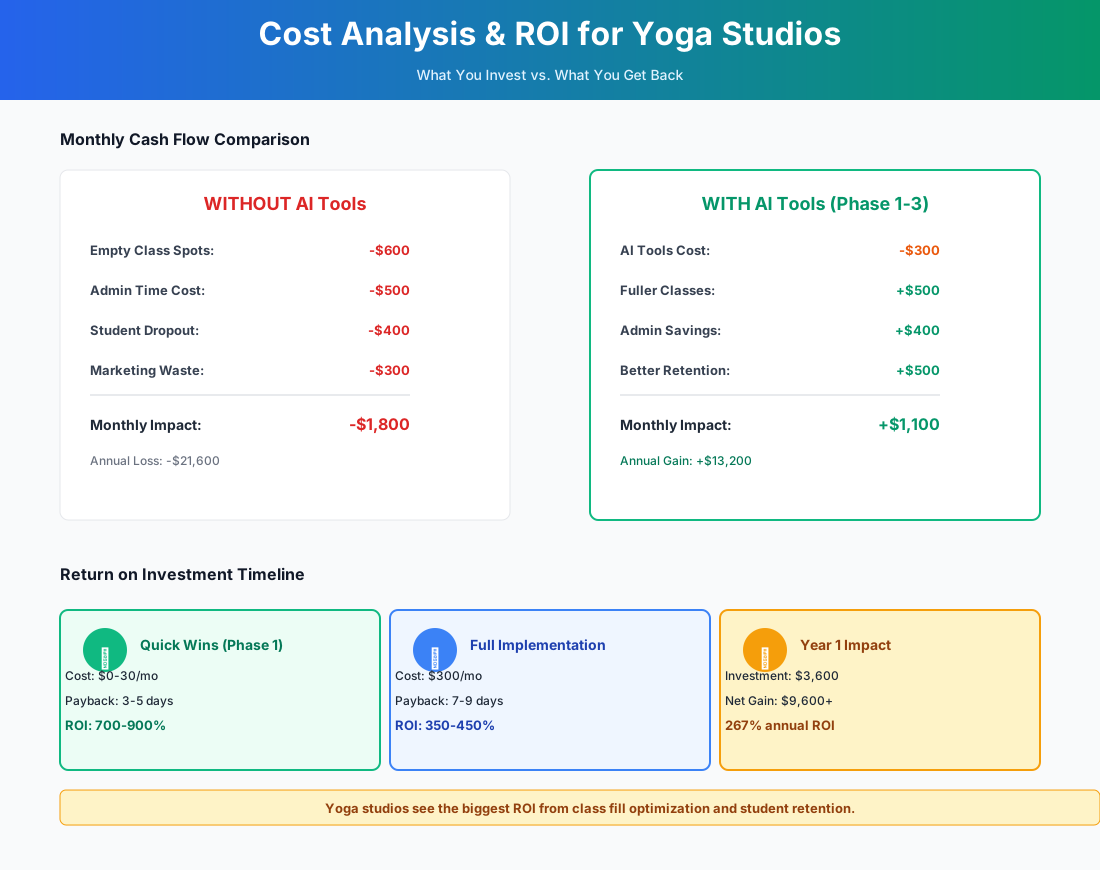
Here's a breakdown of the costs and expected returns:
Frequently Asked Questions
Can AI handle Mindbody's Clients At Risk scoring if I'm on the Starter plan ($139/month)?
No. Clients At Risk requires Mindbody's Accelerate tier ($279/month) or higher. If you're on Starter or Essential, you have three options: upgrade (the retention savings usually justify the difference), switch to WellnessLiving ($149/month Pro tier includes Isaac AI), or replicate it manually. The manual version: pull a Mindbody attendance report weekly and flag anyone who hasn't visited in 14+ days. Takes about 20 minutes. Not glamorous, but it works until you're ready to upgrade.
How do I handle ClassPass students in my Klaviyo automations without wasting the sequence on visitors who will never convert?
This is a real tension. ClassPass pays $9–$14 per visit versus $18–$25 from direct members, and ClassPass users are notoriously difficult to convert to direct memberships. In Klaviyo, create a segment exclusion rule: tag ClassPass visitors in Mindbody (most studios already do this for tracking), sync that tag to Klaviyo, and exclude it from your welcome sequence. Then build a separate one-email ClassPass-specific flow that shows them why a direct membership is cheaper per class than burning ClassPass credits. Convert the convertible — don't waste sequence emails on the rest.
What happens to my Tidio chatbot when I update my class schedule seasonally?
Tidio's Lyro AI doesn't auto-sync with Mindbody or Glofox. Change your summer schedule and the chatbot will still quote your winter times until you update its knowledge base manually. The fix: set a calendar reminder for each seasonal schedule change (most studios shift 2–4 times per year) to update Tidio's FAQ content. Takes about 15 minutes. Alternatively, instead of hard-coding class times into Tidio, configure responses that link to your live schedule page: "Here's our current schedule — it updates in real time: [link]."
Will recording classes for on-demand create legal issues with my independent contractor instructors?
Yes, and most studios overlook this until it becomes a dispute. Your standard independent contractor agreement almost certainly doesn't cover the right to record, distribute, and monetize an instructor's likeness and teaching content. Before recording any classes, you need a content release addendum specifying: which classes may be recorded, whether the instructor receives additional compensation, who owns the content if the instructor leaves, and whether the instructor can use the same recordings on their own platforms. Many studio lawyers recommend a flat per-recording fee ($25–$75) or a small revenue share (5–10%) to avoid disputes later. Get this signed before you hit record.
My instructors are independent contractors — does using AI scheduling tools risk reclassifying them as employees?
Legitimate concern. The IRS uses a multi-factor test for worker classification, and one key factor is behavioral control — how much you direct when, where, and how work is done. Using AI to auto-assign subs or optimize instructor scheduling could support an argument that you're exercising employer-level control. The safe approach: use AI tools for availability matching and sub-request distribution, but let the instructor accept or decline. Never auto-confirm a contractor for a class without their explicit opt-in. If this is a real concern for your studio, a $300–$500 consultation with an employment attorney familiar with the fitness industry is usually worth it.
Is AI going to replace my front desk staff?
No. And anyone telling you it will is selling something. What it does is handle the repetitive, low-judgment work — FAQ answering, schedule lookups, payment reminders — so your front desk person can focus on the things that actually require a human: welcoming first-timers, handling complaints, building the relationships that make people renew. The studios that do this well end up with more engaged front desk staff, not fewer.
The yoga studio that builds lasting community isn't the one with the nicest lobby or the most Instagram followers. It's the one whose owner is actually present — teaching, developing instructors, talking to members — because the administrative work that used to eat their mornings is handled.
The table at the top of this guide shows what the gap looks like between a typical studio and a well-optimized one. That gap closes one system at a time, starting with the follow-up email you're not currently sending.
More AI Implementation Guides
AI Closer & Automation for Gyms & Fitness Studios
AI closer software, automation & churn tools for gyms and fitness studios. Follow up leads in seconds, cut member churn, save 20+ hrs/week — setup steps inside.
AI Receptionist for Martial Arts Schools (Top Picks)
AI receptionist for martial arts schools: capture every after-hours trial-class call, cut no-shows 40%, automate billing. See top picks & pricing inside.
AI Tools for Breweries: The 2026 Owner's Playbook
The best AI tools for breweries in 2026: cut TTB compliance time, tighten COGS, streamline taproom scheduling, and target release marketing — starting free.
AI Tools for Bookkeeping Services: 2026 Guide
Best AI tools for bookkeeping services in 2026: Automate categorization, reconciliation, and document chasing without hiring extra staff.
AI Tools for Marketing Agencies: 2026 Playbook
The best AI tools for marketing agencies in 2026. A phased plan to kill Hell Week reporting, scale content, and fix billable utilization without new hires.
AI Tools for Home Health Care Agencies: 2026 Guide
A practical 2026 guide to AI tools for home health care agencies — HIPAA-safe automation for shift-filling, OASIS-E documentation, EVV, and claim denials.
Keep exploring
Browse the full library by industry or category, see every product we cover in the AI tools directory, or read the head-to-head comparisons.