
It's 5:47 AM and your spin instructor just texted: "Can't make it today — food poisoning." You're lying in bed, thumb-scrolling through your instructor group chat, firing off "Anyone free to cover the 6 AM?" into the void. Three dots appear. Disappear. Nothing. By 5:55 you're pulling on shorts, driving to the gym yourself, and leading a class you haven't prepped for — while 14 voicemails from yesterday's web leads sit untouched and that spreadsheet of at-risk members you've been meaning to call gathers another layer of digital dust.
This isn't a bad day. This is most days when you run a gym.
But here's the thing about gym economics that most "AI for small business" guides miss entirely: the missed leads and the instructor scramble are annoying, but they're not what kills independent fitness businesses. Churn is. Specifically, the slow, invisible kind — a member visits less often, stops booking classes, ignores your emails, and one Tuesday morning hits "cancel." You never saw it coming. And now you need to spend $65-$150 to acquire someone to replace them.
The tools in this guide are organized around that reality. Stop the leak first. Convert trials before worrying about phone call automation.
TL;DR — Top 3 Recommendations
- Start free today: Use ChatGPT/Claude to build cancellation save scripts, lead response templates, and a weekly social media calendar — saves 7-12 hours/week at $0 cost
- Invest $149/month next: GymLeads automates lead follow-up within seconds, converting 3-5 more members/month and paying for itself 10x over
- Reduce churn by 8-15 points: Activate your gym platform's AI churn prediction (Glofox At Risk Report or manual method) and pair it with an automated onboarding sequence via ActiveCampaign ($19/month)
Why Retention Math Hits Different at a Gym
Most service businesses worry about churn once a year. Gym owners should be watching it monthly — because the numbers compound in either direction faster than most owners realize.
Here's a benchmark table built from IHRSA industry data and operator surveys. Use it to see where your gym actually stands:
| Metric | Independent Gym Median | Boutique Studio Median | What "Good" Looks Like |
|---|---|---|---|
| Monthly churn rate | 3.5–4.5% | 4–6% | Under 2.5% |
| Trial-to-member conversion | 28–35% | 32–40% | 45%+ |
| Cost to replace one churned member (CAC) | $65–$110 | $90–$150 | — |
| First-90-day retention | 55–65% | 50–60% | 75%+ |
| Failed payment recovery rate | 15–25% | 10–20% | 40–60% |
The trial-to-member number is the one most owners underestimate. A studio running 40 free trials per month at 30% conversion gets 12 new members. Push that to 45% — with better follow-up and a smarter onboarding sequence — and you get 18. Six extra members at $75/month is $450 in monthly recurring revenue from the same marketing spend. No new ads. No price changes. Just better follow-through.
Everything below is aimed at moving those numbers.
If you also run yoga classes or a dedicated yoga program, the class scheduling and retention advice in our AI tools guide for yoga studios overlaps significantly — worth reading alongside this.
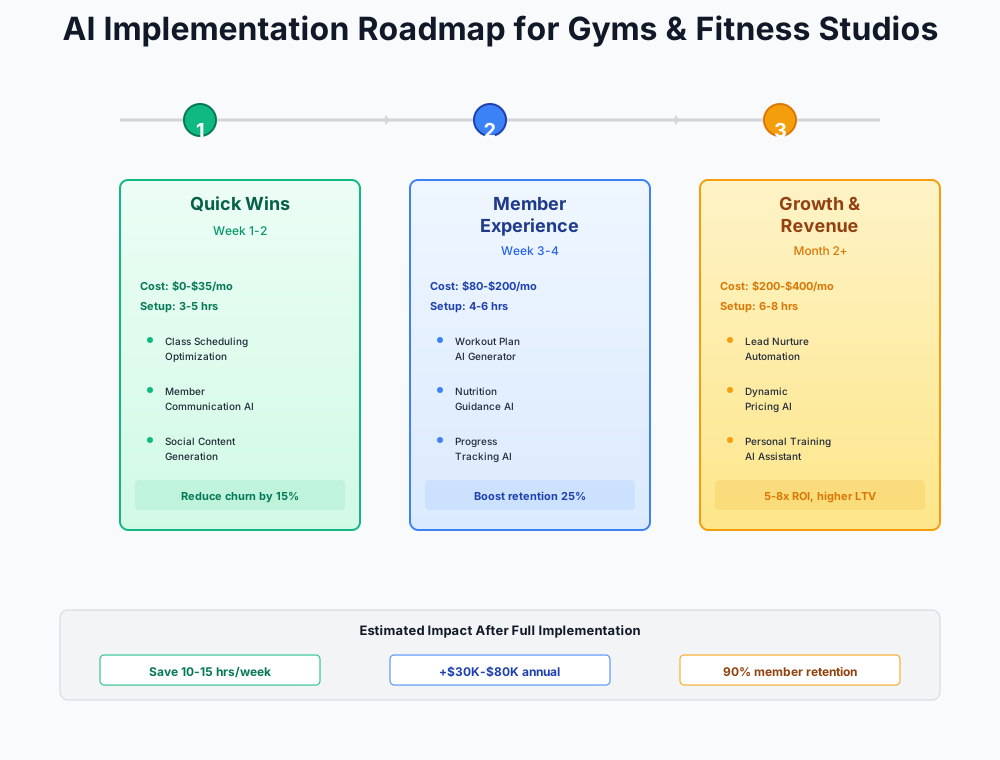
Here's a visual overview of the implementation approach:
Quick Wins: What You Can Build Today for Free
These require nothing more than a free ChatGPT or Claude account and your existing gym management software. Set aside 4-6 hours this week and you'll save 10+ hours every week going forward.
The Three Conversations Your Staff Is Winging
Every gym has the same three conversations that go poorly because staff improvise them every time: the lead follow-up call, the cancellation save, and the lapsed member re-engagement text. AI can write all three scripts in under an hour. The staff training takes another 15 minutes.
Write a cancellation save conversation script for gym front desk staff. The member says they want to cancel because they're not using the gym enough.
Include:
- An empathetic opening (no guilt-tripping)
- 3 diagnostic questions to uncover the REAL reason (time? intimidation? boredom? money?)
- 3 save offers matched to each reason:
- Time issues → membership freeze for up to 3 months
- Intimidation → free personal training intro session
- Money → downgrade to off-peak membership at $[X]/month
- A graceful close if they still want to cancel (ask for feedback, leave door open)
Our gym offers: [LIST YOUR MEMBERSHIP TIERS, FREEZE POLICY, AND ANY CURRENT PROMOTIONS] Tone: warm, understanding, zero pressure
Print it. Laminate it. Put one at every front desk station. Then run a 15-minute role-play session with your staff — the script is worthless if they've never practiced it. Gyms that train staff on save scripts recover 2-3 cancellations per month, worth $1,200-$3,600/year in retained membership revenue per save.
Write 3 text message templates for responding to new gym leads within 60 seconds:
- Web form inquiry (someone submitted interest on our website)
- Social media DM (someone messaged us on Instagram asking about membership)
- Google/Yelp lead (someone found us through a review and called/emailed)
Each template should:
- Be under 160 characters (one SMS)
- Include the lead's first name as [NAME]
- Mention a specific next step (book a tour, try a free class)
- Feel personal, not automated
- End with the staff member's first name
Our gym name: [YOUR GYM NAME] Our best intro offer: [FREE CLASS / FREE WEEK / DISCOUNTED FIRST MONTH]
Save these as text replacement shortcuts on your phone (iPhone: Settings → General → Keyboard → Text Replacement). When a lead notification pops up, any staff member can fire off a personalized response in under 60 seconds — no typing required. Faster response alone improves lead conversion by 10-20%, and the 3-5 hours a week you stop spending writing from scratch compounds fast.
From 5-10 Hours to 30 Minutes on Social Media
Most gym owners spend 5-10 hours per week on social media and still post inconsistently. The fix isn't posting more — it's batching your content creation into one 30-minute session per week.
Create a 7-day Instagram content plan for [GYM NAME], a [BOUTIQUE STUDIO / TRADITIONAL GYM] in [CITY].
For each day, provide:
- Post type (Reel, carousel, single image, Story)
- Caption under 150 words
- 5 relevant hashtags mixing local and fitness tags
Weekly content mix:
- Monday: Workout tip or exercise tutorial (educational)
- Tuesday: Member transformation or spotlight (social proof)
- Wednesday: Behind-the-scenes or instructor feature (personality)
- Thursday: Class promotion or schedule highlight (CTA)
- Friday: Fun/motivational content or gym culture moment (engagement)
- Saturday: Weekend class energy or community event (FOMO)
- Sunday: Recovery tip, nutrition advice, or weekly preview (value)
Tone: energetic but authentic. Avoid clichés like "no excuses" or "beast mode." Sound like a real person, not a motivational poster.
This week's special events/promos to work in: [ANY UPCOMING EVENTS, CHALLENGES, OR PROMOTIONS]
Pair this with Canva's free tier for graphics. Search "Instagram fitness" in Canva's template library, pick one style for the week, and batch-create all 7 visuals in 20 minutes. Schedule them using Instagram's built-in scheduler (free) or Later's free plan.
Consistent posting generates 3-5x more inbound leads. Even two extra memberships from better social presence — $100-$200 in recurring revenue — pays for the Canva subscription five times over.
Fix the Saturday Morning Sub Scramble for Free
If you're still building schedules in Google Sheets and hunting for class subs via group text, Homebase's free tier is the single most impactful change you can make this week.
Homebase
Best for: Single-location gyms with mixed staff types
Free scheduling, time clock, and shift-swap platform designed for hourly workers. Handles the mix of W-2 employees and per-class contractors common in gyms. Staff manage availability and swap shifts through the mobile app — no more group text chaos.
Setup takes 2 hours including getting all staff to download the app — do this during a staff meeting, not by emailing them a link and hoping. Enable shift swap requests immediately. This is the feature that eliminates the 5:47 AM scramble: check the app, not 12 group texts.
Once staff are in the app, you'll save 3-5 hours a week on schedule building and catch overtime violations before they become a $500-$1,500/month labor cost problem.
If you run a martial arts school or any class-based studio alongside your gym, Homebase works across all of them under one location.
ROI Snapshot
Monthly Cost
$0/mo
Time Saved
10hrs/week
Monthly Value
$3,000
ROI
Infinity%
Converting More Trials and Stopping Churn Before It Starts ($150-$500/month)
With the free tools running, you've freed up 10+ hours per week. Now invest that time — and a modest budget — into tools that directly improve trial-to-member conversion, catch at-risk members early, and push personal training revenue higher.
The Lead That Books a Tour at Your Competitor
Your front desk is checking in members, answering phones, selling smoothies, and processing freeze requests. A web lead comes in at 2:15 PM. Nobody sees it until 4:30 PM. By then, that person has already booked a tour at the CrossFit box down the street that texted them back in 90 seconds.
That's not an exaggeration. The data on lead response time is brutal: responding within 5 minutes converts at 9x the rate of responding after 30 minutes. Most independent gyms respond in 4-24 hours.
GymLeads
Best for: Gyms spending $500+/month on ads without proper lead tracking
Gym-specific lead CRM with instant automated follow-up sequences, lead source attribution, and direct integration with Mindbody, Glofox, Zen Planner, and PushPress. Finally see which marketing channel actually produces members — not just leads.
Connect your Meta Ad account and website form first — these are where 60-70% of leads originate. Then customize the follow-up sequence:
- Immediate text (within 30 seconds): "Thanks for checking us out! Here's a link to book a free tour this week → [LINK]"
- 1-hour email: Class schedule overview, pricing, and a member testimonial
- Day 2 text: "Still interested? We have tour spots open today at [TIME]"
- Day 5 email: Member success story with a limited-time intro offer
The lead source attribution alone is worth $149/month. Most gym owners cannot tell you whether their Google Ads or Meta Ads produce more paying members — only which produces more clicks. GymLeads closes that gap so you stop burning budget on channels that generate leads but not members.
For most gyms, GymLeads converts 3-5 more members per month — $2,000-$6,000 in new recurring revenue at a $149/month cost. The 4-6 hours your front desk stops spending on manual follow-up is the bonus.
Catching the Members Who Are Already Halfway Out the Door
Most gyms only discover a member is leaving when they call to cancel. At that point, your save rate is under 20%. But the behavioral signals show up 4-6 weeks earlier — visit frequency drops, booking pattern changes, payment issues, class engagement decline. The problem is that almost nobody is watching.
If you're on ABC Glofox (Boost or Elite tier), you already have access to a machine learning "At Risk" report that analyzes 16+ behavioral signals across 41 million global member profiles to classify each member as low, medium, or high churn risk.
ABC Glofox (At Risk AI Report)
Best for: Boutique studios and gyms wanting built-in AI retention
Built-in ML churn prediction using 16+ data points from 41M+ member profiles. Identifies at-risk members weeks before cancellation. Available on Boost and Elite tiers. Includes scheduling, billing, member app, and CRM.
Make this a Monday morning ritual: pull the At Risk report, filter for "High Risk," check each flagged member's profile — what classes did they attend? When did they last come in? Then draft a personal text using this prompt:
Write a warm, personal re-engagement text message for a gym member named [NAME] who:
- Used to attend [CLASS TYPE] on [DAY] regularly
- Hasn't visited in [X] days
- Their stated fitness goal when they signed up was [GOAL]
The message should:
- Reference their specific class/habit (not generic)
- Acknowledge life gets busy without being preachy
- Offer one specific incentive to come back this week: [CHOOSE: complimentary smoothie, free buddy pass, complimentary PT assessment, reserved spot in their favorite class]
- Be under 160 characters if possible (one SMS)
- Sound like it's from a real person who noticed they're missing, not a system
Sign it from [STAFF NAME], [ROLE]
Assign one staff member to contact 5-10 at-risk members every Monday. Text beats email here — 98% open rates versus 20%. The 14-day inactivity mark is your intervention window. By 30 days without a visit, it's often too late.
Not on Glofox? Build a manual version: export member visit data monthly from your platform, sort by "days since last visit," and flag anyone past 14 days. It takes 30 minutes per week and captures 70% of the value of the AI version.
Saving 5-10 members per month from canceling — at $50-$100/month each — puts $3,000-$8,000 back into retained revenue every single month. A member you saved in January keeps paying through December.
More Personal Training Revenue Without More Trainers
Personal training is your highest-margin service — 60-75% gross margin — but trainers spend 60-90 minutes per client designing programs manually. That caps how many clients they can serve. Cut design time to 10-15 minutes and the same two trainers can run more sessions and actually have bandwidth to prospect new clients.
ABC Trainerize
Best for: Gyms with 2+ trainers wanting standardized programming
AI Workout Builder generates personalized programs from client goals, fitness level, and equipment access. Includes exercise demo videos, progress tracking via client app, and integration with Mindbody and Glofox. Trainers review and customize AI suggestions — it assists, never replaces.
Start with a 2-trainer pilot. Have each trainer pick 2-3 existing clients and enter their assessment data into Trainerize. The AI generates a multi-week program in minutes — the trainer's job is to review every suggestion, adjust for injuries and preferences, and add their professional judgment. AI handles the template; the trainer adds the expertise.
Every 75 minutes saved per trainer per week is one more session they can run. At $60-$100/session, two trainers running two extra sessions a week adds $2,000-$5,000/month in training revenue. The tool costs $19.80.
ROI Snapshot
Monthly Cost
$319/mo
Time Saved
15hrs/week
Monthly Value
$6,800
ROI
2032%
Full Automation: Running Without Daily Staff Intervention ($300-$800/month)
Deploy these after the earlier tools are delivering measurable results. You'll need that baseline data — and confidence in your configurations — before investing at this level.
The Revenue Leak Nobody Talks About
Failed credit cards are the quiet budget killer. For a 500-member gym billing $75/month average, 3-8% failure rates mean $1,125-$3,000 disappearing every single month. Your platform sends one email and gives up. Staff avoid the awkward phone call. The member churns silently over a billing issue, not a fitness issue.
Churn Buster
Best for: Gyms processing payments through Stripe
Multi-step dunning automation that retries failed cards at AI-optimized intervals, sends personalized SMS/email recovery sequences, and provides a frictionless payment update page. Recovers an average of 15% of soft declines silently — before the member knows there was an issue. Only costs a percentage of what it actually recovers.
The percentage-of-recovered-revenue pricing is what makes this a straightforward decision. You only pay Churn Buster a cut of revenue it recovers — money you would have lost entirely without it. Configure a 5-step sequence:
- Day 0: Smart card retry at AI-optimized time
- Day 1: Friendly text with one-tap payment update link
- Day 3: Email with payment update page
- Day 7: Text with soft urgency
- Day 14: Final notice with manager contact
The tone matters enormously here. Most failed payments are accidental — expired cards, bank flags on recurring charges. Your messages should sound like a helpful friend, not a collections agency. Recovering 40-60% of those failed payments — $1,500-$4,000/month, or up to $48,000/year — is money you'd have lost entirely. Your front desk also stops spending 2-4 hours a week making uncomfortable payment calls.
The Onboarding Sequence That Cuts First-Year Dropout
Half of all gym quitters leave within their first six months. Poor onboarding is the primary reason. A key fob and a quick walk-around isn't onboarding — it's abandonment with a nice welcome mat.
ActiveCampaign
Best for: Gyms wanting behavior-triggered email and SMS automation
Marketing automation with visual workflow builder, SMS integration, and AI-powered subject line optimization. Connects to Mindbody, Glofox, Zen Planner, and WellnessLiving via Zapier. Build once, runs forever.
Connect ActiveCampaign to your gym platform via Zapier. The trigger: "New member created" → member enters the onboarding automation. Here's the sequence:
- Day 1: Welcome email + link to book a gym orientation or intro class
- Day 3: "Here are our 3 most popular classes this week — book your first one here"
- Day 7: Text — "How's your first week going? Reply if you need anything"
- Day 14: Email — beginner workout guide (create this PDF once)
- Day 21: Text — "We noticed you haven't tried [CLASS TYPE] yet — it's perfect for [THEIR GOAL]"
- Day 30: Email — 30-day check-in with progress encouragement
- Day 60: Email — member success story + personal training intro offer
- Day 90: Text — "You've been with us 90 days! Here's a guest pass to bring a friend"
Add a conditional branch: if a member hasn't checked in within 10 days of joining, trigger an immediate "We miss you" text with a personal outreach offer. This catches members who signed up on a wave of motivation but never built the habit.
Cut first-90-day churn by 15-25% and you're keeping 3-8 extra members per month — $600-$1,200 apiece in annual lifetime value. The sequence costs $19/month and runs forever without anyone touching it.
Review Velocity and What It Does to Conversion
Gyms with 100+ Google reviews convert 35% more website visitors into leads than those with fewer than 10 reviews. If your gym has 25 reviews from 2023, prospective members are choosing your competitor with 150 recent reviews — even if your gym is objectively better.
Start free: create a Google review short link, print it as a QR code on a small card, and train staff to hand it to members after class. "Glad you enjoyed HIIT today — would you mind leaving us a quick Google review? It really helps us." The personal ask converts 5-10x better than automated requests.
For gyms ready to invest, Podium automates review requests after positive interactions and uses AI to draft review responses within hours.
Ten new reviews a month, sustained over six months, does more for your Google ranking than most ad spend. That 35% lift in website conversion compounds every month as your count grows.
Two Problems Unique to Class-Based Fitness
Generic "AI for small business" advice never touches these, but they're worth their own section.
Building a Sub Matrix (So 5 AM Stops Being a Crisis)
Last-minute instructor cancellations hit 10-15% of class instances. When a class gets cancelled, members don't just miss one workout — they question whether they can rely on your schedule at all. It's a top reason members cite when canceling.
Homebase's shift-swap feature handles the mechanical part. The real upgrade is building a sub preference matrix so anyone managing the schedule knows immediately who to call.
I run a fitness studio with these group classes and instructors:
Classes: [LIST YOUR CLASSES - e.g., Spin, HIIT, Yoga Flow, Pilates, Barre, Strength] Instructors: [LIST INSTRUCTORS AND WHAT THEY'RE CERTIFIED TO TEACH]
Create a substitution matrix that shows:
- For each class, rank the qualified subs in priority order based on certification, teaching style compatibility, and member experience consistency
- Flag any classes where we have only 1 qualified instructor (single point of failure)
- Suggest cross-training opportunities where an instructor could get certified in one additional format to reduce our sub vulnerability
Format as a table I can print and post in the staff room.
This matrix turns panicked 5 AM scrambles into a systematic process: check the matrix, contact Sub #1, then Sub #2. If your spin instructor calls out, you're not texting 12 people — you're texting 2.
Empty Seats Are Paid Instructor Time, Going Nowhere
If you're paying $40 per class and running at 50% capacity, you're burning $20 per empty seat per class. With 25 classes per week, that's $500/week in underperformance. Most gym platforms show you fill rates — they just don't tell you what to do about them.
Here is my gym's class schedule data for the past 4 weeks:
[PASTE YOUR CLASS ATTENDANCE DATA - class name, day, time, capacity, average attendance]
Analyze this data and recommend:
- Which classes should be moved to different time slots (attendance below 50% capacity consistently)
- Which classes should be added (time slots with no classes but high check-in traffic nearby)
- Which classes are candidates for elimination (below 40% for 4+ weeks with no upward trend)
- Where dynamic waitlist pricing could work (classes consistently at 90%+ — charge a premium waitlist spot fee)
- Seasonal adjustments to consider for the next quarter
Assume instructor cost is $[X] per class and our break-even point is [X] members per class.
This is the kind of analysis that consultants charge $2,000 for. You can run it monthly in 15 minutes with your actual data.
Where Gym Owners Commonly Go Wrong
Don't start with an AI phone receptionist. Tools like Replify ($200-$500+/month) are legitimate, but they're premature if your lead follow-up is broken. GymLeads at $149/month yields 3-5x more ROI as a first investment. Fix the fundamentals before adding layers.
Don't buy Keepme as a single-location gym. Keepme is built for multi-location operators with custom enterprise pricing. A single-location studio gets 80% of the retention benefit from Glofox's built-in At Risk report plus personalized outreach with ChatGPT. Save Keepme for when you open location #2 or #3 — and when that day comes, the Keepme vs Glofox comparison is a useful read for understanding where the dedicated retention engine pulls ahead.
Don't invest in AI video content production yet. At $286-$969/month, tools like Hyperhuman are built for gym chains producing volume content for on-demand libraries. Phone-recorded workout clips edited in CapCut (free) outperform polished AI video on social media. Authenticity wins on Instagram and TikTok right now.
Don't automate the cancellation conversation itself. Automate everything before the cancel request — churn prediction, re-engagement texts, onboarding sequences. But when a member asks to cancel, a trained human with the script from earlier should handle it. That conversation is your highest-leverage retention moment and the one place where a chatbot will make things worse.
Don't market "AI personal training" as a trainer replacement. AI workout generators assist trainers by cutting program design time 75%. Members pay $60-$100/hour for the human relationship, accountability, and in-person form correction. Use AI to make trainers more efficient, not to eliminate them — and never put that positioning in front of members.
Your First Two Weeks
- Sign up for free ChatGPT or Claude account — generate cancellation save script, 3 lead response templates, and 5 Google review response templates (Day 1, 1-2 hours)
- Print and laminate scripts — place at every front desk station and run a 15-minute role-play training with staff (Day 2)
- Save lead response templates as text replacement shortcuts on your phone and your front desk staff's phones (Day 2, 15 minutes)
- Generate your first weekly social media content calendar and batch-create 7 Canva graphics (Day 3, 45 minutes)
- Sign up for Homebase free tier and add all staff — do app downloads during a staff meeting (Day 4-5, 2 hours)
- Build next week's schedule in Homebase and enable shift-swap requests (Day 5-6)
- Pull your first churn risk report: export member visit data, sort by days since last visit, flag anyone at 14+ days (Day 7, 30 minutes)
- Contact your top 10 at-risk members via personal text using AI-drafted messages (Day 8)
- Evaluate paid tools: sign up for GymLeads and Trainerize free trials (Day 10)
- Schedule a monthly review: track lead response time, conversion rate, churn rate, and content consistency (Day 14)
Start with item #1 today. The scripts alone will save your front desk 3-5 hours this week and potentially recover 2-3 memberships that would have walked out the door.
Frequently Asked Questions
Can AI churn prediction actually work with fewer than 500 members?
Yes, but the manual method is nearly as good at that size. Glofox's At Risk model trains on 41 million member profiles globally, so your gym's headcount doesn't limit accuracy — it draws from industry-wide patterns. With fewer than 200 active members, sorting your platform export by "days since last visit" and flagging anyone past 14 days costs nothing and captures 70% of the value. The real question isn't data volume: it's whether you'll act on the flags. A perfect prediction sitting in a dashboard unread is worth zero.
How do I handle W-2 vs. 1099 instructor classification when using scheduling software?
This is the compliance question most gym tech advice ignores. Scheduling software doesn't change a worker's classification, but how you use it can create reclassification risk. Setting mandatory shift times, requiring app clock-ins, and dictating work methods for someone classified as 1099 is exactly the kind of behavioral control the IRS looks for — and fitness businesses get heavy scrutiny on this. For contractors, use Homebase to coordinate availability and shift-swaps, but avoid features that track hours or enforce clock-in times. If you have a mixed W-2/1099 workforce, talk to an employment attorney. The cost of misclassification (back taxes, penalties, benefits owed) dwarfs any software savings.
What happens to my automated sequences when a member freezes their membership?
Most gyms find this out the hard way. A member freezes their account but stays in your ActiveCampaign onboarding sequence — so they keep receiving "We miss you!" texts that make it obvious your outreach isn't actually personal. Fix: build a "Frozen Member" tag in ActiveCampaign and add a conditional rule that exits any active automation when a member's status changes to frozen. When they reactivate, trigger a separate "Welcome Back" sequence instead. Check that your Zapier integration includes freeze/unfreeze status updates — many default setups don't pass that field through.
Do GLP-1 drugs like Ozempic change how I should use AI for member engagement?
Honestly, yes — and most gym owners aren't adapting fast enough. Members on GLP-1 medications are losing weight pharmacologically and typically come to the gym for muscle preservation and metabolic health, not aesthetic goals. If your AI-generated content and re-engagement messages are all "crush your weight loss goals!" framing, you'll alienate a growing segment of your membership. When drafting content prompts, specify messaging that focuses on strength, energy, mobility, and overall health. This also creates a legitimate personal training upsell: "strength training while on GLP-1" programming is a niche your trainers can own before a competitor does.
My gym platform already has email marketing. Why do I need ActiveCampaign?
Built-in email tools on Mindbody, Glofox, and most gym platforms are fine for newsletters — holiday hours, January specials. What they can't do is behavior-triggered automation: "This member joined 14 days ago and hasn't booked a class → send this specific text." That distinction is everything. ActiveCampaign's visual automation builder, SMS integration, and conditional branching based on member activity is what turns a generic email into a retention machine. If you're only sending announcements, your platform's email tool is fine. If you want a 30/60/90-day onboarding sequence that runs itself and adapts based on what members actually do, you need a dedicated automation tool.
How do I know if these tools are actually working?
Five numbers, measured monthly: (1) Lead response time — target under 5 minutes for automated first response; (2) Trial-to-member conversion rate — target 35-45% of tours; (3) Monthly churn rate — target under 2.5%; (4) Failed payment recovery rate — target 40-60%; (5) First-90-day retention — target 70-80%. Pull these from your gym management platform and GymLeads. If a number isn't moving after 60 days, the tool usually isn't the problem — it's the configuration or the lack of staff follow-through on the recommendations. Dig into setup before blaming the software.
The gym texting a lead back in 90 seconds, flagging at-risk members 4 weeks early, and recovering $3,000/month in failed payments isn't running some sophisticated AI stack. They're using the tools listed above, set up in roughly this order, for roughly these costs. The gap between that gym and yours is about 6 hours of setup time.
Start with the checklist. Step 1. Today.
More AI Implementation Guides
AI Receptionist for Martial Arts Schools (Top Picks)
AI receptionist for martial arts schools: capture every after-hours trial-class call, cut no-shows 40%, automate billing. See top picks & pricing inside.
AI Tools for Yoga Studios: 2026 Implementation Guide
The best AI tools for yoga studios in 2026. Automate follow-ups, cut admin hours in half, recover failed payments, and convert more trial students into members.
AI Tools for Bookkeeping Services: 2026 Guide
Best AI tools for bookkeeping services in 2026: Automate categorization, reconciliation, and document chasing without hiring extra staff.
AI Tools for Marketing Agencies: 2026 Playbook
The best AI tools for marketing agencies in 2026. A phased plan to kill Hell Week reporting, scale content, and fix billable utilization without new hires.
AI Tools for Home Health Care Agencies: 2026 Guide
A practical 2026 guide to AI tools for home health care agencies — HIPAA-safe automation for shift-filling, OASIS-E documentation, EVV, and claim denials.
AI Tools for Dermatology Practices: 2026 Guide
The best AI tools for dermatology practices in 2026 — cut prior-auth hours, reduce no-shows, and grow your cosmetic line, with a HIPAA-first rollout plan.
Keep exploring
Browse the full library by industry or category, see every product we cover in the AI tools directory, or read the head-to-head comparisons.