
When a homeowner's tank backs up into the basement at 9 p.m., they don't leave a voicemail and wait. They Google "septic pumping near me," and they call the first three results until a human — or something that sounds like one — picks up. Whoever answers gets a $400 to $1,200 emergency job that the customer is in no mood to price-shop. Whoever sends them to voicemail gets nothing. That one shift in customer behavior — the collapse of patience, the assumption that someone is always reachable — is quietly deciding which septic companies grow and which ones plateau.
Closing that gap doesn't require hiring a night dispatcher or paying an answering service $800 a month anymore. AI call-answering, septic-specific scheduling software, and route optimization have gotten cheap enough and good enough that a two-truck shop can run all three for under $400 a month. Used right, they recover emergency jobs you're currently losing, resurrect the pump-due customers rotting in your old invoices, and claw back 10 to 18 hours a week of owner and office time.
This guide is a phased plan, not a tool dump. It stays out of the tank — AI never touches the licensed, regulated work — and lives on the phone and in the office, where the real leaks are.
TL;DR — Start Here
- Stop losing after-hours emergency calls with an AI answering agent like Trillet AI ($49/mo) that screens "backing up into the house" from a routine pump request.
- Build a pump-due recall list from your old invoices using a free spreadsheet plus ChatGPT or Claude — this one step usually pays for the entire toolkit.
- Move to septic-specific software (SepticCycle at $149/mo flat, or PumpDocket from $99/mo) that automates recalls, routing, and EPA 40 CFR Part 503 compliance paperwork.
Understanding Your Septic & Sewer Business
You run a route business dressed up as an emergency business. Roughly 21% of U.S. households aren't on municipal sewer, and every one of those tanks fills on a 3-to-5-year clock whether anyone's paying attention or not. That makes your revenue theoretically predictable — a residential pump-out runs about $400 to $500, a grease trap or commercial job $400 to $1,200 — but only if you actually call people back when they're due. Most shops don't. The pump-due recall is the single biggest lost-revenue leak in the industry, and it's almost always "managed" by a spreadsheet nobody updates or by nothing at all.
Meanwhile, a single vacuum truck realistically completes 4 to 8 pump-outs a day, so drive time between stops is your real throughput ceiling. Build routes by memory and geography each morning and you'll run 5 stops; build them well and you'll run 8. The owner typically burns 40% of their time on admin and dispatch, another 25% fielding calls and quoting — which is exactly the work AI is now good at.
Then there's the part no other trade has to think about quite like you do: septage disposal and compliance. You're hauling to approved land-application or treatment sites at roughly $75 to $250 per 1,000 gallons (higher in some out-of-district or premium facilities), maintaining manifests and disposal logs, and reporting under EPA 40 CFR Part 503 plus a patchwork of state and county rules that varies wildly by jurisdiction. Net margins run 10% to 25%, so rising tipping fees and a single failed audit both hit the bottom line hard. Add a CDL requirement for the truck, state installer/inspector licensing that costs $1,500 to $4,000 per tech in year one, and turnover north of 30%, and you have a business where every hour of owner time is precious. The whole point of what follows is to give those hours back.
Watch Out
AI belongs in the office and on the phone — not in the tank. Point-of-sale inspections, drain-field diagnoses, and system pass/fail determinations carry real legal and safety weight. AI can turn a licensed inspector's field notes into a clean report in two minutes, but the inspection and the judgment stay human and licensed. Keep that line bright.
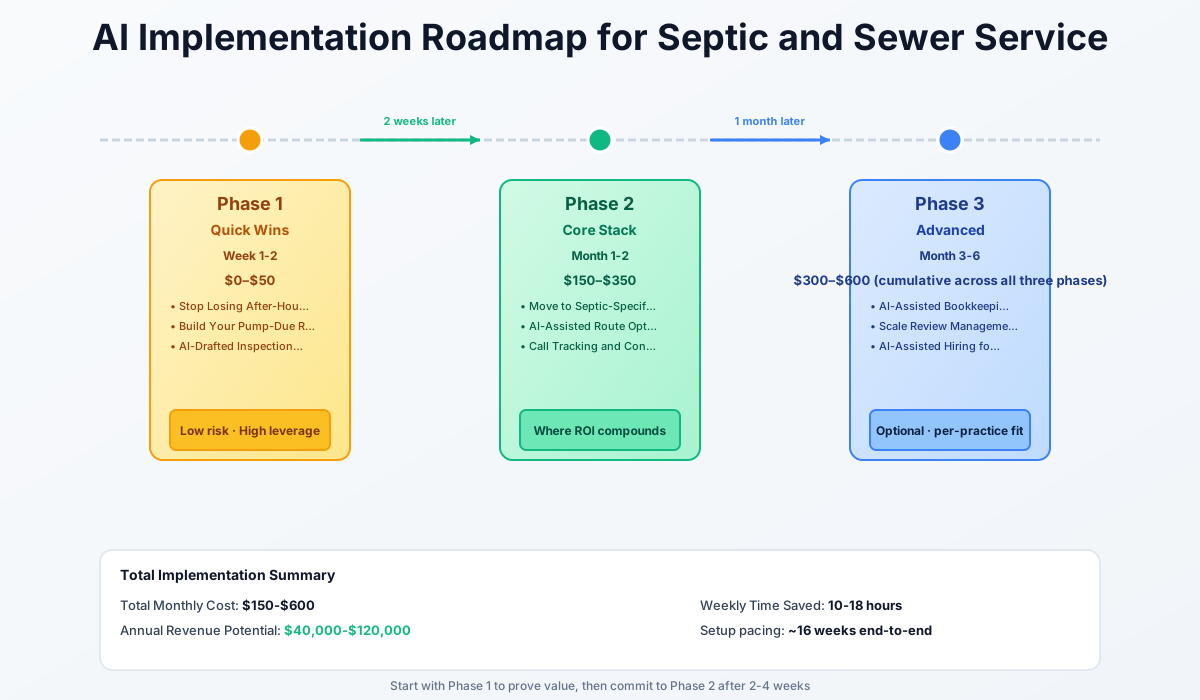
Here's a visual overview of the implementation phases:
Phase 1: Quick Wins (Week 1–2)
Everything in this phase is free or under $50/month. The goal is to stop losing jobs you're already paying to generate before you spend a dollar on new software. Total setup time: 3 to 5 hours.
Quick Win #1: Stop Losing After-Hours Emergency Calls
A missed emergency call is a lost $400 to $1,200 job, and emergencies are the least price-sensitive, highest-margin work you'll ever get. Right now those calls hit voicemail or the owner's cell after hours — and at a typical shop, 20% to 40% of after-hours calls go unanswered. Every single one is a gift to your competitor down the road.
Fix it in two steps. First, forward your business line to a free Google Voice number for one week just to see your missed-call volume and timing — most owners are genuinely shocked by how many calls land between 6 p.m. and 8 a.m. Then stand up an AI answering agent that picks up 24/7, screens emergencies from routine pump requests, and texts you the moment a real emergency comes in.
Trillet AI
Best for: Single- to few-truck shops losing after-hours calls
An AI voice agent with a dedicated septic-services use case. It distinguishes "my tank is backing up into the house" (emergency — escalate now) from "I think I'm due for a pump-out" (routine — book it), can book straightforward jobs into your calendar on its own, and fires an urgent-call SMS to the owner and a backup tech when it can't close the job itself. $0.20/minute after the included 150 minutes, no contracts, 28-day money-back guarantee.
Alternatives worth knowing. If you want a human safety net rather than pure AI, Smith.ai has a free tier (25 calls/month) and escalates complex or upset callers to live agents on higher plans — though it gets expensive fast at volume. And if you're already running Jobber or Housecall Pro, their native AI receptionists (Jobber AI Receptionist from $29/mo as an add-on — 30 conversations included, $0.79 each after, unlimited on the Plus plan; Housecall Pro CSR AI, priced on request) book directly into the schedule you already use with zero integration work. We cover the standalone options in more depth in our guide to the best AI receptionists for small businesses, and the full price breakdown in how much an AI receptionist costs.
Setup steps:
- Forward your main line to a free Google Voice number for 7 days to measure missed-call volume and timing
- Start a Trillet AI free trial and connect it to your business number
- Write 3–4 example emergency phrases (backing up into house, sewage in yard, smell inside) so the AI knows what to escalate
- Set the urgent-call SMS alert to hit the owner's cell AND one backup tech
- Have a friend call and say 'my tank is backing up' to confirm it escalates correctly before you trust it
- Add one line to your voicemail greeting and website: after-hours calls are now answered immediately
Give it two full weeks before you judge it, but shops that run this well see 3 to 5 hours/week of owner time back and $2,000 to $6,000/month in recovered emergency and after-hours jobs — a 15x to 40x return on the $49/month tier.
Quick Win #2: Build Your Pump-Due Recall List (Before You Pay for Software)
This one costs nothing and is usually the biggest revenue opportunity hiding in the business. Nobody's tracking which customers are due for their 3-to-5-year pump-out. A customer worth $450 every few years gets treated like a one-time job because nobody calls them back — so they forget, and when the tank finally fills, they call whoever answers (see Quick Win #1, except now it's your competitor's customer).
Pull QuickBooks invoice history — or paper tickets, or memory, whatever you've got — into a free spreadsheet to build the recall list, then let ChatGPT or Claude draft the reminder messages. No software purchase required yet.
Setup steps:
- Export the last 3–5 years of invoices from QuickBooks: customer, address, tank size if known, last pump date
- Build a sheet: Customer | Address | Last Pumped | Tank Size | Next Due (last pumped + 3 years)
- Sort by Next Due; flag anyone overdue or due in the next 60 days — that's your call list starting tomorrow
- Use ChatGPT/Claude to draft the reminder text and postcard script (prompt below)
- Call or text the top 20 overdue accounts this week
Write a short, friendly reminder for a septic customer who is due for their routine pump-out. Our records show their last pump-out was about 3.5 years ago on a [tank size]-gallon tank. Write two versions: (1) a text message under 50 words, and (2) a postcard script under 70 words. Gently note that going too long between pump-outs risks a backup and a far more expensive repair, and make it easy to book — "reply or call [phone] to get on the schedule." Warm, local small-business tone, no scare tactics or pressure.
Common mistakes: Only pulling the last 12 months of records (go back 3 to 5 years to catch the overdue customers), and sending one blast then stopping — this needs to become a monthly habit, which is exactly what Phase 2 automates.
This step is free, and it routinely surfaces the single biggest revenue opportunity in the shop: 2 to 3 hours/week saved once the list exists, and $3,000 to $10,000/month in recovered recurring jobs as you work through it.
Quick Win #3: AI-Drafted Inspection Reports, Job Postings & Review Replies
Point-of-sale inspection summaries, CDL/tech job postings, and review responses each eat 15 to 45 minutes of writing time nobody has — so they get pushed to "later," and later often means never. That costs you real-estate referral business, hiring momentum, and your online reputation, three things a small shop can't really afford to lose.
ChatGPT or Claude — free tier is fine — with the three prompts below turns each one into a solid draft in under five minutes. The inspection prompt is the one to use first: faster point-of-sale turnaround is how you win repeat referrals from real-estate agents.
I'm a licensed septic inspector. Turn these raw field notes into a professional point-of-sale inspection summary that a real estate agent and a buyer's attorney can read and understand: "Tank 1000gal concrete, installed ~1998, scum layer 4in, sludge 9in, baffles intact, no cracks visible, drain field standing water near NE corner, distribution box ok, risers added 2015." Write it as a clear pass/fail-style summary with a plain-language recommendation a non-technician homebuyer can follow. Flag the drain-field standing water as the key concern. Do not invent findings I didn't note.
Write a 200-word Indeed job posting for a CDL Class B septic pump truck driver/technician at a small, family-owned septic company. Starting pay $22–26/hr depending on experience. We'll help pay for CDL training and state septic installer/inspector licensing if the candidate doesn't have it yet. Home every night (no long-haul), year-round work. Lead with the licensing-assistance benefit — CDL plus state licensing is the single biggest barrier candidates face. Practical tone, no corporate jargon.
Write a short, genuine reply to this 2-star Google review for my septic pumping company: "Technician was late and didn't explain the extra charge for the filter cleaning." Acknowledge the frustration, briefly explain that filter cleaning is an optional add-on noted on the invoice, apologize for the lateness, and invite them to call the office directly to resolve it. Under 80 words, not defensive.
One rule: always read the output before it goes out. These are drafts, not final copy — especially the inspection summary, which affects a real-estate transaction and must be checked against your actual findings.
It's free, and it's pure time savings: 2 to 4 hours/week back across inspections, hiring, and reputation, plus faster inspection turnaround and better job postings that help offset the 30%+ annual turnover this industry lives with.
Phase 2: Growth Accelerators (Month 1–3)
Phase 1 proved AI saves real hours and wins real jobs. Now invest in the systems that run the recall list automatically, optimize routes, and kill the double data entry between truck and office. Budget: $150 to $350/month, 6 to 10 hours of setup.
Growth Move #1: Move to Septic-Specific Software With Built-In Recall & Compliance
Your Phase 1 spreadsheet doesn't scale. Nobody updates it past month two, and hand-kept manifests and disposal logs leave real EPA 40 CFR Part 503 audit exposure sitting on a shelf somewhere. Generic field-service software won't bail you out either — it doesn't understand tank sizes, pump cycles, septage manifests, or state trip-ticket rules, and never will.
This is where the septic vertical genuinely diverges from every other trade, so the move is to migrate the recall list and compliance logging into software built specifically for septic operations — a septic-native tool, not a general FSM with a septic label slapped on.
SepticCycle
Best for: Compliance-heavy states; owners who want built-in AI help
Septic-specific business management — customer/property records, tank-by-tank scheduling, invoicing, contracts, and compliance tracking — with a built-in AI assistant powered by Claude that's trained on SepticCycle's workflows and Texas TCEQ/OSSF regulations. Ask it a compliance or how-to question in plain English and it answers like a knowledgeable clerk. Flat $149/month for unlimited users and customers, with a 90-day free trial and no credit card. Its regulatory knowledge is deepest for Texas today, so confirm your state's coverage before you lean on the auto-generated reports.
PumpDocket
Best for: 1–10 truck fleets that want 50-state compliant trip tickets
Dispatch and compliance software built specifically for septic, grease-trap, and portable-sanitation pumpers, with 50-state trip-ticket compliance and jurisdiction-cited manifests. Auto-generated trip tickets backed by cited compliance profiles cut manual manifest re-keying; it also auto-builds FOG (fats/oils/grease) manifests for grease-trap work and emails end-of-day bookkeeper reports. Starter $99/mo (1–3 trucks); Team $230/mo (4–10 trucks) adds recurring scheduling, state trip tickets, and QuickBooks sync. The trip-ticket automation is rules-based jurisdiction templating rather than generative AI — still a huge time saver, just be clear about what it is.
For larger multi-truck operators who want one system of record, ServiceCore is the widely cited category leader (route optimization, disposal-log tracking, automated recall scheduling, QuickBooks integration), though it's quote-priced — contact sales for a number.
ROI math for a 3-truck shop on SepticCycle, using the conservative end of the ranges above (5 hours/week of admin time back at $35/hour, plus the low end of recovered recall revenue once the list is fully populated — in practice this ramps up over 2-3 months, it isn't day-one money):
ROI Snapshot
Monthly Cost
$149/mo
Time Saved
5hrs/week
Monthly Value
$2,200
ROI
1377%
Even at this conservative end, the software pays for itself several times over. The $5,000-$15,000/month recall-revenue range is the bigger number, but it depends entirely on how many overdue customers are sitting in your records and how consistently you work the list — treat the figure above as the floor, not a guarantee.
Setup steps:
- Start SepticCycle's 90-day free trial (or PumpDocket's 30-day), sized to your truck count
- Import the Phase 1 recall spreadsheet as your starting customer/tank database
- Turn on automatic pump-cycle scheduling so the system flags upcoming-due customers for you
- Configure state compliance report generation — and confirm your specific state/county is supported
- Run one full billing cycle in parallel with the old method before retiring the spreadsheet
Once automated reminders run at scale, expect 4 to 6 hours/week off compliance logging, manifest entry, and manual recall tracking, plus $5,000 to $15,000/month in recovered recall revenue — and meaningfully lower audit/fine exposure as a side effect.
Growth Move #2: AI-Assisted Route Optimization
Drive time is your throughput ceiling, so building routes by memory every morning is an expensive habit. It wastes 2+ hours a day and caps a truck at 5 stops when the same truck could run 8 with a better sequence. Add AI-assisted routing that factors real-time traffic, time windows, and skill-based assignment — and that re-optimizes when an emergency call blows up the plan at 10 a.m.
Zeo Route Planner
Best for: Owner-operators upgrading from Google Maps routing
A standalone route-optimization app with a dedicated septic-services use case page. AI-assisted sequencing factors traffic and road restrictions, supports skill-based driver assignment, and sends customers real-time ETA notifications (so they stop calling to ask "when will you be here?"). Single Driver $15/mo, Fleet Manager $35/mo per seat, free tier available. It's a routing layer only — no disposal logs or recall tracking — so if your septic FSM already routes well, don't pay for both.
The two-truck trap to avoid: running Zeo and your septic FSM's built-in router and paying twice for the same function. If you adopted SepticCycle, PumpDocket, or ServiceCore in the move above, check whether their routing is good enough before adding Zeo. Our pool service AI guide and pest control AI guide walk through the same route-density math for other recurring-visit trades if you want a second angle on it.
Do it right and you'll see 2+ hours/day of recovered drive-time and $3,000 to $8,000/month from 1 to 3 additional stops per truck per day at roughly $450 each — a 20x to 50x return at the $15 to $35/month price.
Growth Move #3: Call Tracking & Conversation Intelligence for Lead-Source ROI
How much of your Angi, HomeAdvisor, and Google Ads spend is actually turning into booked jobs? Most owners can't answer that, and most have no record of what was promised on the phone when a billing dispute shows up later. Layer call tracking with AI transcription on top of your existing marketing spend and you can see conversion by source, then flag upset or high-value callers before they turn into a bad review.
CallRail Conversation Intelligence
Best for: Shops buying Angi/HomeAdvisor leads who need source-level ROI
Call tracking (likely already in your stack) with AI transcription, auto-summaries, call scoring, and sentiment analysis bundled into every plan as of 2026. Give each lead source its own tracking number and you'll see which channel actually books jobs — then cut the worst performer. Sentiment flagging surfaces an upset caller before they leave a one-star review. $95/mo Starter. It's an attribution and call-quality layer, not a booking engine — it won't push jobs into your septic FSM directly.
Give each channel 30 to 60 days of data before cutting it, and actually block 15 minutes every Monday to read the reports — the number-one mistake here is setting up tracking numbers and never looking at them. Done right, that's 1 to 2 hours/week no longer spent guessing which ad spend works, and $500 to $2,000/month reallocated away from your worst-converting lead source.
Phase 3: Advanced AI Integration (Month 4–6+)
With calls, recalls, routing, and call intelligence all running, close the loop on the back office. Budget: $150 to $300/month incremental on top of Phases 1–2.
AI-assisted bookkeeping inside QuickBooks. ~80%+ of septic shops already run QuickBooks, and Intuit Assist is now built into every QuickBooks Online plan at no extra charge, with 2026 trades-specific job-costing features. Turn it on, have it generate weekly cash-flow summaries, and — critically — track disposal/tipping fees as their own expense category so rising per-1,000-gallon costs are visible per job instead of buried in "supplies." At 10% to 25% net margins, catching fee creep early matters. If transaction volume makes manual categorization a weekly headache even with Intuit Assist, evaluate Booke AI ($129/business/month), which automates categorization and reconciliation daily inside QBO and flags anomalies. (Booke AI shows up across several of our trades guides, including fencing companies.)
Scale review management. Graduate from Phase 1's manual ChatGPT replies to RepliFast ($15/mo Starter, $29/mo Pro with autopilot), which drafts and posts Google review responses per star-rating rules. Set it to auto-reply to 4- and 5-star reviews while routing anything 3 stars or below to the owner for a personal reply. Do not autopilot negative reviews — a tone-deaf automated response to a real service failure makes you look worse. Skip the $400+/month enterprise platforms (Podium and the like) unless you're well past $2M in revenue.
AI-assisted hiring for the licensed-labor crunch. CDL plus state installer/inspector credentialing narrows the pool hard, and first-year credentialing runs $1,500 to $4,000 per tech. Use your Phase 1 job-posting prompt as Indeed Sponsored Jobs copy (set a daily spend cap — CDL/skilled-trades clicks run $0.80 to $1.80), and lead with the licensing-assistance benefit, which is the biggest differentiator a small shop can offer. Only add an AI screening layer like Truffle ($49/mo) if you're hiring more than 2 to 3 techs a year; below that, the subscription outruns the time saved.
What to look for when evaluating premium tools: septic-native features (tank sizes, septage manifests, state trip tickets), flat or truck-count pricing rather than per-seat enterprise contracts, a genuine free trial, and human-in-the-loop controls on anything touching compliance. If a tool can't check those boxes, it's probably built for a bigger operation than yours.
What to Avoid
- Don't let AI make inspection or diagnosis calls. Turning field notes into a report: great. Deciding pass/fail on a point-of-sale inspection or diagnosing a drain-field failure: licensed humans only. These carry real legal and health weight.
- Don't buy ServiceTitan or Podium at your scale. Both are priced and built for $2M+ operations. At $500K to $1.5M revenue the cost-to-value math doesn't work — the septic-specific and budget tools in this plan deliver comparable value for a fraction of the price.
- Don't trust AI-generated compliance reports as submission-ready. EPA 40 CFR Part 503 plus state and county rules form a jurisdiction patchwork. A tool confidently generating a report doesn't guarantee it matches your state's current requirements — treat every report like a new employee's first draft and verify before it leaves the building, especially outside states with mature AI coverage.
- Don't automate replies to 1–3 star reviews. A negative review is often a real failure or a customer worth personally winning back. Keep those on manual.
- Don't stack tools that do the same job. A standalone router plus your FSM's built-in router, or two call-tracking tools — audit the stack every six months and cut the redundancy.
Getting Started Checklist
- Week 1: Forward your line to Google Voice for 7 days to measure missed after-hours calls
- Week 1: Start a Trillet AI (or Smith.ai free-tier) trial and configure emergency-escalation SMS
- Week 1: Export 3–5 years of QuickBooks invoices and build the pump-due recall spreadsheet
- Week 2: Call the top 20 overdue accounts; bookmark the three ChatGPT/Claude prompts for the office
- Month 1: Start a SepticCycle (90-day) or PumpDocket (30-day) free trial and import the recall list
- Month 2: Add Zeo Route Planner (only if your new FSM's routing isn't enough) and measure stops/truck/day
- Month 2: Confirm CallRail is on an AI-enabled tier; set up per-source tracking numbers
- Month 4+: Turn on Intuit Assist, add a disposal-fee expense category, and connect RepliFast to Google
You don't need all of this at once. Start with Step 1 of this checklist — measuring your missed after-hours calls — because almost every septic owner underestimates that number, and seeing it is what makes the rest of the plan feel urgent instead of optional.
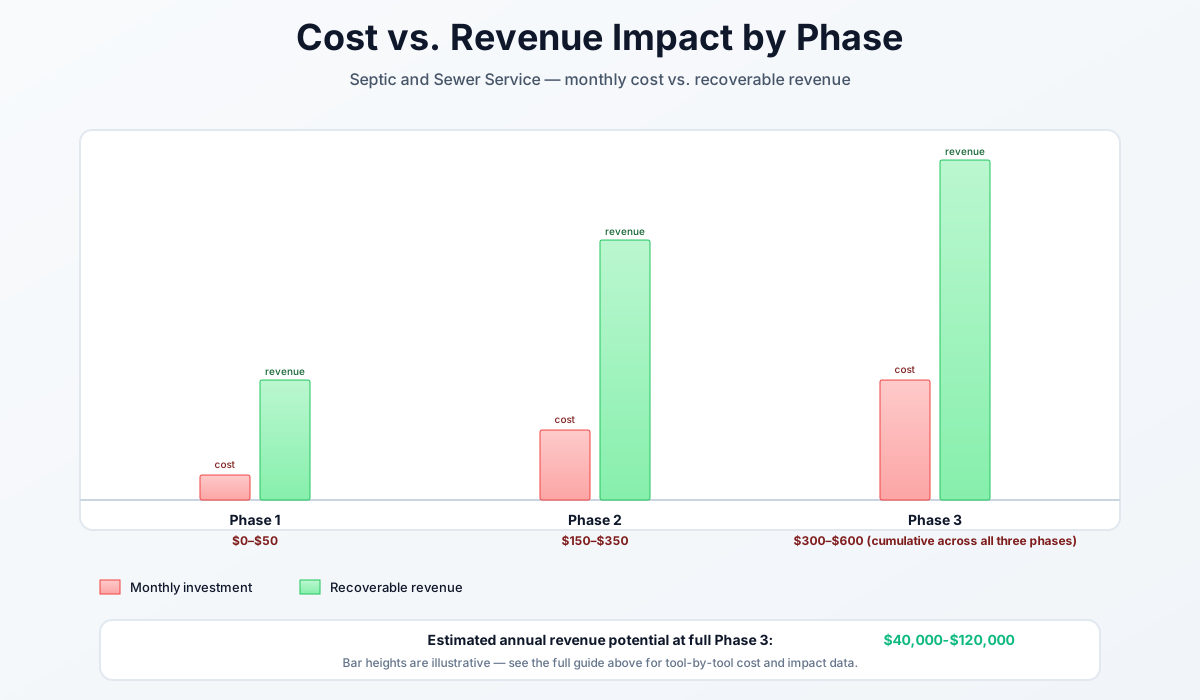
Here's a breakdown of the costs and expected returns:
Frequently Asked Questions
Can an AI answering agent correctly tell a sewage emergency from a routine pump-out request? Yes — that's the whole point of a tool like Trillet AI or Smith.ai over generic voicemail. They're trained to flag urgency language ("backing up into the house," "sewage in the yard") and escalate by SMS immediately, while booking routine requests on their own. Still, test it yourself before you trust it: feed it your own emergency phrases and have a friend test-call saying "my tank is backing up" to watch it escalate correctly.
Will AI-generated septic manifests and disposal logs actually keep me compliant under EPA 40 CFR Part 503? Not on their own. Tools like SepticCycle and PumpDocket auto-populate known jurisdiction fields and generate draft trip tickets and manifests, which eliminates most of the manual re-keying — but no tool here files paperwork autonomously, and none guarantees it matches your specific state and county rules, which vary significantly. SepticCycle's AI assistant knows Texas TCEQ/OSSF rules best; coverage elsewhere is less mature. Treat every generated report like a draft from a new hire: verify before submission, especially in the first 60 to 90 days.
Should a two-truck septic shop buy septic-specific software, or just use Jobber or Housecall Pro? It depends on which pain point hurts most. Generic FSMs like Jobber and Housecall Pro are excellent for scheduling, invoicing, and (with their AI receptionist add-ons) call answering — and if you already run one, that's the lowest-friction place to add call coverage. But they don't understand tank sizes, pump cycles, septage manifests, or state trip-ticket rules. If recall tracking and EPA 503 compliance are your biggest headaches, a septic-native tool like SepticCycle ($149/mo flat regardless of truck count) or PumpDocket will serve you far better than bolting compliance workarounds onto a general platform.
How do I handle AI routing when an emergency backup blows up the planned route mid-day? This is the catch with route optimization that trips up new users. Zeo and ServiceCore support re-optimization on the fly, but someone has to actually trigger it — the route won't rebuild itself when a 10 a.m. emergency lands. Build the habit: when an emergency comes in, drop it into the tool and re-sequence the remaining stops rather than just squeezing it in by gut feel. The whole value of AI routing is lost if you only run it once at 6 a.m. and never touch it again.
Is it worth paying for AI hiring tools given how rarely a small septic shop hires? For the screening layer, usually no. A tool like Truffle ($49/mo) only pays off at 2+ hires a year. The free move — a ChatGPT-written Indeed posting that leads with CDL and licensing assistance — does more for your hiring odds than any paid screening tool will, because licensing is the real barrier candidates face, not resume volume.
How is this different from AI advice for plumbers or other trades? A lot overlaps — call answering, routing, and review management apply to any field-service trade, and our plumbing and HVAC guides cover those shared tools. What's unique to septic is the regulated disposal side: septage manifests, per-1,000-gallon tipping fees, EPA 40 CFR Part 503 recordkeeping, and state trip-ticket rules that no plumbing tool handles. That's exactly why septic-native software (SepticCycle, PumpDocket) exists and why we recommend it over a generic FSM once compliance and recall tracking become your bottleneck.
More AI Implementation Guides
AI Tools for Window & Door Installers: 2026 Guide
The best AI tools for window and door installation companies in 2026. A phased plan to win the speed-to-lead race, cut no-shows, and stop reorder losses.
AI Tools for Locksmith Businesses: 2026 Guide
The best AI tools for locksmiths in 2026: capture after-hours calls, stop phone-quote disputes, and tame van inventory. A phased plan that starts at $0.
Best AI Receptionists for Small Businesses (2026)
The best AI receptionist for a small business depends on your call volume and budget. We compare 7 real tools with verified 2026 pricing and who each fits.
How Much Does an AI Receptionist Cost? (2026)
How much does an AI receptionist cost in 2026? Real pricing for AI answering tools — from $29/mo flat plans to per-minute models. Compare tools & costs.
AI for HVAC Companies: Best Tools & Assistants
AI for HVAC companies & contractors: capture missed calls, close more estimates, save 20-35 hrs/week. Compare top AI tools, assistants & pricing inside.
AI Tools for Plumbing Businesses: 2026 Guide
The best AI tools for plumbing businesses in 2026. Capture calls, automate dispatch, dominate Google reviews, add $75K–$250K annual revenue.
Keep exploring
See every AI implementation guide we've published for Trades & Contractors, or browse the full library by industry or category. Looking for a specific platform? The AI tools directory indexes every product mentioned across our guides, and the comparisons hub puts the most-asked head-to-heads side by side.